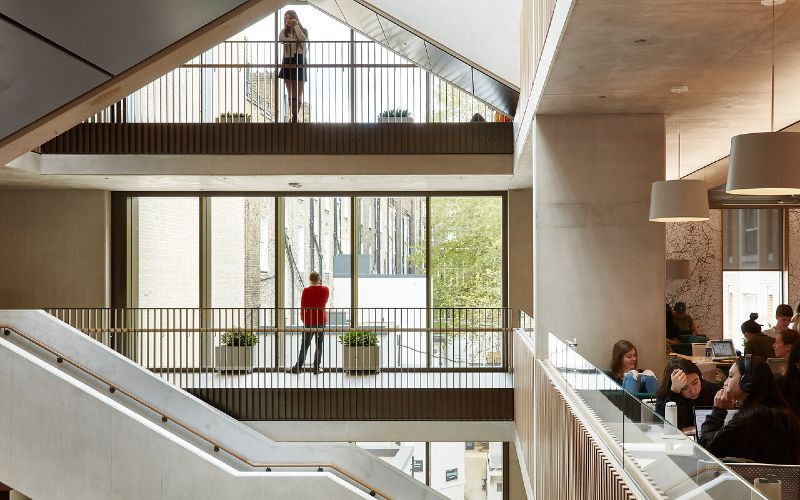
Psychology of Education MSc

London, Bloomsbury

The Psychology of Education MSc will introduce students to contemporary issues in education from a psychological perspective. Key theoretical and empirical approaches will be critically considered with a view to exploring their practical application in a variety of educational settings. The course is accredited by the British Psychological Society (BPS) as a conversion course, enabling graduates without a background in psychology to build on their first-degree qualification and become eligible for the BPS Graduate Basis for Chartered Membership. It is available full-time, part-time or via flexible/modular study (up to five years to complete).

UK students International students
Study mode
UK tuition fees (2026/27)
£14,200
£7,100
Programme also available on a modular (flexible) basis.
Overseas tuition fees (2026/27)
£35,400
£17,700
Programme also available on a modular (flexible) basis.
Duration
1 calendar year
2 calendar years
5 calendar years
Programme starts
September 2026
Applications accepted
Applicants who require a visa: 20 Oct 2025 – 27 Mar 2026
Applications close at 5pm UK time

Applications open

Applicants who do not require a visa: 20 Oct 2025 – 28 Aug 2026
Applications close at 5pm UK time

Applications open

Entry requirements

A minimum of a second-class Bachelor's degree from a UK university, or an overseas qualification of an equivalent standard.

The English language level for this course is: Level 4

UCL Pre-Master's and Pre-sessional English courses are for international students who are aiming to study for a postgraduate degree at UCL. The courses will develop your academic English and academic skills required to succeed at postgraduate level.

Further information can be found on our English language requirements page.

This course is suitable for international students on a Student visa – study must be full-time, face-to-face, starting September.

Equivalent qualifications

Country-specific information, including details of when UCL representatives are visiting your part of the world, can be obtained from the International Students website.

International applicants can find out the equivalent qualification for their country by selecting from the list below. Please note that the equivalency will correspond to the broad UK degree classification stated on this page (e.g. upper second-class). Where a specific overall percentage is required in the UK qualification, the international equivalency will be higher than that stated below. Please contact Graduate Admissions should you require further advice.

About this degree

This course aims to develop understanding of the psychology of education and provide students with an opportunity to engage in research. On successful completion of the course, students should be able to produce and communicate reasoned and informed argument, both in writing and orally on topics relevant to this field. Students will also be able to critically evaluate theory and empirical evidence in psychology.

Who this course is for

This course is suitable for applicants who wish to progress to research careers or professional training. It will be of interest to teachers and professionals working in related fields and those pursuing an applied career in psychology. The course is an accredited British Psychological Society (BPS) conversion course aimed at graduates who haven't taken a BPS accredited course in psychology. Conversion courses provide an opportunity for graduates to build on their first-degree qualification to become eligible for the BPS Graduate Basis for Chartered Membership.

What this course will give you

UCL Institute of Education (IOE) is one of the world's leading centres for education and related areas of social science. For the twelfth year in succession IOE has been ranked as the world's leading university for Education (QS World University Rankings by Subject 2025).

Students will be learning how psychological theory and research contribute to educational issues and practices. While examining teaching and learning from a psychological perspective, students can explore key topics such as cognitive development, motivation, and the social-emotional aspects of education. Supported by experts in the field, the course enables students to critically evaluate theory and evidence, while also developing the skills needed to communicate informed arguments clearly, both in writing and speaking.

The foundation of your career

This course offers a comprehensive research training in the psychology of education. It provides a good grounding for doctoral study and valuable preparation for a research career in the academic community, the public sector or in industry.

The empirical research you get to conduct for the dissertation, the access to resources, materials and sample population makes the research actually worth it. And the constant dedication by the staff, from the administrators to the professors, has been extremely impressive.

Dhanishtha Patel, Psychology of Education MSc student

Dhanishtha Patel

Psychology of Education MSc

Employability

The Graduates of this course are currently (HESA, Graduate Outcomes Survey 2017-22):

  • Teaching and other educational activities
  • Health and social care
  • Policy and government 
  • Academic research and higher education
  • Accountancy and financial services
  • Human resources and recruitment
  • Educational psychologists (following professional doctoral training) 

Networking

Students will have opportunities to attend research seminars, journal clubs and research talks.

Accreditation

This programme is accredited by the British Psychological Society (BPS). Students who successfully complete the course can apply for Graduate Basis for Chartered Membership.

Teaching and learning

The course is delivered through a combination of lectures, group work, student preparation of tasks and presentations, discussion, and computer workshops giving hands-on practice.

Assessment is through varied coursework, for example, critiquing research, presentations, essays, exams and reports. Students will also engage in a dissertation supported by a member of staff.

In terms 1 and 2 full-time students can typically expect between 5 and 8 contact hours and 18 to 22 hours of self-directed study per teaching week through a mixture of lectures, seminars, workshops, and meetings with their dissertation supervisor. In term 3 and the summer period, students will be completing their own dissertation research, keeping regular contact with their dissertation supervisors.

Modules

The course comprises four taught modules and a dissertation. It is delivered through a combination of lectures given both by IOE academic staff and guest speakers, group work, and computer workshops giving hands-on practice.

The taught modules on the course are lecture-based modules, designed to provide you with a firm foundation in the different topics relevant to psychology of education. You will take four compulsory modules and a dissertation. The dissertation is a research project carried out under the supervision of a member of academic staff from UCL.

If studied on a full-time basis, the course will take place over a full calendar year. Alternatively, it can be studied part-time over two years or modular flexible over five years.

The course comprises four taught modules and a dissertation. It is delivered through a combination of lectures given both by IOE academic staff and guest speakers, group work, and computer workshops giving hands-on practice.

The taught modules on the course are lecture-based modules, designed to provide you with a firm foundation in the different topics relevant to psychology of education. You will take four compulsory modules and a dissertation. The dissertation is a research project carried out under the supervision of a member of academic staff from UCL.

If studied on a part-time basis, the course will take place over two calendar years. Part-time students typically complete three modules in their first year (90 credits) and one module plus the dissertation in their second year (90 credits).

The course comprises four taught modules and a dissertation. It is delivered through a combination of lectures given both by IOE academic staff and guest speakers, group work, and computer workshops giving hands-on practice.

The taught modules on the course are lecture-based modules, designed to provide you with a firm foundation in the different topics relevant to psychology of education. You will take four compulsory modules and a dissertation. The dissertation is a research project carried out under the supervision of a member of academic staff from UCL.

If studied on a flexible basis, the course will take place up to five years. Although students have the flexibility to select which modules to complete in any given year, we recommend that Core Topics in the Psychology of Education and Research and Analytical Methods in Psychology are taken early in the degree to facilitate understanding and skill development for the rest of the course. We also recommend that the dissertation module is taken in the final year.

Please note that the list of modules given here is indicative. This information is published a long time in advance of enrolment and module content and availability are subject to change. Modules that are in use for the current academic year are linked for further information. Where no link is present, further information is not yet available.

Students undertake modules to the value of 180 credits. Upon successful completion of 180 credits, you will be awarded an MSc in Psychology of Education.

Accessibility

The department will endeavour to make reasonable adjustments for students with disabilities, including those with long-term health conditions, neurodivergence, learning differences and mental health conditions. This list is not exhaustive. If you're unsure of your eligibility for reasonable adjustments at UCL, please contact Student Support and Wellbeing Services.

Reasonable adjustments are implemented on a case-by-case basis. With the student's consent, reasonable adjustments are considered by UCL Student Support and Wellbeing Services, and where required, in collaboration with the respective department.

Details of the accessibility of UCL buildings can be obtained from AccessAble. Further information about support available can be obtained from UCL Student Support and Wellbeing Services.

For more information about the department and accessibility arrangements for your course, please contact the department.

Online - Open day

Graduate Open Events: Psychology and Human Development

Develop your knowledge and career in psychology education with the leading centre devoted to developmental psychology and its application in education and other real-world settings. We welcome you to book your place at our Virtual Open Event. You will meet our academics, hear about the courses you are interested in and have the chance to ask any questions you might have. This event is free and open to all.

Fees and funding

Fees for this course

UK students International students
Fee description Full-time Part-time
Tuition fees (2026/27) £14,200 £7,100
Tuition fees (2026/27) £35,400 £17,700

Programme also available on a modular (flexible) basis.

Postgraduate Taught students benefit from a cohort guarantee, meaning that their tuition fees will not increase during the course of the programme, but UCL reserves the right to increase tuition fees to reflect any sums (including levies, taxes, or similar financial charges) that UCL is required to pay any governmental authority in connection with tuition fees.

The tuition fees shown are for the year indicated above. Where the course is offered on a flexible/modular basis, fees are charged pro-rata to the appropriate full-time Master's fee taken in an academic session. Further information on fee status, fee increases and the fee schedule can be viewed on the UCL Students website: ucl.ac.uk/students/fees.

Additional costs

For full-time and part-time offer holders with a fee status classification of UK, a fee deposit will be charged at 2.5% of the first year fee.

For full-time and part-time offer holders with a fee status classification of Overseas, a fee deposit will be charged at 10% of the first year fee.

For modular/flexible offer holders with a fee status classification of UK, a £350 deposit will be charged.

For modular/flexible offer holders with a fee status classification of Overseas, a £500 deposit will be charged.

Further information can be found in the Tuition fee deposits section on this page: Tuition fees.

Students are responsible for covering any travel, accommodation, and other expenses involved in conducting research for their dissertation and should account for these costs when planning their finances.

DBS may be required depending on the type of research undertaken for the dissertation module. The DBS application cost will be covered by UCL, but offer holders will also need to have their ID checked and verified at a Post Office, for which they will incur a charge of £15 (note, this was the fee for 2025 but may change). The offer holder is also required to arrange and pay for any overseas police check that may be necessary; costs vary by country. For more information about the DBS application process, please contact the Admissions team.

For in-person teaching, UCL’s main teaching locations are in zones 1 (Bloomsbury) and zones 2/3 (UCL East). The cost of a monthly 18+ Oyster travel card for zones 1-2 is £119.90. This price was published by TfL in 2025. For more information on additional costs for prospective students and the cost of living in London, please view our estimated cost of essential expenditure at UCL's cost of living guide.

Funding your studies

For a comprehensive list of the funding opportunities available at UCL, including funding relevant to your nationality, please visit the Scholarships and Funding website.

IOE - Aziz Foundation Scholarships

Value: Full tuition fees (1 year)
Criteria Based on academic merit
Eligibility: UK

IOE-Clarke Scholarships

Deadline: 5 May 2025
Value: Tuition fees, return flights and stipend (1 year)
Criteria Based on both academic merit and financial need
Eligibility: EU, Overseas

IOE-ISH Centenary Masters Scholarships

Deadline: 5 May 2025
Value: Tuition fees and accommodation at International Students House (1 year)
Criteria Based on both academic merit and financial need
Eligibility: Overseas

Next steps

Students are advised to apply as early as possible due to competition for places. Those applying for scholarship funding (particularly overseas applicants) should take note of application deadlines.

There is an application processing fee for this course of £90 for online applications. Further information can be found at Application fees.

When we assess your application, we would like to learn:

  • why you want to study Psychology of Education at graduate level
  • why you want to study Psychology of Education at UCL
  • why do you want BPS accreditation?
  • what particularly attracts you to the chosen course
  • how your academic and professional background meets the demands of this challenging course
  • where you would like to go professionally with your degree.

Together with essential academic requirements, the personal statement is your opportunity to illustrate whether your reasons for applying to this course match what the course will deliver.

Please note that you may submit applications for a maximum of two graduate courses (or one application for the Law LLM) in any application cycle.

Choose your programme

Please read the Application Guidance before proceeding with your application.

Year of entry: 2026-2027

UCL is regulated by the Office for Students.