 Close
Close


UCL-led team develops fast HIV diagnostic tool
27 September 2017
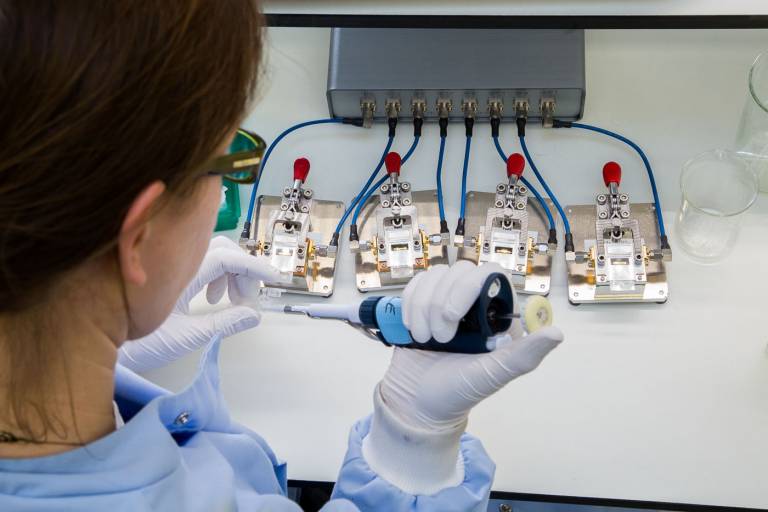
A team led by Professor Rachel McKendry (UCL London Centre of Nanotechnology) have published new research showing promising developments towards a mobile phone-connected diagnostic tool that can detect HIV in seconds.
Early detection of HIV plays an important role in containing outbreaks, however currently available tests require complex lab equipment, highly trained staff, and long wait times for results.
Postdoctoral Research Associate, Dr Valérian Turbé (UCL London Centre for Nanotechnology), says
"This could mean delays in people with HIV receiving essential, life-saving
treatment and increase the risk of transmission."
Access to antiretroviral treatment has been reported to
increase life-expectancy by 10 years, reduce infant mortality by 76 per cent
and can almost completely prevent transmission from pregnant women to their
babies.
Harnessing Surface Acoustic Wave Biochips
With funding from the National Institute for Health Research (NIHR), the newly developed diagnostic
tool needs just a single finger prick of blood to produce a positive test
result within 10 seconds by harnessing surface acoustic wave (SAW) biochips,
which are based on components already found in every consumer smartphone.
The findings open up the potential for consumer electronics
to cut lengthy test waiting times, giving patients on the spot access to
treatment and supporting more timely public health interventions to prevent
disease.
CEO of OJ-Bio, Dr Dale Athey, explains, "Current
point-of-care tests for HIV based on lateral flow technology are still
relatively slow, with most between 10-20 minutes to produce results, which
exceeds the approximate nine minutes for a doctor's appointment in the UK."
"The 10 second result time achieved here makes this approach
a potential game changer."
Supporting patients and healthcare workers
The device comprises of a disposable biochip, a pocket-sized
control box reader developed by OJ-Bio, and a mobile device to analyse display
and transmit results.
The speed and accuracy of the tests will help to support
patients and front-line health-workers by widening access to testing outside of
hospital settings, and cut waiting times.
Professor McKendry says, "This is an exciting breakthrough
that lays the foundations for future clinical studies and product development.
"If successful, this platform technology could
revolutionalise rapid HIV diagnosis and deliver major health and economic
benefit to millions of people worldwide."
This work was funded by the NIHR i4i programme and EPSRC IRC
in Early Warning Sensing Systems for Infectious Diseases.
Links
- UCL London Centre for Nanotechnology
- UCL Physics and Astronomy
- UCL Division of Medicine
- OJ-Bio
- Natioanl Institute for Health Research
Source
Open Days
The Faculty participates in a number of open days throughout the academic year, including the UCL Undergraduate Open Days and the UCL Graduate Open Day.

Friends of Out@UCL
Professor Ivan Parkin -
Dean, UCL Faculty of Mathematical and Physical Sciences
"I fully support the aims of the Friends of Out@UCL campaign. I have
personal experience of the need for such a campaign and the
difficulties that the LGBTQ+ community face." Read more...
Snapshots from Space History

Online exhibition of historic space photos from the faculty's planetary science archives.