 Close
Close


UCL led team awarded prestigious EU grant to prepare for data from ESA's Euclid
2 May 2018
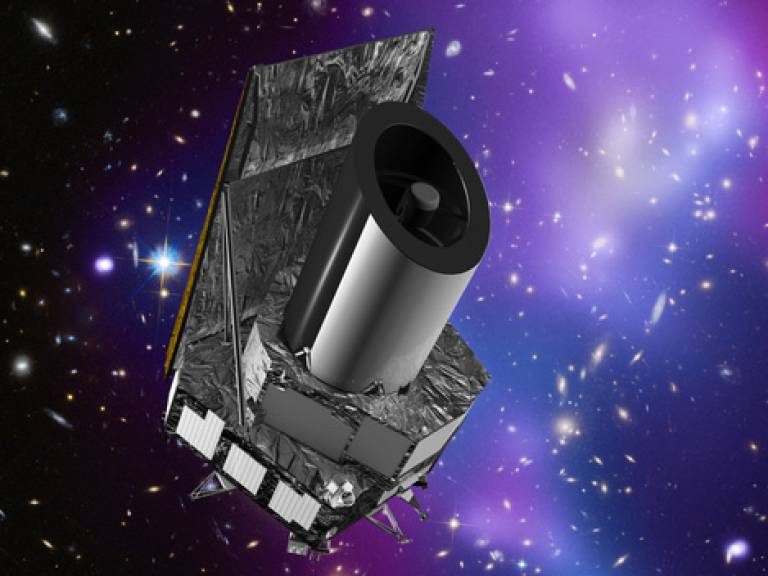
A team of cosmologists from nine countries, led by UCL, have been awarded €1.6m in a prestigious EU Horizon 2020 grant to work across Europe in order to prepare for the next generation of astronomical data that will come from the European Space Agency Euclid mission.
Euclid, due to launch in 2021, will map three-quarters of the extra-galactic sky back in time over three-quarters of the age of the Universe. Its scientific objective is to determine the nature of dark energy, which is causing the accelerated expansion of the universe, by mapping how dark matter grows over time.
One of the primary ways that Euclid will do this is by measuring an effect called weak lensing whereby dark matter structure distorts the observed images of galaxies. Euclid will measure this signal by imaging 1.5 billion galaxies with a resolution similar to that of the Hubble Space Telescope.
Although Euclid is designed to minimize observational systematics, the observations are still limited by two factors. Various instrumental effects need to be corrected, and the tremendous improvement in precision has to be matched with comparable advances in the modelling of astrophysical effects that affect the signal.
To address these problems, the team will make use of currently available data, which have unique aspects that are unavailable from the Euclid data alone - so called calibration data. The calibration data sets are the PauCAM Survey, the Hubble Space Telescope Archive, and the ESO Spectroscopy Large Programme.
"This new grant from the EU is perfectly timed, only 3 years before the launch of Euclid, to ensure that we will be prepared to make the most of the step-change in our view of the Universe that Euclid will provide." said principle investigator Dr Tom Kitching (UCL Space & Climate Physics).
The imaging camera that Euclid will use is being built at UCL in the Mullard Space Science Laboratory. However Euclid preparations are a cross disciplinary and cross-departmental activity at UCL, both the UCL Space & Climate Physics and UCL Physics & Astronomy departments are heavily involved in preparations for the imaging survey. For example researchers have been leading studies to determine the requirements cosmic lensing places on the optical design of the instrument; studying the impact of choice of optical filters on the accuracy of the photometric redshift measurements and working on the requirements for spectroscopic training sets.
Links
Open Days
The Faculty participates in a number of open days throughout the academic year, including the UCL Undergraduate Open Days and the UCL Graduate Open Day.

Friends of Out@UCL
Professor Ivan Parkin -
Dean, UCL Faculty of Mathematical and Physical Sciences
"I fully support the aims of the Friends of Out@UCL campaign. I have
personal experience of the need for such a campaign and the
difficulties that the LGBTQ+ community face." Read more...
Snapshots from Space History
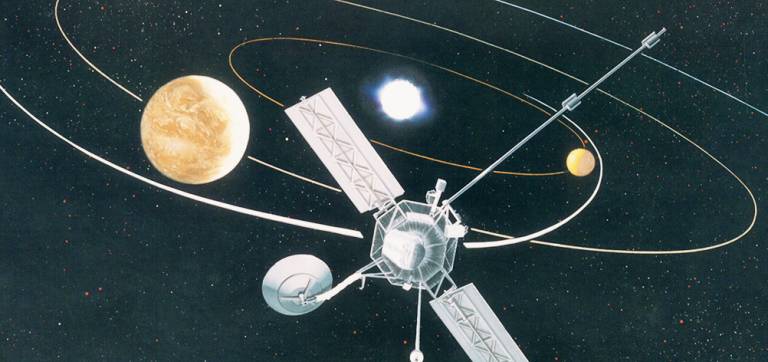
Online exhibition of historic space photos from the faculty's planetary science archives.