 Close
Close


New X-ray Photoelectron Spectrometer enters trial phase in UCL Chemistry
20 October 2017
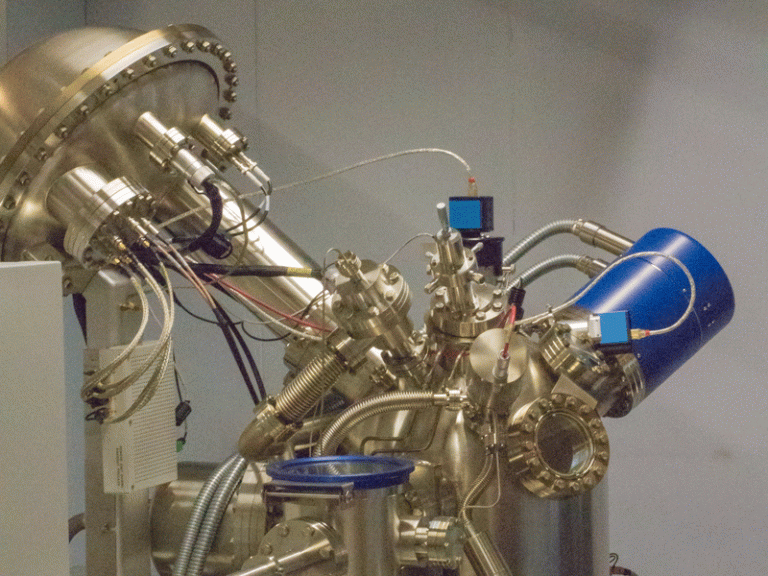
UCL's Chemistry department has used a multi-user EPSRC grant to purchase a new X-Ray Photoelectron Spectrometer (XPS). The XPS is available for use by all UCL researchers, and promises new opportunities for research in the Faculty for Mathematical and Physical Sciences and beyond.
The XPS studies the surfaces of materials, looking at the chemistry and physics of the top atomic levels in order to understand how the material interacts with the world. It uses a "light in, electron out" technique, whereby x-rays shine onto a sample, which then emits electrons from the top layers of atoms.
By measuring the kinetic energy of the electrons, researchers are able to find out about what the atoms are, their electron arrangement, how they are bonded and about their chemical interactions.
Similar equipment has previously been used by UCL Chemistry to study solar cell materials, by the UCL Mullard Space Science Laboratories (MSSL) to investigate how the surface of spaceships have been corroded, and by the Royal Free Hospital to examine 3D printed bone implants to assess their effectiveness in re-growing bone.
The new XPS has several new features including: Ultra-Violet Photoelectron Spectroscopy, which uses lower energy light and can give more detailed information; Ion Scattering Spectroscopy and Reflected Electron Energy Loss Spectroscopy, which gives information on the composition and bonding of the surface; and heating and cooling in situ, samples can be cooled to -100˚C and heated to 400˚C in the analysis position.
The uses of this equipment are wide ranging and scientists from many disciplines are encouraged to consider how this could impact on their own research. Dr Robert Palgrave (UCL Chemistry) emphasised that even if researchers have not used XPS equipment before UCL Chemistry were happy to discuss how the XPS could add to their research.
The XPS is currently in the installation phase; the first sample data was taken on Tuesday. In a couple of weeks the equipment will be functional and the testing phase will be implemented.
Links
Open Days
The Faculty participates in a number of open days throughout the academic year, including the UCL Undergraduate Open Days and the UCL Graduate Open Day.

Friends of Out@UCL
Professor Ivan Parkin -
Dean, UCL Faculty of Mathematical and Physical Sciences
"I fully support the aims of the Friends of Out@UCL campaign. I have
personal experience of the need for such a campaign and the
difficulties that the LGBTQ+ community face." Read more...
Snapshots from Space History
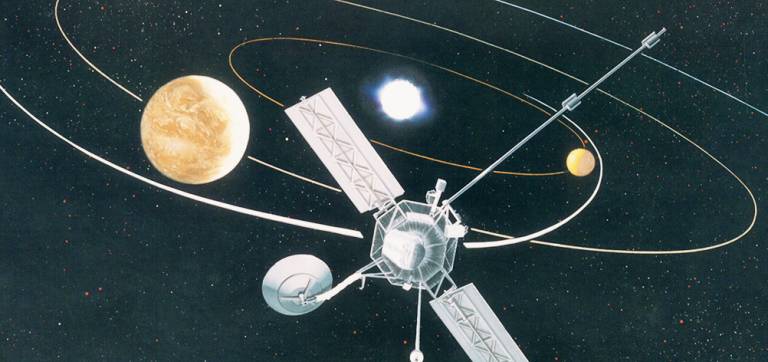
Online exhibition of historic space photos from the faculty's planetary science archives.