 Close
Close


An ultimate speed limit for cooling
14 March 2017
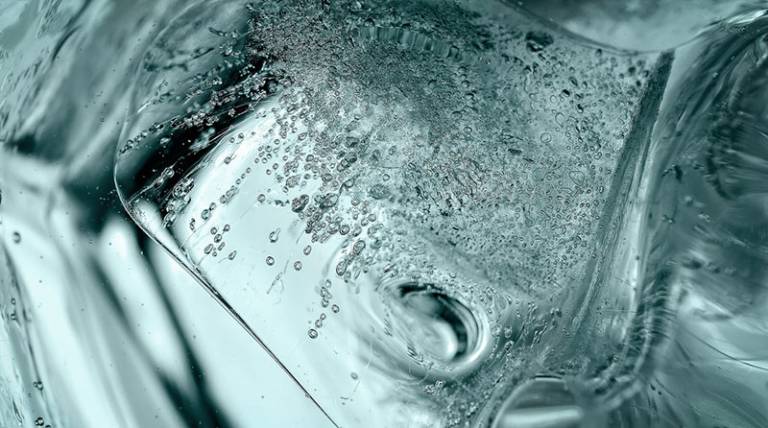
How cold can it get? That depends how long you are willing to wait. The third law of thermodynamics, conjectured in 1912 by the Nobel laureate Walter Nernst, states that it takes an infinite time to cool a system to absolute zero - the coldest temperature possible.
However, despite being one of the cornerstones of the field of thermodynamics, it has never been proven. In fact, most of Nernst's early attempts at a proof of the third law were refuted by Albert Einstein, who also attempted proofs of his own. Einstein believed that any proof of the third law needed to somehow rely on the newly discovered quantum mechanics. However, despite rather fierce debates between the scientists of that era, no proof of the third law was forthcoming, and the validity of the third law has continued to be a matter of controversy.
Recently however, new mathematical techniques developed in the field of quantum information theory have finally enabled a proof of this long open conjecture, and through their upcoming study, UCL researchers are now able to elevate it to the level of an actual fundamental law of nature.
The third law is becoming increasingly important in the field of quantum technologies, which aim to build devices such as quantum computers that operate at incredibly low temperatures. We now know that there is a speed limit to cooling.
No matter what cooling method you use, you cannot break the bound proven in the study.
Links
Image
Open Days
The Faculty participates in a number of open days throughout the academic year, including the UCL Undergraduate Open Days and the UCL Graduate Open Day.

Friends of Out@UCL
Professor Ivan Parkin -
Dean, UCL Faculty of Mathematical and Physical Sciences
"I fully support the aims of the Friends of Out@UCL campaign. I have
personal experience of the need for such a campaign and the
difficulties that the LGBTQ+ community face." Read more...
Snapshots from Space History
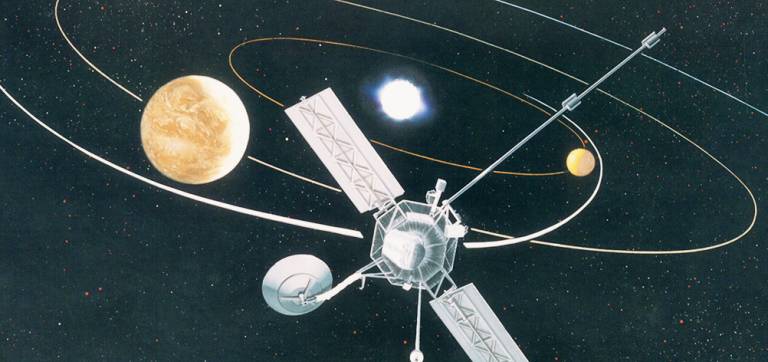
Online exhibition of historic space photos from the faculty's planetary science archives.