 Close
Close


Surfing water molecules could hold the key to fast and controllable water transport
20 October 2015
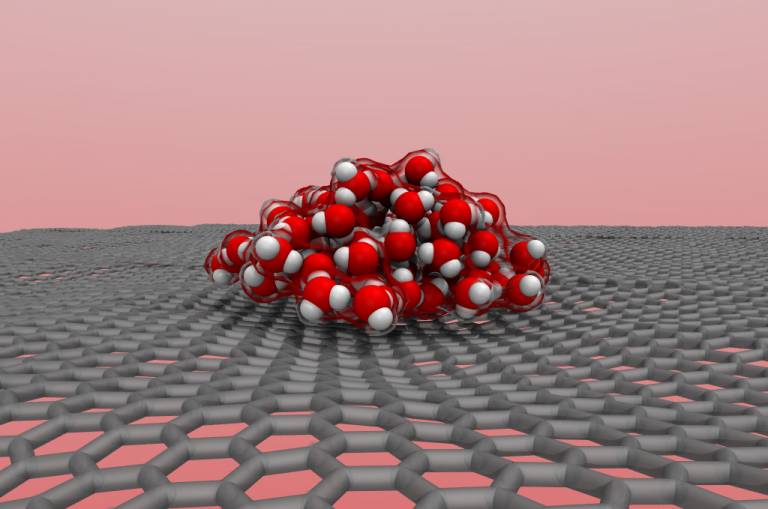
Scientists at UCL have identified a new and potentially faster way of moving molecules across the surfaces of certain materials.
The team carried out sophisticated computer simulations of tiny droplets of water as they interact with graphene surfaces. These simulations reveal that the molecules can "surf" across the surface whilst being carried by the moving ripples of graphene.
The study, published in Nature Materials, demonstrates that because the molecules were swept along by the movement of strong ripples in the carbon fabric of graphene, they were able to move at an exceedingly fast rate, at least ten times faster than previously observed.
Furthermore, the researchers found that by altering the size of the ripples, and the type of molecules on the surface, they could achieve fast and controlled motion of molecules other than water. This opens up a range of possibilities for industrial applications such as improved sensors and filters.
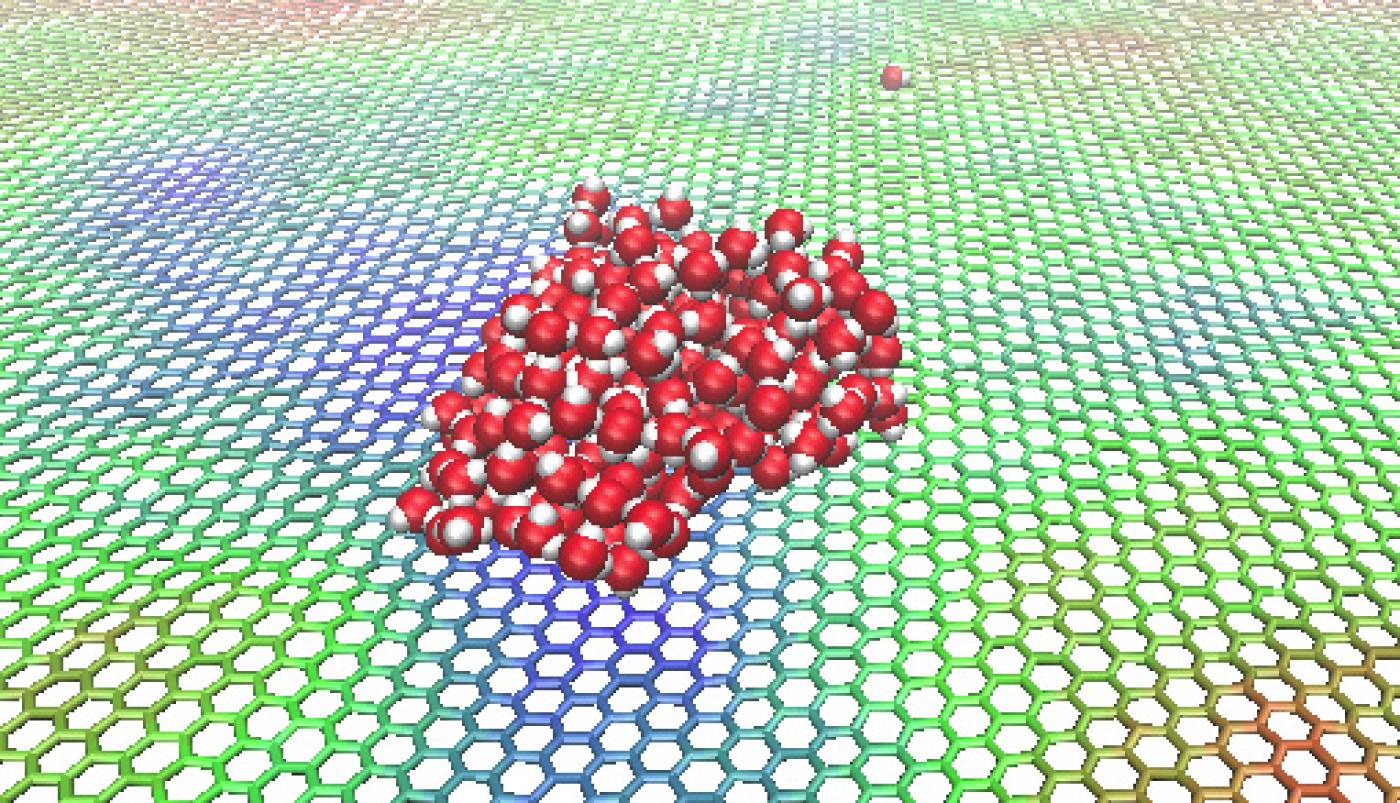
Professor Angelos Michaelides, from the Thomas Young Centre and London Centre for Nanotechnology (LCN) at UCL, lead researcher of the study, explained: "Atoms and molecules usually move across materials by hopping from one point on their surface to the next. However, through computer simulations we have uncovered an interesting new diffusion mechanism for motion across graphene that is inherently different from the usual random movements we see on other surfaces."
The motion of atoms and molecules across the surface of materials is of critical importance to a long list of applications, such as the diffusion of molecules across the surface of catalysts, crystal growth or filtration. Of particular technological relevance, and attracting the most attention at present, is the study of water on graphene. Ongoing research suggests that water interacting with graphene has properties as exceptional and potentially transformative as graphene's electronic and mechanical properties.
Although scientists have used a whole array of experimental techniques in the past to investigate the atomic scale details of surface diffusion, they have generally studied the surfaces of traditional three-dimensional materials and have supported the notion that diffusion involves a simple random walk on the surface.
Dr. Ming Ma, the first author of the paper added: "Our work is the culmination of an extensive and meticulously validated set of simulations which has uncovered an unexpected result that may well be at the root of the promised performance of graphene in filters and sensors."
This work was carried out in collaboration with Dr Gabriele Tocci (formerly at the London Centre for Nanotechnology) and Prof Gabriel Aeppli, co founder of the London Centre for Nanotechnology and now Professor of Physics at ETH Zürich and EPF Lausanne, and head of the Synchrotron and Nanotechnology Department of the Paul Scherrer Institute, Switzerland.
Related links
Open Days
The Faculty participates in a number of open days throughout the academic year, including the UCL Undergraduate Open Days and the UCL Graduate Open Day.

Friends of Out@UCL
Professor Ivan Parkin -
Dean, UCL Faculty of Mathematical and Physical Sciences
"I fully support the aims of the Friends of Out@UCL campaign. I have
personal experience of the need for such a campaign and the
difficulties that the LGBTQ+ community face." Read more...
Snapshots from Space History
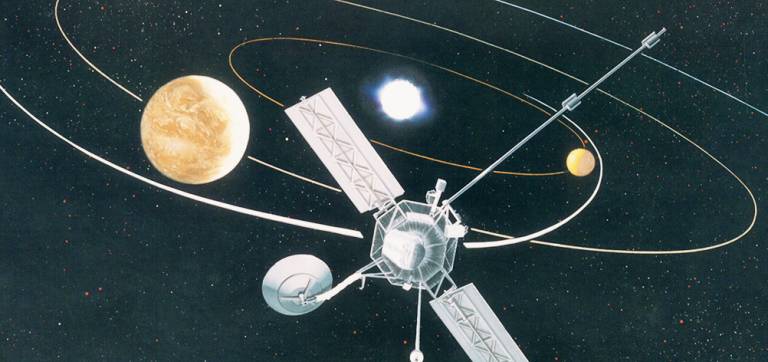
Online exhibition of historic space photos from the faculty's planetary science archives.