 Close
Close


A formula for cheating at dice
23 June 2014
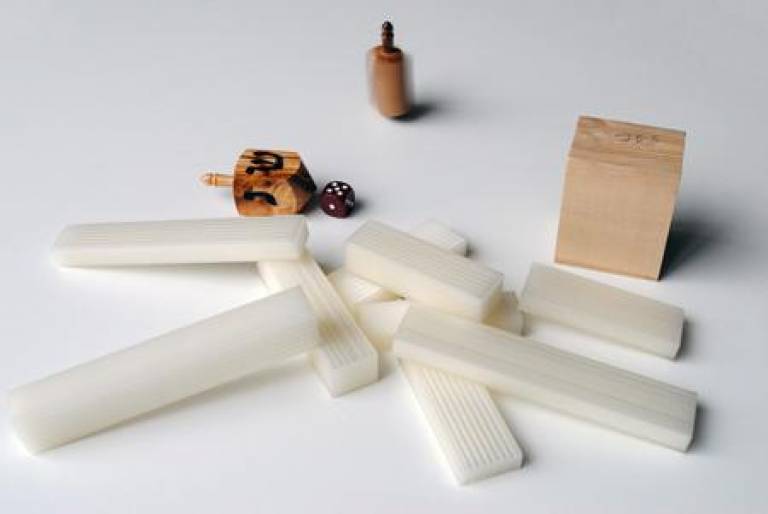
A perfectly fair die has one chance in six of landing on each side when it is rolled. But load the dice by making some of the edges longer than others, and the probabilities suddenly become more complicated. In fact, nobody has ever produced a comprehensive theory of the probabilities of such a biased die landing on any given face - a challenge for physicists, as well as for anyone who might want to cheat a casino.
New research by Martin Uhrin and George Pender, PhD students in UCL Physics & Astronomy, represents a major step forward in understanding the behaviour of biased dice. They have developed the first comprehensive mathematical model that deals with this problem in two dimensions. In so doing, they have solved part of a problem which has puzzled scientists for centuries, and which is even mentioned in the writings of Isaac Newton.
"I dropped a length of pine onto the floor and it landed on its narrower, less probable, side," Pender says. "My wife innocently exclaimed, 'Huh. What was the chance of that?'; a question she may later have come to regret after tallying the outcome of the ten thousandth test roll with planks of various side ratios."
The chance of a die landing on any given side is not as simple as measuring the size of the faces and assuming that the chance of it settling on that side is proportional to its dimensions. A thrown die will bounce and roll along a surface until it eventually comes to a stop, but how many times it bounces, and what face it settles on depends on a number of factors that need to be broken down.
Uhrin and Pender analysed all the stages in the motion of a die using a type of flow-chart known to scientists as a Markov Chain. In their analysis, the energy state of the die is calculated at each stage of its motion, determining what will happen next. Each time the die hits the surface, it loses a little energy, and if it falls below a certain threshold (the amount of energy necessary to make the die bounce high enough to tip onto another face), it will stop and settle on that face. Alternatively, if it has enough energy, it will bounce up and run through the flow-chart again.
Based on their analysis, Pender and Uhrin proposed a simple formula (see notes) for determining which face a two dimensional die is likely to land on. A two dimensional die, in this context, is one in which one of the dimensions is so long that the die cannot land on that end, leaving only four faces available - which substantially simplifies the mathematics involved. The object itself is three dimensional - a long rectangular cuboid similar in proportions to a Mars bar. A common real manifestation of a "2D die" is the dreidel, a traditional four-sided Jewish spinning toy.

Even small changes in the dimensions of a die, their equation suggests, can make a significant difference: for instance lengthening one side by just 1 per cent, an almost invisibly small amount, can increase the chances of it landing on either of the two enlarged faces by around 2% - enough to get a serious advantage in a game.
After coming up with the theory they tested the formula's predictions with biased dice of various different dimensions, which they produced in a 3D printer at UCL's Institute of Making. Pender's wife, Katy, helped record the results of 16,300 throws of these "dice", each time logging which face they landed on.
Uhrin, a former video games programmer, used specialised software to simulate a further million throws of the dice. The software, known as the Bullet Engine, is used in computer games such as Grand Theft Auto and Hollywood special effects (including the disaster movie 2012) to produce realistic simulations of collisions and falling objects, thanks to its accurate reproduction of Newton's laws of motion.
"Together, the remarkable consistency between theory, experiment and simulation, acts as a big vote of confidence for the Bullet Engine and its ability to reproduce the laws of nature accurately," Uhrin says.
The only noticeable differences between theory and experiment came from the type of surface the die was thrown on.
This means that Pender and Uhrin's formula can be used for two-dimensional dice of any size to predict their properties, based only on their dimensions - something which has not been possible up until now.
Moving from four-faced (two dimensional) dice, to six-faced (three dimensional) dice, like those used in most games, is a big step and the mathematical form of Pender and Uhrin's model is such that it can't be simply extended into 3D.
"It may be that, with a little imagination, our theory could be extended to three dimensions," says Pender, "but it's also possible that, in three dimensions, the final state probabilities depend on the way it is thrown, such as the direction of its initial spin axis."
Notes
- The research is published in the European Journal of Physics, in an article entitled "Predicting non-square 2D dice probabilities"
- The ratio of probabilites for a 2D die (the probability of it landing on one side divided by the probability of it landing on the other) is expressed by the formula:
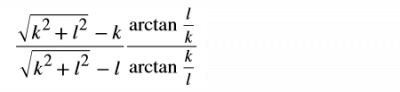
(where k and l are the dimensions of the cross-section of the die)
Related links
High-resolution image
This image can be reproduced freely providing the source is credited
Science contact
George Pender
UCL Physics & Astronomy
george.pender.10@ucl.ac.uk
Martin Uhrin
UCL Physics & Astronomy
martin.uhrin.10@ucl.ac.uk
Media contact
Oli Usher
UCL Faculty of Mathematical and Physical Sciences
020 7679 7964
o.usher@ucl.ac.uk
Open Days

The Faculty participates in a number of open days throughout the academic year, including the UCL Undergraduate Open Days and the UCL Graduate Open Day.

Friends of Out@UCL
Professor Ivan Parkin -
Dean, UCL Faculty of Mathematical and Physical Sciences
"I fully support the aims of the Friends of Out@UCL campaign. I have
personal experience of the need for such a campaign and the
difficulties that the LGBTQ+ community face." Read more...
Snapshots from Space History
Online exhibition of historic space photos from the faculty's planetary science archives.