 Close
Close


Supernova in Messier 82 discovered by UCL students
22 January 2014
Updated 23 Jan 2014 - 9:30am
Students and staff at UCL's teaching observatory, the University of London Observatory, have spotted one of the closest supernova to Earth in recent decades. At 19:20 GMT on 21 January, a team of students - Ben Cooke, Tom Wright, Matthew Wilde and Guy Pollack - assisted by Dr Steve Fossey, spotted the exploding star in nearby galaxy Messier 82 (the Cigar Galaxy).
The discovery was a fluke - a 10 minute telescope workshop for undergraduate students that led to a global scramble to acquire confirming images and spectra of a supernova in one of the most unusual and interesting of our near-neighbour galaxies.
"The weather was closing in, with increasing cloud," Fossey says, "so instead of the planned practical astronomy class, I gave the students an introductory demonstration of how to use the CCD camera on one of the observatory's automated 0.35-metre telescopes."
The students chose M 82, a bright and photogenic galaxy as their target, as it was in one of the shrinking patches of clear sky. While adjusting the telescope's position, Fossey noticed a 'star' overlaid on the galaxy which he did not recognise from previous observations.
They inspected online archive images of the galaxy, and it became apparent that there was indeed a new star-like object in M 82. With clouds closing in, there was hardly time to check: so they switched to taking a rapid series of 1 and 2 minute exposures through different coloured filters to check that the object persisted, and to be able to measure its brightness and colour.
Meanwhile, they started up a second telescope to obtain a second source of data, to ensure the object was not an instrumental artefact. By about 19:40 GMT, the cloud cover was almost complete, but it was just possible to make out the new object in the second data set: this was a real astronomical source.
There were no online reports of any prior discoveries of this object, so it seemed clear that this was a new transient source, such as a supernova. It was important to move quickly to alert astronomers worldwide to confirm the discovery, and most importantly, to obtain a spectrum - which would confirm whether or not it was a supernova, rather than some other phenomenon, such as an asteroid that happened to lie in front of the galaxy.
Fossey prepared a report for the International Astronomical Union's Central Bureau for Astronomical Telegrams, the organisation that catalogues supernovae. He also alerted a US-based supernova search, team who have access to spectroscopic facilities.
Spectra collected by astronomers at other observatories around the world suggest that it is a Type Ia supernova, caused by a white dwarf star pulling matter off a larger neighbouring star until it becomes unstable and explodes.
The IAU's official report last night (UK time; daytime 22 January in the US), confirms that Fossey was the first to report the new supernova, and gives the supernova the designation SN 2014J.
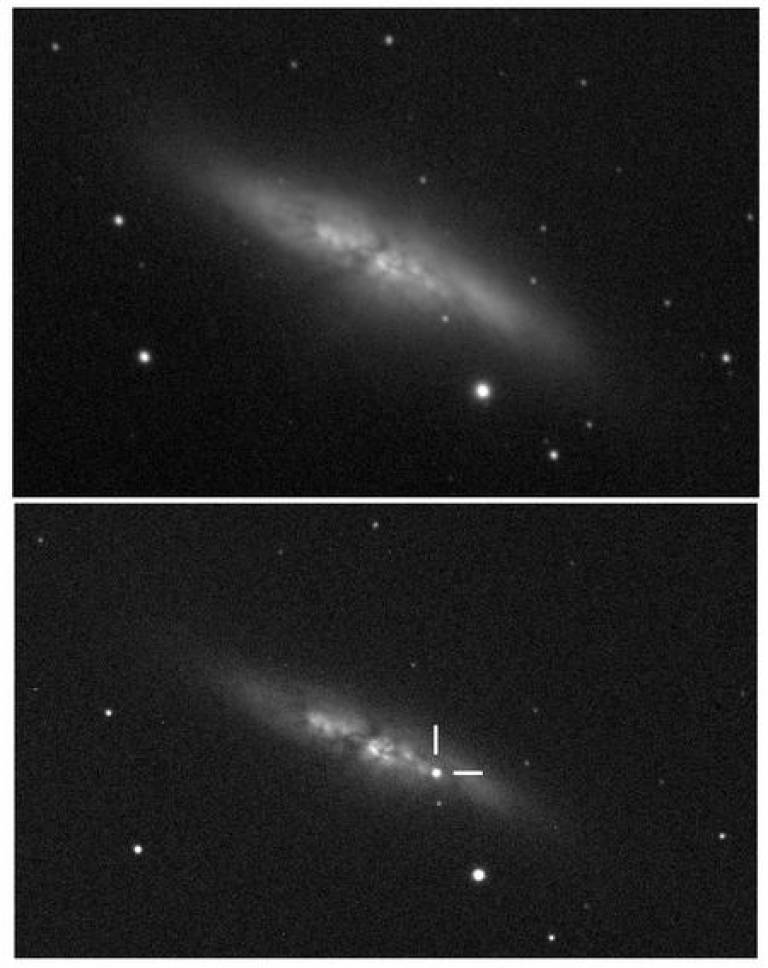
The two images here show the Cigar Galaxy before and during the event. Above, an image taken on 10 December 2013, and below the image taken by the students on 21 January 2014. A bright spot of light (labelled) is clearly visible, even though the exposure is shorter and the rest of the galaxy appears darker.
The supernova is one of the nearest to be observed in recent decades. The closest by far since the invention of the telescope was Supernova 1987A (the remnant of which was recently studied by UCL astronomers) in February 1987, located at a distance of 168 000 light years. This discovery is more distant at around 12 million light years, about the same as the 1993 discovery of a supernova in nearby Messier 81.
The students said:
Ben Cooke: "The chances of finding anything new in the sky is astronomical but this was particularly astounding as it was one of the first images we had taken on this telescope. My career plan had been to continue my studies in astrophysics. It's going to be hard to ever top this though!"
Guy Pollack: "It was a surreal and exciting experience taking images of the unidentified object as Steve ran around the observatory verifying the result. I'm very chuffed to have helped in the discovery of the M 82 Supernova."
Tom Wright: "One minute we're eating pizza then five minutes later we've helped to discover a supernova. I couldn't believe it. It reminds me why I got interested in astronomy in the first place."
Matt Wilde: "To be honest it was just a really odd experience. We were expecting a standard quick look through the telescope and a chance to use the camera for the first time before the clouds moved in, that's all. When we started looking and Steve began getting a bit more excited none of us could really believe what was going on. I can't wait to get back on a telescope next week now."
Notes
- Magnitudes of the supernova were measured from discovery images obtained with an SBIG STL-6303E CCD and R and V filters, under poor sky conditions, with reference to the nearby star BD +70 587. The object's magnitude is estimated to be: V=11.7 (2014 Jan 21.818), R=10.5 (2014 Jan 21.805). This is bright enough to see with a good quality amateur telescope.
Related links
- UCL Department of Physics & Astronomy
- University of London Observatory
- IAU Central Bureau of Astronomical Telegrams
High-resolution image
Supernova in Messier 82
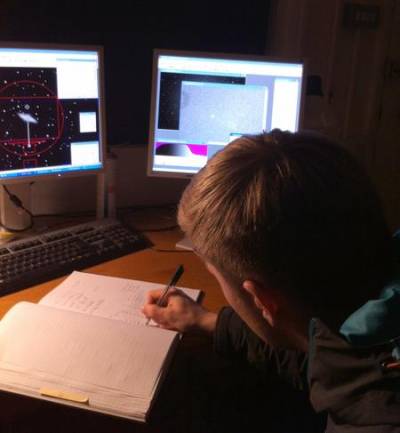
Student logs observations on the night of the discovery
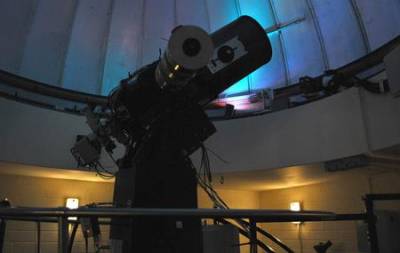
Celestron C14 telescope at the University of London Observatory
Science contact
Dr Steve Fossey
UCL Physics & Astronomy - University of London Observatory
020 8238 8876
s.fossey@ucl.ac.uk
Media contacts
Oli Usher
UCL Faculty of Mathematical and Physical Sciences
020 7679 7964
o.usher@ucl.ac.uk
David Weston (out of hours)
UCL Media Relations
07917 271 364
d.weston@ucl.ac.uk
The Faculty participates in a number of open days throughout the academic year, including the UCL Undergraduate Open Days and the UCL Graduate Open Day.

Friends of Out@UCL
Professor Ivan Parkin - Dean, UCL Faculty of Mathematical and Physical Sciences
"I fully support the aims of the Friends of Out@UCL campaign. I have personal experience of the need for such a campaign and the difficulties that the LGBTQ+ community face." Read more...
Snapshots from Space History
Online exhibition of historic space photos from the faculty's planetary science archives.