Navigate back to homepage
Open search bar.
Open main navigation menu

Main navigation

  • Study
    UCL Portico statue
    Study at UCL

    Being a student at UCL is about so much more than just acquiring knowledge. Studying here gives you the opportunity to realise your potential as an individual, and the skills and tools to thrive.

    • Undergraduate courses
    • Graduate courses
    • Short courses
    • Study abroad
    • Centre for Languages & International Education
  • Research
    Tree-of-Life-MehmetDavrandi-UCL-EastmanDentalInstitute-042_2017-18-800x500-withborder (1)
    Research at UCL

    Find out more about what makes UCL research world-leading, how to access UCL expertise, and teams in the Office of the Vice-Provost (Research, Innovation and Global Engagement).

    • Engage with us
    • Explore our Research
    • Initiatives and networks
    • Research news
  • Engage
    UCL Print room
    Engage with UCL

    Discover the many ways you can connect with UCL, and how we work with industry, government and not-for-profit organisations to tackle tough challenges.

    • Alumni
    • Business partnerships and collaboration
    • Global engagement
    • News and Media relations
    • Public Policy
    • Schools and priority groups
    • Visit us
  • About
    UCL welcome quad
    About UCL

    Founded in 1826 in the heart of London, UCL is London's leading multidisciplinary university, with more than 16,000 staff and 50,000 students from 150 different countries.

    • Who we are
    • Faculties
    • Governance
    • President and Provost
    • Strategy
  • Active parent page: Mathematical & Physical Sciences
    • About
    • Study
    • Research
    • Departments
    • Active parent page: News and events
    • Innovation & Enterprise
    • Contacts

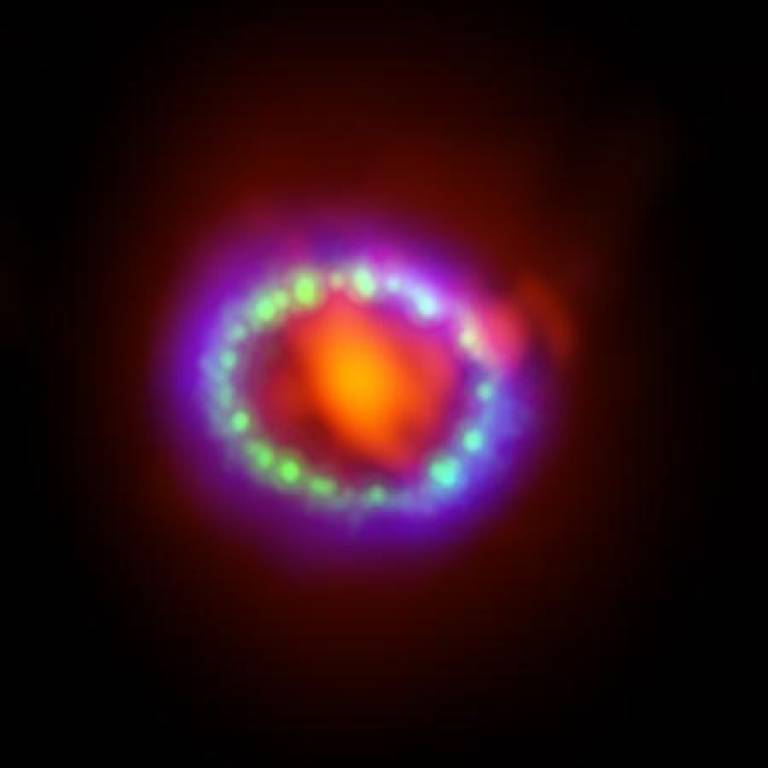
Ashes of a dead star

SN 1987A seen by Hubble, ALMA and Chandra

Breadcrumb trail

  • Mathematical & Physical Sciences
  • News and events

Faculty menu

  • Current page: News
  • Events

SN 1987A seen by Hubble, ALMA and Chandra

Link

In 1987, a bright point of light appeared in the night sky. Training their telescopes on it, astronomers quickly realised that they were witnessing one of the most elusive events in astronomy: a supernova, the collapse and subsequent explosion of a giant star.

Supernovae are very rare, as stars live a long time and only the very largest end their lives as supernovae. None have been observed within our Milky Way galaxy since the invention of the telescope in the 16th century.

Supernova 1987A, as the 1987 event was quickly christened, exploded in the Large Magellanic Cloud, a satellite galaxy of the Milky Way located about 160 000 light years away. It is by far the closest supernova ever observed with a telescope.

In the quarter century that has followed, Supernova 1987A has been heavily studied. The bright flash of the exploding star has long since faded, but the shockwaves and expanding clouds gas are still extremely active.

In the last few years, the shockwaves have reached a shell of gas surrounding the dead star, and have made parts of it light up, creating a necklace of bright glowing pearls of gas.

Now, a new study by a team including Mike Barlow and Mikako Matsuura (both UCL Physics & Astronomy) has used the the Atacama Large Millimeter-submillimeter Array (ALMA, the world's most advanced radiotelescope) to study the cold dust at the centre of the supernova remnant, something which is impossible to see using visible light.

The picture above combines these two recent discoveries. The location of the cold dust (seen by ALMA at millimetre wavelengths) is shown in red, while the ring of glowing pearls observed by Hubble (optical) and Chandra (X-ray) is in green and blue respectively.

Credit: ALMA (ESO/NAOJ/NRAO)/A. Angelich, NASA/ESA Hubble Space Telescope, NASA Chandra X-Ray Observatory

Links

  • Press release on Mike Barlow and Mikako Matsuura's study of dust in SN 1987A
  • UCL Physics & Astronomy
  • ALMA Observatory
  • Hubble Space Telescope
  • Chandra X-Ray Observatory

High resolution image

  • Download image in full resolution
  • View image on Flickr

These images can be reproduced freely providing the source is credited

EU Referendum

Widget Placeholder

EU referendum: UCL Provost's message to students and staff

In light of the UK's vote to leave the European Union, UCL President & Provost Professor Michael Arthur assures UCL students and staff from EU countries that they will continue to be as valued and as welcome as before. Professor Arthur also confirms that there will be no immediate changes to arrangements for EU staff and students.

Open Days

UCL Undergraduate Open Day


The Faculty participates in a number of open days throughout the academic year, including the UCL Undergraduate Open Days and the UCL Graduate Open Day.

View dates

Out@UCL

Friends of Out@UCL

Professor Ivan Parkin - Dean, UCL Faculty of Mathematical and Physical Sciences
"I fully support the aims of the Friends of Out@UCL campaign. I have personal experience of the need for such a campaign and the difficulties that the LGBTQ+ community face." Read more...

Snapshots from Space History
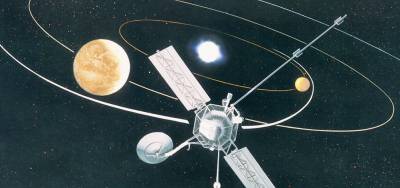
Space history photo (for index right)

Link

Online exhibition of historic space photos from the faculty's planetary science archives.

See the photos

  • Twitter
  • Facebook
  • YouTube
  • Instagram

UCL footer

Visit

  • Bloomsbury Theatre and Studio
  • Library, Museums and Collections
  • UCL Maps
  • UCL Shop
  • Contact UCL

Students

  • Accommodation
  • Current Students
  • Moodle
  • Students' Union

Staff

  • Inside UCL
  • Staff Intranet
  • Work at UCL
  • Human Resources

UCL social media menu

  • Link to Instagram
  • Link to Flickr
  • Link to Youtube
  • Link to TikTok
  • Link to Facebook
  • Link to Twitter
  • Link to Soundcloud

University College London, Gower Street, London, WC1E 6BT

Tel: +44 (0) 20 7679 2000

© 2025 UCL

Essential

  • Disclaimer
  • Freedom of Information
  • Accessibility
  • Cookies
  • Privacy
  • Slavery statement
  • Log in