 Close
Close


Using Lego to build a nanoscope
16 September 2013

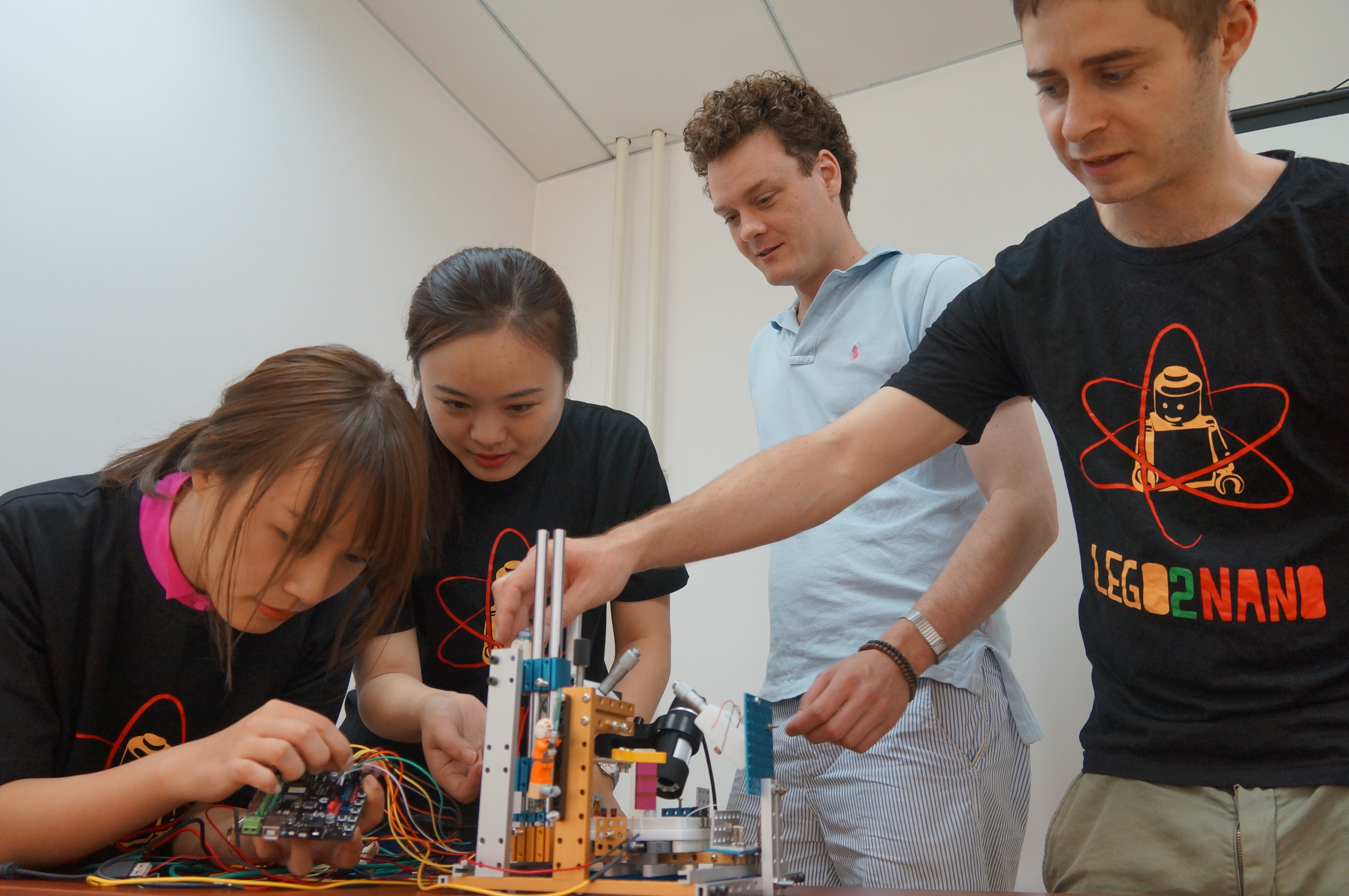
The world's first low cost Atomic Force Microscope (AFM) has been developed in Beijing by a group of PhD students from UCL, Tsinghua University and Peking University - using Lego.
In the first event of its kind, LEGO2NANO brought together students, experienced makers and scientists to take on the challenge of building a cheap and effective AFM, a device able to probe objects only a millionth of a millimetre in size - far smaller than anything an optical microscope can observe.
Research-grade AFMs typically cost upwards of £50,000, and use custom hardware, however, the newly designed low-cost version could cost just a few hundred pounds to produce.
The design brief for the student teams was to build a functional nanoscope, using only Lego, Arduino microcontrollers, 3D-printed parts and consumer electronics. The event was co-sponsored by the Lego Foundation, and involved active participation by Chinese high-school students, as potential users of such low-cost science tools.
It took just five days for the student team to demonstrate the scanning functionality of their AFM, earning them the award for Best Technical Design.
Photo credit: Woody De-Yu Wang, Toyhouse, Tsinghua University
Links
High resolution image
Contact Joanna Rooke (London Centre for Nanotechnology) for reproduction queries.
Open Days
The Faculty participates in a number of open days throughout the academic year, including the UCL Undergraduate Open Days and the UCL Graduate Open Day.

Friends of Out@UCL
Professor Ivan Parkin - Dean, UCL Faculty of Mathematical and Physical Sciences
"I fully support the aims of the Friends of Out@UCL campaign. I have personal experience of the need for such a campaign and the difficulties that the LGBTQ+ community face." Read more...
Snapshots from Space History

Online exhibition of historic space photos from the faculty's planetary science archives.