UCL Logo Navigate back to homepage

Main navigation

  • Home
  • Study

    Study

    • Study at UCL
    • Prospective students
    • Current students
    • Accommodation
    • Careers
    • Doctoral School
    • Immigration and visas
    • Student finances
    • Support and wellbeing
  • Research

    Research

    • Research at UCL
    • Engage with us
    • Explore our Research
    • Initiatives and networks
    • Research news
  • Engage

    Engage

    • Engage with UCL
    • Alumni
    • Business partnerships and collaboration
    • Global engagement
    • News and Media relations
    • Public Policy
    • Schools and priority groups
    • Give to UCL
  • About

    About

    • About UCL
    • Who we are
    • Faculties
    • Governance
    • President and Provost
    • Strategy
    • UCL's Bicentenary
  • UCL Logo Active parent page: Mathematical & Physical Sciences
    • About
    • Study
    • UCL200
    • Research
    • Departments
    • Active parent page: News and events
    • Innovation & Enterprise
    • Contacts

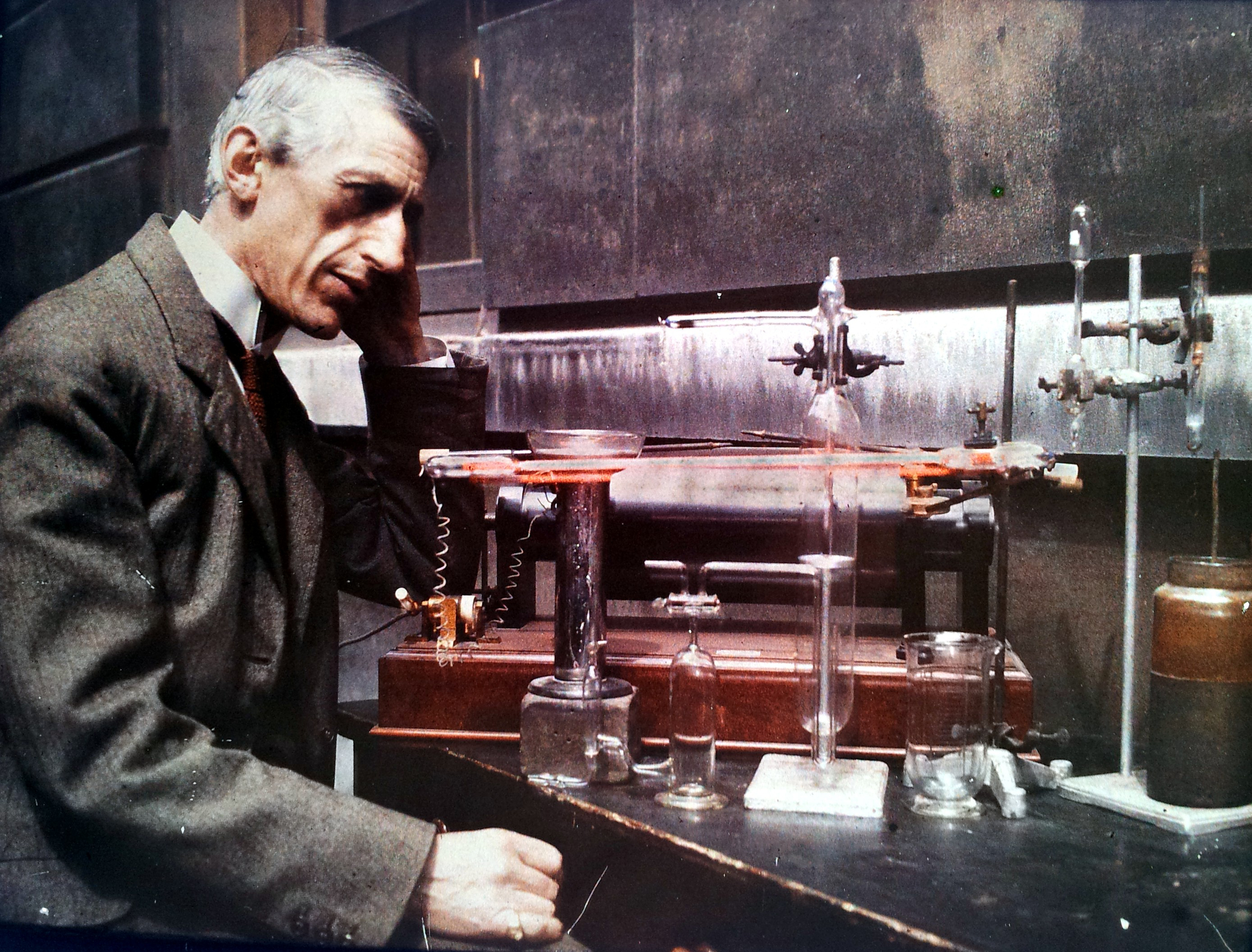
Chemistry in colour

Norman Collie, circa 1911-1913

Breadcrumb trail

  • Faculty of Mathematical & Physical Sciences

Faculty menu

  • Current page: News
  • Events

Breadcrumb trail

  • Faculty of Mathematical & Physical Sciences
  • News and events
  • Chemistry in colour

Norman Collie, circa 1911-1913

Link

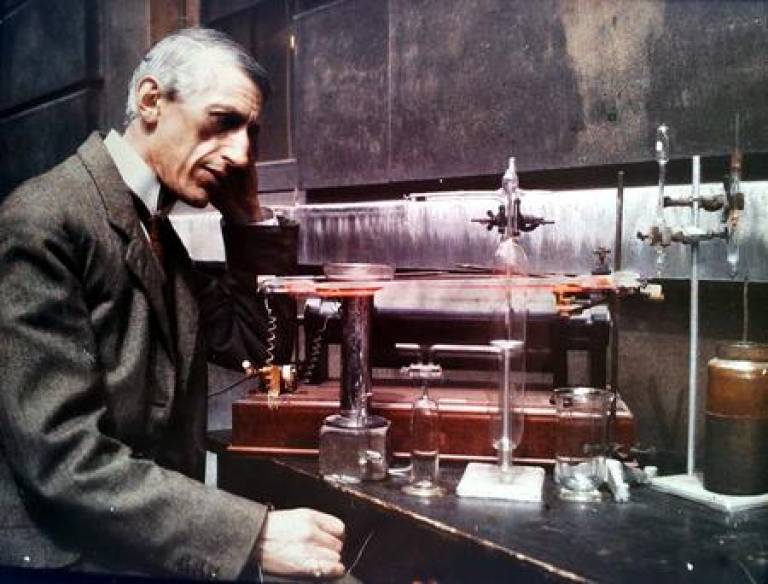
The turn of the 20th century was a hugely successful time for UCL’s chemistry department, bringing with it the college’s first Nobel Prize. William Ramsay was the 1904 laureate in chemistry for the discovery of the noble gases. One of the key participants in this research was J Norman Collie, pictured above next to a glowing neon gas discharge tube. Collie served as Professor of Chemistry and head of the laboratories at UCL until 1928.

Probably taken between 1911 and 1913, this photo is a rare, and extremely well-preserved example of the Autochrome process, which was the first practical method for producing colour photos with a single photographic plate. Other early colour photos, such as the famous photos of Tsarist Russia made by Sergey Prokudin-Gorsky, required multiple monochrome exposures through coloured filters, which were then combined back into colour photos later. This was a cumbersome method, particularly when photographing people or moving objects, although the colour reproduction was better.

One of the Slade windows today. The soot and grime is gone, replaced by splashes of paint left by Fine Art students.  

Although the location is hardly recognisable under the thick coating of soot that covered most London buildings at the time, it is a spot which will be familiar to many who know UCL: the basement level frontage of the Slade School of Fine Art, on the north side of the main quadrangle. Before the opening in 1913 of what is now known as the Kathleen Lonsdale Building, this building housed the college’s chemistry labs.

Aside from his academic career, Collie was a renowned mountaineer, a pioneer of medical X-rays (he performed the UK’s first), and there is even some evidence that he was Arthur Conan Doyle’s inspiration for the character of Sherlock Holmes - something which seems quite plausible given his appearance in this photo.

He was the first to climb 71 peaks around the world, and has two mountains named after him, Sgurr Thormaid (Norman’s Peak) in Scotland, and Mount Collie in Canada.

Photo credit: UCL Chemistry Collections, acknowledgement: Prof Alwyn Davies

Links

  • UCL Chemistry

High resolution images

  • Download image in full resolution
  • View image on Flickr

This image can be reproduced freely providing the source is credited

EU Referendum

Widget Placeholder

EU referendum: UCL Provost’s message to students and staff

In light of the UK’s vote to leave the European Union, UCL President & Provost Professor Michael Arthur assures UCL students and staff from EU countries that they will continue to be as valued and as welcome as before. Professor Arthur also confirms that there will be no immediate changes to arrangements for EU staff and students.

Open Days

UCL Undergraduate Open Day


The Faculty participates in a number of open days throughout the academic year, including the UCL Undergraduate Open Days and the UCL Graduate Open Day.
View dates

Out@UCL

Friends of Out@UCL

Professor Ivan Parkin - Dean, UCL Faculty of Mathematical and Physical Sciences
“I fully support the aims of the Friends of Out@UCL campaign. I have personal experience of the need for such a campaign and the difficulties that the LGBTQ+ community face.” Read more…

Snapshots from Space History

Space history photo (for index right)

Link

Online exhibition of historic space photos from the faculty’s planetary science archives.

See the photos

  • Twitter
  • Facebook
  • YouTube
  • Instagram

UCL footer

Visit

  • Bloomsbury Theatre and Studio
  • Library, Museums and Collections
  • UCL Maps
  • UCL Shop
  • Contact UCL

Students

  • Accommodation
  • Current Students
  • Moodle
  • Students' Union

Staff

  • Inside UCL
  • Staff Intranet
  • Work at UCL
  • Human Resources
UCL Logo

University College London, Gower Street, London, WC1E 6BT

Tel: +44 (0) 20 7679 2000

UCL social media menu

  • Link to Instagram
  • Link to Youtube
  • Link to TikTok
  • Link to Facebook
  • Link to Soundcloud
Here, it can happen.
Back to top

Essential

  • Disclaimer
  • Freedom of Information
  • Accessibility
  • Cookies
  • Privacy
  • Slavery statement
  • Log in

© 2026 UCL