 Close
Close


Huge solar flare caught by Hinode satellite
3 June 2013
This year, solar activity should reach its peak. Solar flares are the most energetic explosions in the Solar System, with energies reaching the equivalent of tens of millions of atomic bombs in minutes.
This solar cycle has been a little unusual with a long
lasting minimum period, leading to concerns that we were going into an extended
minimum. However activity has picked up, with a series of large flares
occurring in the last few weeks. This movie shows a flare that occurred early in the morning of 15 May, which was observed by the Hinode spacecraft.
Hinode was launched almost 7 years ago, and is the 'Hubble' of the Sun, observing activity in high resolution. It was built and is operated through a collaboration between Japan, the US and the UK, including one instrument built at UCL. Researchers at UCL's Mullard Space Science Laboratory use data from Hinode to study solar physics.
The movie shows dark spots known as sunspots which are the location of extremely strong magnetic fields and are the sources of strong flaring. The Sun has strong convection and unusual differential rotation, both of these movements causing magnetic fields to collide, releasing energy. The bright regions occurring above the sunspots is the flare itself, which is many times larger that the size of the Earth.
When Hinode detects a flare, it goes into 'flare mode', increasing the rate at which it captures images. So as not to overwhelm its data connection back to Earth, the size of its images is automatically reduced, which is why black bars appear at the sides of the image part-way through the sequence.
Notes
Hinode is a Japanese mission developed and launched by ISAS/JAXA, collaborating with NAOJ as a domestic partner, NASA and STFC (UK) as international partners. Scientific operation of the Hinode mission is conducted by the Hinode science team organized at ISAS/JAXA. This team mainly consists of scientists from institutes in the partner countries. Support for the post-launch operation is provided by JAXA and NAOJ (Japan), STFC (U.K.), NASA, ESA, and NSC (Norway).
Related links
High resolution image
This image can be reproduced freely providing the source is credited
High resolution video
This video can be reproduced freely providing the source is credited
Media contact
Oli Usher
UCL Faculty of Mathematical and Physical Sciences
020 7679 7964
o.usher@ucl.ac.uk
Open Days

The Faculty participates in a number of open days throughout the academic year, including the UCL Undergraduate Open Days and the UCL Graduate Open Day.

Friends of Out@UCL
Professor Ivan Parkin -
Dean, UCL Faculty of Mathematical and Physical Sciences
"I fully support the aims of the Friends of Out@UCL campaign. I have
personal experience of the need for such a campaign and the
difficulties that the LGBTQ+ community face." Read more...
Snapshots from Space History
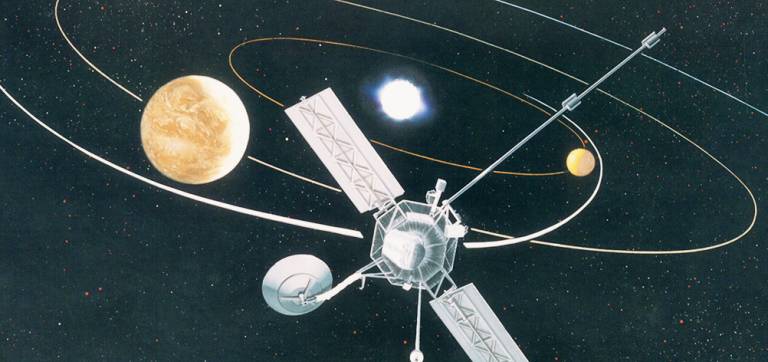
Online exhibition of historic space photos from the faculty's planetary science archives.