UCL Logo Navigate back to homepage

Main navigation

  • Home
  • Study

    Study

    • Study at UCL
    • Prospective students
    • Current students
    • Languages and international education
    • Accommodation
    • Careers
    • Doctoral School
    • Immigration and visas
    • Student finances
    • Support and wellbeing
  • Research

    Research

    • Research at UCL
    • Engage with us
    • Explore our Research
    • Initiatives and networks
    • Research news
  • Engage

    Engage

    • Engage with UCL
    • Alumni
    • Business partnerships and collaboration
    • Global engagement
    • News and Media relations
    • Policy and political engagement
    • Schools and priority groups
    • Give to UCL
  • About

    About

    • About UCL
    • Who we are
    • Faculties
    • Governance
    • President and Provost
    • Strategy
    • UCL's Bicentenary
  • UCL Logo Active parent page: Mathematical & Physical Sciences
    • Study
    • UCL200
    • Research
    • Departments
    • Active parent page: News and events
    • Innovation & Enterprise
    • About
    • Contacts

How to make a diamond

The diamond lab at LCN

Breadcrumb trail

  • Faculty of Mathematical & Physical Sciences

Faculty menu

  • Current page: News
  • Events

Breadcrumb trail

  • Faculty of Mathematical & Physical Sciences
  • News and events
  • How to make a diamond

The diamond lab at LCN

Link

Diamonds are formed deep in the Earth in the immense pressure and temperature of magma (molten rock). These conditions are totally inaccessible, typically lying hundreds of kilometres beneath our feet.

For this reason, there are relatively few diamond mines in the world, and they have to be located in areas where volcanoes have brought the diamond-bearing magma up to the surface. The famous Kimberley mine in South Africa is one such example.

The scarcity of diamonds - combined with their beauty and numerous uses in industry - makes them a very precious material.

Since the 1950s, scientists and engineers have known how to produce diamonds  artificially, and these processes have become a major source of diamonds for industry, although the jewellery business still prefers natural gemstones.

Diamonds are not chemically complicated - they are just a crystal of common carbon, the same element in graphite pencils. But getting the carbon atoms to form the tight, pure and incredibly hard lattice that makes up a diamond crystal is not a simple task.

The diamond lab at the London Centre for Nanotechnology carries out research into synthetic diamonds, and explores ways they can be used in electronics, healthcare and other fields of science.

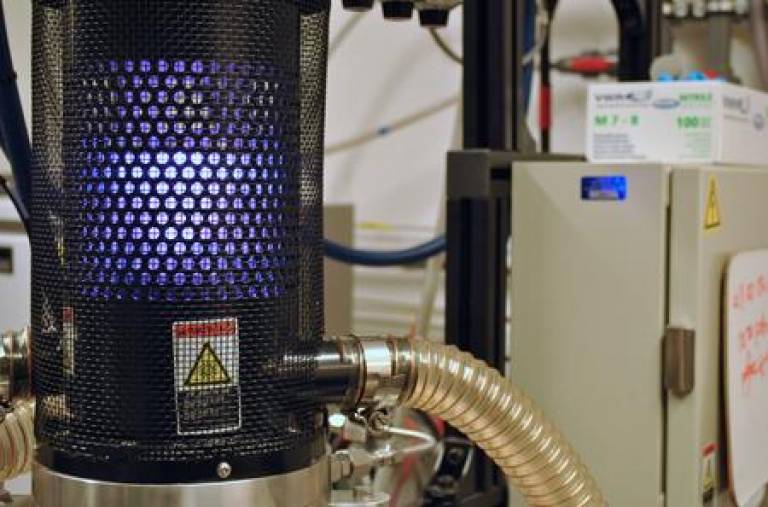
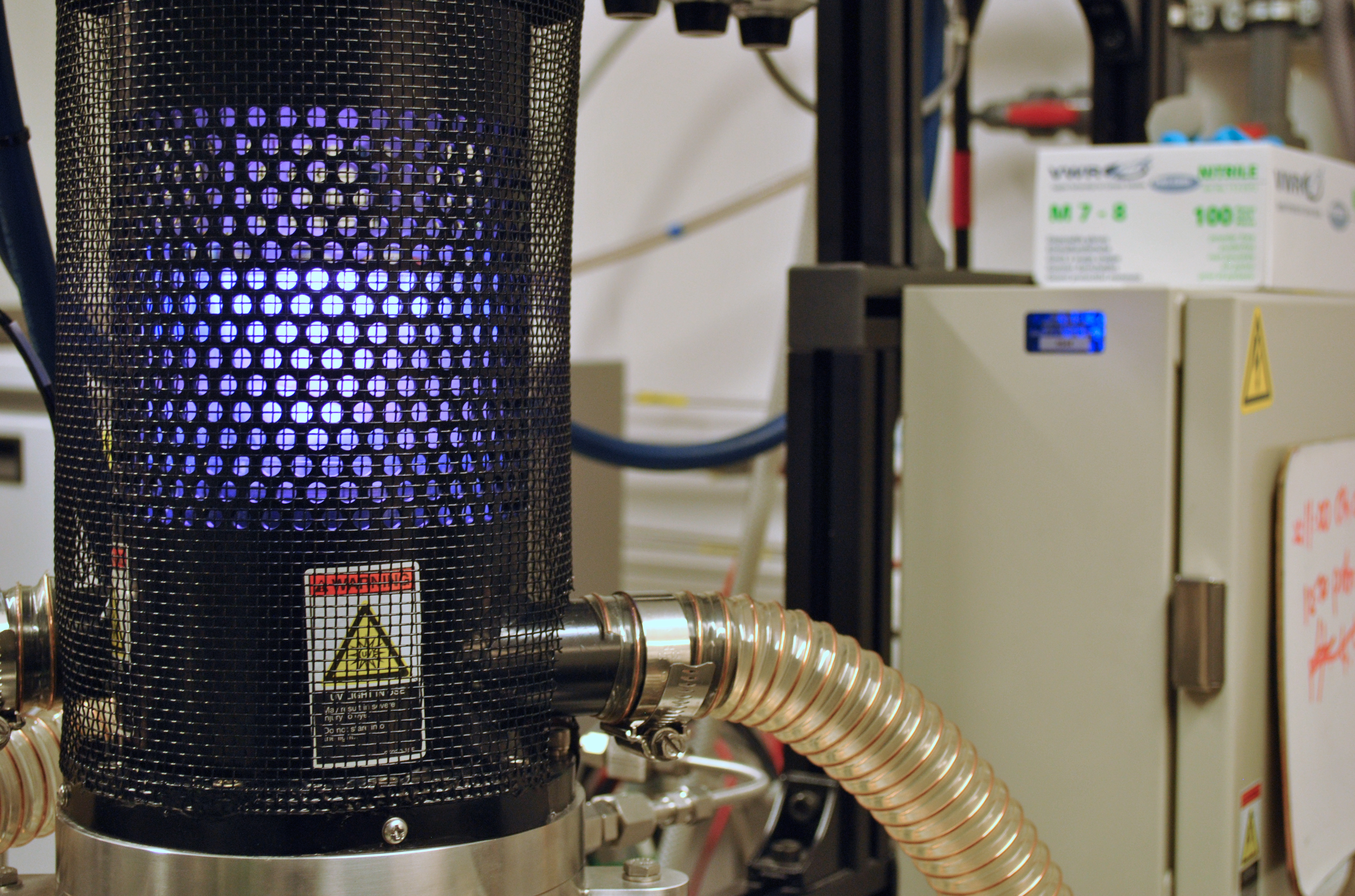
Scientists in the lab use the chemical vapour deposition machine pictured here to create diamonds for their research. The machine passes methane gas (made of hydrogen and carbon) through a plasma of hydrogen gas, depositing the carbon on a surface, slowly forming a diamond in the process.

The purple glow is emitted by the hydrogen plasma.
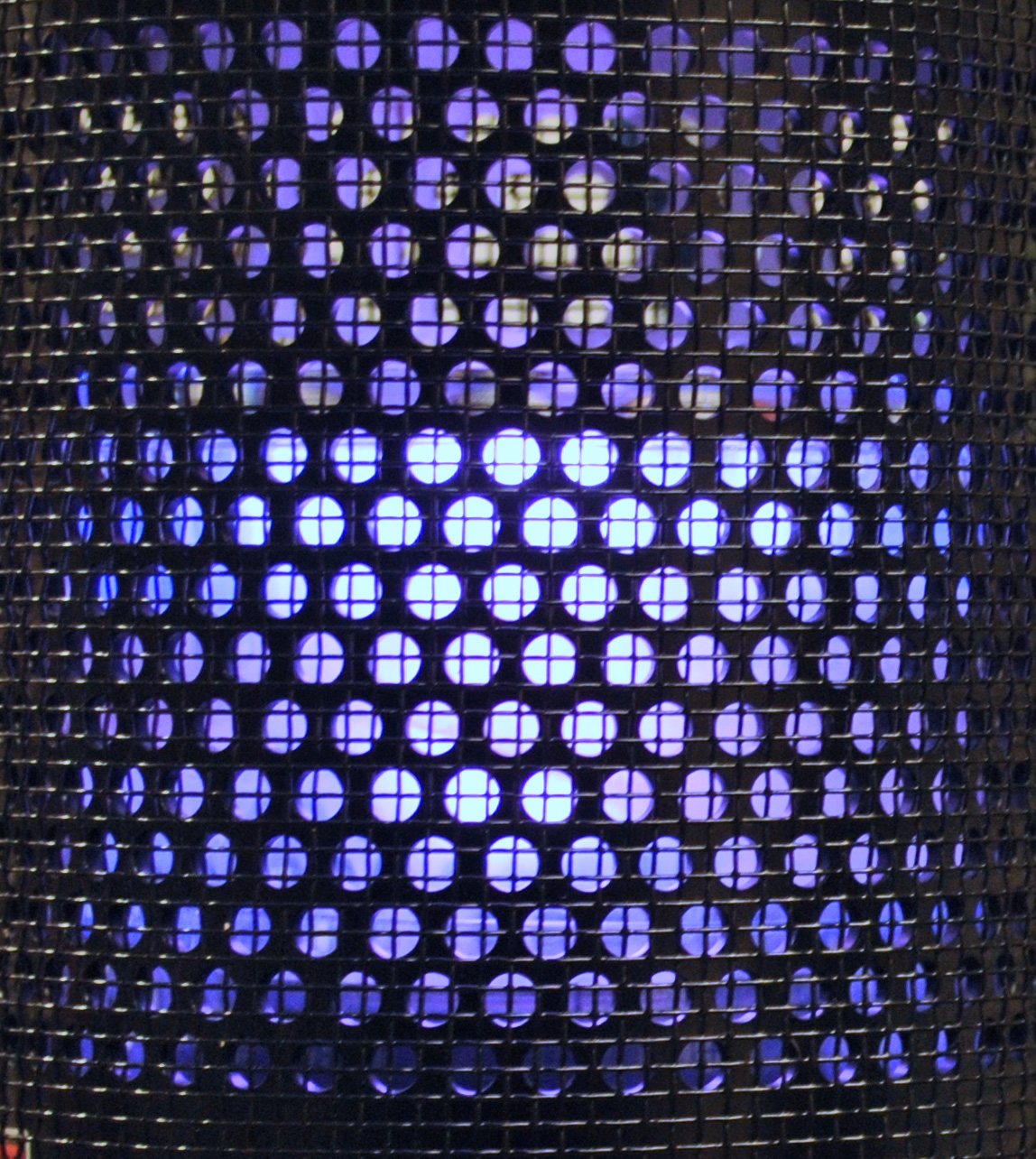
Hydrogen plasma

Link

A plasma is a highly energised state of matter similar to a gas. In a plasma, heat, electricity, or some other source of energy has excited the atoms, letting the nuclei and electrons move freely.

The conditions in the plasma allow the methane to break up, and for its carbon to be deposited in the form of diamond without any need for the enormous pressures that form diamonds in nature.

Photo credit: O. Usher (UCL MAPS)

Links

  • London Centre for Nanotechnology

High resolution image

  • Download image in full resolution
  • View image on Flickr

This image can be reproduced freely providing the source is credited

EU Referendum

Widget Placeholder

EU referendum: UCL Provost’s message to students and staff

In light of the UK’s vote to leave the European Union, UCL President & Provost Professor Michael Arthur assures UCL students and staff from EU countries that they will continue to be as valued and as welcome as before. Professor Arthur also confirms that there will be no immediate changes to arrangements for EU staff and students.

Open Days

UCL Undergraduate Open Day


The Faculty participates in a number of open days throughout the academic year, including the UCL Undergraduate Open Days and the UCL Graduate Open Day.

View dates

Out@UCL

Friends of Out@UCL

Professor Ivan Parkin - Dean, UCL Faculty of Mathematical and Physical Sciences
“I fully support the aims of the Friends of Out@UCL campaign. I have personal experience of the need for such a campaign and the difficulties that the LGBTQ+ community face.” Read more…

Snapshots from Space History

Space history photo (for index right)

Link

Online exhibition of historic space photos from the faculty’s planetary science archives.

See the photos

  • Twitter
  • Facebook
  • YouTube
  • Instagram

UCL footer

Visit

  • Bloomsbury Theatre and Studio
  • Library, Museums and Collections
  • UCL Maps
  • UCL Shop
  • Contact UCL

Students

  • Accommodation
  • Current Students
  • Moodle
  • Students' Union

Staff

  • Inside UCL
  • Staff Intranet
  • Work at UCL
  • Human Resources
UCL Logo

University College London

Gower Street, London, WC1E 6BT

Telephone: +44 (0) 20 7679 2000

UCL social media menu

  • Link to Instagram
  • Link to Youtube
  • Link to TikTok
  • Link to Facebook
  • Link to Soundcloud
Here, it can happen.
Back to top

Essential

  • Disclaimer
  • Freedom of Information
  • Accessibility
  • Cookies
  • Privacy
  • Slavery statement
  • Log in

© 2026 UCL