 Close
Close


UCL Chemistry-led research on the Origin of Water on Earth
30 November 2010

UCL Chemistry-led research on the Origin of Water on Earth, published as front cover in RSC Chemical Communications, was featured in the New Scientist and selected as an RSC Chemical Science Highlight
Computational research led by Nora de Leeuw has validated a new theory on the source of terrestrial water.
The origin of water on our planet is not only of interest for our understanding of the evolution of our own planet and life thereon, but even more so for the increasing exploration of other planets within our solar system and the discovery of potential planetary systems in other galaxies.
Having spent half a life-time teaching his students the accepted versions of the origin of our planetary water, which increasingly did not fit the available evidence, Mike Drake at the University of Arizona suggested an alternative hypothesis, where water was already present at the surfaces of interstellar dust grains, when they accreted to form our planet. Although this hypothesis fitted with all available evidence, it would only work if the adsorption of water to the dust grains was sufficiently strong to survive the harsh conditions in the accretion disk.
Computer simulations by De Leeuw and colleagues in UCL, Arizona and Muenster on the chemisorption of water to surfaces of the olivine mineral, which is ubiquitous in interstellar dust clouds, show that the kind of highly fractal surfaces found on the interstellar dust grains are indeed suitable for the strong retention of water under the extreme temperatures and pressure conditions prevalent in the accretion disk during planetary formation. This work thus provides very strong evidence that the new hypothesis as to the delivery of water is correct; water was indeed present at the birth of our planet Earth rather than a late-comer once the planet had been formed.
The full paper is available on the RSC Chemical Science website at http://pubs.rsc.org/en/Content/ArticleLanding/2010/CC/C0CC02312D, whereas the New Scientist article is available on http://www.newscientist.com/article/mg20827853.800-earth-may-have-had-water-from-day-one.html and the RSC 'Chemical Science Highlight' can be found here http://www.rsc.org/Publishing/ChemScience/Volume/2010/11/Earth_water.asp
Open Days
The Faculty participates in a number of open days throughout the academic year, including the UCL Undergraduate Open Days and the UCL Graduate Open Day.

Friends of Out@UCL
Professor Ivan Parkin -
Dean, UCL Faculty of Mathematical and Physical Sciences
"I fully support the aims of the Friends of Out@UCL campaign. I have
personal experience of the need for such a campaign and the
difficulties that the LGBTQ+ community face." Read more...
Snapshots from Space History
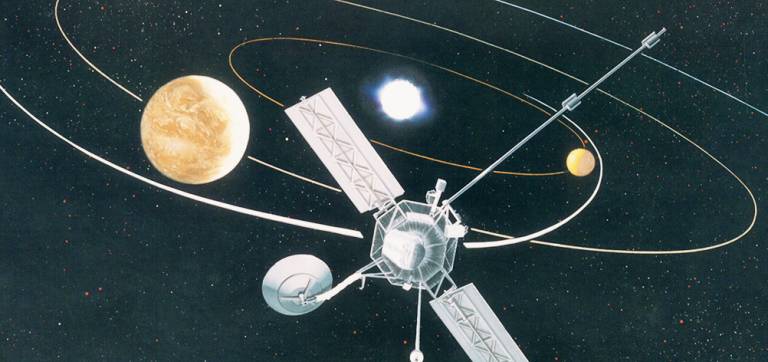
Online exhibition of historic space photos from the faculty's planetary science archives.