Security
Objectives

- to track, assess and analyse developments relating to Russia’s war on Ukraine
- to generate new insights through cross-disciplinary discussion
- to foster exchange between policymakers and the academy
Project partners
Fostering dialogue between policymakers and academics
We convened three roundtables and produced a policy report:
- Brussels Roundtable 'Ukraine's European Future: Prospects and Possibilities' (27 February 2024)
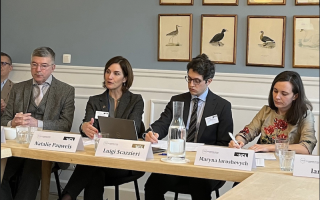
The first of three roundtables took place in Brussels on 27 February 2024 on Ukraine’s European future. The conversation what Ukraine and the EU might need to do to prepare for Ukraine’s accession, the obstacles relating to Ukraine’s accession, and potential reform to the accession process itself. It also considered whether EU membership on its own would be enough to guarantee Ukraine’s security, whether Ukraine might in future join NATO and what role the European Political Community might play in fostering Ukraine’s Euro-Atlantic integration.
Andrew Wilson, Professor of Ukrainian Studies at UCL School of Slavonic and East European Studies, was joined on the panel by Ian Bond, Deputy Director, Centre for European Reform; Maryna Iaroshevych, European Integration Programme Director at The Foreign Policy Council "Ukrainian Prism"; and Natalie Pauwels, Head of Unit, Inter-institutional, Coordination of Relief & Reconstruction, Ukraine Service at DG NEAR in the European Commission. The session was chaired by Luigi Scazzieri, Senior Research Fellow, Centre for European Reform.
- London Roundtable 'The Russian Presidential Election' (10 April 2024)
This roundtable took place in London in April 2024 at the offices of the Centre for European Reform. The discussion focused on the implications of Putin’s inevitable re-election for the war in Ukraine and the security of Europe, while interrogating how Europe should approach relations with Russia and what would have to change (in Russia or the West) to return to a stable equilibrium. The following speakers participated:
- Chris Allan, Director, Eastern Europe & Central Asia, Foreign, Commonwealth & Development Office
- Dr Ben Noble, Associate Professor of Russian Politics, University College London
- Ekaterina Schulmann, Non-Resident Scholar, Carnegie Russia Eurasia Center, Carnegie Endowment for International Peace
- Prof. Gulnaz Sharafutdinova, Professor of Russian Politics & Director, King's Russia Institute, King's College London.
- Berlin roundtable 'Europe's Future Security Architecture' (10 September 2024)
A third and final roundtable was held on the future of European security, including Europe's future security architecture, the impact of the US election, and implications for EU-UK relations. The discussion was hosted at the British Embassy in Berlin and chaired by Deputy Director of the Centre for European Reform, Ian Bond, with contributions from:
- Claudia Major, Head, International Security Research Division, German Institute for International & Security Affairs (SWP)
- Jana Puglierin, Head, Berlin Office, European Council on Foreign Relations
- Luigi Scazzieri, Senior Research Fellow, Centre for European Reform
- Michael Scharfschwerdt, Director Policy Planning, Federal Foreign Office, Germany
- Policy report 'European security in a time of war: standing with Ukraine, against Russia and without the US' (December 2025)
By Ian Bond, Deputy Director, Centre for European Reform
Executive summary
Russian aggression and US indifference threaten Europe. Europe must build security against Russia, without the US but with Ukraine.
- European security structures have been tottering for more than a decade, first under the impact of Russia’s annexation of Crimea and then following its full-scale attack on Ukraine. Donald Trump’s two terms as US president have provoked European worries about the reliability of NATO defence guarantees.
- There are good reasons for EU and NATO member-states on Russia’s border to be concerned about the risk of a military confrontation. But as well as the threat from Russia, Europe also faces domestic threats from political extremism and other forces that seek to divide European societies.
- Ukraine is often portrayed as a state split between Ukrainian-speakers and Russian-speakers with different views of the country’s orientation: should it face towards Brussels or towards Moscow? In reality, divisions have rarely been as deep as Russian narratives claimed, and since Russia’s full-scale invasion in 2022, support for integration with the EU has risen sharply in the east.
- Ukraine has made its choice, but it still has many hurdles to overcome before it can join the EU. It must not fall back into old, corrupt ways of doing things. The EU must circumvent opposition to Ukraine’s membership from some member-states and vested interests, and somehow balance the geopolitical imperative of Ukrainian membership against the need to maintain high standards of governance – something it has struggled with since the 2004 round of enlargement in Central Europe.
- Russia has historically oscillated between trying to catch up with the rest of Europe, rejecting European influences, and seeing itself as Europe’s superior. Putin started out in 2000 by looking for closer co-operation with the EU, but has become more and more Eurasianist, claiming for Russia the status of a unique civilisational power and a hegemon in the territory of the former Russian empire.
- Russian leaders have made two attempts to get the West to accept a Russian sphere of influence in Eastern Europe, first with Dmitriy Medvedev’s ‘European Security Treaty’ in 2008-2009, and then with two draft treaties put forward by Russia in December 2021, which sought to leave large parts of Central Europe defenceless and to remove US nuclear deterrent forces from Europe. Putin is now intent on creating a sphere of influence by force rather than through treaties.
- At some point, the war in Ukraine will end. But Russia’s restrictive view of Ukrainian sovereignty is likely to remain, even after Putin. It is hard to imagine Europe building security with Russia for the foreseeable future; it will have to reconcile itself to building security against Russia. It will also have to deal with the prospect of doing it without the US – an increasingly unreliable partner.
- The challenges the US poses to Europe are growing more complicated. Not only is the US likely to provide much less military support to Europe in future; people in or associated with Trump’s administration have been exacerbating Europe’s domestic divisions and giving encouragement to right-wing populists sympathetic to Russia and hostile to European integration. Trump’s most recent peace plan for Ukraine, before it was modified as a result of Ukrainian and European opposition, would not only have put Russia in a stronger position vis-à-vis Kyiv; it would have threatened the broader interests of Europe.
- Europe needs not only to strengthen its defence capabilities but to increase the resilience of its societies. Only then can it think about structures, perhaps based on the Organisation for Security and Co-operation in Europe, for managing what is likely to be a long-term stand-off with Russia. But as long as Russia seeks to dominate its Eastern European neighbours, it is hard to see how the rest of Europe can do anything other than defend them, and itself. The logic of Putin’s world-view, in which Russia is a ‘besieged fortress’, is that as each neighbour is subdued, the next country becomes a threat.
This publication was co-funded by the Erasmus+ programme of the European Union. The author is grateful to Dr Ben Noble for his comments on an earlier draft, and to Dr Uta Staiger of the UCL European Institute for her support for the project. The text reflects only the author’s views, and the European Commission and UK National Agency are not responsible for any use that may be made of the information in the publication.

Contact
If you’d like to find out more about this work-stream, please contact Dr Ben Noble (Benjamin.noble@ucl.ac.uk) or Lucy Shackleton (l.shackleton@ucl.ac.uk).
Spotlight on Ben Noble
Read more about Dr Ben Noble, academic lead for this workstream, by reading his Spotlight interview here:
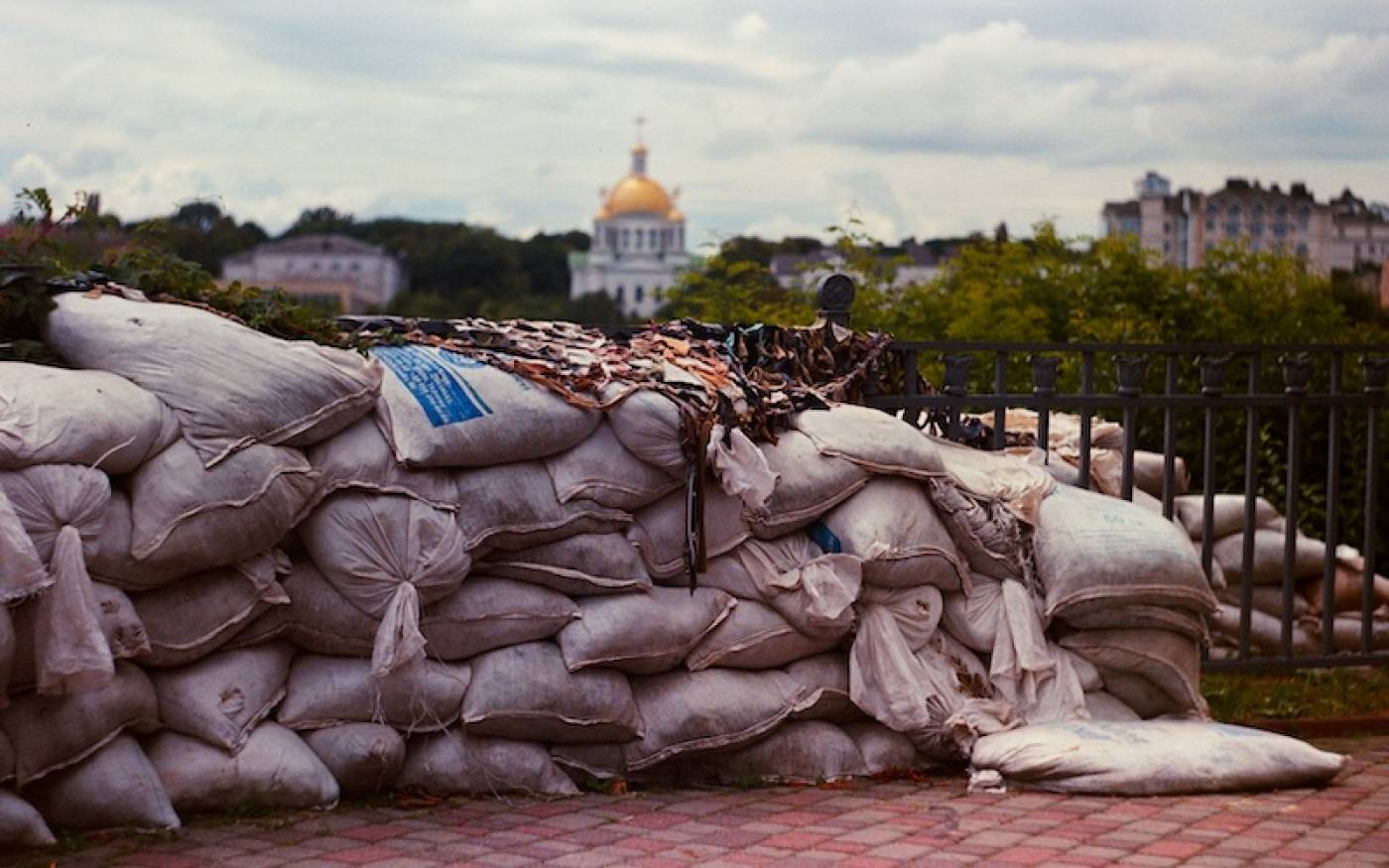
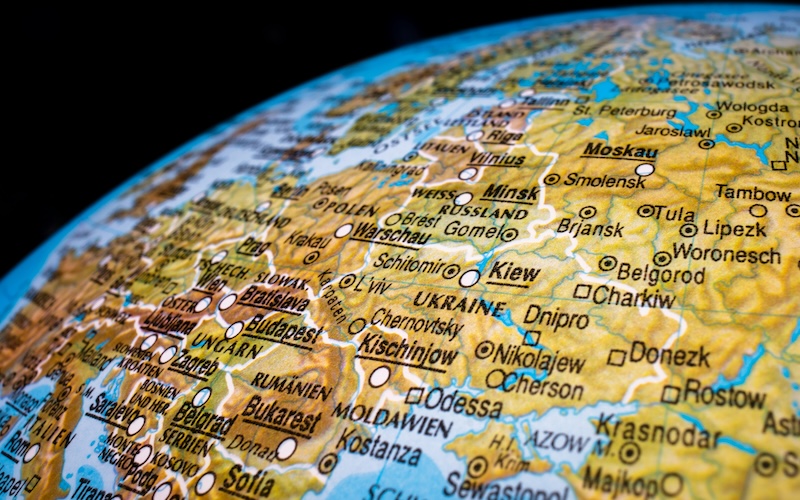
Images: Poltava, Poltava Oblast, Ukraine, Published on 12 August 2022, Photo by Margarita Marushevska on Unsplash. Globe, Photo by Jan Reinicke on Unsplash.

Close