
Navigate back to homepage
Open search bar.
Open main navigation menu

Main navigation

  • Study
    UCL Portico statue
    Study at UCL

    Being a student at UCL is about so much more than just acquiring knowledge. Studying here gives you the opportunity to realise your potential as an individual, and the skills and tools to thrive.

    • Undergraduate courses
    • Graduate courses
    • Short courses
    • Study abroad
    • Centre for Languages & International Education
  • Research
    Tree-of-Life-MehmetDavrandi-UCL-EastmanDentalInstitute-042_2017-18-800x500-withborder (1)
    Research at UCL

    Find out more about what makes UCL research world-leading, how to access UCL expertise, and teams in the Office of the Vice-Provost (Research, Innovation and Global Engagement).

    • Engage with us
    • Explore our Research
    • Initiatives and networks
    • Research news
  • Engage
    UCL Print room
    Engage with UCL

    Discover the many ways you can connect with UCL, and how we work with industry, government and not-for-profit organisations to tackle tough challenges.

    • Alumni
    • Business partnerships and collaboration
    • Global engagement
    • News and Media relations
    • Public Policy
    • Schools and priority groups
    • Visit us
  • About
    UCL welcome quad
    About UCL

    Founded in 1826 in the heart of London, UCL is London's leading multidisciplinary university, with more than 16,000 staff and 50,000 students from 150 different countries.

    • Who we are
    • Faculties
    • Governance
    • President and Provost
    • Strategy
  • Active parent page: UCL Faculty of Laws
    • About us
    • Study
    • Short Courses
    • Active parent page: Research
    • People
    • Alumni
    • News
    • Events

Structural Injustice and Workers’ Rights

By Professor Virginia Mantouvalou (Professor of Human Rights and Labour Law at UCL Laws)
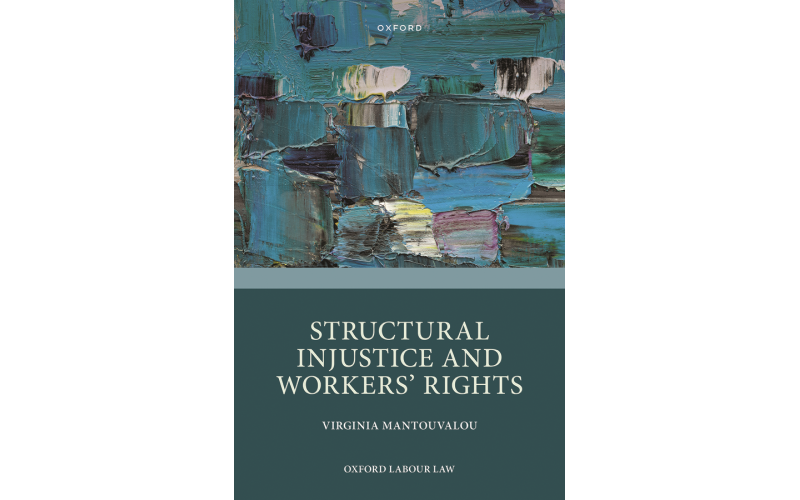
Book cover of Structural Injustice and Workers’ Rights

Breadcrumb trail

  • UCL Faculty of Laws
  • Research

Faculty menu

  • Current page: Publications
    • Policy Briefs

Publication details

Mantouvalou, V. (2023) Structural Injustice and Workers’ Rights. Oxford, UK: Oxford University Press.

Summary

When discussing exploitation in workplaces, governments typically deploy a rhetoric of personal responsibility: they place attention on employers who take advantage of workers, or on workers who choose non-standard, precarious work arrangements. On this account, the responsibility of the state is to address the harm inflicted by private actors.

This book questions that approach and develops the concept of 'state-mediated structural injustice at work': a phenomenon which manifests when legislation that has an appearance of legitimacy, in fact has very damaging effects for large numbers of people and results in structures of exploitation at work. Using a series of examples such as migrant workers, captive workers, people under welfare conditionality schemes, and other precarious workers, Mantouvalou shows how the law creates these structures of injustice, entrenching long-term, standard, and routine exploitation. She also assesses these examples against human rights principles, including civil, political, economic, and social rights. The ultimate aim of the work is to show that these structures routinely lead to workers' exploitation which may in turn give rise to state responsibility for human rights violations and to argue that there is a pressing need for reform.

UCL footer

Visit

  • Bloomsbury Theatre and Studio
  • Library, Museums and Collections
  • UCL Maps
  • UCL Shop
  • Contact UCL

Students

  • Accommodation
  • Current Students
  • Moodle
  • Students' Union

Staff

  • Inside UCL
  • Staff Intranet
  • Work at UCL
  • Human Resources

UCL social media menu

  • Link to Instagram
  • Link to LinkedIn
  • Link to Youtube
  • Link to TikTok
  • Link to Facebook
  • Link to Bluesky
  • Link to Threads
  • Link to Soundcloud

University College London, Gower Street, London, WC1E 6BT

Tel: +44 (0) 20 7679 2000

© 2025 UCL

Essential

  • Disclaimer
  • Freedom of Information
  • Accessibility
  • Cookies
  • Privacy
  • Slavery statement
  • Log in