
Navigate back to homepage
Open search bar.
Open main navigation menu

Main navigation

  • Study
    UCL Portico statue
    Study at UCL

    Being a student at UCL is about so much more than just acquiring knowledge. Studying here gives you the opportunity to realise your potential as an individual, and the skills and tools to thrive.

    • Undergraduate courses
    • Graduate courses
    • Short courses
    • Study abroad
    • Centre for Languages & International Education
  • Research
    Tree-of-Life-MehmetDavrandi-UCL-EastmanDentalInstitute-042_2017-18-800x500-withborder (1)
    Research at UCL

    Find out more about what makes UCL research world-leading, how to access UCL expertise, and teams in the Office of the Vice-Provost (Research, Innovation and Global Engagement).

    • Engage with us
    • Explore our Research
    • Initiatives and networks
    • Research news
  • Engage
    UCL Print room
    Engage with UCL

    Discover the many ways you can connect with UCL, and how we work with industry, government and not-for-profit organisations to tackle tough challenges.

    • Alumni
    • Business partnerships and collaboration
    • Global engagement
    • News and Media relations
    • Public Policy
    • Schools and priority groups
    • Visit us
  • About
    UCL welcome quad
    About UCL

    Founded in 1826 in the heart of London, UCL is London's leading multidisciplinary university, with more than 16,000 staff and 50,000 students from 150 different countries.

    • Who we are
    • Faculties
    • Governance
    • President and Provost
    • Strategy
  • Active parent page: UCL Faculty of Laws
    • About us
    • Study
    • Short Courses
    • Active parent page: Research
    • People
    • Alumni
    • News
    • Events

Principles of International Environmental Law

The fourth edition of the Cambridge University Press publication, by Philippe Sands and Jacqueline Peel, with Adriana Fabra and Ruth MacKenzie
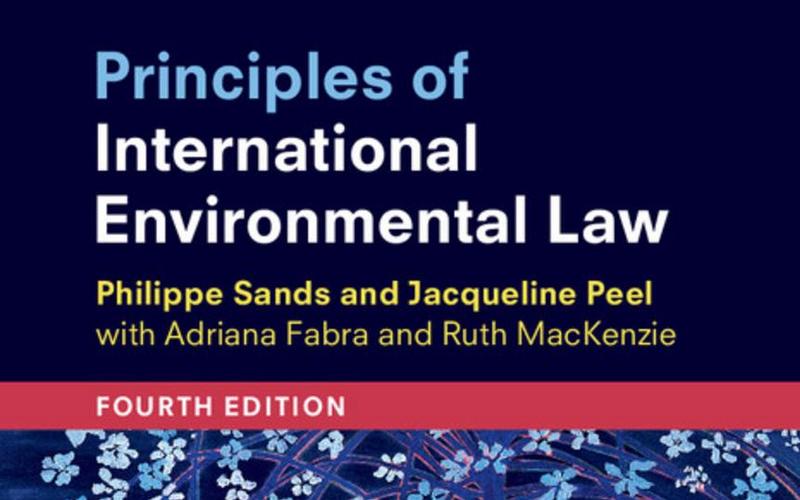
Screen grab of the cover of the report Principles of international Environmental Law

Breadcrumb trail

  • UCL Faculty of Laws
  • Research

Faculty menu

  • Current page: Publications
    • Policy Briefs

It is widely recognised that the planet faces serious environmental challenges that can only be addressed through international cooperation.  Climate change and ozone depletion, loss of biodiversity, toxic and hazardous pollution of air and sea, pollution of rivers and depletion of freshwater resources are among the issues that international law is called upon to address. 

In its fourth edition, 'Principles of International Environmental Law' affirms the consolidation of international environmental law as a central part of the international legal order.  Major treaty regimes cover virtually all environmental issues, with new treaties now in place for mercury pollution and climate change. 

Case law on environmental and natural resources issues continues to grow, and there is considerable evidence that practitioners and judges are engaging more fully with questions regarding science and expert evidence in factually complex and technical disputes. In the period since the third edition, linkages between international environmental law and other areas of international law have deepened and broadened.

More than ever, the subject of international environmental law is approaching a critical point: can it deliver real protections, or will its impact be merely marginal or cosmetic?

Get the book

UCL footer

Visit

  • Bloomsbury Theatre and Studio
  • Library, Museums and Collections
  • UCL Maps
  • UCL Shop
  • Contact UCL

Students

  • Accommodation
  • Current Students
  • Moodle
  • Students' Union

Staff

  • Inside UCL
  • Staff Intranet
  • Work at UCL
  • Human Resources

UCL social media menu

  • Link to Instagram
  • Link to LinkedIn
  • Link to Youtube
  • Link to TikTok
  • Link to Facebook
  • Link to Bluesky
  • Link to Threads
  • Link to Soundcloud

University College London, Gower Street, London, WC1E 6BT

Tel: +44 (0) 20 7679 2000

© 2025 UCL

Essential

  • Disclaimer
  • Freedom of Information
  • Accessibility
  • Cookies
  • Privacy
  • Slavery statement
  • Log in