 Close
Close


Hybrid | The United Kingdom Constitution: An Introduction
30 October 2023, 5:15 pm–7:15 pm
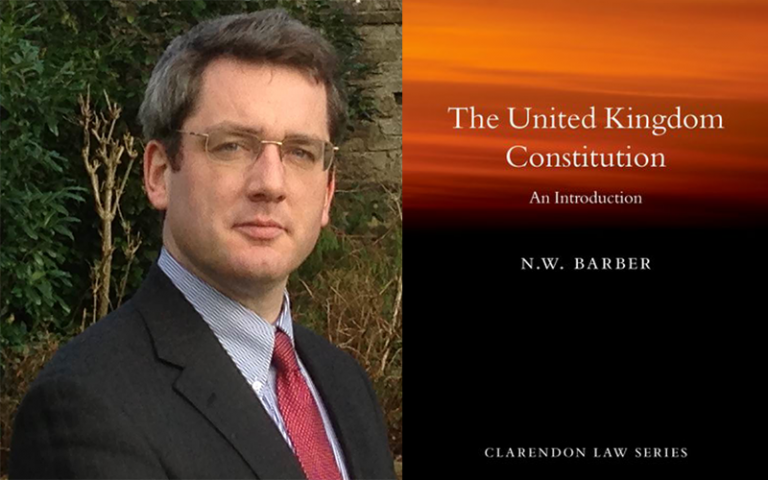
This symposium is organised by the UCL Public Law Group
Event Information
Open to
- All
Organiser
-
UCL Laws
Location
-
UCL Faculty of LawsBentham House4-8 Endsleigh GardensLondonWC1H 0EG
About the Paper
Barber’s The United Kingdom Constitution: An Introduction recognises and embraces the constitution’s historical, social, political, and legal dimensions. It critically examines the radical changes to the UK constitution that have occurred over the last thirty years, paying particular attention to the revival of the constituent territories of the UK - Wales, Scotland, Northern Ireland, and England - and to the increasing role played by the judges in constitutional disputes. Barber explores the constitutional principles, including state sovereignty, separation of powers, democracy, subsidiarity, and the rule of law, principles which set the overall structure of the constitution and inform statutes and the decisions of judges
Barber’s book is widely regarded to be both deep and simply expressed at the same time, recalling some of the fine and lasting titles produced by Oxford’s Clarendon Law series over the years. In this session, a range of UCL public law scholars will explore the contents of the book in a discussion which, consistently with the book itself, will be pitched to be both deep and accessible to undergraduate students, who are most heartily welcome to join the event. The event, like the book, is for both research-active scholars and public policy makers as well as students coming to grips with the basics of the constitution.
- About the Speaker
Nick Barber joined the Oxford Law Faculty in 1998 and was appointed Professor of Constitutional Law and Theory in 2017. He has published many papers in constitutional law, and his books in constitutional theory – The Constitutional State, published in 2011 and The Principles of Constitutionalism, published in 2018 – have been widely reviewed. His most recent book, The United Kingdom Constitution: An Introduction was published in the Clarendon Law Series in late 2021. Both The American Journal of Jurisprudence and The Jerusalem Review of Legal Studies have published collections of essays on his work. His books were shortlisted for the Birks Prize and the Inner Temple Book Prize.
He was also founder editor of the United Kingdom Constitutional Law Blog, and a co-author, with Jeff King and Tom Hickman, of the blog post that sparked the litigation in Miller, a post which first advanced the arguments eventually adopted by the High Court and Supreme Court.
- About the Commentators
Commentators for this Symposium include:
Erin F. Delaney (Cambridge (Ph.D.), NYU (J.D.) and Harvard (A.B.)) is Professor of Law at Northwestern University Pritzker School of Law and has an affiliated faculty position in Northwestern’s Department of Political Science. She has held the Fulbright Visiting Research Chair in the Theory and Practice of Constitutionalism and Federalism at McGill University, as well as research fellowships at Edinburgh University and the Université Libre de Bruxelles. Prior to her position at Northwestern, Prof Delaney served as a law clerk to Supreme Court Justice David H. Souter and to Second Circuit Judge Guido Calabresi. Her scholarship explores constitutionalism in comparative perspective, with a focus on federalism and judicial design in federal systems. With a background in both political science and law, she integrates a functionalist socio-political view into the more formalist frameworks presented in legal discourse. Professor Delaney was a Distinguished Visiting Professor at UCL Laws in 2023.

Tom Hickman is a Professor of Public Law at University College London. Tom is a Graduate of Cambridge University and the University of Toronto. He is a Barrister at Blackstone Chambers. He has been Standing Counsel to the Investigatory Powers Commissioner since 2017. Tom writes and teaches about constitutional law, administrative law, human rights and national security law.
He is author of Public Law After the Human Rights Act (2010) (Inner Temple Book Prize 2008-11 (new author)); co-author of Human Rights : Judicial Protection in the United Kingdom (2008).
Tom often blogs on the UK Constitutional Law Group Blog including well-known blog posts on access to justice (“Public Law’s Disgrace" (Part 1 and Part 2)) and “Pulling the Article 50 Trigger: Parliament’s Indispensable Role” with Jeff King and Nick Barber, which argued that legislation was necessary to trigger Article 50 and led to the Supreme Court's ruling in the Miller I case (in which Tom also acted as Counsel). A blog on the misuse of guidance during the Covid-19 pandemic is available here; and a blog on the Judicial Review and Courts Act 2022 here.
Tom's evidence to parliamentary committees has been referred to in a number of committee reports, such as the House of Lords Constitution Committee's June 2021 report on the use of emergency powers during Covid-19 pandemic and the report of the Privileges Committee in June 2022 on Select Committee's powers. Tom's evidence to the JCHR on the Bill of Rights (2022) can be found here.
In January 2020, Tom was the first person in the history of the Bundesverfassungsgericht to give oral evidence on foreign law to that Court, in the landmark BND Act case (his evidence was on interception of communication laws and oversight) (1 BvR 2835/17).
Tom was Awarded the Sutherland Prize for Legal History by the American Society of Legal History in 2016 for an essay on the law of seditious libel in eighteenth century England.
Tom is a practising barrister and King's Counsel at Blackstone Chambers.
Jeff King joined the UCL Laws as a Senior Lecturer in 2011, and has been Professor of Law since 2016. He is currently a Visiting Professor at the Faculty of Law, University of Oxford, and was between 2019-2021 a Legal Adviser to the House of Lords Select Committee on the Constitution. He sits on the Editorial Committee of Public Law, the General Council of the International Society of Public Law (ICON Society), and is a member of the Study of Parliament Group . He was previously the Co-Editor of Current Legal Problems and the Co-Editor of the UK Constitutional Law Blog. Prior to coming to UCL, he was a Fellow and Tutor in law at Balliol College, and CUF Lecturer for the Faculty of Law, University of Oxford (2008-2011), a Research Fellow and Tutor law at Keble College, Oxford (2007-08), and an attorney at Sullivan & Cromwell LLP in New York City (2003-04). In addition to Oxford, he has held visiting posts at the University of Toronto (2013, 2020), Renmin University (Beijing), the University of New South Wales, and in 2014-15 was an Alexander von Humboldt Foundation visiting fellow at the Humboldt University of Berlin. His book Judging Social Rights (Cambridge University Press, 2012) won the Society of Legal Scholars 2014 Peter Birks Prize for Outstanding Legal Scholarship, and in 2017 he was awarded a Philip Leverhulme Prize in Law. Colm O’Cinneide is Professor of Constitutional and Human Rights Law at University College London (UCL). A graduate of University College Cork, he has published extensively in the field of comparative constitutional, human rights and anti-discrimination law. He has also acted as specialist legal adviser to the Joint Committee on Human Rights and the Women & Equalities Committee of the UK Parliament, and advised a range of international organisations including the UN, ILO and the European Commission. He also was from 2006-16 a member of the European Committee on Social Rights of the Council of Europe (serving as Vice-President of the Committee from 2010-4), and since 2008 has been a member of the academic advisory board of Blackstone Chambers in London.

Dr Ewan Smith joined UCL Laws as Associate Professor of Public Law in 2022. Prior to that he was a Fellow of Christ Church, Oxford, the Shaw Foundation Junior Research Fellow at Jesus College, Oxford, and an Early Career Fellow at the Bonavero Institute of Human Rights. Ewan read law at Oxford, at the University of Paris and at Harvard Law School. He has previously worked at Peking, Tsinghua and Renmin Universities in China and at the National University of Singapore. He is admitted to practice in New York, where he worked for Debevoise and Plimpton LLP. Between 2005 and 2015, he worked for the Foreign Office. Ewan was a Hauser Fellow at New York University Law School in 2023. In 2024, he will be a Visiting Professor at the University of Bologna.
- About the Group
The UCL Public Law Group is a community of scholars working in the field of public law, broadly understood. Our aim is to provide a supportive forum for the discussion and development of theoretical and doctrinal questions in constitutional theory, comparative constitutional law, human rights, judicial review, legal and political theory, and more.
- Book your place
You can attend this event in-person at UCL Faculty of Laws (Bentham House, 4-8 Endsleigh Gardens, London WC1H 0EG) or alternatively you can join via a live stream.
Please make sure you choose the correct ticket when booking your place.