Seminars
The Biological Physics seminar schedule will draw together a programe of speakers from seminar listings across UCL including (but not restricted to) CMMP, LCN and AMOPP that may be of interest to Biological Physics researchers. At present, it primarily provides links to the different related seminar programmes at UCL.
Please send details of seminars to be included to Sophie Cross.
Date |
Speaker |
Title |
Location |
|
Wednesday 21 Mar 2012, 5pm |
Gregory A Voth (Chicago University) |
TYC seminar: Theory and simulation of biomolecular systems: surmounting the challenge of bridging the scales |
Nyholm Room, Chemistry Dept |
|
Wednesday 22 Feb 2012, 4pm |
David Carberry (Bristol University) |
Non-spherical optically trapped probes: design control and applications |
A1 Physics Dept |
|
Wednesday 22 Feb 2012, 1pm |
Ulrich Keyser (Cambridge University) |
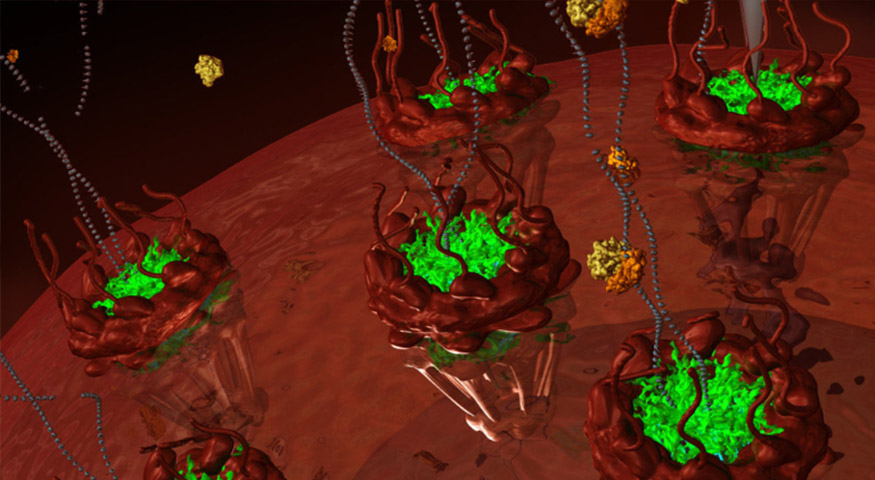
Controlling molecular transport through nanopores |
Ramsay Lecture Theatre |
|
Wednesday 11 Jan 2012, 1pm |
Bart Hoogenboom (UCL) |
Feeling biomolecules by atomic force microscopy |
Ramsay Lecture Theatre |
|
Wednesday 05 October 2011, 4pm |
Phil Jones (UCL) |
AMOPP Seminar: Research in the Optical Tweezers Group |
A1 Physics Dept |
|
Monday, April 11, 2011 from 9:30 AM - 2:00 PM |
Welcome and Opening Address: David Price (VP for Research UCL) Neil Ebenezer (Medicines & Healthcare products Regulatory Agency) “nanotechnology and medical devices”
Tom Duke LCN “Overview of nanomedicine activities at the LCN”
Dr. M Lythgoe (CABI) “Imaging and magnetic targeting of nanoparticles for preclinical use”
Alex Seffalian (Royal Free Hampstead NHS Trust Hospital, Hampstead Campus)
Quentin Pankhurst (UCL/Royal Institution)
Richard Jackman (Electronic and Electrical Engineering) "Nanodiamond"
Mohan Edirisinghe (UCL Mech Eng) “Novel Preparation of Nanoparticles for Nanomedcine" |
UCL Nanomedicine 2011 (Networking Event) | OLD REFECTORY |
|
Thu 17 February, 2:00-6:00pm |
Angus Bain (Physics) "Time-resolved fluorescence studes of biomolecular structure, interactions & dynamics" Angus Silver (NPP) "The acousto-optics lens two-photon micfroscope and its application to neuroscience" Clare Elwell (Medical Physics & Bioengineering) "The use of near infra-red spectroscopy to measure tissue oxygenation, haemodynamics and metabolism" Chris Thrasivoulou (Cell & Developmental Biology) title tbc Guillaume Charras (LCN) "Imaging challenges in molecular cell biology" |
Optical techniques in biological physics. A half-day meeting for physical and life scientists with an interest in applying optical techniques - including spectroscopy, imaging and optical manipulation - to biological problems. |
E7 Physics Dept |
|
Wed 12 Jan 2011, 4:00pm |
David McGloin (Dundee University) |
Optical manipulation of droplets: aerosols and hydrosomes |
A1 Physics Dept |
|
Wed 8 December 2010 |
Paola Borri (Cardiff University |
Novel Multiphoton Microscopy Techniques for Cell Imaging: CARS Microscopy and Resonant Four-Wave Mixing |
A1 Physics Dept |
| 1st December, 2:15pm-4.00pm |
Nguyen TK Thanh (Physics) ‘Synthesis, Biofunctionalisation of Magnetic NPs for Biomedical applications’ Stephen Hart (ICH) 'title tbc’ Scott Woodley (Materials Chemistry) 'title tbc’ Josef Kittler (NPP) ‘Quantum Dots to probe the membrane dynamics of neurotransmitter receptors’ Katherine Holt (Chemistry) 'Redox chemistry of undoped diamond nanoparticles' Tammy Kalber (Centre for Advanced Biomedical Imaging) |
UCL Systems Biology and the Department of Physics and Astronomy are holding a joint meeting to give an overview of research activities at UCL in the area of nanoparticles. The meeting aims to bring together: - life scientists who use or are interested in using nanoparticles for cellular/molecular imaging and therapeutic application - physical scientists who work on synthesis, characterisation and modelling of nanoparticles - physical scientists and engineers who develop novel applications of nanoparticles. |
Cruciform Building Lecture Theatre 2 Please contact Matt Wakelin (m.wakelin@ucl.ac.uk) if you wish to attend. |
|
Thu 4 Nov, 4:00pm |
Sunny Xie, Harvard University |
Stimulated Raman Scattering Microscopy: Label-free Chemical Imaging for Biology and Medicine |
FIL Seminar Room, 12 Queen Square |
|
Wed 12 Jan 2011, 4:00pm |
David McGloin (Dundee University) |
Optical manipulation of droplets: aerosols and hydrosomes |
A1 Physics Dept |
Novel Multiphoton Microscopy Techniques for Cell Imaging: CARS Microscopy and Resonant Four-Wave Mixing
Paola Borri (School of Biosciences, Cardiff University)
Optical microscopy is an indispensable tool that is driving progress in cell biology, and is still the only practical means of obtaining spatial and temporal resolution within living cells and tissues. Much effort is being devoted recently to achieve intrinsic three-dimensional (3D) spatial resolution by exploiting optical nonlinear effects which can only take place in the small focal volume where high photon densities are reached. One of the most utilised multiphoton (ie nonlinear) microscopy techniques is two-photon fluorescence where the biomolecules of interest are labelled with fluorophores, which are optically excited via simultaneous absorption of two photons. However, these modified biomolecules raise questions if their behaviour is real or artefactual. Furthermore, all organic fluorophores are prone to photo-bleaching which severely limits time-course observations and is accompanied by toxicity effects and consequent cell damage.
Coherent Antistokes Raman Scattering (CARS) microscopy has recently emerged as a new multiphoton microscopy technique which overcomes the need of fluorescent labelling and yet retains biomolecular specificity and intrinsic 3D resolution. We have developed in our laboratory a fully home-built CARS microscope featuring innovative CARS excitation/detection schemes. In particular, we have demonstrated differential-CARS (D-CARS) and single-laser CARS utilising femtosecond laser pulses linearly chirped by glass dispersion. Furthermore we have invented and demonstrated a novel imaging modality, based on the resonant Four-Wave Mixing (FWM) of colloidal nanoparticles. Results on this work showed that nanoparticles, both semiconductor and metallic, can be used as alternative labels beyond fluorescence by exploiting their resonant FWM, to achieve a novel coherent multiphoton microscopy modality free from background and with a spatial resolution significantly surpassing the one-photon diffraction limit. I will present our latest progress with both techniques and their applications to cell imaging.
Optical manipulation of droplets: aerosols and hydrosomes
David McGloin (Dundee University)
Abstract: In this talk I will discuss work in which my group has developed techniques to optical manipulate liquid droplets in both the air (aerosols) and in another liquid phase (hydrosomes). I will look at hope the optical manipulation of airborne droplets is subtly different from the trapping of particles in liquids in that one can access underdamped particle dynamics in contrast to the conventional heavily overdamped optical tweezers. I will touch on different technqiues for sizing such particles and how droplet composition can be determined using enhanced spectroscopic methods. In addition I will also touch on how optical fields can also be used to manipulate lqiuid droplets in an oil phase, both through direct optical forces and through thermal manipulation, and how this could lead to interesting ways to develop new forms of biological well plates.
Events & Seminars at: CoMPLEX
Institute of Structural and Molecular Biology
London Centre for Nanotechnology
MRC Laboratory for Molecular and Cellular Biology