Undergraduate Degrees
| UCAS Code | Programme | Title | Duration |
| F510 | Astrophysics | BSc | 3 years | |
| F300 | Physics | BSc | 3 years | |
| F340 | Theoretical Physics | BSc | 3 years | |
| F511 | Astrophysics | MSci | 4 years | |
| F303 | Physics | MSci | 4 years | |
| F345 | Theoretical Physics | MSci | 4 years |
|
Overview |
The Department |
|
Expected intake 114 Research Assessment: |
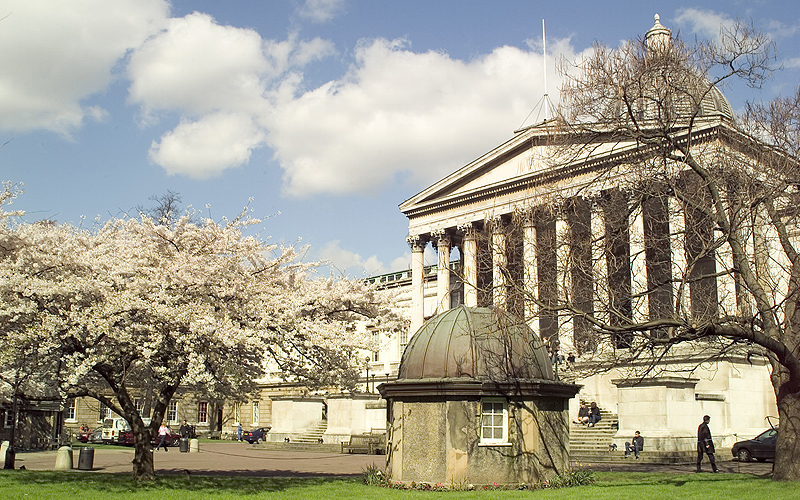
The Physics and Astronomy Department at UCL is located in the heart of the historical area of Bloomsbury. Scientific research and study has been a strong feature of UCL since its inception in 1826 and the Department is currently one of the top rank Physics departments in the country, and indeed the world. ![]() We have forged an internationally renowned reputation for being at the forefront of world leading research and providing high class teaching. Those joining us can expect to be part of a dynamic community of Physicists and Astronomers whose enthusiasm for science and innovation is exceptional. |
Application for admission should be made through UCAS (the Universities and Colleges Admissions Service). Applicants currently at school or college will be provided with advice on the process; however, applicants who have left school or who are based outside the United Kingdom may obtain information directly from UCAS.
Transfers into Year 2 from other departments or other universities are not possible.
Entry requirements
|
A Levels |
| Grades |
A in Maths A in Physics A to B in another subject (For Theoretical Physics the third subject has to be Further maths) |
| AS Levels | A pass in a further subject at AS level or equivalent. |
| GCSEs |
English Language and Mathematics at grade C. For UK-based students, a grade C or equivalent in a foreign language (other than Ancient Greek, Biblical Hebrew or Latin) is required. UCL provides opportunities to meet this requirement following enrolment at UCL. |
|
IB Diploma |
| Points | 36-38 |
| Subjects | A total of 17-18 points in three higher level subjects including Mathematics and Physics at grade 6, with no score below 5. |
| English Language requirement |
For
native or near-native speakers: For non-native speakers: |
|
Other UK Qualifications |
| Birkbeck Certificate of Higher Education |
Distinctions in Mathematics in Parts 1, 2 and 3 Distinctions in Physics in Parts 1, 2 and 3 |
| Access to HE Diploma | Pass in Access to HE Diploma, with a minimum of 18-23 credits awarded with Distinction in the Level 3 units, the remainder of the Level 3 units awarded with Merit. |
|
Advanced Diploma |
Level 3 Advanced Diploma (any individual line of learning) awarded with an overall minimum grade of A, plus 2 GCE A-levels awarded at a minimum of grades AA-AB in the additional/specialist learning component. See A-levels for subject requirements. |
| BTEC | Edexcel level 3 "National" Extended Diploma (QCF) with Distinction in at least 3 subjects including Maths and Physics. |
|
Foreign Qualifications |
| Entry requirement for other countries are listed here. If your county is not listed, please contact us. |
Selection
If you are based in the UK, and your application demonstrates your suitability for the programme, you will be invited to a compulsory applicant open day. This will include presentations, a tour of facilities and an opportunity to meet current students and staff members.
If you are based outside the UK we will decide whether
to make you an offer on the basis of your UCAS application and
reference; a telephone discussion may be offered.
The aim of our teaching programme is to produce graduates who are independent scholars, having developed independent study and research skills during their degree programmes in the Department. We expect students to be highly motivated and dedicated to their studies, in an exciting and enriched environment for hard work.
There are three main components of your degree programme:
Lecture courses |
Practical courses |
Computer programming |
|
These take up about 20% of your time.
|
|
Tutorials
All students are assigned a Personal Tutor, who is the first point of contact for any confidential matters, such as domestic difficulties, on which help or advice is needed. There are a number of example classes in key subjects such as mathematics to help you in your work and your tutor can help you find additional help if you both feel that is needed. The tutor is also a key person in helping to develop your communication skills.
How is the final degree class arrived at?
The class of degree which you are awarded after three or four years of study at UCL is decided by the quality and quantity of the work you do during that period. Results of examinations are combined with continuous assessment marks in a simple formula to gauge your overall performance. The formula used recognises that some students do not settle immediately, so an increasing weight is given to results from each successive year of the programme.
Bsc / Msci Degree Programme Structure
This
handbook gives information on how courses offered fit
into particular degree structures as well as brief descriptions of the
courses themselves. Please note that it cannot be guaranteed that all
courses offered will run and that only the most usual pre-requisites for
courses are given.
Detailed Course Descriptions
This listing contains details about all the constituent courses for full-time undergraduate programmes which are planned to be offered by the Department of Physics and Astronomy in the current Session. For each course you will find aims and objectives, the syllabus and its teaching and assessment methodology.
Intercollegiate MSci
During the fourth year of their MSci degree programmes, UCL students have the opportunity to take some intercollegiate modules at Queen Mary, King's College and Royal Holloway.
Further information on the Intercollegiate programme
UCL Examination registration Form for Intercollegiate Students
While every effort has been made to ensure the accuracy of the information in this document, the Department cannot accept responsibility for any errors or omissions contained herein.
Next UCL Undergraduate Open Day: Thursday 27 June 2013Bookings will open in Spring 2013. |
UCL is pleased to offer guided tours
of the campus by current UCL students. The tours are primarily for
prospective students and their family members and normally last
approximately an hour and a half, including an introductory
presentation.
You are welcome to visit UCL on any weekday between 10.00 am - 4.00 pm and follow our self-guided tour;
simply print out the page, then visit UCL and follow the tour route as
shown.
The Physics Building is open to visitors between 10.00am
and 4.00pm from Monday to Friday. On the first floor of the building, you will find the First Year Lab and on the fourth floor, you can see the
Undergraduate Common Room (A17), the computer cluster room (A19) and the
departmental library (A27). The undergraduate office is in room E2
on the ground floor, however please note the admissions administrator
may not always be available to meet you. If you have any questions
regarding the application process, you can contact us using the details
at the bottom of this page.
If you are unable to visit in person, you can take a virtual tour
of UCL instead. You'll be able to look inside lecture theatres,
laboratories, the Library, Fitness Centre, the Bloomsbury Theatre and
the Students' Union. Virtual tours of our Student Houses and Halls of Residence are also available. A list of Student Houses and Halls of Residence detailing prices and locations can be found on this document.
Please
note that once we have received your application, you will be invited
to attend a compulsory UCAS Open Day where you will meet members of staff and
current students and will be taken on a tour of the department and the
campus. The visit will take place between November and March, well before the deadline for firming your
university choices.