 Close
Close


David Cameron has transformed SNP's long game of Scottish Independence into penalty shoot out
9 January 2012
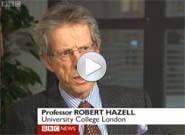
The Prime Minister has hugely raised the stakes over Scottish independence by planning to give the Scottish Parliament legal powers to hold a binding referendum, provided it takes place within a tight time frame. The director of the Constitution Unit Prof Robert Hazell says 'The long game being played by the SNP has suddenly been transformed into a penalty shootout'.
'The SNP strategy has been gradualist, in four stages. First to legislate for an advisory referendum within the Parliament's powers; second to hold the referendum; third, if the Scottish people voted Yes to independence, to negotiate the details of separation with Westminster which could be very complicated. The velvet divorce between the Czech Republic in 1992 and Slovakia required 30 treaties and 12000 legal agreements. The big issues include: division of the national debt; division of North Sea oil; the future of the UK's nuclear bases on the Clyde; the possible sharing of other defence capabilities; Scotland's future membership of the EU. The UK would be desperate to retain the submarine bases, since the Clyde is the only suitable deep water port with multiple entrances. But Scotland would be equally desperate to remain in the EU, which would be heavily influenced by whether the UK supported Scotland's application or not. (The law is not wholly clear, but most international lawyers say that Scotland would have to re-apply). Finally Westminster would pass a Scotland Act giving independence on the agreed terms.
The Constitution Unit argued in our book, Scottish Independence - A Practical Guide, that stage four should be preceded by a second referendum, in which the people of Scotland confirmed that they wanted independence on these terms. The SNP has never accepted the need for a second referendum, stating that 'one referendum on the principle of independence could give the Scottish Parliament and Scottish government sufficient clarity and confidence that the people wish Scotland to become an independent state'.
With or without a second referendum, this is a leisurely timetable, in which the SNP could gradually test Scotland's appetite for independence, and then negotiate with the UK government. According to that timetable, the final vote and independence legislation would not happen until after 2015/16 - after the terms of the present Westminster and Scottish government have expired. But by bidding to bring forward the timetable, and to make the referendum decisive, David Cameron has transformed the politics of a Scottish referendum.'
Notes to Editors:
- Prof Hazell is available for interview on 020 7679 4971 (r.hazell@ucl.ac.uk), or contact our Press Officer Brian Walker on 07892 176347. Victoria Spence is the Unit Administrator and Robert's PA, available on 0207 679 4977 (v.spence@ucl.ac.uk).
- Scottish Independence - A Practical Guide is available from Edinburgh University Press at http://www.euppublishing.com/book/9780748616992
- The Constitution Unit is an independent research centre based in the Department of Political Science at University College London.
Media:
- BBC Newsnight (24.01.12)
- North East facing squeeze from north and south (Journal Live, 19.01.12)
- What is the West Lothian Question and why does it matter? (Guardian, 17.01.12)
- BBC Newsnight (11.01.12)
- Would an independent Scotland be forced to join the euro? (Guardian blog, 11.01.12)
- Cameron may regret this penalty shootout 10.01.12 (Times paywall, but also available on the Unit blog)
- Does David Cameron have the power to dictate when Scotland votes on independence (Guardian, 10.01.12)
- Coalition's sudden-death plan attacked (Herald, 10.01.12)
- Renewed sparring over Scottish independence movement (New York Times, 10.01.12)
- BBC News at Six 09.01.12 (same report at Ten)
- BBC Radio 4 Today (1hr 09 min) 09.01.12
- BBC Radio Good Morning Scotland (1hr 46 min) 09.01.12
- BBC Radio 5 Live Breakfast (1hr 53 min) 09.01.12
Further Information:
- Barry Winetrobe's blog: But What Union?
