A A A

Alberto Hernandez Barral' Webpage

Photo of Alberto Barral

Postgraduate Researcher

Phone: +44 (0)20 7679 2643
Email: Alberto.barral.10@ucl.ac.uk

Address:
Department of Chemical Engineering
University College London
Torrington Place
London WC1E 7JE
United Kingdom

Alberto obtained his 4-year BSc in Chemical Engineering from the University of Salamanca (Spain) in 2003, after 1 year-project and 3-month practical training in the cellulose paste factory (Kraft process) of Navia, Asturias (Spain).

After completing a 6-month research assistantship in the Physical-Chemical Department of the same university in supercritical H2O, he went to the US as a Graduate Teaching Assistant, where he obtained his MSc in Chemical Engineering from the University of Alabama in Huntsville (UAH) in 2006, with a Master’s thesis “Thermal Diffusivity Measurements of Curing Portland Cement”. In UAH, he had a chance to study CFD with Distinguish Professor T.J. Chung, in the developing of FORTRAN and C++ codes for a 2D rocket combustion chamber.

After this, he pursued industrial experience as he worked as a Validation Engineer in Vintage Pharmaceuticals, LLC, Huntsville, AL (2006-2007). He later worked in Madrid as an Applications Specialist for Pall Corporation, in the pharmaceutical division of Spain and Portugal (2008 – 2011).

Alberto enjoys teaching and he has recently won the 1st prize in the UCL Postgraduate Association competition “Tell Everybody your dissertation”.

Research project

Title: Advanced studies on stratified flow of oil-water in horizontal pipes

Supervisors: Dr Panagiota Angeli

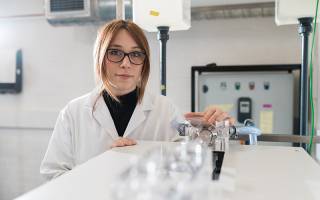
Photo of annual separator maintenance

The extraction of oil from mature wells carries amounts of water and gas from the bore. The transportation of this mixture to the process plant is an operation full of challenges and difficulties for the people of Flow Assurance of companies like Chevron.

 How are these components arranged in the pipe along the many miles from the well to the plant? The flow pattern inside the pipes determines fundamentally the safety and efficiency of the operation. Pressure drop, viscous energy dissipation or the presence of drops or bubbles trapped in the pipe are closely dependent on the type of flow.

 His research is concerned with the unveiling of the physics and fundamental laws that make oil and water flow stratified in the pipe. His aim is to improve the current models to predict the transition to a different flow pattern, the stability of interfacial waves and the onset of drop formation.

 A 15-m acrylic pipe of 1 ½” in diameter circuit, along with a separator and two 800-L tanks for oil and water are available for studies. He is intending to use traditional techniques such as conductance probes for measuring interface characteristics, as well as novel ones, such as Particle Image Velocimetry (PIV), to map velocities and flow features.

The modelling starts from the classic Kelvin-Helmholtz instability for inviscid fluids and will account for any instabilities due to shear stresses distribution or viscous effects.

Page last modified on 15 sep 11 09:41