Images

These are sagittal and axial slices through a microMRI image
of a 15.5 dpc embryo which is heterozygous for the gene Chd7. This
gene is implicated in the human condition CHARGE syndrome. MRI is an
effective method of screening embryos and in this case a heart defect
was detected. This ventricular septal defect is clearly seen in the
volume render (top-right) where the two ventricles (LV and RV) can be
seen to communicate.

This image shows the 3D volume rendering of MRI images from an mouse embryo heart with a ventricular septum defect (VSD). RA = right atrium, LA = left atrium, RV = right ventricle, LV = left ventricle

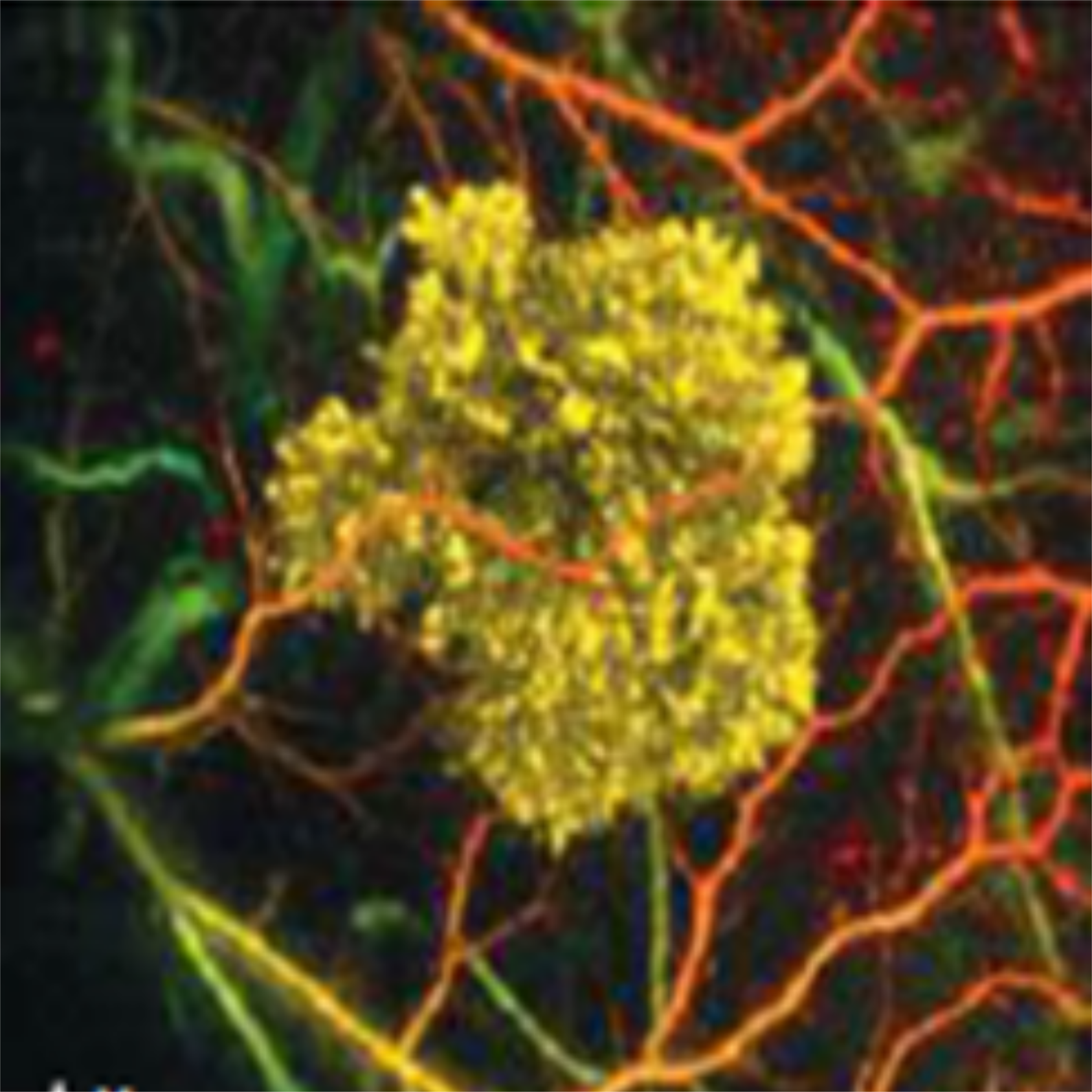
Iron particles (red) are visualised in 3D inside an SPIO-labelled
human mononuclear cell (green - cytoplasm, blue - nucleus) using
reflectance confocal microscopy.

MR images of a rat heart in various views with an in-plane resolution of 200x200 μm. (yellow scale bar represents 1 cm)

Short-axis MR image of a rat heart with a signal void (white arrow) due to iron-labelled stem cells in the myocardium.

Axial section of a high-resolution 3D MRI dataset showing a male Tc1 wild-type brain. Resolution: 40μm isotropic; Gd-DTPA enhanced

Different 3D volume renderings of MRI images of a Bumblebee.


Images by: Anthony Price, Jon Cleary, ManKin Choy, Manfred Junemann-Ramirez, Kenneth Cheung, Panagiotis Kyrtatos, Johannes Riegler,
Frances Wiseman, Lizzy Fisher, Peter Scambler, Karen McCue, Sarah Beddow,
Sveva Bollini, Madi Boyd, Adam Badar
[1] Heiberg, E., et al. Time Resolved Three-dimensional Automated segmentation of the Left Ventricle.
Proc. IEEE Computers in Cardiology 32, 599-602 (2005) http://segment.heiberg.se.
Page last modified on 02 mar 12 18:43