Prof Jonathan Thomson
- Professor, Fine Art Media
Featured Media
Party Booby Trap Exhibition
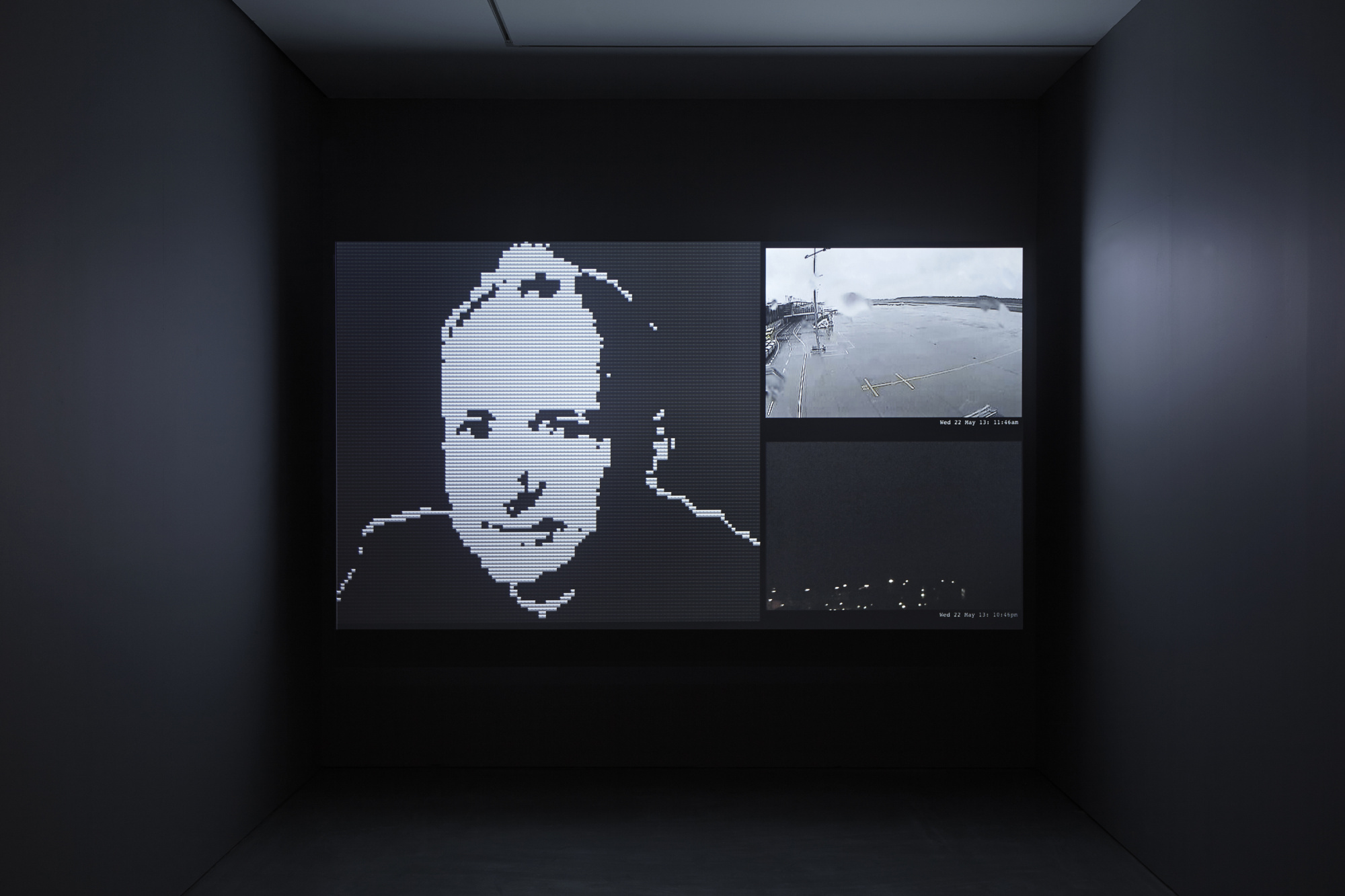
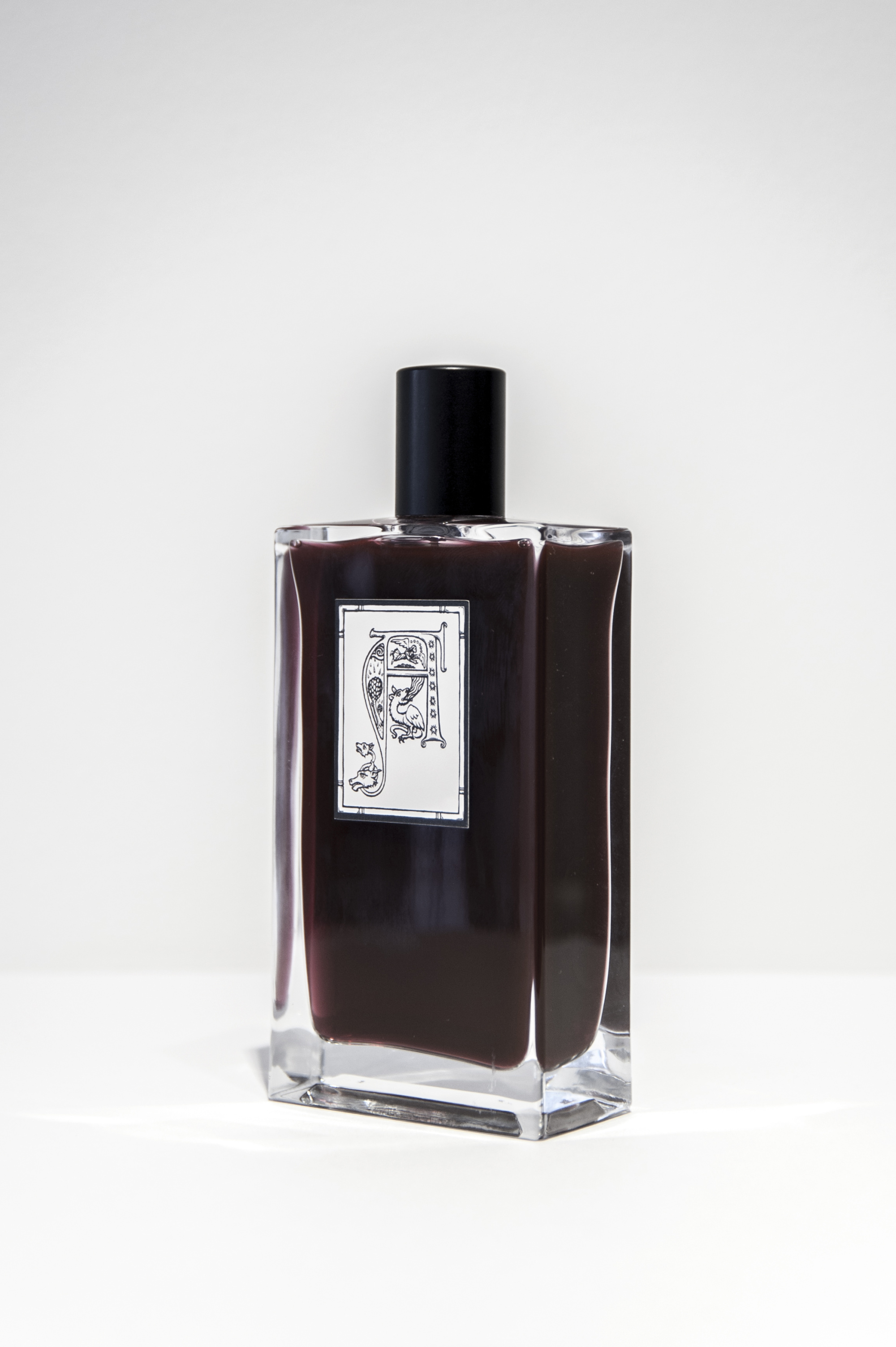
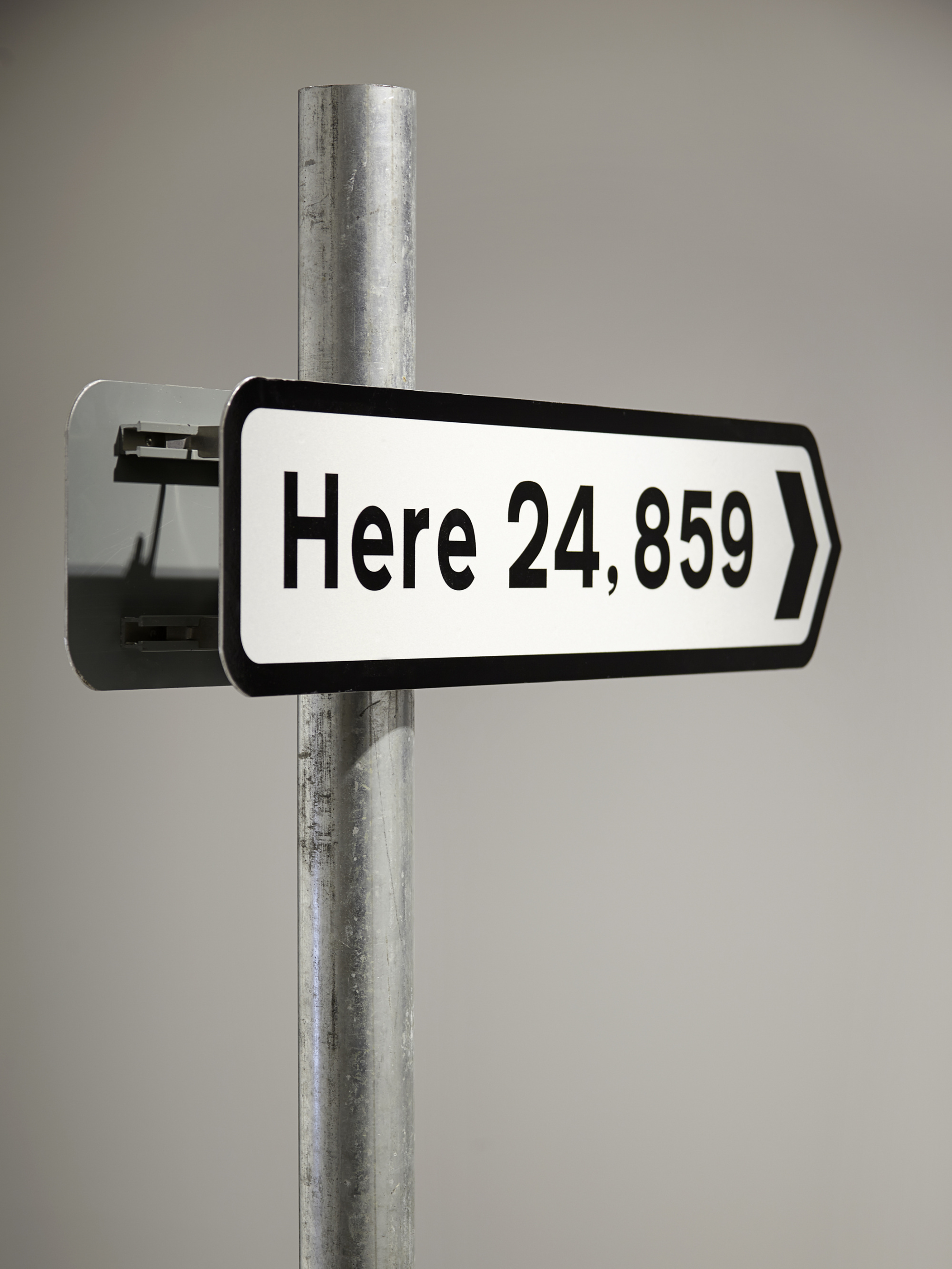
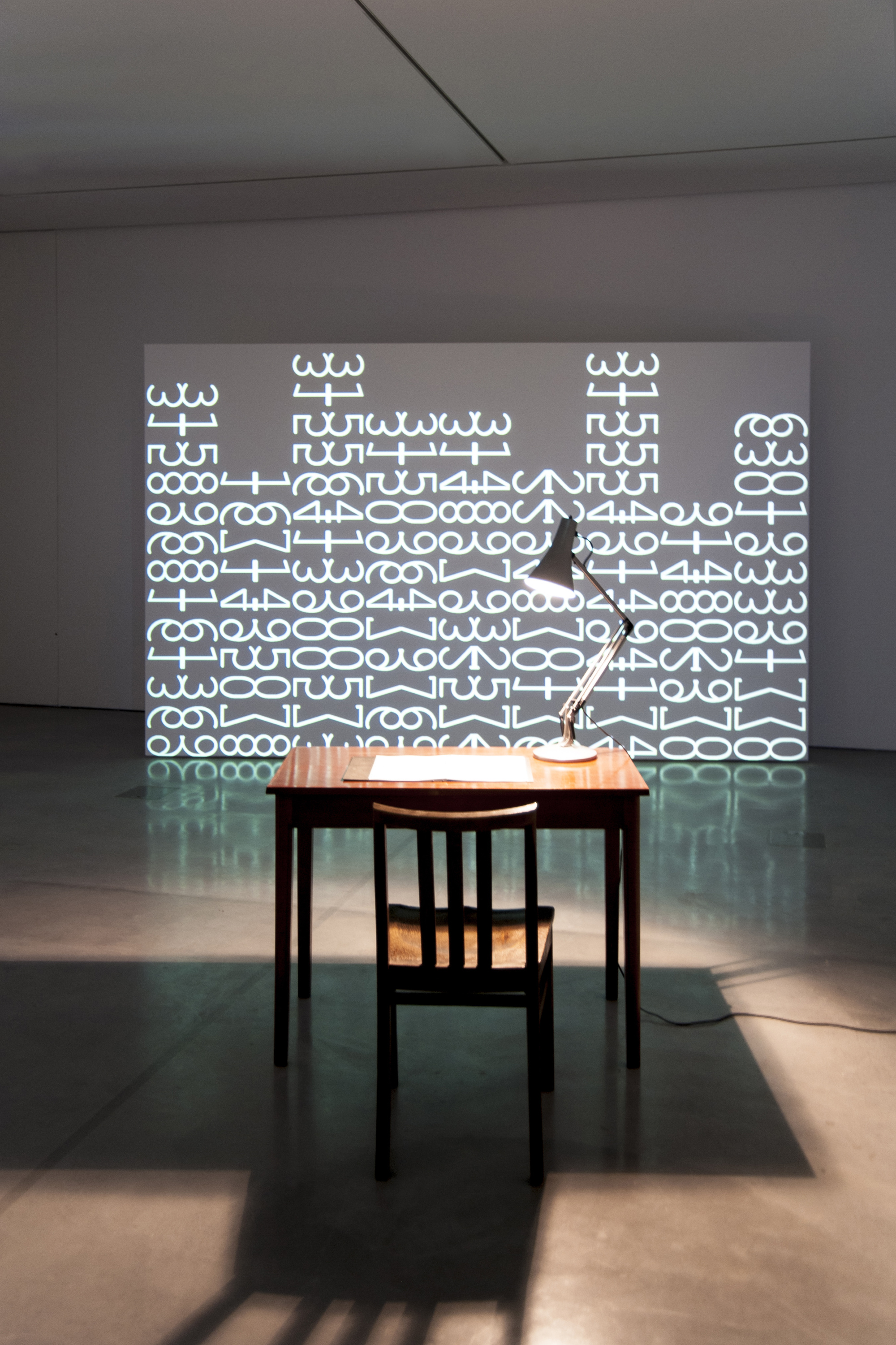
©Thomson & Craighead
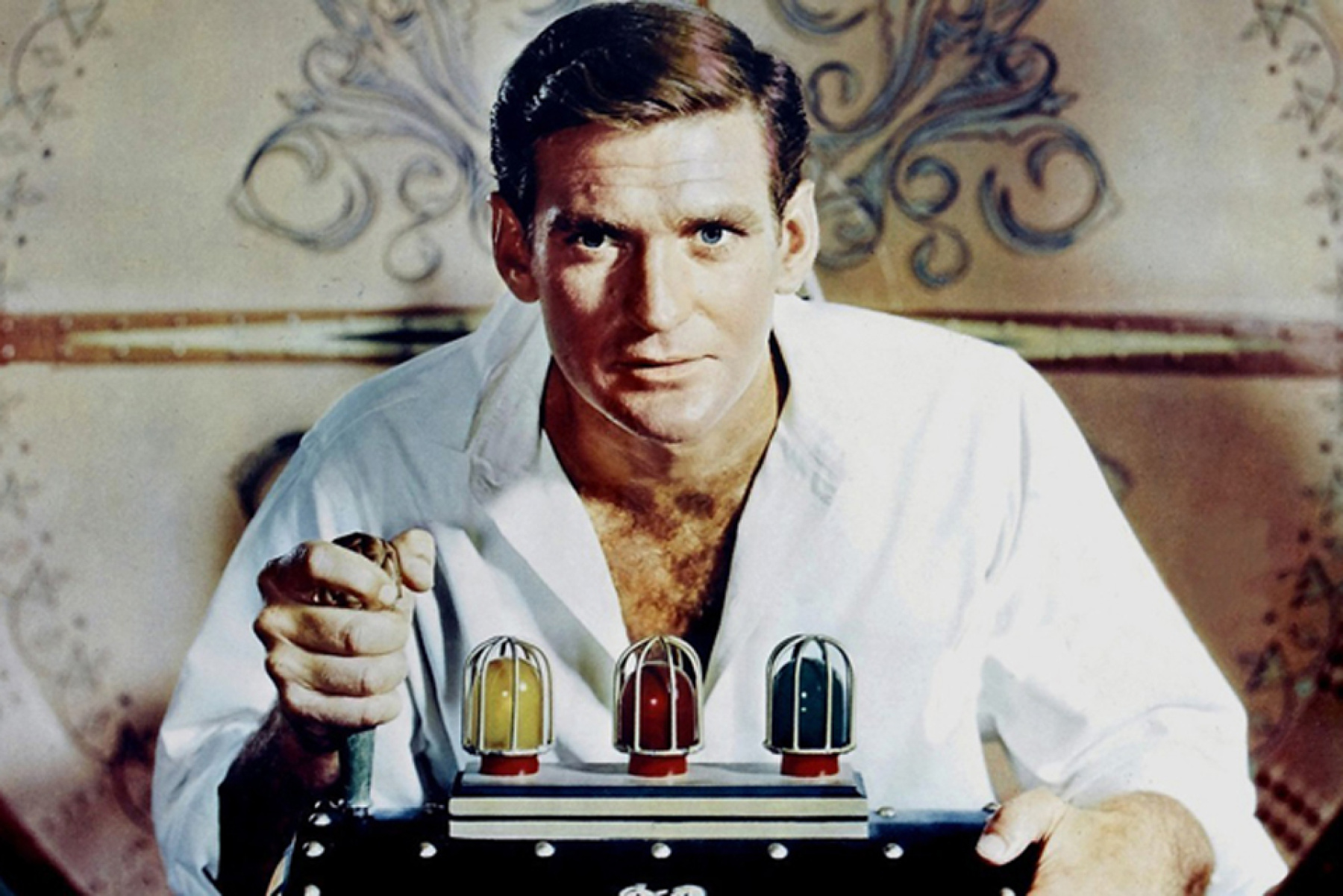
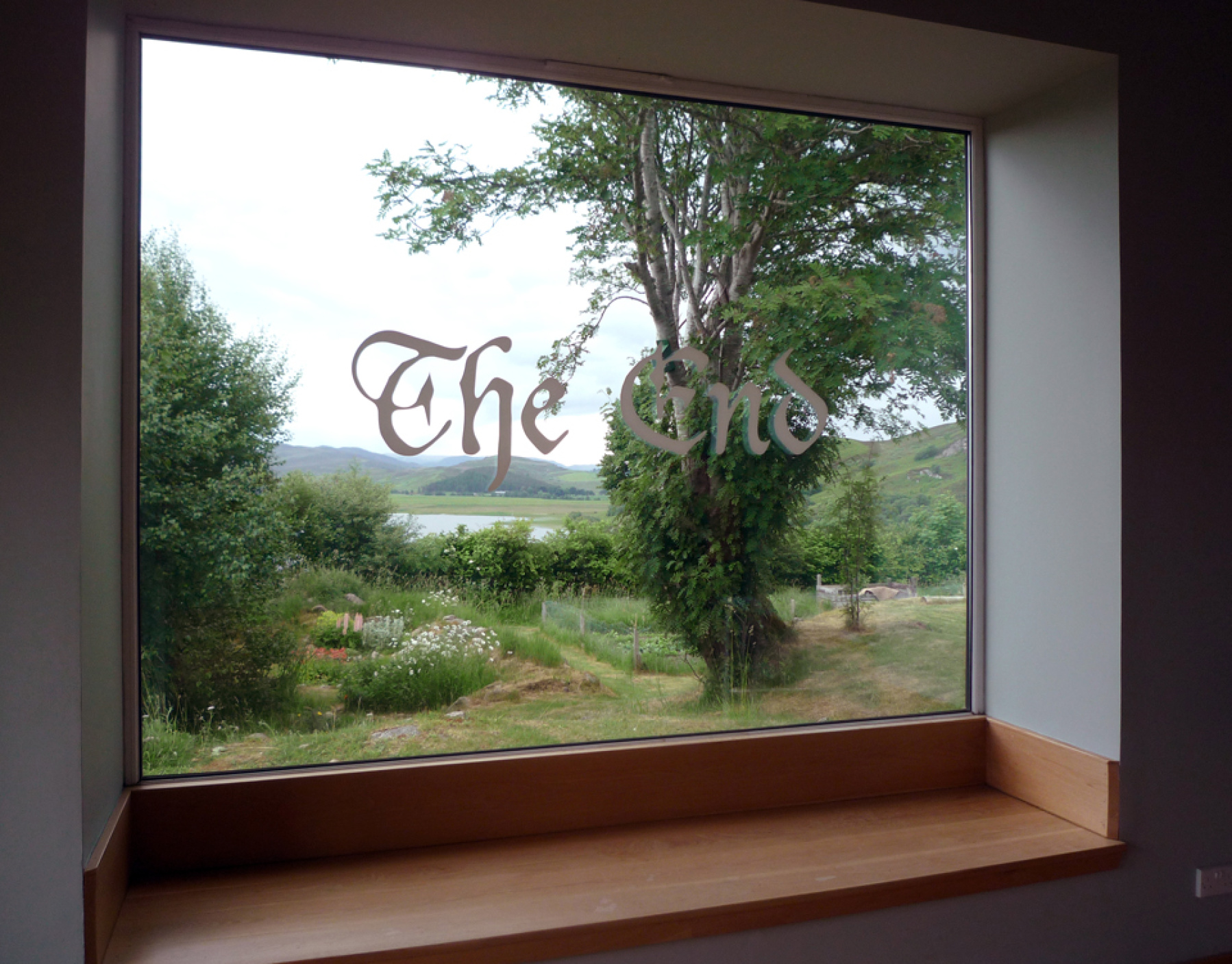
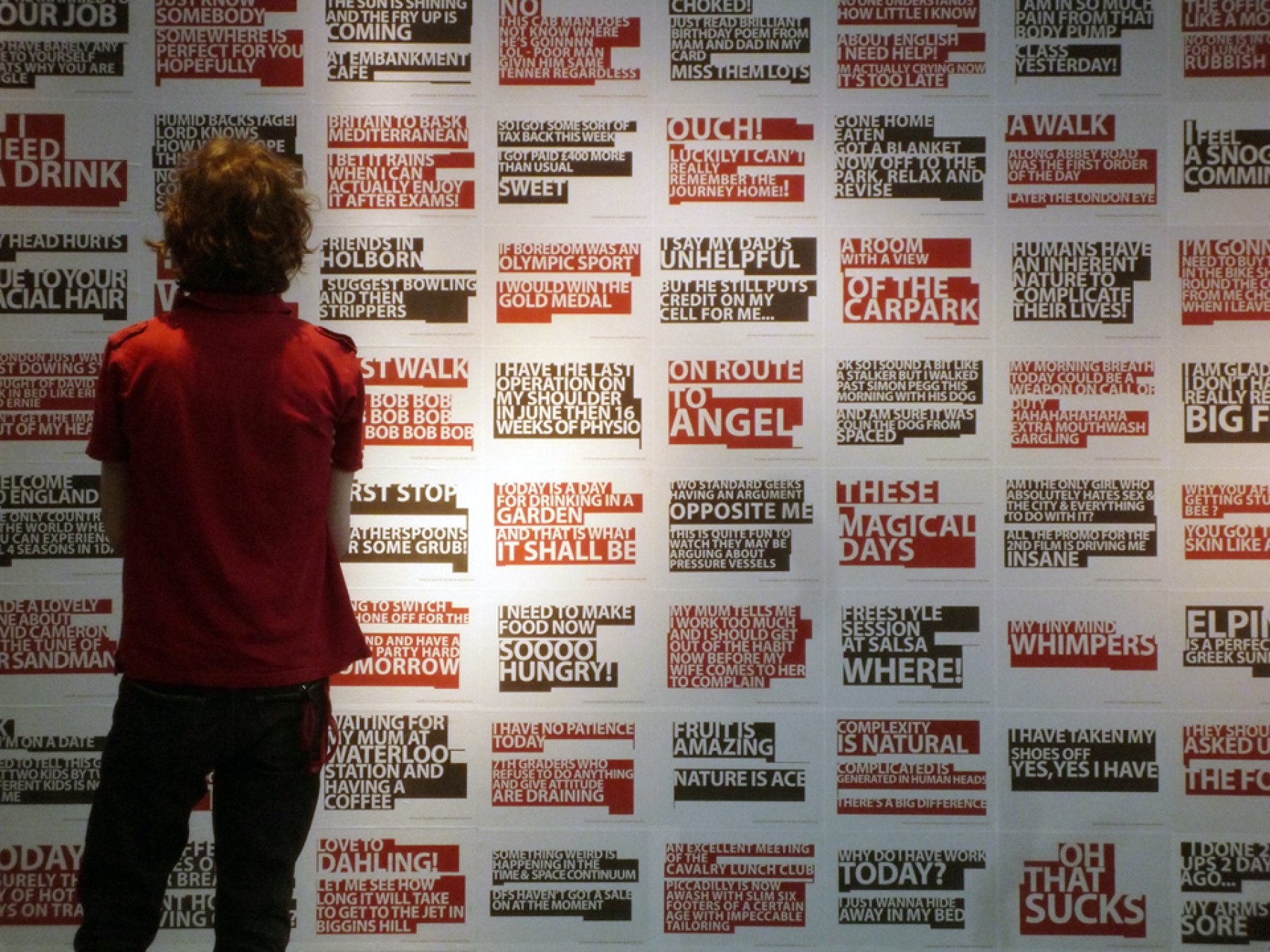
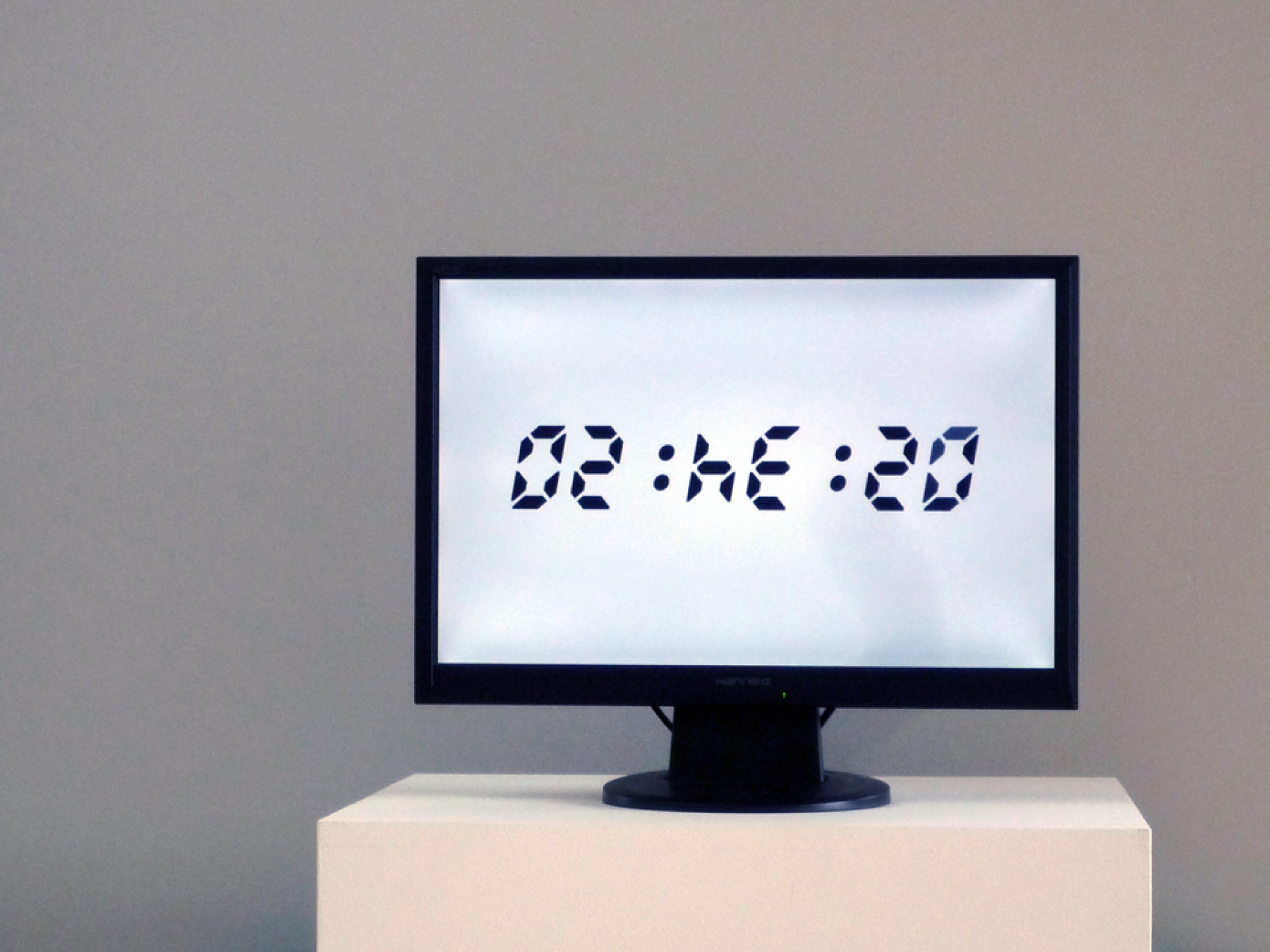
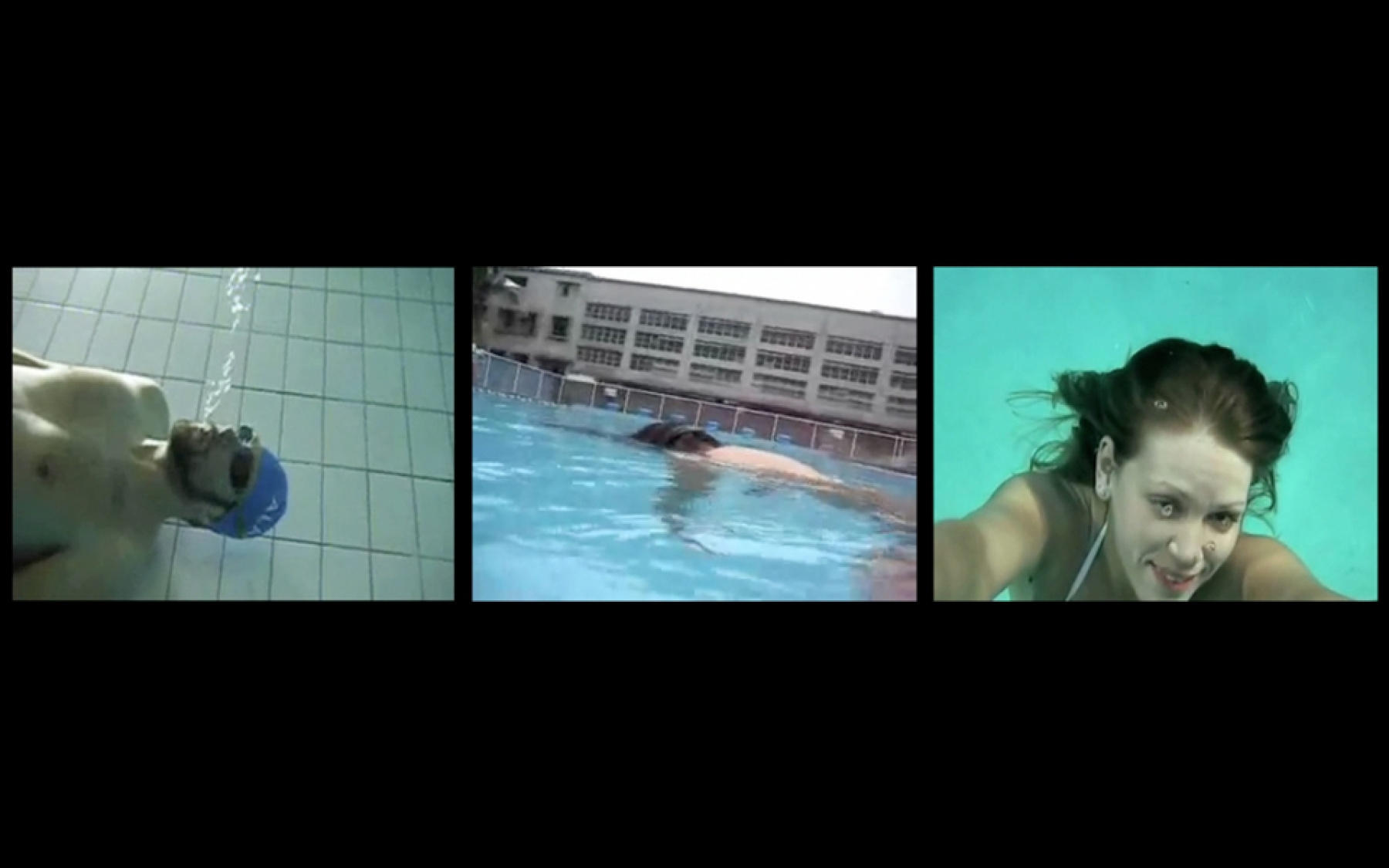
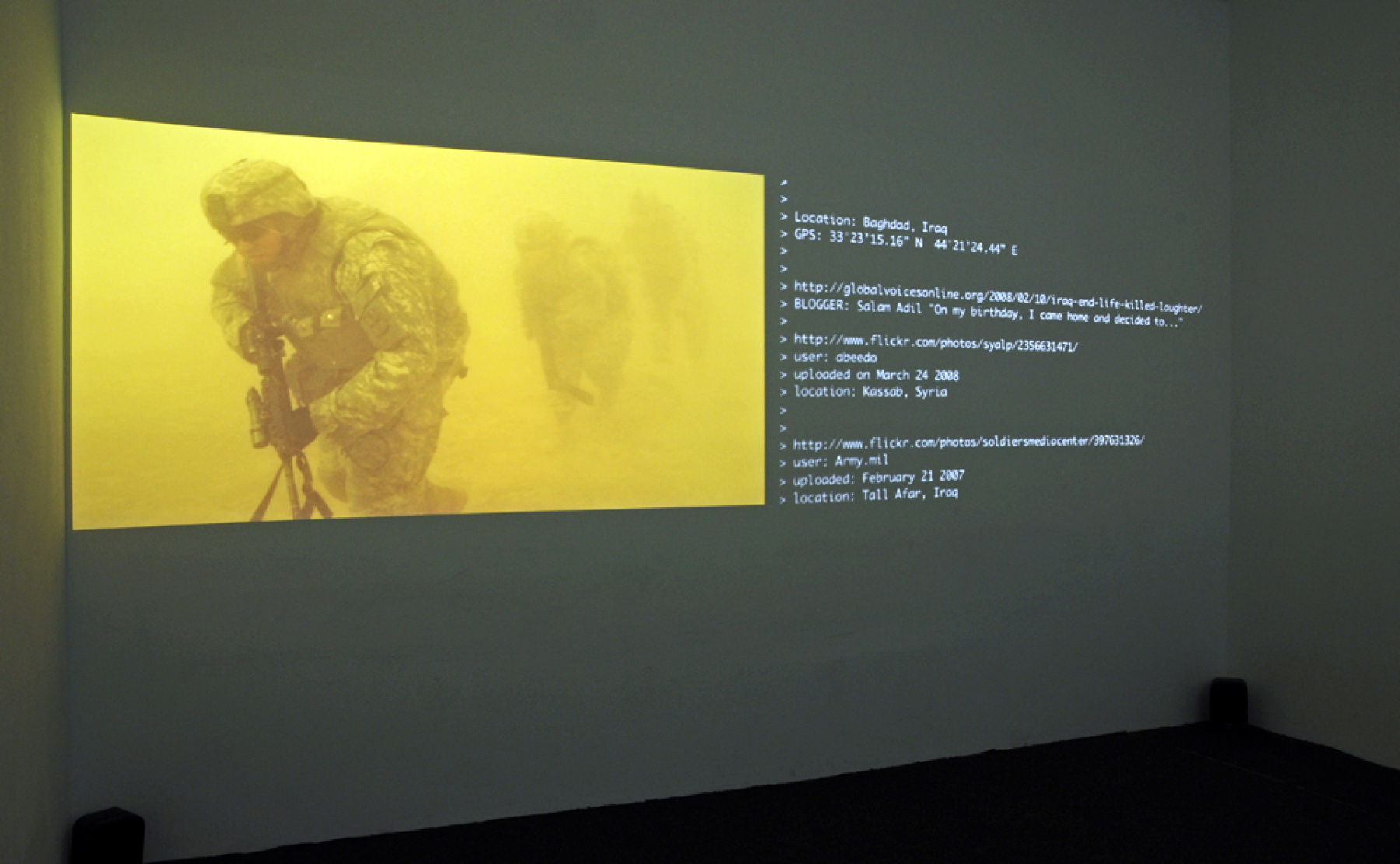
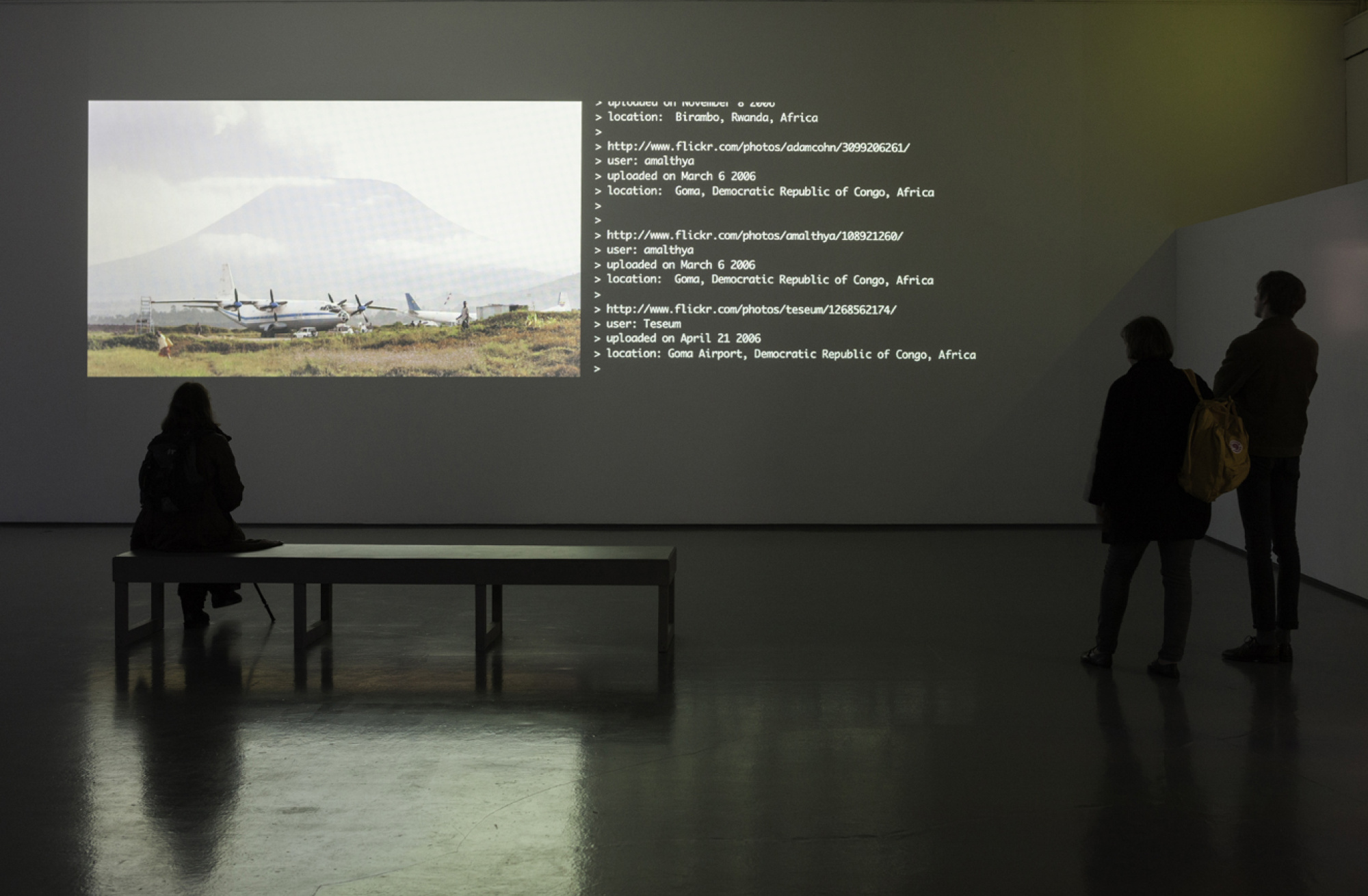
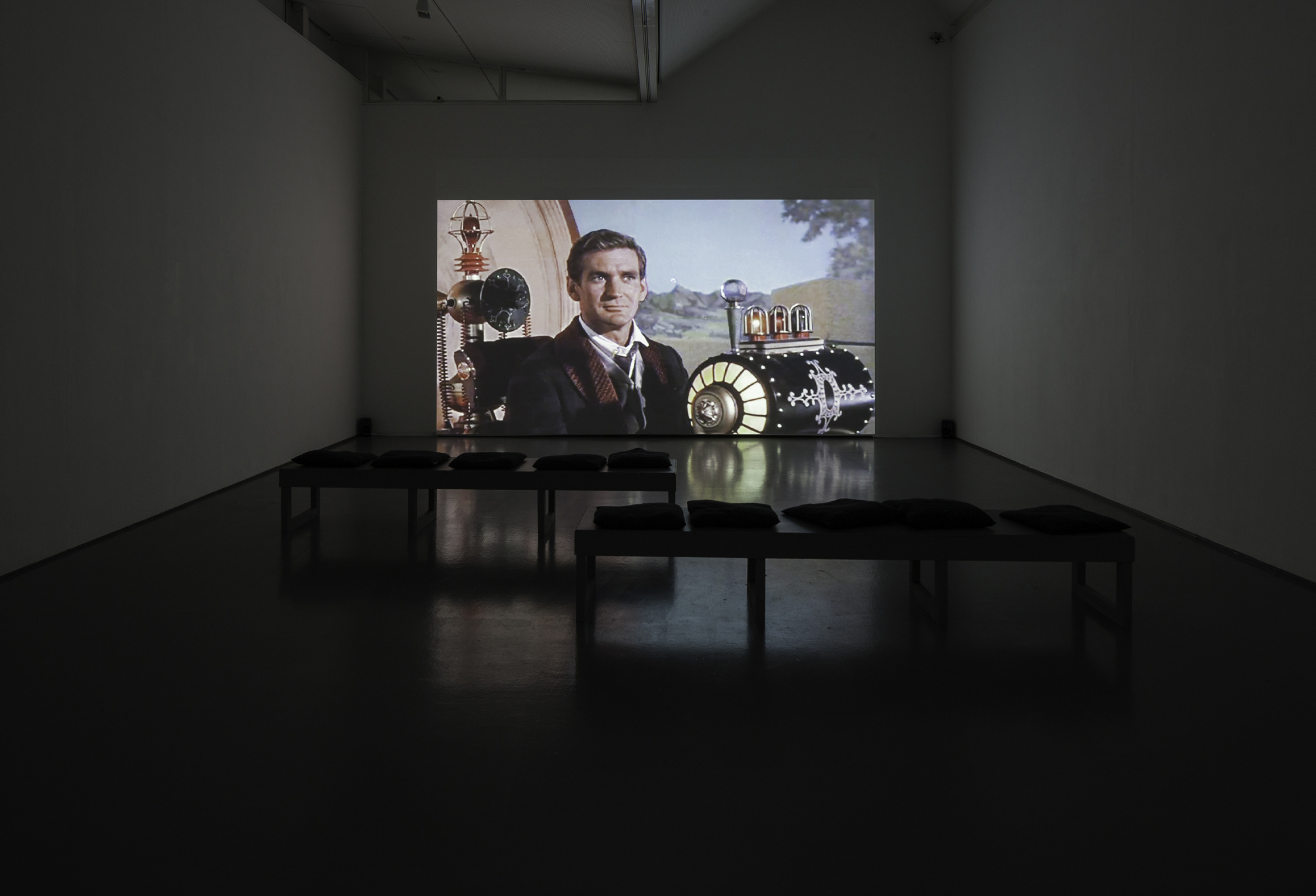
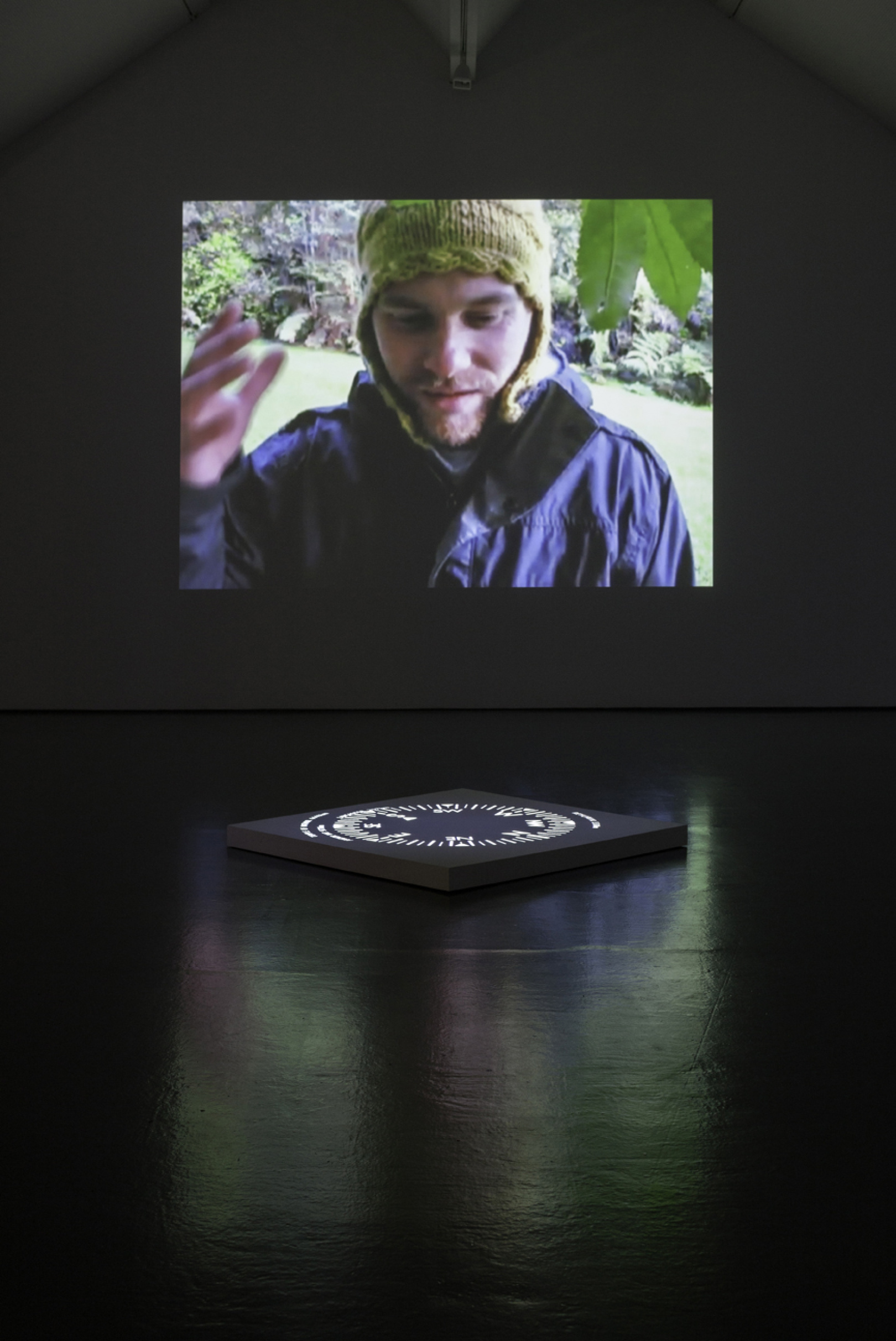
is the final work in the Flat Earth Trilogy following on from Flat Earth (2007) and A short film about War (2009/2010).
Slade School of Fine Art
University College London
Gower Street
London
WC1E 6BT
Biography
Beginning in 1995, Thomson set up The Slade Centre for Electronic Media in Fine Art (SCEMFA) (www.scemfa.org) with Professor Collins bringing together artist-researchers predominantly based at the Slade working digitally on the cutting edge of contemporary art practice. At the same time he began working collaboratively on individual research with Alison Craighead (Reader in Contemporary Art and Visual Culture, University of Westminster and Lecturer in Fine Art at Goldsmiths University of London) under the name Thomson & Craighead (www.thomson-craighead.net). These two working relationships remain at the heart of his research practice to date.
In 2007 Thomson successfully completed an AHRC small grant in the creative and performing arts in collaboration with SCEMFA and the British Film Institute, London. This combined the three principle strands in his research; an interest in using live information as a material component of an artwork; a more general look at the growing relationship between physical and digital space; and how the internet is altering our understanding and interpretation of factual information.
From 2007 – 2012 Thomson built on the work done under this AHRC grant. Working with a number of organisations (Channel 4 Television, Animate Projects, New Media Scotland, and Creative Scotland) he developed Flat Earth Trilogy (thomson-craighead.net/trilogy.html); a series of experimental documentary artworks exploring how the worldwide web is changing our understanding of what a documentary can be.
Then in 2012, he joined the Nuclear Culture research project (http://nuclear.artscatalyst.org) established by Dr Carpenter (Goldsmiths University London): a widely interdisciplinary project hosted by Arts Catalyst London including artists, scientists, activists, and members of the UK’s Nuclear Submarine Dismantling Project Advisory Group set up in 2006 to discuss the decommissioning of our current fleet of nuclear submarines and as such has been highly innovative in combining research with public engagement, knowledge exchange and national policy direction.
This has led them to take up further interdisciplinary research opportunities and in 2014 they were invited to work with computational biologists Professor Barton and Dr Scurch in the eminent School of Life Sciences at the University of Dundee, to develop work using the human genome as an artistic material. This was done with the assistance of a Wellcome Trust award for art (£38,000), an artwork called Stutterer, most recently exhibited at The Sanger Institute near Cambridge.
These last two projects mark a development in his work, which is beginning to consider the impact Big Data is having on society, and how we as individuals can measure our own experience against unfathomably large bodies of information and inhuman timescales.Three monographs on Thomson and Craighead have been published to date; Thomson & Craighead (Film & Video Umbrella); Never Odd Or Even (Carroll/Fletcher Gallery); and Flat Earth (Dundee Contemporary Arts). Their work is written about in a growing number of publications and exhibition catalogues defining the field of media art and contemporary art indicating the relevance of their research to theorists, art historians and curators as they build the critical framework surrounding contemporary art practice after the internet.
Research Interests
Thomson's practice-based research has considered how the development of the internet, in particular the worldwide web, has transformed the way we all perceive the world around us, and how our constant ability to be physically somewhere but virtually anywhere affects our socio-political understanding of the world both as individuals and as societies.
Thomson works as a visual artists working in collaboration with Alison Craighead under the name Thomson & Craighead and has been exhibiting their research widely in galleries and museums across the world in particular in Europe, North America and China.
You can explore their current and past work on their archive website at http://www.thomson-craighead.net or visit their blog at http://thomson-craighead.blogspot.com
Teaching Summary
Thomson is a 0.4 Professor in fine art media working across the school with MA/MFA and PhD students
Exhibitions
Taking the Leap 2019 - PHOTOFAIRS, Shanghai, China
"Taking the Leap is an exhibition of work selected from the University of Salford Art Collection by celebrated independent curator Ying Kwok. The exhibition will take place at PHOTOFAIRS, Shanghai.
Taking the Leap – a brave, risky or challenging move away from one’s comfort zone – is the theme for this exhibition. Curator Ying Kwok, an internationally celebrated Hong Kong independent curator, selected works by artists that are innovative and confident in their creative strategy and design. The theme also aligns with the University of Salford Art Collection’s own leap to diversify the Collection – particularly in relation to Chinese contemporary art and digital art.
For this inaugural exhibition in China we will be exhibiting our first co-commission with Cao Fei (Haze and Fog) and our latest co-commission with multimedia artist Lu Yang. Visitors will be greeted by a site-specific installation by Lu Yang, specially commissioned by the University to accompany a new, unique print The Great Adventure of Material World #1 by the same artist, that will be premiered at PHOTOFAIRS Shanghai before entering the University Art Collection. In a special screening room there will be the opportunity to view Cao Fei’s celebrated Haze and Fog , co-commissioned with the Centre for Chinese Contemporary Art in 2013.
Taking the Leap demonstrates the strong partnerships between the university and arts organisations in the UK – including the installation by Luke Ching, originally co-commissioned for LOOK 17 with Open Eye Gallery in Liverpool, and four prints from Where the City Can’t See project by Liam Young, originally co-commissioned with the AND Festival in 2017. Other digital works include a video by Simon Faithfull, an animation by Sun Xun and lightboxes by Thomson and Craighead based on computer viruses. The collection also regularly works with artists in the North West of England, represented by a large photograph by Manchester based Mishka Henner and a collaborative work by University of Salford alumni Lizzie King working with Technical Demonstrator Craig Tattersall, commissioned in 2015."
Anytime Now 2018 - TENT Rotterdam
Anytime Now focuses on feelings of tension and global instability. The exhibition responds to a ubiquitous feeling of anxiety engendered by the perceived threat of war, terrorism, climate change, social polarisation, and the erosion of the welfare state. The exhibition also questions the feeling that the end of an era is approaching. With impressive images, the artists evoke both a sense of immediate threat and measures of time beyond human comprehension. With the continuous presence of live performers, the inescapable question of humankind’s role forms the heart of this exhibition.
The centerpiece of the exhibition is the theatrical installation Domain of Things by Pedro Gómez-Egaña. On a steel structure, almost two metres above the ground, there is a twilight-lit living room without walls. Half-empty cups, an open laptop, and other details suggest someone’s recent presence. When the house’s wooden floorboards start to slide like tectonic plates, it becomes clear that people have been present all along. Like a machine, tacitly and slowly, they set the construction into motion. Why did these people go underground? To seek shelter from the instability in the world above, or are they part of the very mechanism causing the instability?
For the past nine years, Olphaert den Otter has been producing a relentless stream of images showing catastrophes and natural disasters. These World Stress Paintings depict hurricanes, floods, explosions, plane crashes, and destroyed homes. The images are based on news photos, but they differ in one crucial respect: there are no people, and with that, there is no reference to a specific drama. The more his torrent of images flows, the clearer it becomes that Den Otter is not concerned with exceptional incidents, but with a permanent condition of global chaos. TENT is also presenting a new large-scale painting by Den Otter in which he merges ruined city landscapes, from classical antiquity to Homs in Syria, into a maelstrom of destruction.
Against the ever-present sense of threat and insecurity, Anton Vrede mobilises an ongoing series of symbolic animal figures. In various legends, they are known as ‘tricksters’: archetypal figures who can endure the challenges and dangers of the world with cunning and guile. Across world history, the trickster emerges as a hero of the marginalised and oppressed. The animal figures also function as a symbolic code which allows people to share stories about fooling and undermining power in contexts where open resistance is impossible. For those who know the code, Vrede’s seemingly innocent drawings of the hare, the monkey and other animals form a subtle gesture of defiance. For years, every morning, Vrede sent a trickster drawing via social media into the world as a daily antidote to growing social tensions. At TENT he presents a wall of drawings.
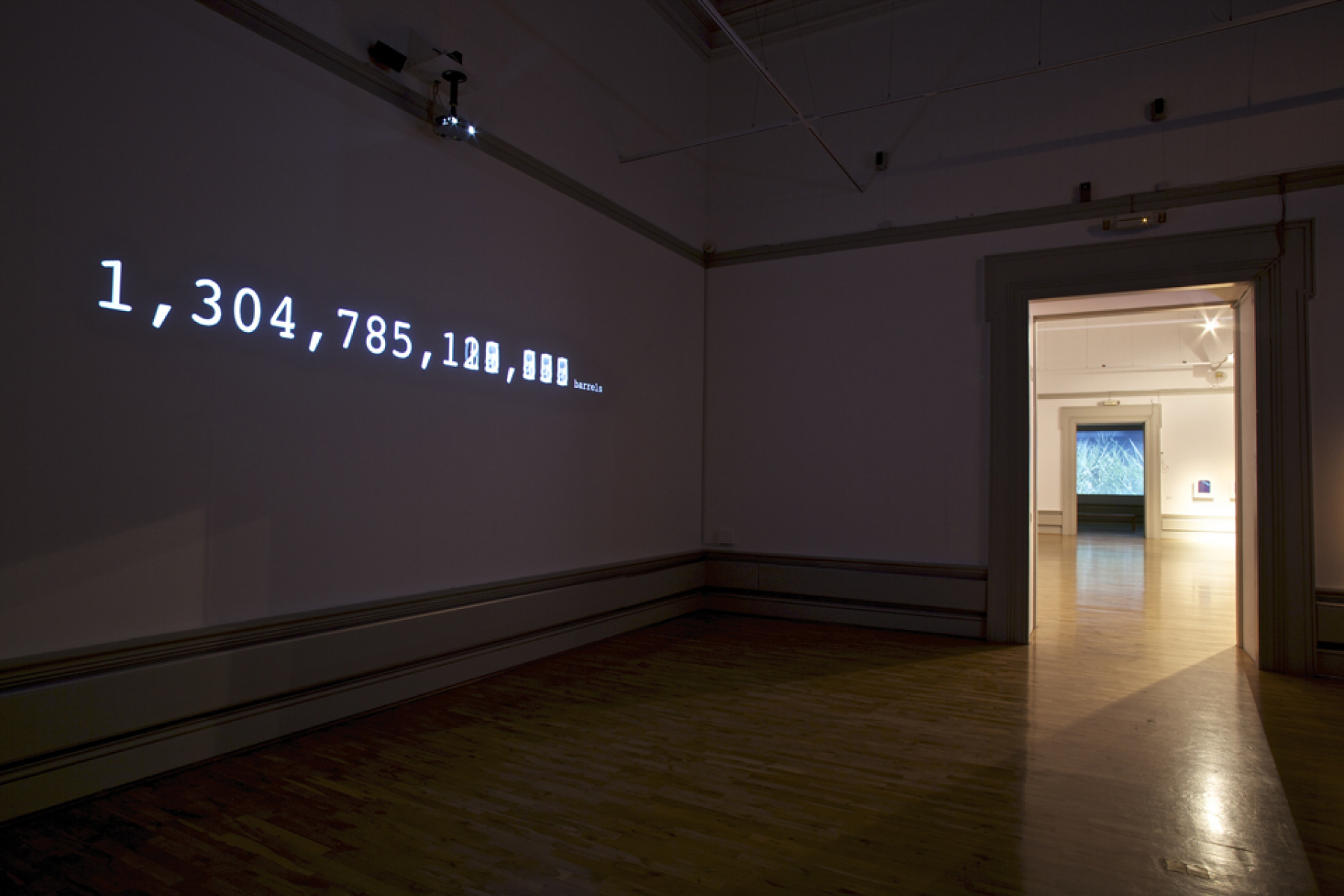
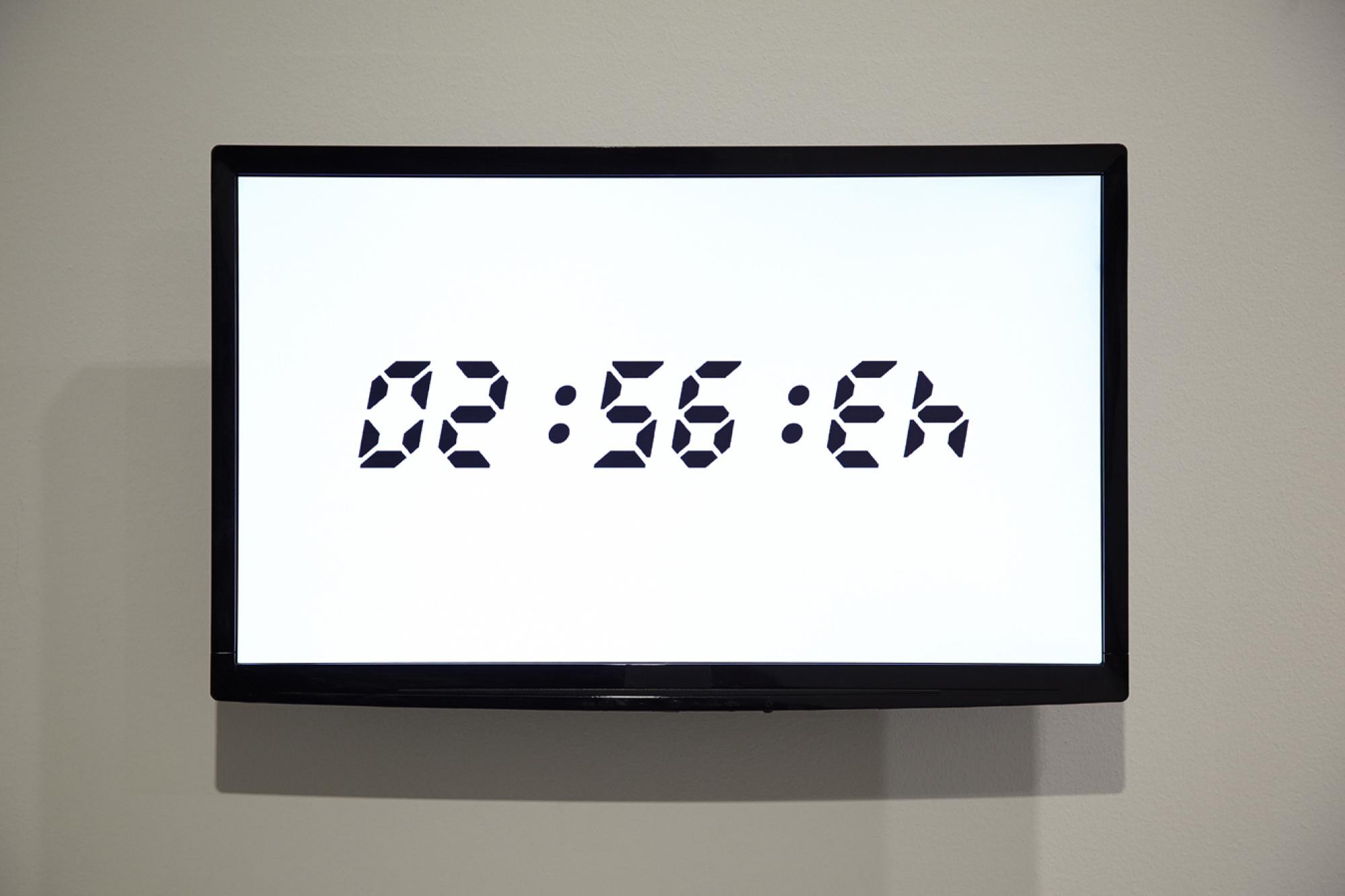
Thomson & Craighead present two works dealing with two profoundly different notions of time, the first beyond and the second within human comprehension. The installation A Temporary Index is a huge clock that counts down in real time to the moment when sites of entombed nuclear waste accross the world become safe for humans. This may take millions of years, a time frame so unimaginable that we relinquish our responsibility. Thomson & Craighead make this inconceivable time span visible using self-designed numerical symbols; signs that may only be understood by future generations. They also present a work based on the ultimate huma
Perpetual Uncertainty - art and radioactivity 2018 - Digital Projection From Online Sources, Table, Chair, Lamp And Folder - Malmö Konstmuseum
Perpetual Uncertainty brings together artists from Europe, Japan and the USA to investigate questions of nuclear technology, radiation and the transmission of knowledge over deep time futures.
The artworks in the exhibition explore how nuclear technology has affected our perception of memory, knowledge and time. How can we understand the long-lived half-lives of radioactive isotopes? How can we communicate to people where our radioactive waste is stored 100 000 years from now? Is it even possible to imagine how the world will look then?
The exhibition gives a contemporary perspective on living in a nuclear economy, just seven years after the accident in Fukushima and 32 years after the disaster in Chernobyl. Today North Korea’s nuclear weapon tests remind us of the threat of nuclear war. At the same time, humans are starting to bury radioactive waste, which must be isolated from the environment for up to a million years.
Artists: James Acord, Shuji Akagi, Lise Autogena and Joshua Portway, Erich Berger and Mari Keto, Nick Crowe and Ian Rawlinson, Don’t Follow the Wind, Finger Pointing Worker, Dave Griffiths, Isao Hashimoto, Erika Kobayashi, David Mabb, Cécile Massart, Eva and Franco Mattes, Yelena Popova, Susan Schuppli, Shimpei Takeda, Kota Takeuchi, Jon Thomson and Alison Craighead, Suzanne Treister, Andy Weir, Robert Williams and Bryan McGovern Wilson, Ken + Julia Yonetani.
Perpetual Uncertainty is produced by Bildmuseet and curated by Ele Carpenter.
The Academy of Saturn 2018 - Solo Exhibition - Cooley Gallery Portland Oregon
The Cooley Gallery is proud to present a solo exhibition by celebrated UK artist-collaborators Jon Thomson & Alison Craighead.
Since the mid-1990s, Thomson & Craighead have explored the visual, statistical, and poetic nature of networked information and its relationship to capitalism, war, and everyday life. The title of the exhibition—The Academy of Saturn—derives from Voltaire’s 1752 novella Micromégas, in which colossal astral travelers from The Academy of Saturn visit earth and engage in a philosophical discussion with a group of scientists. Radical scale shifts of knowledge and comprehension result in an absurd, zero-sum exchange between the species; however, the story is an acerbic parable about the inanity of war and the value of external perspective. With kindred tenacity and wit, Thomson & Craighead explore global information’s competing—and increasingly intertwined—experiences of intimacy and incomprehensibility, touching information to be here now.
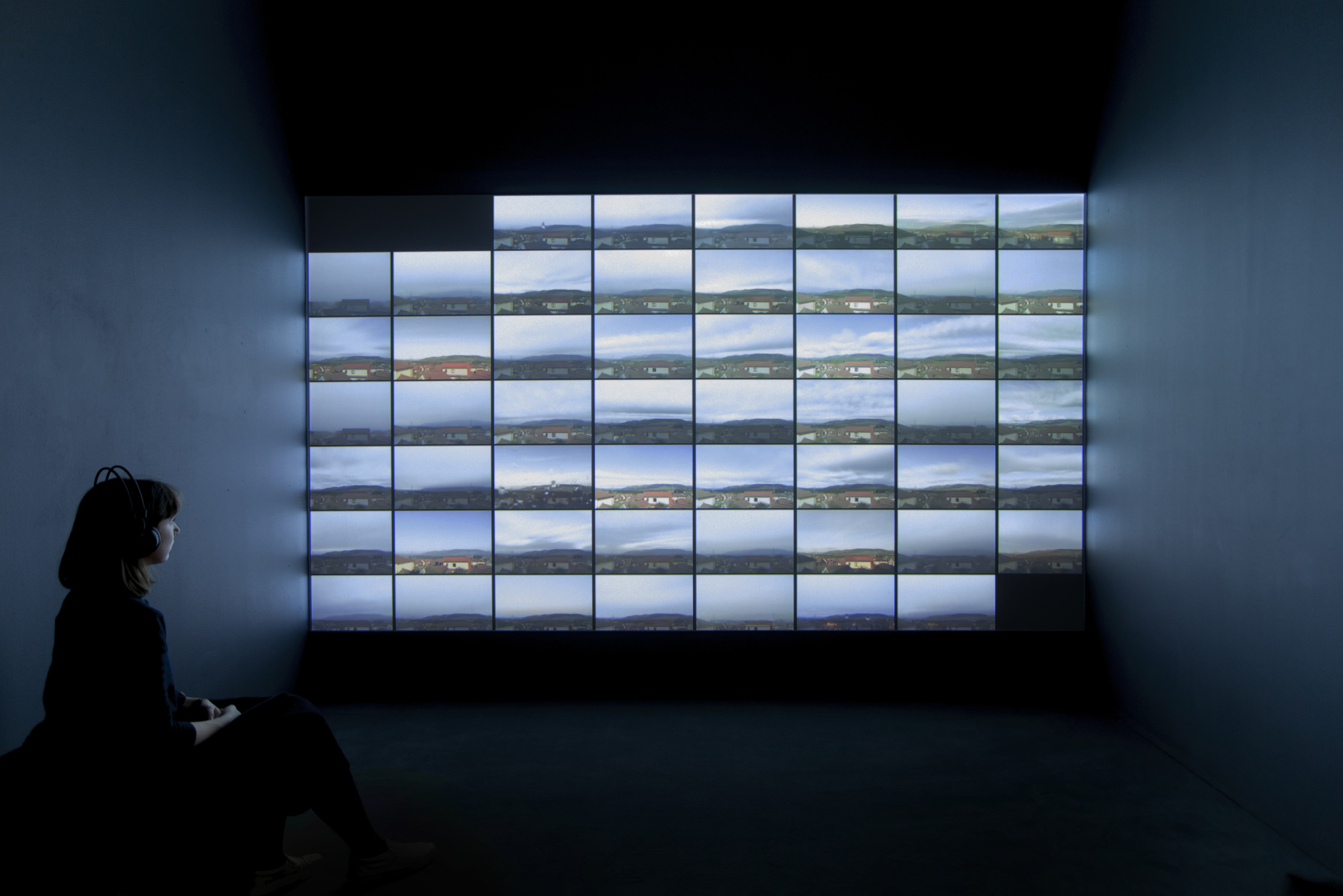
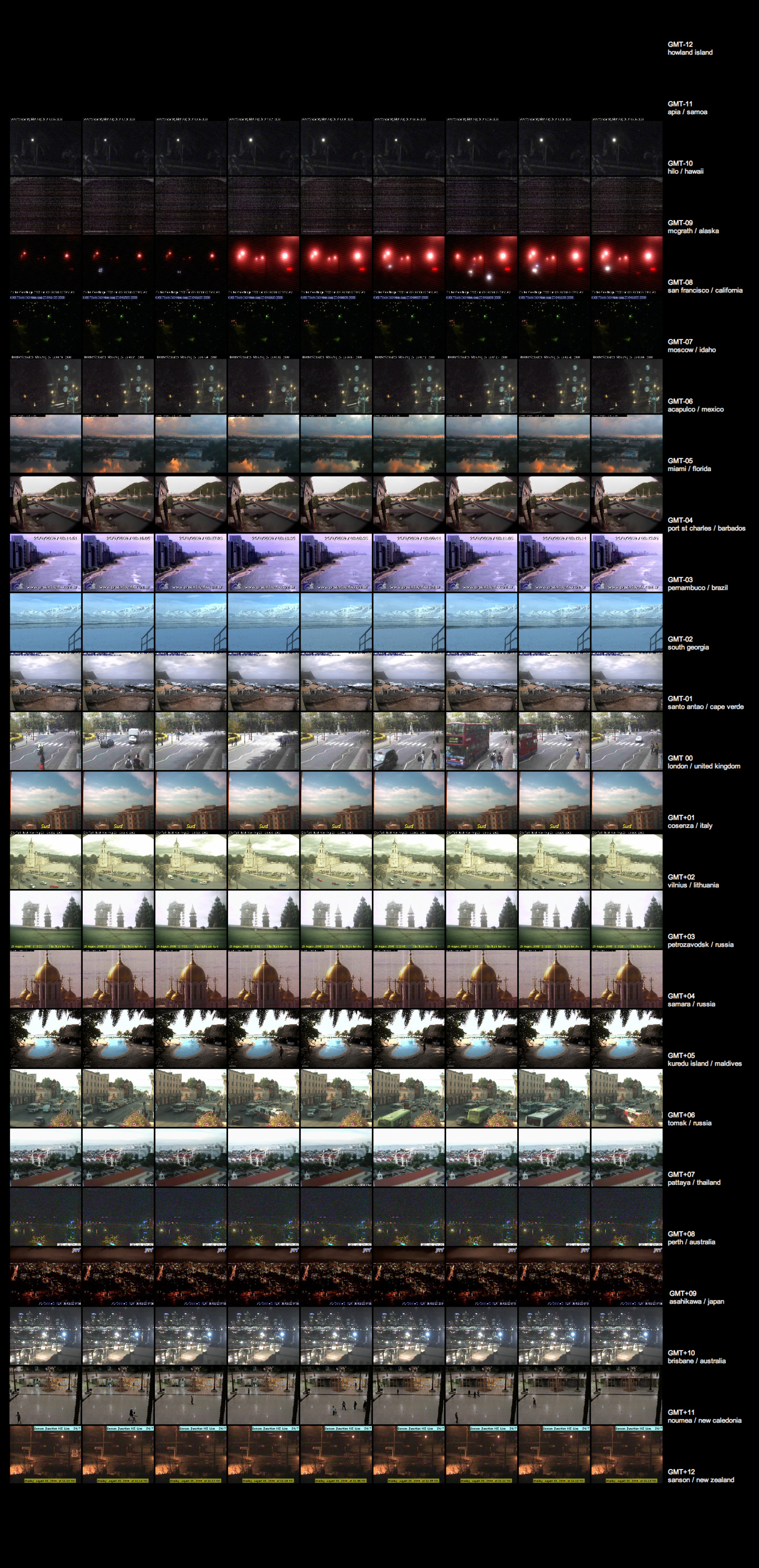
Distillation, order, and observation take different forms throughout the exhibition. The monumental Horizon (2009–present), for instance, comprises a grid of real-time webcam images from every time zone in the world. In Thomson’s words: “The result is a constantly updating array of images that read like a series of movie storyboards, but also as an idiosyncratic global electronic sundial.” As Horizon conjoins time and space in axial form, it amplifies the lyricism of each circadian landscape.
Thomson & Craighead also snare and repurpose networked information in material form, often working with ongoing streams of personal utterance. For The Academy of Saturn, the artists are creating a new iteration of their text-based project London Wall (2010–present), entitled, appropriately, Portland Wall. The work is based on public “status updates” posted on Twitter and Facebook in a three-mile radius from the Cooley. The texts are transformed into graphic posters and installed onto the walls of the gallery, forming a vast meander of endlessly readable concrete poetry—fleeting thoughts, arrested and echoed in their community of origin.
Perhaps the artists’ most alchemical work—Apocalypse (2016)—atomizes the King James Bible’s account of the horrors of the End Times in the form of a luxury perfume (developed in collaboration with Edinburgh perfumer Euan McCall). The project was inspired by Master Bertram von Minden’s fifteenth-century altarpiece depicting forty-five scenes from the Book of Revelations (housed at the Victoria and Albert Museum, London). The artists determined Apocalypse’s olfactory notes by calculating the number of times a given substance, such as “blood” or “flesh,” is mentioned in the text.
Thomson & Craighead’s interest in the found poetry of historical narrative and networked culture speaks to artistic forms such as the Oulipo movement founded in the 1960s. Oulipo artists constructed their work using patterned constraints such as palindromes and the S+7 technique, in which each noun in a text is replaced with the seventh noun that follows it in the dictionary. In Thomson & Craighead’s sculpture Here (2011–present, also produced in a new iteration for the Cooley) a regulation street sign displays the distance the sign exists from itself if pointing in the direction of the North or South pole. Like a palindrome, the work encapsulates its own unidirectional movement: physical geography tuned to the logic of networked space. And in the video installation Control Room
Looking at one thing and thinking of something else (An Exhibition in Four Parts) Part Two: Observations 2017 - Online Sources, HTML And Javascript, Projection, Audio Amplification - Caroll/Fletcher Gallery
Over the course of the last 10 years, I think we have seen the influence of the Internet on media to make everything shorter and more easily consumed. This influence has undoubtedly had an effect on art, including my own art with varying degrees of self awareness. Part of what interests me is the struggle to take more control over my relationship with time.
-- Evan Roth, discussing his Landscapes series
At a time where information is rapidly consumed and instant judgements have become the norm, Part Two: Observations brings together works that encourage close attention and contemplation. Using media as varied as photography, film, online data and sculpture, the works in the second part of Looking at one thing and thinking of something else interrogate our patterns of viewing, seeking to foster new, more sustained modes of engagement in our image-saturated environment.
Natascha Sadr Haghighian’s onco-mickey-catch (2016) uses a new application for image correction to investigate socially, culturally and technologically conditioned conventions of viewing. The application CatchEye uses facial recognition software to align the gaze of users of applications such as Skype, in order to give the impression that each person is looking directly into the camera and making eye contact with the other. Visitors are invited to access the application on two computer monitors embedded in a sculptural form resembling an oversized mouse, a reference to the OncoMouse™ known for being the first patented mammal. onco-mickey-catch calls attention to technologies developed in close connection with military research that have been adapted for commercial purposes, and makes manifest the ever more porous boundaries between the body and technology that inform our modes of relating.
Compression Artifacts (2013), a project by Joshua Citarella, explores how artworks are consumed within today’s model of image production and distribution. In 2013, an exhibition was held in a custom-built structure at an undisclosed location. Citarella describes that the works in the show were curated in such a way as to “anticipate their transmission as images and, as such, have taken on certain characteristics native to graphics editing software.” He explains, “Art objects and exhibition spaces may now be partially fabricated, documented and hyper-realistically transformed into idealistic states whose physical manifestation would reach beyond the material means of their producers. In a universe comprised of images, the ability to create the outward appearance of value becomes a means of empowerment.”
Christine Sun Kim and Thomas Mader’s Tables and Windows (2016) is a playful attempt to provide a new set of visual tools for mapping space and describing objects. Taking as its point of departure the sign language teacher Andreas Costrau's assertion that non-Deaf students often struggle to describe rooms and the objects within them, these two videos show Kim and Mader combining their facial expressions and hand gestures to together sign highly detailed descriptions of a variety of tables and windows.
First uploaded in 2004, Thomson & Craighead’s Template Cinema is a series of low-tech networked short films made from data appropriated in real-time from the world wide web. Each one is comprised of footage from a live webcam paired with a found soundtrack, and framed within the tropes of the cinematic experience. The vista from a surveillance camera on a coastal walkway,
Life Time - Biological Clocks of the Universe 2017 - MU Eindhoven
This exhibition explores different dimensions and scales of time, from the universal to the personal and from the cellular to the geological, even the astronomical. Time can be seen as simultaneously binding us, through heredity, and separating us, by death, across generations. And then at the smallest, quantum scale, time seems to mock us, by behaving illogically and entangling all matter over vast distances.
The arts have long embraced time through forms like video and performance or, in the case of much bio art and design, explored it through birth, growth, rot, decay, and the cycles of whole ecological systems. With many of the works in the exhibition, time and life are examined simultaneously, acknowledging our human limitation of a lifetime, taking stock of our collective impact, and also gazing in awe at the immensity of what has come before and what will, inevitably, follow us all.
Life Time presents the winning projects of the Bio Art and Design Award 2017, developed in collaboration with leading Dutch researchers in the life sciences, alongside several recent works that share a focus on the theme of time. The works reflect on, demonstrate, or even contest advances in life sciences research. They also probe time and life in the realms of the oceans, under the earth, in our minds, and in our cells.
Curator: Angelique Spaninks.
Chairman of the BAD Award and writer of the Life Time essay is William Myers
Participating artists:
Susana Cámara Leret (ES) & Sissel Tolaas (NO), Guo Cheng (CN), Gil Delindro (PT) , Xandra van der Eijk (NL), Noah Hutton (US), Fujita Keisuke (JP), Katie Paterson (UK), Thomson & Craighead (UK), Thomas Thwaites (UK), Wild Vlees (NL), Jiwon Woo (KR), Timo Wright (FI)
Slow Violence 2017 - Video Installation - University of Hertfordshire Arts
UHArts is delighted to host a group exhibition of works by artists Ackroyd & Harvey, Adam Chodzko, Emma Critchley, Ellie Harrison, Tom James, Katie Paterson, Michael Pinsky and Thomson & Craighead to reconsider the prevalent and far-reaching threat of climate change.
We all know that climate change is a reality – we witness extreme weather conditions and acknowledge the scientific data – yet communicating its impact effectively to instigate behavioural change and decision-making is one of the most serious challenges of our time.
This exhibition takes its name and impetus from Rob Nixon’s seminal book ‘Slow Violence and the Environmentalism of the Poor’ (2013) and proposes fresh examinations of climate change through this lens. Nixon proposes we reject the idea of ‘violence’ as explosive, immediate or sensational - features usually associated with climate change - and instead suggests the ‘violence’ of the phenomenon can be localised, durational, unrecognised, even invisible.
Working across film, photography, print and installation, the contributing artists challenge us to rethink the prevailing iconography and headlines. Rejecting melting ice caps and desertification, their visual interpretations introduce alternative narratives and questions, at times bringing them unnervingly close to home.
The Slow Violence exhibition, symposium and other events have been developed collaboratively by UHArts and the Contemporary Arts Practice Group, School of Creative Arts, University of Hertfordshire.
Humansbeingdigital 2017 - Perfume (edition Of 50) - The Lowry
Engaging with art can be an emotional experience - performance, sculpture, painting or music can all touch us beyond words – yet technology is often considered mechanical, cold or inhuman. So how can artists show new perspectives on life, emotion and relationships by using digital technologies to connect human beings and digital?
This exhibition of nine international artists allows you to experience a range of emotional and physical reactions to artwork that explore the links between humans, machines and technology - both now and in the future.
Thom Kubli brings his piece Black Hole Horizon, whilst U_Joo+LimheeYoung use human hair in their surreal work Machine with hair caught in it that gives a feeling of unease. Felix Luque Sanchez, Max Dovey and Libby Heaney use humorous aspects of modern communication in their works which involve emails, Instagram and Tinder respectively, with Dovey’s work using an algorithm to decide if visitors look ‘hipster’ enough to enter his work, A Hipster Bar. The artworks look at ideas about identity, relationships, independence and the absurd side of technology.
Housewives Making Drugs by Mary Maggic and the three individual works Heart, Brain and Lungs by Pascal Haudressy are screen-based pieces that encourage you to think about your own bodies and others, whilst leading digital artists Thomson and Craighead awaken those bodies and senses with their perfume Apocalypse.
Finally, Nye Thompson uses CCTV footage to create a curious environment that asks questions about technology and privacy, contributing a sense of anxiety to an exhibition of many emotions.
humansbeingdigital artists:
U_Joo and Limhee Young; Max Dovey; Thom Kubli; Nye Thompson; Thomson and Craighead; Mary Maggic; Mango Chijo Tree and The Jayder; Pascal Haudressy; Libby Heaney and Felix Luque Sanchez.
ELECTRONIC SUPERHIGHWAY (1966-2016) TOURING 2017 - Museum Art Architecture Technology (MAAT) Lisbon
MAAT brings to Portugal the exhibition Electronic Superhighway, produced by the Whitechapel Gallery, London, in 2016. Electronic Superhighway gathers over one hundred pieces to show the impact of new technologies and the Internet on artists from the mid-1960s until today.
It showcases both new and rarely seen multimedia works, alongside film, painting, sculpture, photography and drawing by over 70 artists, including Cory Arcangel, Judith Barry, James Bridle, Constant Dullaart, Lynn Hershman Leeson, Vera Molnar, Nam June Paik, Thomas Ruff, Hito Steyerl, Amalia Ulman, and more.
The exhibition’s title, Electronic Superhighway, is taken from a term coined in 1974 by South Korean video art pioneer Nam June Paik, who foresaw the potential of global connections through network technology. Arranged in reverse chronological order, Electronic Superhighway begins with works made at the turn of the millennium, and ends with Experiments in Art and Technology (E.A.T.), an iconic event that took place in 1966. Spanning 50 years, from 2016 to 1966, key moments in the history of art and the Internet emerge as the exhibition travels back in time.
PARTICIPATING ARTISTS
Zach Blas, Vuk Ćosić, Douglas Coupland, Joana Hadjithomas and Khalil Joreige, Camille Henrot, Gary Hill, Ann Hirsch, JODI, Allan Kaprow, Oliver Laric, Rafael Lozano-Hemmer, Eva and Franco Mattes, Manfred Mohr, Lillian F. Schwartz, Richard Serra/ Nancy Holt, Taryn Simon, Stan VanDerBeek, Steina and Woody Vasulka, amoung others.
The New Observatory 2017 - FACT, Liverpool, UK
The New Observatory transforms our galleries into an observatory for the 21st century. In collaboration with the Open Data Institute, the exhibition brings together an international group of artists whose work explores new and alternative modes of measuring, predicting, and sensing the world today through data, imagination and other observational methods.
Today we are part of ever growing systems and evolving data infrastructures, which include organisations, algorithms, numbers, facts, governments, machines, and others. Inherent to this is the opportunity for the minutiae of our everyday lives to be watched and tracked. The New Observatory is an open call to everyone to become actively involved in responding to the opportunities and threats this situation demands and to reimagine new possibilities, subjects, and modes of behaviour, in interesting, surprising and sometimes playful ways.
Liverpool has its own unique history of observatories with the Liverpool and Bidston Observatories, which began observations in 1845 and 1867, monitoring natural phenomena from the stars to the sea, creating and using bespoke scientific instruments. Taking this as a key reference point, artists in The New Observatory ingeniously explore how data, devices, and networks once exclusive to scientists are now part of our everyday lives.
The New Observatory responds to the challenges of standardisation in an increasingly technologically-mediated world. It offers a space where the predictability of things is challenged, where logic may fail, and where that failure can create space for new possibilities.
By conjuring new and untold stories, from the personal to the political, micro to macro, abstract numbers are transformed into tactile and immersive artworks: personal health records are metamorphosed into digitally printed seashells, the data of divorce is reassessed, soft robotics visualise the social structures of micro-chipped naked mole rats, open source ground stations trace the constellations of satellites that circle the earth, and animatronic face masks replay covert recordings of NSA employees.
It invites visitors to consider how everyday life is a subject of observation in which we all perform as our own micro-observatories, or ‘observatories of ourselves’. It asks us to reassess our roles as active citizens within a ‘surveillance’ culture, where the infrastructure that surrounds and enables our lives is both physical and digital, and to forge more meaningful, critical or intimate relationships with the data landscapes we inhabit.
Curated by Hannah Redler Hawes (ODI) and Sam Skinner, the exhibition includes interactive works, installations, sound, film, photography, critical design projects, drawing and mixed media. It will be the world premiere of Recruitment Gone Wrong (2016), Divorce Index (2016) and Curtain of Broken Dreams (2016), three new large-scale commissions by internationally renowned British artists Thomson & Craighead and Natasha Caruana, respectively, who were the ODI’s first ever artists in residence in 2015. Other confirmed artists are: Burak Arikan, Wafaa Bilal, James Coupe, Phil Coy, Julie Freeman, Citizen Sense, David Gauthier, Interaction Research Studio, Rachel Jacobs, Jackie Karuti, Kei Kreutler, Libre Space Foundation, Stanza, Liz Orton, Proboscis (Giles Lane and Stefan Kueppers), Jeronimo Voss, and Yu-Chen Wang.
The 3D and 2D design for The New Observatory will be created by Ab Rogers Design.
Thomson & Craighead at Peacock Arts for Look Again Festival 2017 - Peacock Arts, Aberdeen, UK
London based visual artists Jon Thomson and Alison Craighead work across video, sound, sculpture, installation and online space. Through sensitive appropriation of images, texts, and data from online and archived sources, the artists produce generous, lyrical works that both exercise the dramatic conventions of cinema and examine the changing socio-political structures of the information age.
They present a new generative moving image work for Look Again called Control Room alongside two existing artworks, Aberdeen Wall (2010 – 2017) and Here (2013).
I Want I Want! Art and Technology 2017 - Birmingham City Art Gallery, UK
This exhibition features work by artists made over the last 20 years who have all been influenced by the rapid development of technology. The approach of each of the 26 artists and collectives to their practice is different, resulting in a rich and contrasting view of the world and the culture that surrounds us.
The artists have used computer animation, video, computer graphics, audio, photography, drawing and gaming technology to create films, moving image, sculptures, paintings, interactive games and small and large scale drawings. The artworks themselves tackle a range of themes such as human relationships and behaviour, surveillance and the habits of modern society.
The title is inspired by ‘I Want! I Want!’, an etching created by the artist William Blake over two hundred years ago. It depicts a tiny figure standing before a celestial ladder that leads up to the crescent moon. The image acts as a metaphor for humankind’s ability to dream and turn ideas into reality.
Works selected date from the mid-1990s to the present day and are drawn from the Arts Council Collection, Birmingham’s museum collection and other public and private collections.
Artists and collectives include: Daria Martin; Dryden Goodwin; Rachel Maclean; Julian Opie; Brian Griffiths; Stefan Gec; Michael Fullerton; Thomson and Craighead; Cao Fei; John Gerrard; Paul Pfeiffer; Aleksandra Mir; Iain Forsyth and Jane Pollard; Edwin Li; Ryan Gander; William Blake; Ed Atkins; Shezad Dawood; Toby Ziegler; Fiona Rae; Eddy Kamauango Ilunga; Rose Finn-Kelcey; Gary Perkins; Massinissa Selmani; Alan Currall; Marcus Coates; and Clare Strand.
I Want! I Want! is part of the Arts Council Collection National Partnership Programme which sees four major UK galleries working together to curate, host, and share a series of exciting and innovative new exhibitions with works drawn from the Arts Council Collection. The National Partner venues are Birmingham Museums Trust, Walker Art Gallery National Museums Liverpool, Yorkshire Sculpture Park and Towner Gallery, Eastbourne.
Find out more about the Arts Council Collection.
Birmingham Museum and Art Gallery is an Arts Council Collection National Partner .
Arts Council Collection is managed by Southbank Centre, London on behalf of Arts Council England.
I Want! I Want!: Art & Technology is in the Gas Hall at Birmingham Museum and Art Gallery. Please be aware that some of the artworks contain nudity, strong language and difficult content.
Looking at one thing and thinking of something else (An Exhibition in Four Parts) Part Four: Disrupt / Disorder / Display 2017 - Carroll/Fletcher Gallery, London, UK
The final instalment of Carroll / Fletcher’s four-part exhibition draws together works that turn their attention to the systems that govern the art market. In critiquing the ways art is produced, distributed and sold, the artists in the exhibition encourage new modes of thinking and reimagine the ways that art can function in the world.
For Stolen Pieces (1995-97), artists Eva and Franco Mattes worked in secret over a period of two years stealing dozens of fragments from the most respected museums in the United States and Europe. These ‘stolen pieces’ include, for example, a label peeled from Jeff Koons’ equilibrium tank, a length of shoelace from a Claes Oldenburg soft sculpture, a little blob of lead from an installation by Joseph Beuys and a tiny chip of porcelain from Marcel Duchamp’s Fountain. A CCTV screen above the gallery reception desk, shows footage shot with a hidden camera, documenting the artists’ last heist: appropriating a shred from a painting by Alberto Burri. Meanwhile, Catt (2010) is a sculpture based on an Internet meme, deceptively exhibited as artist Maurizio Cattelan’s work at a gallery in Houston, Texas in 2011.
Mishka Henner has described the works in his series Golden Ratio as ‘reducing painting to pure investment value.’ He began the series in 2014 with the $0 painting, and from there the progression of the series follows the Fibonacci sequence, with each successive painting made only once the previous one has sold. The works circulate as a word-of-mouth project only and in that way, reflects the circles in which the artist moves. The first pieces were gifted to close family members or sold to friends. In this way, the series acts as an informal marker of the artist’s worth. For the $10,946 painting, the latest work in the series, Henner mimics the cover design of the influential JRP Ringier series of books of critical writings on art, a reference to how the design of book covers are used to assist in selling ideas. Climbing holds bolted to the surface of the piece allude to the dizzying nature of each price rise at this stage in the series, and the sense of both thrill and risk implicit in the climb. A portfolio showing all the works in the series to date can be viewed behind the gallery reception desk.
Natascha Sadr Haghighian’s I can’t work like this (2007) was first produced in response to a gallery’s invitation to contribute a work for an art fair. Written out solely through the gaps between nails hammered into the wall, her declaration rejects the traditional art object. Instead she presents only the tools for installation used to mount art fair displays, the hammer and nail: symbols of labour itself. With this pointed phrase, the artist expresses her frustrations at the pressures and constraints placed on creative freedoms within a commercial context.
In May 1999, news spread through the art world that the Serbo-Slovenian artist Darko Maver had died in the NATO bombing during the Kosovo War. His death precipitated a string of posthumous exhibitions, including a tribute at the 48th Venice Biennale later that year. A radical and reclusive artist, Maver was best known for his life-size sculptures of murder victims, which he positioned in abandoned buildings and hotel rooms, seeking to draw media attention to the brutality of the war in the Balkans. The models were so gruesomely realistic that it is said they shocked and horrified the people who found them. In fact, it later emerged that no
Wake me up when it's over 2017 - Young Projects Gallery, West Hollywood, Los Angeles, USA
Young Projects is pleased to present Wake Me Up When It’s Over by the UK duo, Thomson & Craighead, who have shown extensively at galleries, museums and film-festivals worldwide. The exhibition will feature nearly a dozen works spanning the years 1996-2016, thereby presenting an in-depth look into the couple’s practice and methodologies.
For the better part of the past two decades Jon Thomson and Alison Craighead have been “digging deep,” as curator Marc Garrett once described their practice, “into the algorithmic phenomena of our networked society; its conditions and protocols (architecture of the Internet) and the non-ending terror of the spectacle as a mediated life.”
In the process they've employed web cams, data feeds, networks, movies, images, sound and text in their many installations, videos and art-objects--often with a wide array of art-historical reference points, including 1960s systems art, 1970s structuralist film-making, and the compositional experiments of the literature group, Oulipo.
Of course, given their interest in the ever-shifting world of the digital, their work can also be as sardonic and menacing as our daily news feed might suggest. Terrorism, dystopia, the apocalypse, the loss of privacy, police states, political apathy, radioactive waste, fear mongering and the self-help industry are common targets for the artists. However, in each case, such works can also convey a wry sense-of-humor and a well-honed critical distance. Apocalypse 2016 for instance, (pictured above), which will be featured in Wake Me Up When It’s Over, is a professionally made perfume that captures the odor of the ‘end of times’ as described in the Book of Revelation. "[It's] the nasal equivalent of a subsonic frequency," wrote critic Nell Frizzell after his encounter with the scent. [It's] doom, in sprayable, wearable, purchasable form.”
Other writers, such as Eddy Frankel, have written similarly of Thomson & Craighead. “There’s a chance you’ll feel like [the artists] have a direct line into your neuroses,” he wrote upon exiting one of their exhibitions; “or at the least have been monitoring your emails or something, because it all taps so perfectly into contemporary anxiety. It’s almost too real. This is aggressive, angsty art that really sticks in your throat.”
Perhaps, but one would also be hard-pressed to overlook the obvious compassion and implicit optimism that is also apparent in much of their work. Video-based projects such as Belief, A Short Film About War, and Help Yourself for example, give tactile form to an astonishing array of anonymous, disembodied voices that pervade the internet—voices that often convey the alienation, loneliness and quiet supplication that tends to dominate online life. By doing so, the artists not only celebrate and delight in the so-called 'promise' of technology, but “tell us about a networked society's gaze at its mediated self,” as Garrett has written. For writers such as Baudrillard, Postman and Eco that kind of self-reflexiveness was the very definition of hyperreality, which they dubbed the information age. “But,” as Garrett continues, “if we add a contemporary flavor to what hyperreality looks like now in a networked society we come up with hyper-mediality.”
Wake Me Up When It’s Over is just that: a taste of hyper-mediality in all its strange, woeful and endlessly beguiling glory.
Realtime (touring) 2017 - Lo Pati Centre D'Art Terres de L'Ebre, Amposta, Spain
L'exposició, produïda per Arts Santa Mònica, viatja a Amposta gràcies al Programa d’exposicions itinerants del Departament de Cultura
En la nostra societat accelerada, lo temps esdevé una preocupació principal a mesura que intentem mantenir-nos al corrent dels grans esdeveniments que tenen lloc a escala global, intentem ser competitius fent més en menys temps, i vivim en un estat de connexió permanent. Lo terme “realtime” (temps real) s'ha convertit en un terme d'ús comú que fa referència a qualsevol procés que es produix de forma sincronitzada amb lo temps de l'usuari, al fer de “ser allà” i “ser present” en una era que no permet lo més mínim retard en la reacció.
Lo terme “realtime” (temps real), provinent de la informàtica, s'ha convertit en un terme d'ús comú: sovint fa referència, no només a la computació reactiva, sinó també a qualsevol procés que es produix de forma sincronitzada amb lo temps de l'usuari, al fer de “ser allà” i “ser present” en una era que no permet lo més mínim retard en la reacció.
En lo món de l'art, lo temps és un element crucial en un fet sovint ignorat: la duració de la contemplació de l'obra d'art per part de l'espectador. Com indica Boris Groys, mentre que en los mitjans tradicionals lo temps necessari per a la contemplació és determinat per l'usuari, l'art basat en processos temporals (nous mitjans i performance) passa este control a l'obra. Hi ha, així, un temps de l'obra al qual l'espectador ha d'adaptar el seu propi temps. En la majoria de les obres de cinema i video, lo temps de la ficció se comprimix per a permetre a l'espectador observar els esdeveniments que tindrien lloc durant un llarg període de temps en uns pocs minuts. Però, què succeix quan una obra d'art té lloc en “temps real”, desenvolupant la seua història al llarg de diverses hores, mesos o dècades?
Comissariada per Pau Waelder, Real time. Art en temps real és una exposició col·lectiva que explora l'ús del temps en l'art contemporani presentant una selecció d'obres d'art en les quals lo concepte de “temps real” té un paper principal, ja sigue pel qüestionament de la relativitat del temps, l'ús de dades extretes en temps real d'Internet o per la seua intenció de crear una visió actual, “realista” i sempre canviant del temps en què vivim. Amb obres de Guillem Bayo, Clara Boj i Diego Díaz, Martin John Callanan, Thierry Fournier, Nicolas Maigret, Antoine Schmitt, Thomson and Craighead, Addie Wagenknecht i Carlo Zanni, algunes de les peces seleccionades se nodrixen de la informació que apareix constantment als mitjans de comunicació, mentre altres extreuen dades de diferents fonts, establixen un procés de producció en temps real o bé proposen un qüestionament de la nostra manera de mesurar el temps i relacionar-nos amb lo present. Les tecnologies que utilitzem actualment en la nostra vida quotidiana tenen un paper principal en estes peces, portant estes reflexions sobre el temps a un àmbit molt proper al públic, que en alguns casos pot interactuar amb l'obra i en d'altres ho fa sense saber-ho.
Descarregueu lo llibret al link de l'esquerra, amb tota la informació dels artistes i les peces presentades. La inauguració de l'exposició serà el divendres 27 de gener a les 20:00h.
Glut: Images, Information and Excess 2017 - Holden Gallery, Manchester, UK
Our relationship to the image and the way in which information is captured has changed substantially in recent years. The number of images we encounter on a daily basis has continued to rise ever more steeply, there are now over one and a half billion images uploaded every day. We also appear frequently on surveillance images, with the UK reported to have in excess of 6 million CCTV cameras.
In the midst of this unprecedented growth, Glut focuses on the work of a range of artists who are all making creative use of this new situation. The work takes in themes of (in)visibility, surveillance, data gathering and appropriation. Some of the works start with the idea of piecing together material taken from diverse sources in order to produce something new. Other works are more concerned with the world of watching and the exertion of control. All of the work looks at the different ways in which we exist in the midst of a world teeming with images.
Looking at one thing and thinking of something else (An Exhibition in Four Parts) Part Three: United We Stand 2017 - Carroll/Fletcher Gallery, London, UK
In the wake of Brexit, Donald J. Trump's election as President of the United States, and the ongoing refugee crisis, 2016 could be described as the year the outside world crashed in on contemporary art. In such uncertainty, the role of the artist seems more urgent than ever. United We Stand, the third part of Looking at one thing and thinking of something else, brings together works that aren't afraid to intervene in the political. From the poetic to the absurd, the exhibition presents a variety of creative and critical approaches to resistance and the reimagining of a shared future.
Eva and Franco Mattes' film poster United We Stand (2005) advertises a fictitious, Hollywood-style blockbuster in which Europe, not the USA, saves the world from impending doom. The film synopsis explains that in the year 2020 the USA has declared war on China. 'The European president calls for the intervention of a special Task Force of five highly trained individuals known only as the English (Ewan MacGregor), the Spanish (Penelope Cruz), the German, the Italian and the French agents. Their mission: to work behind the scenes to resolve the international crisis before it's too late.' Today, with increasingly uncertain Sino-US relations and the growing prospect of a new Cold War, America's status as the world's policeman sits on shaky ground. Whilst the Mattes spotlight and satirise the precarious nature of power blocs, they envision the 'European Project' as overseeing the reinstitution of global order, all the more pertinent in light of recent events.
UBERMORGEN's [V]ote-Auction (2000) was a website launched for the 2000 presidential election, allowing US citizens to sell their vote to the highest bidder. Intervening in the electoral contest between Al Gore and George W. Bush, the work unleashed a storm of outrage with several states issuing temporary restraining orders or injunctions for alleged illegal vote trading. Moreover, federal attorney Janet Reno, the FBI and the NSA launched dedicated investigations to ensure the integrity of the voting process, issuing injunctions that amounted to 700 kg of legal documents. Ultimately, the website precipitated over 2500 national and international news features across print, television, radio and online media, including a 27-minute episode of CNN's 'Burden of Proof' devoted exclusively to the work. The artists' incendiary mode of 'media hacking' had the wry ambition of 'bringing capitalism and democracy closer together', a premonition that one might argue is being borne out today with the election of Donald J. Trump.
Likewise, Rafael Lozano-Hemmer's Level of Confidence (2015) also seeks to intervene in current events but to very different ends. The work acts as a poetic memorial to the 43 students from the Ayotzinapa school in Iguala, Guerrero, Mexico who were kidnapped and likely murdered in 2014. Facial recognition technology is trained to tirelessly seek the faces of the disappeared students in those of exhibition visitors. As you stand in front of the camera, the system calculates which student's facial features most resemble your own, and offers a percentage 'level of confidence' for the accuracy of the match. The technology incorporates the same biometric surveillance algorithms that military and police forces would use to look for suspicious individuals, but re-orients them to search for victims instead. In this endlessly thwarted search for the missing students, the work serves as a profound
Monsters of the Machine 2016 - Laboral Centro de Arte y Creación Industrial
Monsters of the Machine is a contemporary take on Mary Shelley’s Frankenstein and asks us to reconsider her warning, that scientific imagining and all technologies have unintended and dramatic consequences for the world. It also invites us to ask the same about the arts and human imagination. Shelley’s classic, gothic horror and science fiction novel, has inspired millions since it was written 200 years ago in 1816, and then published anonymously in London in 1818. It offers a lens through which to look at the practices of arts and sciences today and how they shape society’s relationship with technology.
Dr. Frankenstein plays the role of the Promethean scientist, a creative genius, and also a narcissist tangled up in his own individual desires, exploiting others in an irresponsible and abusive drive to control nature. However, who is the real monster? Dr. Frankenstein or the poor wretched mutant he brought to life? Are we Dr. Frankenstein, or the suffering mutant, or both? This question posed by the exhibition considers the roles of our arts and science traditions and examines these issues as part of everyday life; as they are played out in the anthropocene, and climate change, gender politics, ethics, governance, surveillance, posthumanism, transhumanism, hacking, biohacking, colonialism, neoliberalism, biopolitics and accelerationism.
In this exhibition, visitors can experience artworks in which the human genome is used as the basis for a poetry machine for a self-assembling video montage spanning the thirteen years - a memorial work and an algorithmic visualisation for an historic scientific landmark. 3d printed avatars, representing distorted bodies in pain, in relation to virtual worlds, where there's no geography and the result is the crack / wound, everywhere and nowhere. Visitors participate in a software-driven installation, a performative social neuroscience experiment to discover our shared psychological biases. A surreal video installation shows us a dystopian blend of ‘reality’ out in the remote Australian desert with traditional ghost stories and dreamtime stories, mixed with science fiction. The Sahara Desert is remapped by a custom bot in an algorithmically scripted performance, traversing the data-scape of Google Maps and filling a Tumblr blog and its data-centres. Artists take our bio-matter and the inconceivable quantities of data which we generate in our daily lives as materials with an inherent recombinant intelligence and the power to generate (without the intervention of human will) the narratives of human destiny and more. Do we inhabit our own bodies anymore, or do we share our body materials out for others to measure, reshape and construct, data-scrape and manage remotely. Arthur Kroker in Body Drift: Butler, Hayles, Haraway says that, “we no longer inhabit a body in any meaningful sense of the term but rather occupy a multiplicity of bodies – imaginary, sexualized, disciplined, gendered, laboring technologically augmented bodies.” [2]
Artists and scientists work with the same tools, frameworks and archetypes. There are crossovers, it’s no surprise that we find the boundaries of imaginative fantasy and objective reality breaking down. Take for instance, the jellyfish invasions around nuclear reactors in Japan, Israel, Sweden, and the Scottish plant in Torness. The natural world is writing its own science fiction into a new reality, with vivid images and outlandish outcomes. Right now, the classic techno-uto
Tecnologies de la violència 2016 - Arts Santa Monica, Barcelona, Spain
TECHNOLOGIES OF VIOLENCE explores the critical relations between art and the contemporary production of violence and the digital technologies, as well as the techniques that power uses to impose itself through violence.
Technology, as a system used to organise, service and control power, finds, in its machines, in Internet and electronic systems, tools for world dominance that, after World War Two and during the Cold War, led to the emergence of a “new era in political security”, according to Ralf Fücks, director of Heinrich-Böll-Stiftung, in a publication entitled Hich-Tech-Kriege (High-Tech Wars).
Control of the air and cyberspace and “control of terror”, identified by theorists like Peter Sloterdijk, Marc Augé, Jutta Weber, Herfried Münkler, Constanze Kurz and Paul Virilio, is the goal of the great powers, including governments, companies and terrorist groups, which use sophisticated technology to establish their war zones, generate chaos and seize local and global dominance: anonymous, remote controlled killing by electronic operations; advanced development of cameras, drones and sensors; autonomous computer combat systems; satellite surveillance; and preventive security policies, police control, the killing and forced displacement of people.
TECHNOLOGIES OF VIOLENCE meditates on the shape that violence takes in the collective imagination, on the iconography and symbology of the media and entertainment industry, and the different ways in which the war industry produces, consumes and uses images (cartoons, video games, software and so on). Moreover, taking up the ideas of Foucault, Achille Mbembe and Subhabrata Banerjee about biopolitics, “necropolitics” and “necrocapitalism” as a global system of death production, the exhibition also looks at the forms of insubordination that artists have worked on since the 2000s, as well as the so-called GWOT (Global War on Terrorism) and the implosion of the neocapitalist system after the failure of the great systems of ideological “redemption”.
Participating artists:
PEGGY AHWESH
MAJA BAJEVIC
ALICIA FRAMIS
REGINA JOSÉ GALINDO
MARIAM GHANI
ELNAZ JAVANI
ENRIC MAURÍ
TIM PARCHIKOV
PAOLO PEDERCINI
MOLLEINDUSTRIA
LARISSA SANSOUR
SEAN SNYDER
EDDO STERN
THOMSON & CRAIGHEAD
ZHOU XIAO HU
Stutterer 2016 - Two Channel Digital Installation - The Sanger Institute, Wellcome Genome Campus, Cambridge
An instructional artwork, a poetry machine playing the human genome like a musical score. Cultural Zone, Wellcome Genome Campus
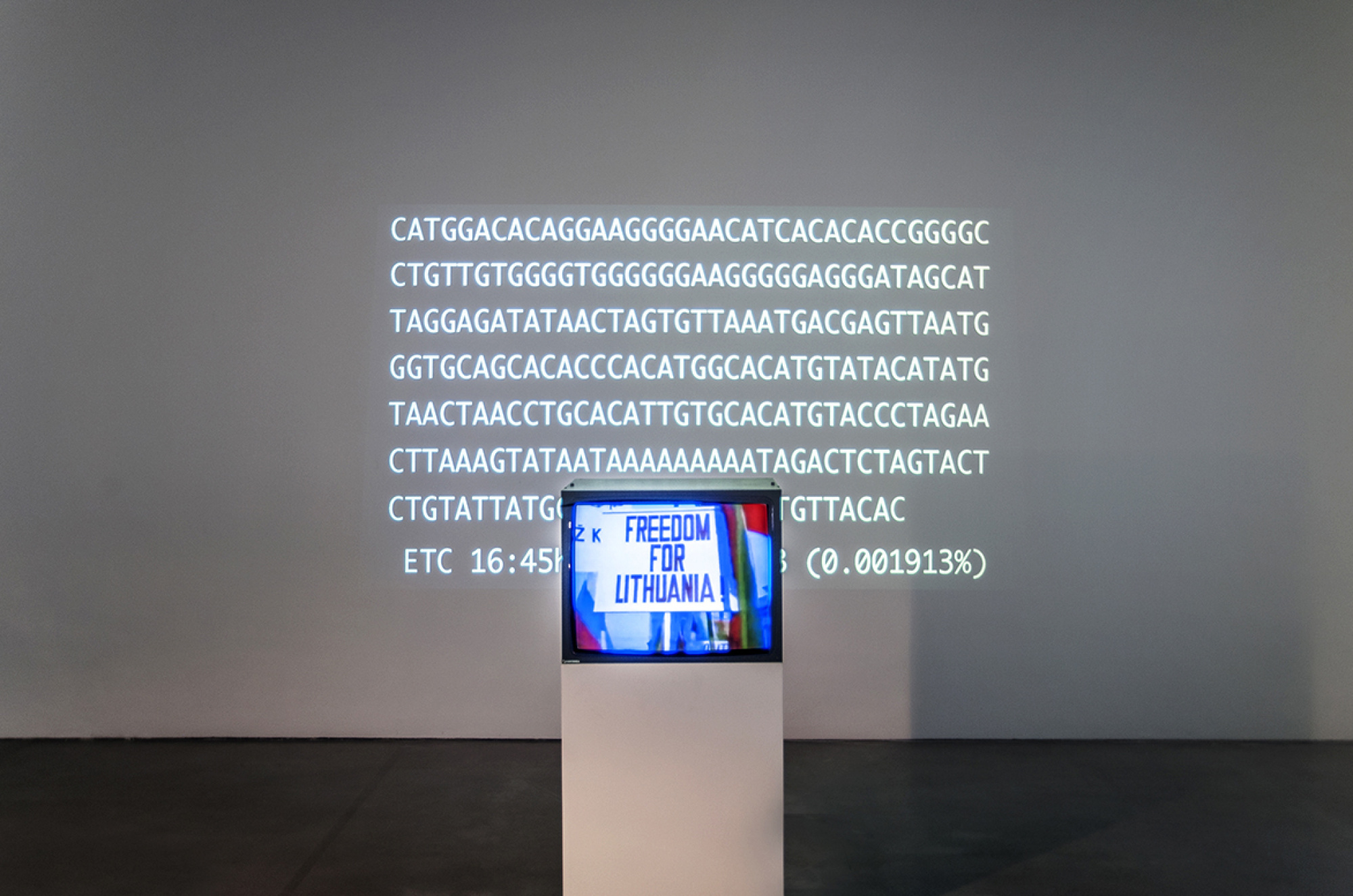
Stutterer plays the 3.2 billion letters of the human genome, our complete set of genetic instructions, like a musical score. As each letter plays out on one screen, the artwork randomly plucks a clip from English language media that was broadcast during the thirteen years it took to sequence the first human genome and plays the clip on a second screen. The work highlights the scale of information contained in each of our cells - if the work played continuously it would run for sixty years - but also the rich period of history that was the backdrop to this monumental project; beginning in 1990 with the release of Nelson Mandela, to the the Iraq War in 2003.
The Human Genome Project was an international collaboration between twenty research institutes in six countries, and the Wellcome Trust Sanger Institute based at the Wellcome Genome Campus was its UK hub. The Sanger was the single biggest contributor, sequencing one third of the genome. Stutterer is exhibited alongside objects from the Human Genome Project, including a DNA sequencing machine, which demonstrate the process of getting from an organic sample of DNA to the final string of letters visualised in the artwork.
Programming by Matt Jarvis. Stutterer was commissioned by LifeSpace Science Art Research Gallery at the University of Dundee for their new Discovery Centre for Translational and Interdisciplinary Research in the College of Life Sciences, which opened in 2014 and was supported by a Wellcome Trust Arts Award.
Image credit: © Ruth Clark and courtesy of the artists and The University of Dundee
Perpetual Uncertainty 2016 - Digital Projection, Monolith, Vinyl Lettering - Bildmuseet, Umeå, Sweden
Perpetual Uncertainty / Contemporary Art in the Nuclear Anthropocene brings together artists from Europe, Japan, the USA and Australia to investigate experiences of nuclear technology, radiation and the complex relationship between knowledge and the deep time.
The artworks explore how nuclear weapons and nuclear power has influenced our interpretation of concepts such as archives, memory, knowledge and time. How can we understand and visualise the ungraspable timeframe of radioactive half-life? How can we archive and communicate knowledge about radioactivity from generation to generation, hundreds of thousands of years into the future?
Participating artists: James Acord, Shuji Akagi, Lise Autogena & Joshua Portway, Erich Berger and Mari Keto, Nick Crowe and Ian Rawlinson, Don't Follow the Wind, Finger Pointing Worker, Dave Griffiths, Isao Hashimoto, Erika Kobayashi, David Mabb, Cécile Massart, Eva and Franco Mattes, Yelena Popova, Susan Schuppli, Shimpei Takeda, Kota Takeuchi, Thomson & Craighead, Suzanne Treister, Andy Weir, Robert Williams and Bryan McGovern Wilson, and Ken + Julia Yonetani.
The exhibition includes a programme of films, open discussions and talks by researchers and experts. The film programme presents art films, documentaries and feature film by Todd Chandler, Jeff Stark, Eva and Franco Mattes / Merilyn Fairskye / Nina Fischer and Maroan el Sani / Peter Galison and Rob Moss / Karen Kramer / Akira Kurosawa / Fredrik Oskarsson / Cécile Massart / Jane and Louise Wilson.
Perpetual Uncertainty is produced by Bildmuseet and curated by Ele Carpenter, Goldsmiths University of London. The exhibition is accompanied by The Nuclear Culture Source Book, a collaboration between Bildmuseet, Arts Catalyst and Black Dog Publishing.
Nuclear Material Culture 2016 - Digital Projection, Desk, Chair, Lamp And Folder - Karst, Plymouth
Artists: Nick Crowe & Ian Rawlinson, James Acord, Susan Schuppli, Kota Takeuchi, Thomson & Craighead, David Mabb, Erika Kobayashi
Curated by Ele Carpenter
Material Nuclear Culture is an exhibition exploring the material traces and cultural legacy of nuclear powered submarines in the UK, within the international discourse of deep time aesthetics and memory.
A partnership between KARST and Arts Catalyst, curated by Ele Carpenter.
The exhibition highlights the complexity of archiving the cultural legacy of submarine heritage within a wider discussion of how to comprehend the deep time challenges of radioactive waste storage.
Nick Crowe & Ian Rawlinson's new film, Courageous, follows the material surfaces of a nuclear submarine. Jon Thomson & Alison Craighead's, temporary index, is a digital artwork that counts down decay rates of entombed radioactive waste sites around the world. David Mabb's new sculptural series, A Provisional Memorial to Nuclear Disarmament, draws on the Royal Navy's love of William Morris fabric and Morris's revolutionary politics. Susan Schuppli's audio work Sound of Sand, investigates the poetics of sonar surveillance.
The exhibition will situate these new works alongside works by Japanese artists investigating the deep time memory over generations. Erika Kobayashi's 'Half Life' calendar maps the intergenerational timescales of radiation between Europe and Japan, through the decay rate of Raduim. Artist Kota Takeuchi will present his work Take Stone Monuments Twice revisiting monuments along the Tohoku coast of Japan. The artwork reflects on the tensions between monuments of the past and markers for the future.
This year will mark the end of the Royal Navy fifteen-year public consultation on how to dismantle British nuclear submarines, and where to store the reactor vessels. The Submarine Dismantling Project Advisory Group is the first MOD public consultation with expert advisors, NGO's and statutory agencies that represent a range of experience and political concerns. The exhibition takes place in the spirit of the advisory group and their commitment to an open and frank discussion about the issues of nuclear dismantling and radioactive waste management.
Partners
The Material Nuclear Culture exhibition is produced by KARST and Arts Catalyst, curated by Ele Carpenter with support from: Arts Council England, Goldsmiths College University of London, University of Westminster, Sasakawa Foundation, and Bildmuseet Sweden. The research and development of the exhibition was also supported by AHRC, npo S-Air and the Daiwa Foundation.
Party Booby Trap 2016 - Carroll / Fletcher, London
Thomson & Craighead present their first fragrance Apocalypse (2016) in Party Booby Trap, the duo’s second solo show at Carroll / Fletcher. The scent will be showcased alongside a series of major new works inspired by sources ranging from nuclear waste to self-help literature and genetics.
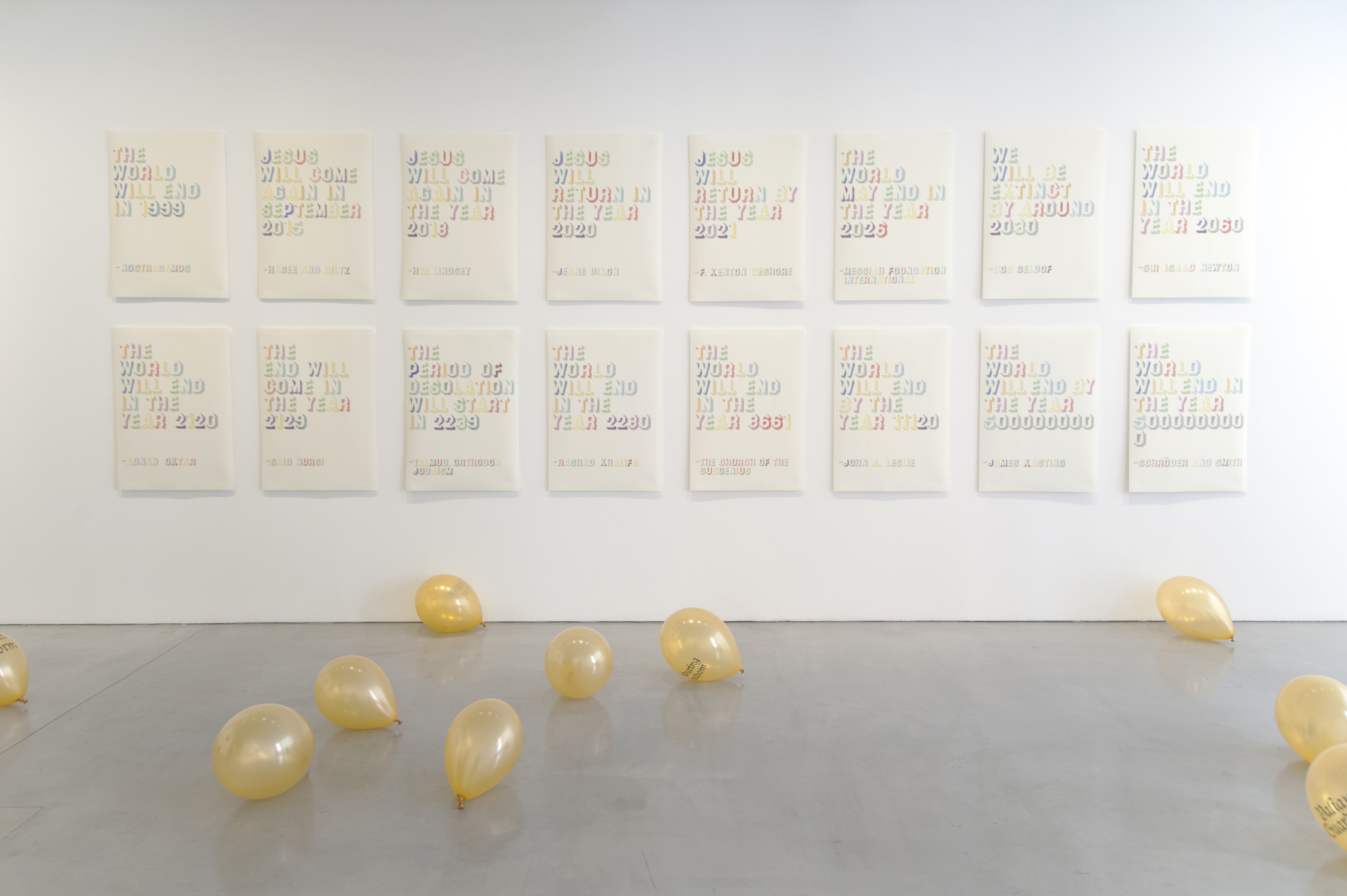
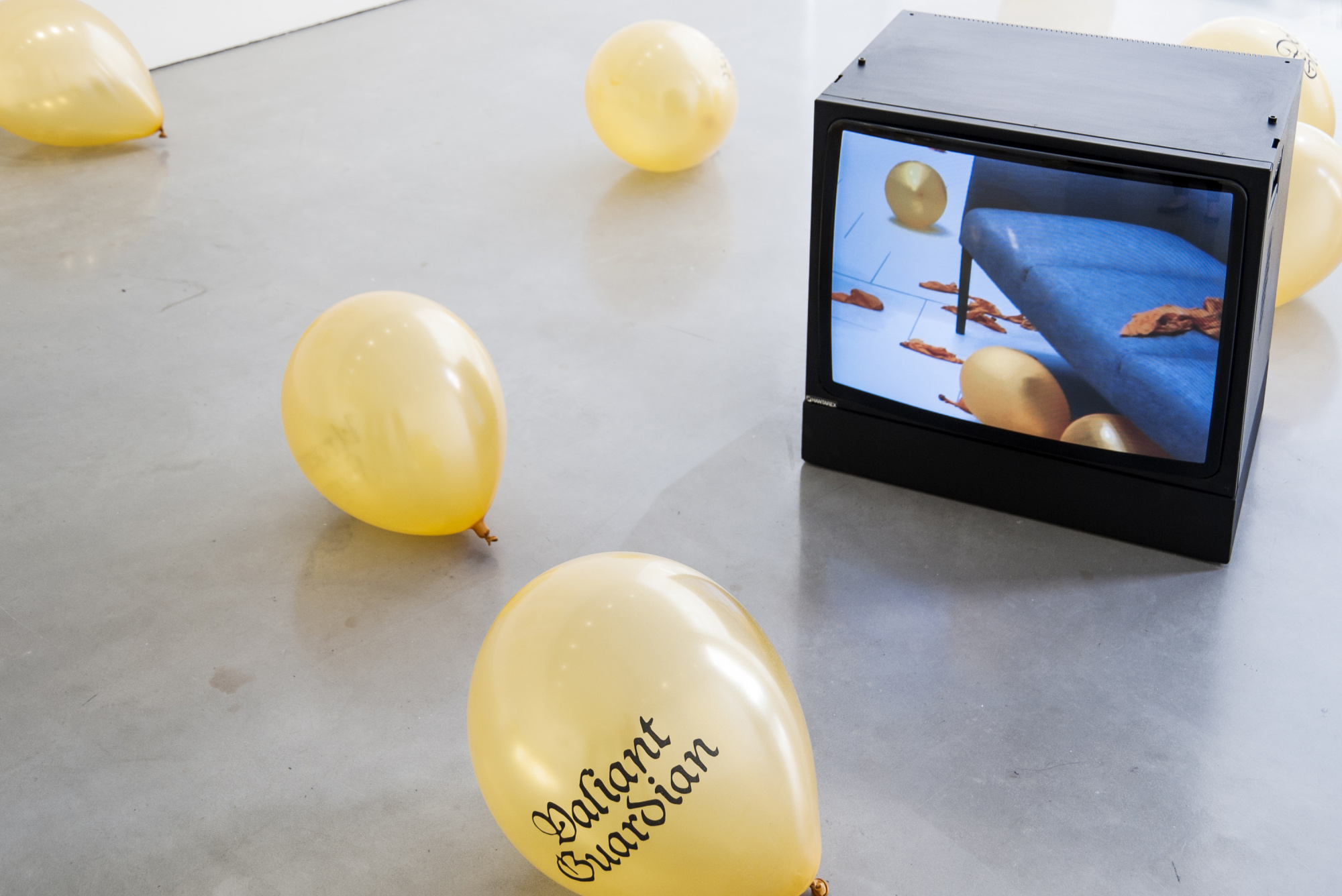
The late 20th century saw one of the most significant scientific advances to date, with the first mapping of a human genome (an individual’s complete DNA set) by the international Human Genome Project. It took thirteen years and twenty universities to reference over three billion base pairs of nucleotides (DNA molecules) that compose one single genome. This process has inspired Thomson & Craighead’s Stutterer (2014), a video installation the artists describe as a “poetry machine.” There are four types of DNA: adenine, cytosine, guanine, and thymine, commonly referred to as A, C, G, and T. The artists seized the creative opportunity afforded by the combination of a sequence of letters and a crucial tranche of recent history. The time it took to complete the Human Genome Project spanned the liberation of Nelson Mandela in 1990 and the fall of Baghdad to the allied military coalition in 2003. Supported by the Wellcome Trust, Stutterer (2014) pairs each letter of the first human genome with a word beginning with the same letter, spoken in television footage from the period. The result is a televisual portrait of an era which encompassed not only the First and the Second Gulf Wars, but also the collapse of the Soviet Union, the deaths of Yitzhak Rabin and Princess Diana, the first cloned sheep Dolly, the launch of Viagra and the shootings at Columbine High School. In October 2002, then-President George W. Bush declared that Iraq was in possession of chemical and biological weapons which “threatened America and the world” – an allegation which is now widely acknowledged as one of the main triggers for the Second Gulf War (2003-11). “Confronting the threat posed by Iraq,” he said, “is crucial to winning the War on Terror.” Thomson & Craighead’s print the war on terror (2016) plays with the phrase in a series of Oulipo-esque anagrams: “the rot narrower”, “tarot hewn error”, “rare tower thorn.” Made with a type-writer on a white sheet of paper like a piece of experimental poetry, these hint at the absurdity of the chain of events that led to the death of hundreds of thousands of civilians in less than a decade. Multi-coloured balloons bearing the names of military operations from “Desert Storm” to “Urgent Fury” crowd the floor. These innocuous presences – absent-mindedly kicked about by visitors as they progress through the exhibition – function as gentle reminders of the pervasive nature of warfare. On a TV screen, some women dutifully pop the balloons after a corporate party, as if trying to contain a reality that could overwhelm them. Created in collaboration with perfumer Euan McCall, the fragrance Apocalypse combines the scents of olfactory elements described in The Book of Revelation, including burnt flesh, incense and blood. Presented in a velvet-lined box, it turns a central tenet of the Western imaginary, and a canonical representation of End Times, into a luxury, limited edition item. At once highly desirable and sickening, the piece is the product of a time in which both consumerism and politics feed on fear, mysticism and fallacies of all stripes. With the series of posters Common Era (2016), Thomson & Craighead gather a collection of predict
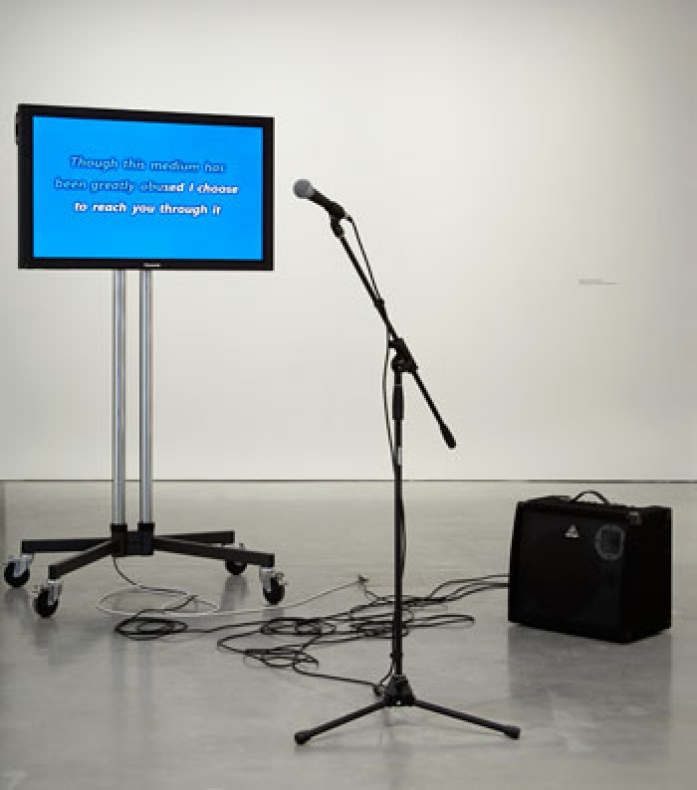
Electronic Superhighway 2016 - Karaoke Videos, PA Amplifier, Microphone, Microphone Stand, Unicol Stand, Flat Sreen Television And Media Player - Whitechapel Gallery
Electronic Superhighway (2016 – 1966)
In January 2016 the Whitechapel Gallery presents Electronic Superhighway (2016-1966) a landmark exhibition that brings together over 100 artworks to show the impact of computer and Internet technologies on artists from the mid-1960s to the present day. It features new and rarely seen multimedia works, together with film, painting, sculpture, photography and drawing by over 70 artists, including works by Cory Arcangel, Roy Ascott, Jeremy Bailey, Judith Barry, James Bridle, Douglas Coupland, Constant Dullaart, Lynn Hershman Leeson, Vera Molnar, Albert Oehlen, Trevor Paglen, Nam June Paik, Jon Rafman, Hito Steyerl, Ryan Trecartin, Thomson & Craighead, Amalia Ulman and Ulla Wiggen. The exhibition title Electronic Superhighway (2016-1966) is taken from a term coined in 1974 by South Korean video art pioneer Nam June Paik, who foresaw the potential of global connections through technology. Arranged in reverse chronological order, Electronic Superhighway (2016-1966) begins with works made between 2000 – 2016, and ends with Experiments in Art and Technology (E.A.T), an iconic, artistic moment that took place in 1966. Spanning 50 years, from 2016 to 1966, key moments in the history of art and the Internet emerge as the exhibition travels back in time. As the exhibition illustrates, the Internet has provided material for different generations of artists. Oliver Laric’s painting series Versions (Missile Variations) (2010) reflects on issues surrounding digital image manipulation, production, authenticity and circulation. Further highlights include a series of photographs from conceptual artist Amalia Ulman’s four-month Instagram project Excellences & Perfections (2014-15), which examines the influence of social media on attitudes towards the female body. Miniature works by Celia Hempton painted live in chatrooms go on display alongside a large scale digital painting by Albert Oehlen and manipulated camera-less photography by Thomas Ruff. The dot-com boom, from the late 1990s to early millennium, is also examined through work from international artists and collectives. The exhibition is curated by Omar Kholeif with Emily Butler, Mahera and Mohammad Abu Ghazaleh Curator, Whitechapel Gallery and Séamus McCormack, Assistant Curator, Whitechapel Gallery.
Real Time 2016 - Arts Santa Mònica, Barcelona
Guillem Bayo, Clara Boj i Diego Díaz, Martin John Callanan, Grégory Chatonsky, Thierry Fournier, Varvara Guljajeva i Mar Canet, Rafael Lozano-Hemmer, Nicolas Maigret, Katie Paterson, Antoine Schmitt, Thomson and Craighead, Addie Wagenknecht, Carlo Zanni
In today’s accelerated society, time becomes a primary concern as one strives to keep abreast of major events taking place internationally and react to developments. We live in a state of permanent connection that leads to the anxiety of being part of a present that is not our own but one described by the media and social networks.
The term real time refers to the ability to show, communicate or react to events at the moment they take place. This term, which is commonly used in computer science, the media and all types of narratives, denotes a process that occurs synchronously with the spectator or user’s time. This immediacy translates into, for example, the ability to interact with a virtual environment, report on current events and tell a story in which time unfolds naturally. The individual present is connected with an external or shared present, promoting forming part of the present or issuing a response. “Real time” is thus linked to “being there” or Dasein as formulated by Martin Heidegger, which refers to the relationship between the individual and his or her environment and indicates that everyone is tied to the world they live and participate in. The concept also leads us to question what “real time” is, how we measure time and how this measuring is relative, even though it determines our perception of reality.
In the art world, time is a crucial element in something often overlooked: the amount of time the spectator spends contemplating the work of art. As Boris Groys has pointed out, while in traditional media the time needed for this contemplation is determined by the user, art based on temporal processes (new media, video and performance) hands this control over to the work. Usually works of art show a specific moment or an action bounded in time, but what happens when a work unfolds in “present continuous,” constantly changing and subject to an endless process?
Real Time. Art in Real Time presents a selection of contemporary works of art in which the concept of “real time” has a key role, whether by questioning the relativity of time, using data taken from the Internet in real time or seeking to create a current picture, “realistic” and always changing with the times we live in. Some of the works selected draw information that appears constantly in the media, while others pull data from various sources, establish a production process in real time or propose a questioning of our way of measuring time and relating to the present. The technologies we use in our daily lives have a central role in these pieces, leading to reflection on time in an area that is very close to the spectator, who in some cases can interact with the work and in others does so unknowingly.
Big Bang Data 2015 - Somerset House
Emails, selfies, shopping transactions, Google searches, dating profiles: every day we’re producing data in huge quantities. Our online activity, alongside that of businesses and governments, has led to a massive explosion – a ‘Big Bang’ – of data. This radical shift in the volume, variety and speed of data being produced, combined with new techniques for storage, access, and analysis, is what defines the proliferation of data. It is radically reshaping our world and is set to revolutionise everything we do. Data today gives us new ways of doing things: from scientific research to business strategy, politics to social interaction, our new data-driven society that has the potential to be more fair, stable, and efficient and yet it also created a tools for unprecedented mass surveillance and commodification. Data access and usage rights, along with the value they comprise, are at the heart of many concerns. Big Bang Data explores the issues surrounding the datafication of our world through the work of artists, designers, journalists and visionaries. As the data explosion accelerates, we ask if we really understand our relationship with data, and explore the meaning and implications of data for our future.
Right Here Right Now 2015 - The Lowry
A major new exhibition providing a thought provoking snapshot of contemporary digital art. Featuring the work of 16 international artists, Right Here, Right Now looks at how technology affects our lives - through surveillance, artificial intelligence, voyeurism or online dating.
Created in the last five years, their critical, playful and illuminating artworks challenge our understanding of the digital systems that surround us, while making visible those that are hidden. Prepare to re-think your increasingly connected digital life.
Art in the age of asymmetrical warfare 2015 - Witte de With
Just as World War II began with a charge on horseback, and ended with the atomic bomb, the technological escalation of killing machines continues today. Art In The Age Of…Asymmetrical Warfare, the third and final iteration of Witte de With’s year-long exhibition series Art In The Age Of…, considers the irregular, and often uneven nature of the hybrid battlefield. As always, war is ever-present, however, its theater has now extended from the so-called real to the virtual. While hard power is still asserted face-to-face and hand- to-hand, remotely controlled weaponry and other means of telecommunicated violence are broadcast and delivered digitally through cyber attacks, and via social media propaganda platforms. Not surprisingly, these new channels have created their own forms of representation in which morale and information have become equal to, or are greater than, traditional military superiority. Instead of simply producing images of war, a new war of images is being fought and sold. As such, Art In The Age Of…Asymmetrical Warfare asks the question: What role do artists play when they slip into these networks and try to reveal the engines and effects of contemporary conflict? Participants: Abbas Akhavan, Sven Augustijnen, James Bridle, Broomberg & Chanarin, Crass, Claire Evans, John Gerrard , Terence Gower, Glenn Kaino, Navine G. Khan-Dossos, Adam Kleinman, Trevor Paglen, Mohammad Salemy, Susan Schuppli, Nida Sinnokrot, Thomson & Craighead, Tom Tlalim, José Antonio Vega Macotela. Curators: Defne Ayas, Natasha Hoare, Adam Kleinman
The Line Sculpture Trail 2015 - Metal Roadsign - Greenwich Tow Path, London
WHAT IS THE LINE?
The Line is London's first dedicated modern and contemporary art walk.
WHAT KIND OF ART CAN I SEE?
By the end of June, there will be 14 works on The Line. These include sculptures by Martin Creed, Damien Hirst, Thomas J Price, Antony Gormley and Eduardo Paolozzi. The art is outside (protected by 24 hour CCTV) and will be lit at night. We are creating a dynamic exhibition with works on loan for two years and with new works continually being introduced. There are also indoor gallery spaces along the route, which will show specific exhibitions.
WHO IS THE LINE FOR?
That's like asking who is art for? We believe everyone will enjoy the experience. Local residents, Londoners, tourists, lovers, families, bird-watchers, cyclists, dog-walkers, art-followers, ramblers and anyone else who enjoys an adventure.
WHO SELECTED THE ARTWORKS THAT ARE ON THE LINE?
The first 9 sculptures were part of an open submission and were selected by a panel that included artist Mark Wallinger, art critic Richard Cork, collector and philanthropist Anita Zabludowicz, Whitechapel Gallery curator Omar Kholeif, CEO of the charity Gasworks Docks Partnership Simon Myers and one of The Line's co-founders, Megan Piper. Carolyn Miner, previously a curator of sculpture at the National Gallery of Art in Washington, has joined the team as Curator and is responsible for further installations and the development of the exhibition programme.
WHAT ROUTE DOES THE LINE FOLLOW?
The Line runs from Greenwich to Stratford, between The Greenwich Peninsula (The O2) and the Queen Elizabeth Olympic Park. It broadly follows the line of the Greenwich Meridian. Three miles in a straight line, much of the walk is along winding waterways and takes around three hours to complete. You can walk all of The Line in one go, or visit different sections on different days. There are underground and overground stations all along the route, and you can cross the Thames in the Emirates Air Line cable car.
WHAT IS THE GREENWICH MERIDIAN?
The Greenwich Meridian is the line that separates east from west in the same way that the Equator separates north from south. It is an imaginary line that marks zero degrees longitude. The Greenwich Meridian is important as it marks the starting point of every time zone in the world.
IS THE LINE FREE?
It is completely free to see the art on The Line. There are two sections where you need to pay to travel. North Greenwich and the Royal Docks are linked by the Emirates Air Line, a cable car, which takes you over the Thames. The Royal Docks and Cody Dock are linked by a three-minute DLR journey (Royal Victoria to Star Lane).
Exposition L'appartement 2015 - Digital Video, Unicol Stand, Microphone, Microphone Stand And Amplifier - Plateforme 73 rue des Haies 75020 Paris France
A small exhibition where the included works are set in a domestic scene: Exposition L'appartement // Du vendredi 24 avril au 10 mai 2015 // Vernissage le vendredi 24 avril de 18h à 22h // Avec les artistes de Plateforme: Stefan Brion, David Plion, Dominique Clerc, Alexandre Durand, Miki Nitadori, Dorota Kleszcz, Eric Le Maire, Vincent Debanne, Axël Kriloff, Hugo Arcier, Marc Poitvin... // Et leurs invités Atomic Pictures, Jon Thomson & Alison Craighead, Jean Baptiste Perrot, Jérôme Poret, Vincent Prieur, Carine Guimbard, Eli Gonzalez-Aoun, Florence Klein-Parahy, Léopold Koukissa, Emmanuelle Dagnaud, Sylvie Albac, Rafael Medeiros, Duel Domestique, Edouard Mortec, Adrien Belgrand...
Data as Culture 3: Data Anthropologies 2015 - Open Data Institute
Data as Culture 3: Data Anthropologies critically positions humans at the centre of emerging data landscapes through artistic exploration. The Open Data Institute offers itself as the focal point of this exploration by hosting a series of artists’ exploration. Thomson & Craighead, in residence between February and June, 2015, will develop a concept for a new artwork, responding to or working with open data. They will work along an open research model, likewise sharing their thinking through a solo exhibition of their existing works at the ODI.
Thomson & Craighead’s work explores the ways in which our lives and experiences are mediated by technology. It raises questions about what it means to aggregate and interconnect large bodies of information, inviting reflection on how mechanisms like the World Wide Web, alter, extend and distort our understanding of the world around us. Thomson & Craighead are keen observers of the ways in which people interact with these new spaces. Working with sound, video and sculpture, their materials include found YouTube footage, search terms and extracted texts from individual and corporate contributors to online media.
Signals: 24/7 (International Film Festival Rotterdam) 2015 - Digital Animation - Hilton Rotterdam Hotel
24/7 will focus on the changing world & technology, and how the attention economy is affecting our lives, how we consume information and how it dominates not only our waking but also our sleeping moments. Our experience of time is mutating at the speed of light, due to the glass fibre and wireless networks that keep us entangled. How this affects our sense of reality now and its impact in the near future is one of the most important discussions in the world today.
In the late 1990s, when Google was barely one year old and was still a privately held company, its future CEO, Dr. Eric Schmidt was already articulating the context in which such a venture would flourish. Schmidt declared that the twenty-first century would be synonymous with what he called the 'attention economy', and that the dominant global corporations would be those that succeed in maximizing the number of 'eyeballs' they could consistently engage and control.
24/7 is focussed on stimulating discussion on this 'attention economy', the global thirst for information and the daily data consumption and mass synchronisation of work and leisure rhythms which are synonymous with this. We are working, communicating and consuming whenever and wherever we happen to be in the world. Divisions between night and day, between rest and work are gradually disappearing. Our experience of time is mutating at the speed of light, due to the glass fibre and wireless networks that keep us entangled.
Therefore 24/7 forces the audience to step out of the cinema, into hotels. A hotel is just like a cinema, a place where one checks in to step out of the daily routine. They are open 24/7 and strongly associated with our need for sleep. While examining the ever-changing world of the 21st Century, this programme challenges the traditional notion of a film 'slot' by raising the question of what we now class as a 'normal duration'.
How to Construct a Time Machine 2015 - Video - MK Gallery, Milton Keynes
MK Gallery presents How to Construct a Time Machine, an exhibition of over twenty-five historical and contemporary works that explore how artists play with media in innovative ways to transform our experience of time.
What is time? How do we order the past, the present, and the future? Why are artists interested in time? How is art a machine, vehicle, or device for exploring time? How is art a means by which time ‘travels’, and how does art permit us to travel in time? Consideration of these and other questions has provided the exhibition rationale for guest curator, Dr Marquard Smith.
The show’s title is taken from an 1899 text by the avant-garde French writer, Alfred Jarry, written in direct response to H. G. Wells’ science fiction novel The Time Machine (1895). Wells invented and popularised a distinctively modern, fictional concept of time travel, with the time machine as a vehicle that could be operated ‘selectively’. Jarry’s response crafted a pseudo-scientific fiction that presents the time machine and time travel as an instance of ‘the science of imaginary solutions’.
Taking this idea of the time machine, time travel, and perhaps even time itself as an instance of ‘the science of imaginary solutions’, the exhibition is divided thematically across the galleries and includes works by John Cage, Martin John Callanan, Jim Campbell, Edgar Cleijne and Ellen Gallagher, Mat Collishaw, Ruth Ewan, Tehching Hsieh, On Kawara, the Lumière Brothers, Chris Marker, Kris Martin, Georges Méliès, Manfred Mohr, Melvin Moti, Nam June Paik, Katie Paterson, Elizabeth Price, Sun Ra, Raqs Media Collective, Meekyoung Shin, Maja Smrekar, The Otolith Group, Thomson & Craighead, Mark Wallinger and Catherine Yass.
Film work ranges from George Méliès’ A Trip to the Moon (1902), an iconic silent movie which follows a group of astronomers as they explore the moon, to Thomson & Craighead’s The Time Machine in alphabetical order (2010), a complete rendition of the 1960s film version of the Wells’ novella re-edited into alphabetical order.
Sculptural work includes Mark Wallinger’s Time and Relative Dimensions in Space (2001), a polished stainless steel version of Dr Who’s ‘Tardis’ police box that simultaneously disappears into the space-time continuum and reflects its own surroundings, and Ruth Ewan’s We Could Have Been Anything That We Wanted to Be (2012), a decimal clock which divides the day into ten (rather than twenty-four) periods, echoing a bold 18th century French Republican attempt to redefine and rationalise the day.
The exhibition is accompanied by a catalogue, designed by Herman Lelie, featuring an extended Introduction by the exhibition’s curator and a translation of Jarry’s How to Construct a Time Machine, together with essays by Dutch cultural theorist and video artist Mieke Bal and radical philosopher Peter Osborne. The exhibition will be supported by a range of related events including tours by the curator and artists, seminars, academic conferences, and film screenings.
It's me, not you (SSA Annual Exhibition 2014, Edinburgh) 2014 - Video - Royal Scottish Academy, Edinburgh
THE 117th ANNUAL OPEN EXHIBITION
See more here:
http://www.s-s-a.org/ssa-annual-exhibition-2014/
Scales of Life 2014 - Digital Installation - LifeSpace Dundee
Scales of Life is the inaugural exhibition in LifeSpace and features new and existing art works by Thomson & Craighead, Elaine Shemilt, Tabitha Moses and Helen Chadwick, alongside artefacts from the University's collections. The exhibition, curated by Sarah Cook, shows how visual artists have represented the fundamental scales of life - from molecules to organelles to cells to tissue. Scientific research into each of these biological components is the basis of the understanding and treatment of many diseases, yet these artworks, made from materials as diverse as embroidery or digital video, present other ways of picturing scientific knowledge. The exhibition is in part supported by The Wellcome Trust.
Micromégas > Powers of Ten 2014 - Pier Arts Centre 28-36 Victoria Street Stromness Orkney
MICROMEGAS > POWERS OF 10 - 58°57’53”N - 3°17’45”W brings together works by Pavel Büchler, Dora Garcia, Jonathan Monk, Scott Myles, Thomson & Craighead, Marco Stout, Tracy Mackenna & Edwin Janssen, a text by Mark Dorrian along with books and print-works published by Orkney based Hansel Cooperative Press and Brae Editions. Mircromegas explores ideas relating to perceptions of scale, philosophical & scientific thought and human foible. Referencing Duncan of Jordanstone College of Art and Design's unique Artists’ Books Collection Dundee (abcD), the exhibition investigates notions of portability, reproduction, distribution and presentation and the potential for artist’s book in contemporary art and curatorial practice.
Thing World (International Triennial of New Media Art 2014 - Digital Installation - National Art Museum of China
“thingworld: International Triennial of New Media Art 2014” is the third edition following the internationally acclaimed Olympic Cultural Project “Synthetic Times: Media Art China 2008” and “transLife: International Triennial of New Media Art” which was officially instituted as a triennial of new media art at the National Art Museum of China in 2011. The previous exhibitions have received extensive media attention and publicity with coverage from major news outlets such as China Central Television (CCTV), China Daily, Radio China, People’s Daily, Wenhuibao, Guangming Daily, China News Agency, Beijing Daily, Southern Daily, China Youth Daily, Vision, Esquire, Domus, Vogue, New Weekly, The Art Newspaper, New York Times, International Herald Tribune, Art Asia Pacific, Artforum, and Skymedia.
These triennials have investigated the most current intellectual trends in the discourse of media art and culture, providing a prominent platform for a global presentation and theorization of cutting edge media artwork. The 2014 edition will present 58 works by 65 artists and artistic collectives from 22 countries. Most of the works in the exhibition will be shown in China for the first time.
From metal balls ascending in an uncanny anti-gravitational movement to a Victorian sofa standing precariously à l’attitude; from miniature instruments which require a magnifying glass to peek at their elegance to monumental inflatables that entwine and elongate to permeate 5,000 square feet of gallery space; from murmuring tweets from the virtual void to billions of algorithmically generated configurations of a mere 24 cards depicting an 18th-century genre painting; from the umwelt of artifacts shuffling through a galaxy to a new ecosystem that emerges from the chemical sludges and trash vortex of the Pacific Ocean, the exhibition unfolds its three themes: Monologue: Ding An Sich; Dialogue: Ding to Thing; and Ensemble: Parliament of Things in a persuasive procession. By aligning Physical Being, Technical Being and Psychic Being (to borrow a concept of being from Gilbert Simondon) as the new vista of equality, Technology (as the reciprocal transduction of humanity and technicity) with its initiating motility may be the surprise candidate to turn anthropocentrism on its head: physical beings via technical beings achieve their own vivid presences, their own agency and autopoiesis, their own generativity, thereby evoking a conative penetration for the human being. They act and interact, dialogue and monologue, or chorus in the assemblage of the thingworld. In celebration of thingworld, there emerges an opportunity to reinvigorate the impasse of cultural production that is contingent solely on the premise of a human subject through a much-expanded field of operation; there will be a newfound world of discussions, concerns giving rise to new forms of artistic experimentation and new vocabularies of aesthetic manifestation that resonate with a vision of equity molded by a renewed political ecology, that is the “Equality of All Things.”
The catalogue accompanying the exhibition is co-published by The National Art Museum of China and The Liverpool University Press. Essay contributors include Graham Harman, Carolyn Christov-Bakargiev, Mark B.N. Hanson, Sean Cubitt, Timothy Morton, WANG Hui and ZHANG Ga.
Participating Artists
Aaajiao 徐文恺 | CN, Keith Armstrong | AU, & Lawrence English | AU, Cécile Babiole | FR, Ralf Baecker | DE, Christopher Baker | US, Rosa Barba | DE,
Video Container: Museum as Method 2014 - Video - Museum of Contemporary Art North Miami
On March 25, the Museum of Contemporary Art, North Miami (MOCA), inaugurates “Video Container: Museum as Method,” a presentation of single-channel video work by 15 contemporary artists who probe the role of the institution within artistic practice today. Part of a new MOCA video series exploring topical issues in contemporary art making, “Video Container” reflects the museum’s ongoing commitment to presenting and contextualizing experimental and critical practices, and to providing a platform for interdisciplinary media and discursive content. The program series is made possible by an endowment to the museum by the John S. and James L. Knight Foundation.
“Video Container: Museum as Method” features videos by leading contemporary artists including: Bernadette Corporation, Loretta Fahrenholz, Harun Farocki, Andrea Fraser, Dan Graham, General Idea, William E. Jones, Maha Maamoun, Danny McDonald, Seth Price and Thomson & Craighead among others. Ranging widely in scope from abstract shorts to long-form documentary, these videos present a new form of institutional critique and attempt to de-stabilize official geopolitical, social, and transnational histories. Videos will rotate each day to address various questions, ranging from the changing relationship between artists and institutions in post-war society to the role of the artist as interpreted through media.
Maps DNA and Spam 2014 - Installation - Dundee Contemporary Arts
We are delighted to welcome back artists Thomson & Craighead to DCA for our first exhibition of 2014. Maps DNA and Spam features new work (Dundee Wall and The First Person) and a selection of older work including The Time Machine in alphabetical order, Belief and A short film about War.
Much of Thomson & Craighead's recent work looks at how communications networks like the worldwide web are changing the way we relate to the world around us - the conflict between our private and public identities, the tension between the global and the local and the way in which modern communications inform our sense of place and self in the world.
The exhibition includes new two new works: The First Person (2013), an endless stream of first person statements taken from American self-help websites, randomly intercut with found video footage of a burning house; and Dundee Wall (2014) a poetic snapshot of social networking traffic from within this city, published as typeset posters and pasted up within DCA.
Two earlier works in the exhibition draw on information found entirely online: A Short Film about War (2009) is a narrative documentary artwork which takes viewers around the world to a variety of war zones as seen through the collective eyes of the online photo sharing community Flickr, and as witnessed by a variety of existing military and civilian bloggers; while Belief (2011-12) presents a series of fragmented broadcasts about faith, all sourced from the video sharing community YouTube.
Other works on display include The Time Machine in Alphabetical Order (2010) a complete re-edit of the 1960s film version of HG Wells Novella reconfigured by the artists into alphabetical order from beginning to end.
Jon Thomson, born 1969, and Alison Craighead, born 1971, studied at Duncan of Jordanstone College of Art in Dundee and now live and work in Scotland and London. Jon Thomson is Reader in Fine Art at The Slade School of Fine Art, University College London, while Alison Craighead is Reader in Visual Culture and Contemporary Art at University of Westminster and lectures in Fine Art at Goldsmiths University London. Thomson & Craighead have been working together since 1993. Recent exhibitions include MEWO Kunsthalle, Memmingen and Carroll/Fletcher, London.
Look Into the Net 2014 - Edith-Russ-Haus für Medienkunst
The works shown in this exhibition of the internationally most relevant net artists belong to the collection of NETescopio, iniciated in 2008 and since then constantly developed by the Spanish Museum of Contemporary Art of Extremadura and Latin America – MEIAC, Badajoz. With NETescopio, the MEIAC is a pioneer in the availability of an Internet accessible art collection beyond the physical presence of the actual Museum. A selection of 120, partly no longer accessible, key works covers the panorama of net art production from the 1990s until today. This exhibition is in this sense a unique opportunity to gain an insight into the net art tendencies and their aesthetics. The main objective of the NETescopio archive, which makes also a historical classification of the collected works, is the preservation of the works, characterized by the incorporation of a large numbers of Spanish and Latin American net artists.
The curator Gustavo Romano has distinguished three strategies of artistic appropriation of the Internet with their various formats:
Disassemblings
During the web´s early years the artists started to experiment with the new medium and dealt with the possibilities of interactivity, the use of interfaces and alternative browsers. It is in the first years of web art, which can be seen in this category, that show a greater radicalism with a stress on experimentation and the deconstruction of the medium.
Re/appropriations
The reuse of symbolic materials and artistic reactions to existing content play a key role in this work. In digital media information can be reproduced and manipulated, developing constant mutation. This poses in discourses to copy, original and authorship, as well as to owner and collector of net art. The artist’s role on the web is of a "redirector" of information.
Intrusion
These works refer to artistic intervention in a new public space, the “Internet”, which involve commonly used sites such as Wikipedia or Google Maps, which parody or subvert private pages, in order to undermine them through artistic contexts. Stealthily infiltration of the user's computer or other computer systems is discussed here. The artist slips here into the role of spies, intruders and solitary flaneurs.
Curated by Gustavo Romano
artists:
0100101110101101.org (Eva & Franco Mattes); Ivan Abreu; Amy Alexander; Marcel·lí Antúnez; Kim Asendorf; Lucas Bambozzi; Ryan Barone; Giselle Beiguelman; Amy Berk; Luther Blissett; Natalie Bookchin; Christophe Bruno; Maite Cajaraville; Martin John Callanan; Azahara Cerezo; Paolo Cirio; Arcángel Constantini; Vuk Cosic; Andy Cox; Critical Art Ensemble; Minerva Cuevas; Young-Hae Chang; Santiago Echeverry; Vadim Epstein; Evru; Fiambrera Obrera; Gonzalo Frasca; Belén Gache; Dora García; Daniel García Andújar; Gazira Babeli; Emilio Gomáriz; Ethan Ham; Luis Hernández Galván; Robin Hewlett; Steev Hise; Ricardo Iglesias; Daniel Jacoby; Sergi Jordá; Scott Kildall; Ben Kinsley; La Société Anonyme (José Luis Brea); Joan Leandre; Les Liens Invisibles; Olia Lialina; Rogelio López Cuenca; Iván Lozano; Alessandro Ludovico; Peter Luining; Fernando Llanos; Brian Mackern; Miltos Manetas; Rafael Marchetti; Iván Marino; Antonio Mendoza; Ricardo Miranda Zúñiga; Antoni Muntadas; Mark Napier; Eduardo Navas; Santiago Ortiz; Christian Oyarzún; Paolo Pedercini (Molleindustria); Raquel Rennó; Ricardo Barreto & Paula Perissinotto; Gustavo Romano; Benjamin Rosenbaum; Mario Santamaría; Santo_File (David Casacuber
global aCtIVISm 2013 - Digital Installation - Zentrum Kunst Media
The exhibition global aCtIVISm is dedicated to the field of artistic form of expression as politically inspired by actions, demonstrations and performances in the public sphere, which draw attention to socio-political grievances and call for changes to existing conditions. By means of objects, photographic, cinematographic, videographic and mass medial documents, the exhibition presents global activism as the first novel art form of the 21st century.
global aCtIVISm serves as prelude to the exhibition marathon "Globale", scheduled to be held on the occasion of the 300-year anniversary of the founding of the city of Karlsruhe 2015.
Project Team: Peter Weibel and Andreas Beitin, Andrea Buddensieg, Dietrich Heissenbüttel, Sabiha Keyif, Elisabeth Klotz, Sarah Maske, Linnea Semmerling, Joulia Strauss, Tatiana Volkova, Philipp Ziegler
Artists
Adbusters Media Foundation, G.M.B. Akash, Anonymous News Germany, ATTAC, Martin Balluch, Zanny Begg, John Beieler, Bombily Group, Ángela Bonadies & Juan José Olavarría, Nadir Bouhmouch, Osman Bozkurt, Campact, Center for Artistic Activism, Chim↑Pom, Noam Chomsky, Ralf Christensen, Chto delat?, Paolo Cirio, Cyber Guerilla, Hassan Darsi, Johanna Domke & Marouan Omara, Electronic Disturbance Theater, Enmedio, Colectivo Etcetera, Everyday Rebellion, Femen, Noah Fischer, Floating Lab Collective, Freedom of the Press Foundation, Muath Freij, Isabelle Fremeaux & John Jordan, Jakob Gautel & Jason Karaïndros, Greenpeace, Stéphane M. Grueso, Ed Hall, Hedonistische Internationale, Stéphane Hessel, Niklas Hoffmann, Jim Hubbard, Indymedia, Alexey Iorsh, Just do it (Kim Asendorf & Ole Fach), Amadou Kane Sy, Thomas Kilpper, Kiss my Ba, kreativerstrassenprotest.twoday.net, Mischa Kuball, Jan Jaap Kuiper & Katja Sokolova, Sasha Kurmaz, Christopher LaMarca, Mohammed Laouli, Lynn Lauterbach, Julia Leser & Clarissa Seidel, Let’s Do It!, Viktoria Lomasko, Renzo Martens, Masasit Mati, Mikaela, Mootiro Maps, Carlos Motta, Neozoon, No TAV, occupygezipics.tumblr.com, Otpor!, Partizaning, Jean-Gabriel Périot, Platform, Pussy Riot, R.E.P., Resist, Oliver Ressler, Mykola Ridnyi, Itamar Rose & Yossi Atia, Faten Rouissi, Sandra Schäfer, Bahia Shehab, Lisa Sperling & Florian Kläger, Jonas Staal & Metahaven, Stop the Traffik, Joulia Strauss & Moritz Mattern, Stuttgart 21-Protest, Jackie Sumell, Surveillance Camera Players, Tanya Sushenkova, Aaron Swartz & Taryn Simon, Take The Square, Pelin Tan, Teatro Valle Occupato,The International Encyclopedia of Revolution and Protest, The Yes Men, Thomson & Craighead, Patricia Triki & Christine Bruckbauer, Troika, UK Uncut, Various authors organized by Sharon Hayes with Angela Beallor, Voina, Christoph Wachter & Mathias Jud, Mark Wallinger, WANGO, wearethe99percent.tumblr.com, WikiLeaks, Alexander Wolodarskij, Yomango, Malala Yousafzai, Salam Yousri and others
Not even the Sky 2013 - Installation - MEWO Kunsthalle Memmingen
Das britische Künstlerpaar Thomson & Craighead nutzt Technologie als ein Medium, um grundlegende Fragen für die Gegenwart neu zu stellen. Viele ihrer Arbeiten befassen sich mit Live-Netzwerken wie dem Internet und damit, wie diese unser Verständnis unserer Situation und der uns umgebenden Welt verändern.
Thomson & Craighead verknüpfen über das Internet verfügbare Informationen mit realen Erfahrungen. So werden in der Filmarbeit Flat Earth die an und für sich neutralen Bilder von Aufklärungssatelliten mit den subjektiven Texten von Bloggern kombiniert und wandeln sich für die Betrachter dadurch zum Bestandteil einer emotionalen Erzählung. Die aus vielen Einzelbildern bestehende Videoarbeit Horizon trägt in Echtzeit Webcam-Aufnahmen aus den unterschiedlichen Zeitzonen zusammen und liefert ein eindrückliches Bild der sich mit uns drehenden und durch Tag und Nacht bewegenden Erde.
Die Arbeiten von Thomson & Craighead verorten uns. Sie bieten uns eine Perspektive auf die Welt, die nicht immer mit unseren vorgefassten Erwartungen übereinstimmt, und die auch nicht der Komik entbehrt: Das Hinweisschild Hier, an der Straße vor der MEWO Kunsthalle positioniert, weist genau nach Norden und damit über beide Pole genau wieder auf uns, wie wir von uns selbst 40.008 km entfernt stehen.
Thomson & Craighead: Broken Webcams, 2013
Jon Thomson (*1969 in London) und Alison Craighead (*1971 in Aberdeen) arbeiten mit Video, Sound, Bildhauerei, Installation und dem Internet. Sie haben am Duncan of Jordanstone College of Art in Dundee studiert und arbeiten seit 1993 gemeinsam als Thomson & Craighead. Jon Thomson unterrichtet an der Slade School of Fine Art und Alison Craighead an der University of Westminster und am Goldsmiths College. Sie leben und arbeiten in London sowie in Kingussie, im Schottischen Hochland.
Flat Earth Trilogy 2013 - Video Installation - Taigh Chearsabhagh
flat earth trilogy – thomson & craighead
7 - 31 august. 11am - 4pm preview & artists talk - tuesday 6 august 7.30pm
Taigh Chearsabhagh Museum & Arts Centre, studio 1
The Flat Earth Trilogy is a series of documentary artworks each made entirely from information found on the worldwide web. They are shown together for the first time in their single screen form at Taigh Chearsabhagh.
The trilogy covers a six-year period beginning with Flat Earth (2007), A short film about War (2009/2010) and ending with Belief (2012). In each case, the viewer is taken around the world encountering fragments taken from real peoples’ blogs, which are knitted together to form something resembling a story.
In Flat Earth, we see the visual language established where Google Earth is used as a way of joining each of these narrative moments together. A short film about War focuses more specifically on the collective gaze of photo-sharing communities like flickr as a way of apprehending the locations being spoken about, while Belief looks to the video sharing community youtube and the phenomenon of video blogging and to a lesser extent ‘trolling’, where individuals attempt to sow discord online as an end in itself.
In all of these works, the artists are interested in exploring how our own spheres of influence have been extended and transformed by the internet, allowing us to experience and broadcast information around the globe in ways unheard of even fifteen years ago.
Flat Earth was made with Channel 4 and Animate Projects for television broadcast, but A short film about War and Belief have been developed as gallery installations as well as the single screen videos seen here.
In the gallery version of A short film about War, a second screen logs the provenance of images, blog fragments and GPS locations of each element comprising the work, so that the same information is simultaneously communicated to the viewer in two parallel formats -on one hand as a dramatised reportage and on the other hand as a text log.
The gallery version of Belief adds a synchronised floor projection of a compass, which interacts with the montage showing us where each clip originates in relation to the geographical location of the artwork thus placing the viewer at the centre point of a cinematic data-visualisation.
In both cases, the artists’ want us to consider our own relationship with this material -the way in which information changes as it is gathered, edited and then mediated through networked communications technologies or broadcast media, and how that changes and distorts what things mean; especially for (the generally wealthy minority of) the world’s users of high speed broadband networks, who have become used to the treacherously persuasive panoptic view that Google Earth (and the worldwide web) appears to give us.
Never Odd or Even 2013 - Carroll / Fletcher Gallery, London
A major solo exhibition of recent work at Carroll / Fletcher Gallery in London curated by Diana Stevenson for Carroll/Fletcher gallery, London.
Videonale 14 (Festival for Contemporary Video Art) 2013 - Video Installation - Kunstmuseum Bonn
Videonale e.V.- Association for the Advancement of Cultural Awareness in the Audio-Visual Field is committed to the presentation, mediation and promotion of contemporary works of video art and time-based art forms as well as to the conservation and study of its historical inheritance.
One of the association’s most important functions is organising an international festival of video art. Since it first took place in 1984, the VIDEONALE – Festival of Contemporary Video Art has been held every two years and, with its ambitious programme of video presentations, exhibitions, lectures and performances, soon became one of the most important festivals for video and time-based art in Germany and Europe. The participants included such pathfinders as Dara Birnbaum, Lynn Hershman, Klaus vom Bruch, Gary Hill, Keren Cytter, Marcel Odenbach, Bill Viola and Christian Jankowski. For many of these artists, VIDEONALE was the first chance to present their work to an international public. To this day VIDEONALE has remained true to its founding principle of casting light on the current trends in time-based art and presenting these to the general public. It continues to focus on the advancement of aspiring young artists, while also presenting established positions of video art.
Initially at home in the Bonn Kunstverein, since 2005 Videonale has been using the rooms of the Bonn Kunstmuseum. It acts as a supplement to the museum’s collection of video art donated by patron and art collector Ingrid Oppenheim who, in the late 70s, laid the symbolic foundations of today’s VIDEONALE.
Since it moved to the museum, the association has organised the VIDEONALE as an exhibition which runs for several weeks and presents up to 40 works of video art, together with a festival programme of talks by artists, roundtable discussions, performances and lectures. Since 2013 the programme has been augmented by the VIDEONALE.Parcours, with additional exhibitions at various locations in Bonn, as well as retrospectives showing innovative positions of video art.
Since the removal to the museum, the investigation and development of new ways of presenting video art in museum spaces has been the subject of particular attention. For every VIDEONALE, a new designer-architect team is invited to develop the exhibition architecture.
During the time between the biennial VIDEONALE exhibitions, the association organises Elektronenströme (streams of electrons), a series of lectures dealing with current discussions and positions of video art, as well as the film-art series VIDEONALE.scope, a yearly series of retrospectives on filmmakers dealing with the interfaces between film and video art. The association further tours its programme as Videonale on Tour with presentations at institutions worldwide.
October 2012 - Artefact - 'Create', Brighton
‘October’ is a special commission for the internationally recognized Brighton Photo-Biennial (BPB12) / Photoworks (October 2012) (£14,000). It is a two-channel documentary artwork about the early rise and fall of the Occupy movement. It extends research begun with software development undertaken in ‘Belief’ (2012) by focusing more closely on how the virtual layer of the internet interacts ever more seamlessly with the physical world. It asks how we can witness a global protest when it takes place simultaneously across the world in over 900 locations. Can the worldwide web (which spawned this movement) let us apprehend and reflect upon such a phenomenon?
The work premiered at a new gallery in Brighton called ‘Create’ and according to BPB12 received 60,000 national and international visitors. ‘October’ was also presented at the international conference during the launch weekend of BPB12. A special edition of Photoworks magazine was published alongside the biennial, to serve as an exhibition catalogue (129 pages ISSN 1742-1659 | ISBN 978-1-903796-36-8) with a commissioned essay on ‘October’ by Lorena Munoz-Alonso. Photoworks is the UK’s leading magazine on British and International Photography. ‘October’ was used by Peter Ride (University of Westminster) as an example of world leading new media art practice for the keynote conference at Microwave New Media Art Festival 2012, Hong Kong.
‘October’ was subsequently exhibited in the group exhibition, ‘Protest’ at Newbury Corn Exchange, April 2013 and was launched online as a single channel work on the Photoworks website in May 2013 (http://photoworks.org.uk/projects/thomson-craigheads-october/). The work will be distributed by Lux, London from Autumn 2013.
The wider body of research evolved from an initial earlier AHRC small award in creative and performing arts (2007 | £15,000 FEC) entitled, ‘Sculpting the Web: Making permanent artworks that explore the boundaries between physical public space and the virtual space of the web.’
Our Mutual Friends 2012 - Video - Online (http://ourmutualfriends.com) and Jerwood Gallery, London
To mark the Charles Dickens bicentenary in 2012, Film and Video Umbrella unveil four newly commissioned online artworks that take Dickens’ final novel as an allegorical tale with numerous echoes in the present.
Manifesting in several locations both on and offline from the Dickensian heartland of Borough and Bankside to the author’s birthplace in Portsmouth and his regular place of retreat along the North Kent coast near Margate, Our Mutual Friends mobilises Facebook, Twitter and other social networking sites to apply Dickens’ satire on ‘society’, ‘celebrity’ and the superficiality of friendships to our contemporary cultural moment.
Instead of the Victorian scrapheaps and ‘dustheaps’ which loom large in the novel, the project highlights the vast accumulation of digital detritus that clutters our everyday lives, and draws parallels between an era of industrial dirt and waste and the apparently disposable and throwaway nature of contemporary digital communication.
Belief at InSpace, Edinburgh 2012 - Inspace, University of Edinburgh Department of Infomatics
The final documentary in our 'Flat Earth Trilogy' (preceded by 'Flat Earth' (2007), and 'A short film about War' (2009/2010) commissioned by Vital Spark / Creative Scotland with support from New Media Scotland and Atlas Arts Skye and premiered at InSpace Gallery, Edinburgh as part of the Edinburgh Film Festival and subsequently shown in Dunvegan Castle on Isle of Skye a year later.
Image Counter Image 2012 - Haus Der Kunst, Munich, Germany
A major group exhibition at Haus Der Kunst Munich looking at how international contemporary artists have visualized conflict and war in recent years. The exhibition included works by nineteen artists with a two hundred page catalogue (ISBN 978-3-86335-208-0)
Our work was entitled ‘A short film about war’ –a documentary artwork made entirely from information found online. ‘A short film about war’ has also been exhibited around the world at Foundation for Art & Creative Technology (FACT), Liverpool as part of the touring exhibition ‘My War’ (catalogue 110 pages ISBN 978-3-86828-134-7 | subsequent venue: Edith Russ Haus, Oldenberg); Rotterdam International Film Festival, 2011; Kunstverein Wolfsburg, Germany, 2011; Rooftop Films, New York, 2011; as part of our solo exhibition at Watermaal Station in Brussels, Belgium 2011; for Recontres Internationales, Centre Pompidou/Gaîté Lyrique, Paris and touring to Madrid and Berlin 2011/2012; and as part of our nomination for the Samsung Art Prize, BFI Southbank, London, 2012
Life Online (open source) 2012 - National Media Museum. UK
Life Online is a major new gallery at the National Media Museum, UK. Four artists were commissioned specially to produce works for the launch of the Life Online Galleries. Our work, ‘A live portrait of Tim Berners-Lee (an early warning system)’ is installed for close to a year in the museum.
Time Landscapes 2011 - Electronic Village Galleries - various venues
Time Landscapes is an exhibition of online work curated by Beryl Graham for Electronic Village Galleries:
New media is often assumed to be the antithesis of all that is rural or natural – a quick and shallow ‘virtual reality’ for city slickers, which doesn’t even approach feeling the sea spray on your face, or just ‘being there’. Yet, there many layers of artificiality and man-made intervention lurking in the landscape – is that coastline restricted by the military? Is that woodland ancient semi-natural, or carefully sculpted for clients owning a country estate? Are those seaside watercolours and those photographs of farmhouse Bed and Breakfasts carefully editing out any sign of modern functionality, such as the electricity pylons? When it comes to art, new media artists still have a strong interest in landscape, and are able to use the characteristics of new media to reveal different layers of reality. This includes those layers which are not visible to the naked eye, and might be expressed as data – for example layers of numbers concerning invisible pollution, appearing as the glitches in landscape images. The connected nature and global reach of the internet also enables the artists here to play with time and space: Pollution is monitored live in real time; from a village in Cornwall, you can see the temperatures in all corners of the globe, right at that moment. Being ‘live on the internet’ does not of course always mean huge speed: these Harewood landscapes are drawn more slowly than a watercolour, and the contemplation of Pico Mirador national park unfolds to the leisurely pace of webcam refresh rates. Take a seat at a screen, and contemplate the sublime mass of data that is the internet …
Electronic Village Galleries is a pilot project developed by Kate Southworth for distributed local and village sites in rural Cornwall.
Current: An Experiment in Collecting Art 2011 - Harris Museum and Art Gallery
An experiment in acquiring contemporary art held in 2011. An exhibition, acquisition and debate, presented in partnership by the Harris Museum & Art Gallery and folly. A unique partnership project between the Harris Museum & Art Gallery and folly, Current:an Experiment in Collecting Digital Art not only celebrated innovative and creative use of new media technology, but formed a pioneering practical case study for the collection and integration of digital artworks into existing permanent collections; furthering the Harris' mission to establish a nationally significant collection of new media art. The partnership invited applications from UK-based artists working with technology to propose new or existing work for exhibition and acquisition. Proposals of work such as digital art, interactive art, net art, electronic art, multi-and time-based media were welcomed. The project included the following elements: A public exhibition of new media artwork held at the Harris Museum & Art Gallery between 26 March and 4 June 2011; An acquisition of one artwork for the museum's permanent collections; A public debate held on 24th May 2011 to analyse the experiment and share findings and best practice on collecting digital art; Evaluation of the project to inform future collecting of new media at the museum. The aims and vision of the project: We will support artists working with technologies in innovative and inspiring ways; We will increase public engagement with new media artwork, as well as increasing the understanding and accessibility of it; We will further develop existing professional knowledge and expertise of new media and museum collecting through a meaningful collaboration; We will share findings with colleagues in both visual arts and museums sectors.
This ground-breaking project will push the boundaries in the representation of new media work and set a standard of best practice for other collecting institutions to learn from. Public Exhibition. Selected by an expert advisory panel, the following artists made the final cut, and presented new and recent work for the Current exhibition which embraced technology in very different ways - from live networked installations through to moving image and sound. Artists: boredomresearch; Michael Szpakowski; James Coupe; Thomson & Craighead; Harwood, Wright, Yokokoji. From this shortlist, one work from the exhibition was selected to be acquired for the Harris’ permanent collection by an expert panel, including Paul Hobson, Director, Contemporary Arts Society; Sarah Fisher, Chair of Axis and Chair of FACT; Gavin Delahunty, Head of Exhibitions and Displays, Tate Liverpool; Taylor Nuttall, Chief Executive, folly; and Alex Walker, Head of Arts & Heritage Preston City Council. In selecting the work to be acquired, the following criteria were applied by the panel -considering the context of the Harris Museum & Art Gallery, the four aims of the project, public engagement, representing current artistic practice and promoting critical dialogue. The selected work was Thomson & Craighead’s piece; The distance travelled through our solar system this year and all the barrels of oil remaining, 2011. The work consists of two wall based gallery projections that dynamically display the number of remaining oil barrels left in the world alongside the distance the earth has travelled this year. By juxtaposing something global (the statistic streams) against something local (a visit to a gallery and contemplat
Several Interruptions: 15 Years of the Slade Centre for Electronic Media in Fine Art 2011 - North Lodge, Gower Street, UCL
Seven, sequential solo presentations to celebrate 15 years of the Slade Centre for Electronic Media in Fine Art in 2011. One work exhibited: 'Each Long Second' 2006, (880 x 850 cms, A0 photocopies, tape) a double-sided paper representation of the imagined flow of internet information, made to be endlessly manipulated and re-configured to produce different three dimensional maps/representations of virtual space.
Thomson & Craighead at Highland Institute for Contemporary Art 2010 - Highland Institute of Contemporary Art, Inverness-shire, Scotland
An exhibition of new work by Jon Thomson & Alison Craighead. Installations exhibited; 'The Time Machine in Alphabetical Order' (world premiere), 'Flipped Clock', 'Nearby, within 5 miles', 'The End' (world premiere), 'Horizon (Print)'. An essay by Alistair Rider about the artists was also commissioned to accompany the exhibition and was published in 2011 and called, 'HICA Exhibitions 2010: Jeremy Millar, Thomson+Craighead, Esther Polak and Ivar van Bekkum, Boyle Family'
The City & The Stars 2010 - Stills Gallery, Edinburgh
The inaugural film lounge programme at Stills Gallery screening a group of time-based artworks that deal with city, memory, and networks. For this exhibition Jon Thomson & Alison Craighead showed their desktop documentary Flat Earth
They do things differently there 2010 - Talbot Rice Gallery, Edinburgh, Scotland
The graduating degree exhibition for curating MA students at Edinburgh College of Art. Full text available here: http://www.eca.ac.uk/theydothingsdifferentlythere/tdtdt_texts.pdf
Urban Video Project (Several Interruptions) 2010 - Downtown, Syracuse, New York (URBAN VIDEO PROJECT)
The large-scale presentation of 'Several Interruptions' on the side of a high rise building in Syracuse, New York
Dead Fingers Talk: The Tape Experiments of William S. Burroughs 2010 - Image Music Text (IMT) Gallery, London, UK
Dead Fingers Talk was an exhibition presenting two unreleased tape experiments by William Burroughs from the mid 1960s alongside responses by 23 artists, musicians, writers, composers and curators. Few writers have exerted as great an influence over such a diverse range of art forms as William Burroughs. Burroughs, author of Naked Lunch, The Soft Machine and Junky, continues to be regularly referenced in music, visual art, sound art, film, web-based practice and literature. One typically overlooked, yet critically important, manifestation of his radical ideas about manipulation, technology and society is found in his extensive experiments with tape recorders in the 1960s and ’70s. Dead Fingers Talk: The Tape Experiments of William S. Burroughs was the first exhibition to truly demonstrate the diversity of resonance in the arts of Burroughs’ theories of sound. listen to your present time tapes and you will begin to see who you are and what you are doing here mix yesterday in with today and hear tomorrow your future rising out of old recordings. everybody splice himself in with everybody else. Inspired by the expelled Surrealist painter Brion Gysin, and yet never meant as art but as a pseudo-scientific investigation of sounds and our relationship to technology and material, the experiments provide early examples of interactions which are essential listening for artists working in the digital age. In the case of the work in the exhibition the contributors were asked to provide a “recording” in response to Burroughs’ tape experiments. The works, which varied significantly in media and focus, demonstrated the diversity of attitudes to such a groundbreaking period of investigation. The exhibition incorporated a programme of events including: Dead Fingers Talk Live, a performance evening on the 18 July with performance works by Ascsoms, Joel Cahen and Solina Hi-Fi, inspired by the cut-up experiments of William S. Burroughs and the exhibition Dead Fingers Talk. Words of Advice – William S. Burroughs on the Road, a screening on the 31st July of Words of Advice a documentary directed by Lars Movin and Steen Møller Rasmussen including never-before-seen footage of Burroughs’ visit to Denmark in 1983, and his later years in Kansas. Dead Fingers Talk: The Tape Experiments of William S. Burroughs was supported by the London College of Communication, CRiSAP and ADi Audiovisual and was made possible by the kind assistance of Riflemaker, the British Library and Donlon Books. Following on from the exhibition, work from Dead Fingers Talk was also exhibited as part of Be Glad For The Song Has No End at the Wysing Arts Centre on 11th September 2010, supported by Arts Council England East, Paul Hamlyn Foundation, The Wire and Resonance 104.4FM, and as Dead Fingers Talk 2012 at Galleri Box, Göteborg in 2012. The exhibition also included a series of talks and performances, and a screening of Words of Advice – William S. Burroughs on the Road. Artists: Alma/Joe Ambrose | Steve Aylett | Alex Baker & Kit Poulson | William S. Burroughs | Lawrence English |
The Human Separation | Riccardo Iacono | Anthony Joseph | Cathy Lane | Eduardo Navas | Negativland | o.blaat | Aki Onda | Jörg Piringer | Plastique Fantastique | Simon Reuben White | Giorgio Sadotti | Scanner | Terre Thaemlitz | Thomson & Craighead | Laureana Toledo | Ultra-red
London Wall: Museum of London 2010 - Museum of London
A special commission for the relaunch of the Museum of London's new collections. From the press release: "The opening of the new galleries was accompanied by London Wall, an interactive installation by artists Thomson & Craighead. Jon Thomson and Alison Craighead are fascinated by the way global communications networks, such as the internet, transform the way we perceive and understand our world. They use these new media to make web-based art, as well as installations for galleries and, occasionally, outdoor sites. Thomson and Craighead live and work in London and Scotland. London Wall builds on their interest in social networks to create a snapshot of tweeting and texting activity over a defined period. From 28 May to 6 June, they downloaded publicly available tweets and texts sent within a three-mile radius of the Museum of London. This included visitors to the Museum, who were given instructions on how to participate. The artists typeset the texts and printed them out as A3 posters with a date and time tag. The posters were then pasted up in the Museum’s foyer in a chronological order. Once they reached the end of the wall, they went back to the beginning and started again. The finished wall presents social networking activity almost as a kind of concrete poetry, in which complaints about public transport and skipped breakfasts segue into fashion tips and plans for evenings out."
Subjective Projections 2010 - Bielefelder Kunstverein, Germany
A presentation of 'Flat Earth' as part of a series of solo presentations simultaneously online and in the Bielefelder Kunstverein under the umbrella title, 'Subjective Projections' curated by Thomas Thiel
MyWar (A short film about War) 2010 - Foundation for Art and Creative Technology (FACT), Liverpool
A radically personal look at war through the work of 12 international artists, MyWar investigates identity, participation and the reality of conflict in a digitally networked world. We live in an age of global conflicts, in which wars are common reality. Since the attacks on the World Trade Center in New York City on September 11, 2001, war is no longer defined as a conflict between hostile states, but as a "war on terror", in order to justify state interventions. Expanding the definition of war in this way makes it increasingly unlikely to imagine a world beyond wars.
Trust in the Age of Lonliness 2010 - British Council, London
A group exhibition of work held in the British Council Collection at British Council Offices, London
A short film about War: Animate projects 2010 - Animate Projects, London (online)
A solo presentation of 'A short film about War' on Animate Projects website, with a contextual essay by Lisa LeFeuvre and an interview with the artists. A Short film about War is a narrative documentary artwork made entirely from information found on the worldwide web. In ten minutes this two screen gallery installation takes viewers around the world to a variety of war zones as seen through the collective eyes of the online photo sharing community Flickr, and as witnessed by a variety of existing military and civilian bloggers.
How We Became Metadata 2010 - Gallery, Westminster University,Regents Street, London
What is Metadata? As the exhibition outlines, it is data about data, information about information. It facilitates the retrieval, use, and mis-use of data, information, and knowledge. It is at the heart of our age: it underpins, drives, and shapes information economies, societal networks, search engines, communication technologies, systems of knowledge, websites, online images, maps, archives, catalogues and indexes, stock markets, and especially capitalism, commerce, and consumption. It is the structure, the organizing principle, the ecology that governs us.
Metadata shapes experience – through data, information, knowledge. It shapes our sense of privacy, identity, security, civic-ness, labour, sharing, peer to peer-ness, being together, and being itself even. It shapes who we are and what we are.
In the past, we used to shape data and information. Now it’s shaping us. It trawls through our searches, monitors our buying habits, its GPS systems tracking us, its cookies shadowing us, tagging us, accumulating data and information along the way, for its own sake, for purposes ominous or as yet unanticipated, even earning capital off the back of our labour as we manage our Facebook sites, all the while accumulating, number-crunching, processing, and then offering our desires back to us. Threefold. Buying a book on Amazon? ‘Customers who bought items in your Recent History also bought…’
In this exhibition the artists locate and challenge the logic, the status, and the nature of data, information, and knowledge. By way of the informational (Callanan), the communicable (Han), the environmental/ecological (Corby & Baily and Mackenzie), the bio-cultural (Kac), the searchable (Thomson and Craighead), the historical (lok), and the archival as itself a mechanical super-structure of data (Maclennan and Orlow), they find new and unique languages to articulate visually and poetically how such systems and networks of data/information/knowledge that constitute and are constituted by metadata might be brought to light, questioned, and, perhaps most pressingly, how they might be disrupted.
‘How We Became Metadata’ is a political and ethical move in that direction: it is a move to highlight the creation, organization, presentation, and control of data and metadata, and, even more so, to interrupt the rhythm of such insidious logic.
We are Time: Seven Installations 2009 - The Museum of Aboriginal Art, Utrecht, Holland
Part of the Impakt festival in Utrecht. A group show of seven artists work looking at different conceptions of time.
Landscape 2.0 2009 - Edith Ruβ Media Space, Oldenburg
How do we perceive landscapes? As real and preferably undisturbed nature? As a real but totally constructed reality or as a digital fantasy world? What can and should the landscape accomplish today? And what visions are there about its future? The exhibition Landscape 2.0 juxtaposes romantic yearnings and emotions with the demands of a modern globalised world and its guiding principles. It concerns a contemporary exploration of the subject matter of the landscape and its importance in the present day. The significance of the landscape is permanently subject to an historic transformation that is influenced by social, ideological and technical changes.
Landscape as an artistic representation was simultaneously always an inventory of the respective discourse regarding nature and its importance in peoples’ lives. A new relationship to our surroundings has resulted from the increasing virtualisation of our world. Now that it has become navigable, predictable and thus manipulable in various ways, the shaped and constructed landscape functions like a catalogue of interpretations of nature, of society, of the economy or culture. The artists participating in the exhibition have developed various strategies of dealing with this complex subject matter.
Sound Escapes (A universal machine for testing everything) 2009 - SPACE studios, London
Peter Cusack, Simon Elvins, Fédération Internationale des Chasseurs de Sons, Nikolaus Gansterer, Stephen Gill, Dan Holdsworth, Jacob Kirkegaard, Camille Norment, Dawn Scarfe, Thomson & Craighead
Sound Escapes examines the very nature of sound. Why is one person’s disturbing noise another’s intriguing sonic landscape? In what ways are our emotions affected by sound? Are plants affected by music? Can you hear a photograph? Do ears make their own sounds? Does the microphone never lie? These are just some questions explored by the works on show.
Curated by Angus Carlyle and Irene Revell; produced by Electra
To watch a video with the Curators click here
The exhibition marks the culmination of an extensive interdisciplinary research project that has coupled artists with acousticians, engineers, and social scientists across the UK to explore how we can move beyond negative noise towards the idea of positive soundscapes. Posters illustrating the findings of this research – scans of the brain, measurements of the heart and the lungs, maps of city sound-walks and representations of the choices people make when thinking and talking about sound - are also hung on the gallery walls.
Thomson & Craighead’s new work A universal machine for testing everything invites visitors to the gallery to make outgoing calls using a telephone line connected to a commercially available lie detector. Alongside the telephone and pinned to the wall are test reports documenting previous calls the artists made to a series of speaking clocks while traveling in the UK and abroad. The work is a playful engagement with the notion of speech intelligibility but also a statement of the ultimate futility of any mathematical algorithm to read the emotional affect of sound. Nikolaus Gansterer’s piece, The Eden Experiment, also plays with the inherent subjectivity of the listening experience, in setting out the laboratory conditions in which two mouse ear cress plants are subjected to Bach and ‘heavy metal’ respectively during the course of the exhibition, all other parameters of the plants’ treatment being equal. By contrast, Dan Holdsworth’s No Echo is a series of large-scale photographic works of anechoic chambers, and presents an almost voyeuristic glimpse of these eerily arcane environments.
Peter Cusack’s Soundscape Sequencer, the main artistic commission from the research project itself, allows visitors to mix surround sound into their own sonic panorama based on field recordings from different cities around the world. Using noise pollution statistics from DEFRA, Simon Elvins’ Silent London shows a contoured landscape of the quietest parts of the city.
Camille Norment’s work Driveby gives the visitor a phantom impression of a car driving past outside the gallery, through a physical experience transmitted at low frequencies from a gallery window, with a heavy bass giving the impression of an exaggerated onboard speaker system. In an examination of the listening process itself, Jacob Kirkegaard’s work Labyrinthitis is a ceiling mounted installation of a series of 16 helicoidally spaced speakers, mimicking the shape of the inner ear. These speakers emit tones which trigger ‘otoacoustic emissions’ – a little known phenomenon where the ear itself resonates sound. If subjected to the right combination of frequencies the inner ear vibrates and emits sound. The tones making up Labyrinthitis are recorded otoaccoustic emissions from Kirkegaard’s own ears, which he has composed i
They told you so 2009 - Bitforms, New York
THEY TOLD YOU SO
July 16 - Aug 14, 2009
featuring John Menick, Benny Nemerofsky Ramsay, Roee Rosen, Thomson & Craighead, and Brina Thurston curated by Mireille Bourgeois and Anaïs Lellouche. bitforms gallery, 529 West 20th Street, NYC. Gallery Hours: Monday - Friday, 11:00 AM to 6:00 PM
Opening Reception: Thursday, July 16, 6:00 - 8:30 PM. bitforms gallery is pleased to announce They Told You So, an exhibition curated by Mireille Bourgeois and Anais Lellouche. The exhibition will run Thursday, July 16st through August 14th, 2009. The group exhibition They Told You So gathers work by international artists: Jon Thomson and Alison Craighead, John Menick, Benny Nemerofsky Ramsay, Roee Rosen, and Brina Thurston. The works selected in the exhibition share a process akin to what the Situationists International have referred to as détournement; a term that implies a reuse of well known media to deliver a message opposed to the original. The artworks gathered have studied a very specific form of rhetoric, one shaped and disseminated as a tool for the political and economic industries. The artworks in They Told You So invert, expand, and parody the rhetoric of power. The artworks reveal the tropes of rhetoric by deconstructing its cliché yet widely spread mechanical apparatus, from lie detectors to surveillance cameras, and investigate some of its psychological methods, such as brainwashing and the use of subliminal messages. They present an industrious tension of skepticism and cognitive desire to mimic and channel the numerous forms of language manipulations that we endure from political and corporate powers daily. The works, via video, sound installation and printed text, capture the successes and shortcomings of linguistics and its means of interpretation. Evaluating the authenticity of the recorded voice as a mechanical source of reliable knowledge, artists Thomson & Craighead have subjected a series of telephone speaking clocks to lie detector tests. In Five lie detector reports (2000-2005) most of the speaking clocks are deemed suspect or untruthful, highlighting the absurdity of these two examples of authoritative technologies. Embedded within multiple layers, language also takes on secret meanings in John Menick's specially commissioned work, The Subliminal Projection Company (2009). This series of audio CDs Vol. 1-4, uses various soothing sounds of nature to lure the listener into a state of relaxation. Experimenting with subliminal techniques, Menick aims to translate a selection of his most intimate memories into the unconscious of the listener. The artist will also exhibit a single drawing from a series entitled How to Tell a Story (2009) based on a writing manuals often used for screenplays and novels. The drawing points to an ostensibly systematic creativity shaped by the guidance of an emotionless and uncritical tool. In Live to Tell (2002) Benny Nemerofsky Ramsay exposes his private performance of the musical hit by Madonna, the queen of pop and gay icon, and positions the viewer as voyeur. Replicating the action in multiple locations, the performances are synchronized in a compilation of security camera footage that inverts the psychological associations of security cameras as tools of repression into ones of free expression and identity politics. A self-stated adorable child is possessed by evil in Confessions Coming Soon (2007) by Roee Rosen and subjected to deliver messages in a language he does not understand. He anno
Flicker: A visual intervention in the cityscape of Damascus 2009 - The British Council, Damascus, Syria
Artists: Haluk Akakçe, Tacita Dean, Willie Doherty, Susan Hiller, Rachel Lowe, Christina Mackie, Rosalind Nashashibi, Thomson & Craighead, Wood & Harrison. Appearing in unexpected places, Flicker offers an opportunity for audiences to experience contemporary artists' film and video, hoping to surprise and inspire. 12 artists’ works from the British Council Collection have been selected for exhibition. They will be shown in a variety of venues, ranging from the Faculty of Arts of Damascus University, Mustafa Ali Gallery, to the exterior wall of a building. Each venue will offer a unique context for the reading of the work. Over a period of three weeks from late March 2009, the works will be launched one by one on consecutive days accompanied by a brief introduction by a local artist, critic or curator, giving insight into the work and encouraging discussion. Alongside the exhibition, an intensive educational wrap-around programme will include: a short course on digital film-making, an artists’ lecture and an introduction to film-making workshop for students and young people. Books and further resources for filmmakers will be held at British Council Damascus and an open submission competition organised locally will aim to encourage aspiring film-makers to make their own short film or video work. www.britishcouncil.org/syria
Friends of the Divided Mind 2009 - Royal College of Art, London
A group exhibition curated by the graduating MA students on MA Curating at Royal Collage of Art, London. Friends of the Divided Mind is an exhibition that addresses the organisations that support contemporary art. The show is divided into four projects that consider potentialities for the future of exhibition histories, artist-run spaces, performative and durational practices, and financially independent art spaces, initiated by a strong desire for alternatives. This is reflected in the partitioning of inquiries, working groups and resources, in support of a shared undertaking by the thirteen curators that in turn subverts traditions of consensual decision making. The results of this engaged and agonistic process as well as the individual projects will be considered in a related publication, which will be launched at RCA Show 2 on 13 June 2009
English Lounge 2009 - Tang Contemporary, Beijing
A group exhibition of work by British Artists curated by Katie Hill for Tang Contemporary Art Space in Beijing, China. Artists: Adam Chodzkl、Airside、Anthony Key、Corby & Baily、Langlands & Bell、Little Artists (John Cake & Darren Neave)、Mad For Real(Cai Yuan & Xi Jianjun)、Martin Creed、Thomson & Craighead.
International Film Festival Rotterdam 2009 2009 - International Film Festival Rotterdam 2009, Karel Doormanstraat 278b, 3012 GP Rotterdam, Netherlands
Screening of the short documentary film Flat Earth as part of the group screening entitled Nanoland at the Rotterdam Film Festival. Screening times: 22.01.09 at 22.30hrs and 26.01.09 at 14.00 hrs.
Timecode 2009 - Dundee Contemporary Arts, 152 Nethergate, Dundee, DD1 4DY
Each artist in the exhibition has an obsession with marking time but have very different ways of expressing this – live web streams, wallpaper, lumps of coal, lava medallions, digital code alongside more traditional, yet still idiosyncratic and highly personal approaches – graphite, watercolour and oil paint. "'Timecode' is a show that marks time in both the sense of celebrating ten years of productive work; and also of pausing for thought. It is in-between time. This is appropriate: it generates a sense of anticipation that time will start again soon, and that what happens next is the most important thing" Art Monthly review of Timecode written by Martin Vincent. Timecode brings together internationally revered artists (Douglas Gordon, On Kawara), alongside artists at an earlier stage in their career (Graham Dolphin, Ilana Halperin).The works all express the passing of time in very different ways. From Christian Stock’s blocks of paint, painstakingly built up over the course of several months to Thomson & Craighead’s new media work which shows webcam views from all the world’s timezones and transmits them live in to the gallery projected on the wall.
Studion: Thomson and Craighead at Moderna Museet, Stockholm 2008 - Moderna Museet, Stockholm, Sweden
A solo exhibition of work in the project space at Moderna Museet specially curated by Bjorn Norberg to accompany the Max Ernst retrospective. The moderna museet in Stockholm does not currently have an archive running back to 2008 but the following snippit exists here in Swedish (http://www.modernamuseet.se/Stockholm/Utstallningar/2008/Max-Ernst/Program/): Studion: I Studion på plan 1 genomförs ett projekt med konstnärerna Thomson & Craighead, som liksom Max Ernst arbetar med autogenerativ konst i form av ord som projiceras på vägg. Projektet visualiserar och förmedlar hur surrealisternas och Max Ernst konstnärliga tillvägagångssätt fortlever idag och hur de har utvecklats genom den nya tekniken. Det visar även hur konstnärer under första hälften av 1900-talet utvecklade idéer som har relevans för 2000-talets konstnärliga uttryck, inte minst vad gäller tillvägagångssätt och inställning. Projektet visas 2-30 oktober och avslutas med ett samtal kring utställningen. Samtidskonstnärer diskuterar Max Ernst inflytande på deras egna konstnärskap med Iris Müller-Westermann. Projektet genomförs i samarbete med Mejan Labs.
Untethered: A sculpture garden of readymades 2008 - Eyebeam, 540W. 21st St, New York, NY 10011, USA
Eyebeam is pleased to announce Untethered, a sculpture garden of everyday objects deprogrammed of their original function, embedded with new intelligence and transformed into surrealist and surprising readymades, including a photocopier that reads the night sky; a PDA turned guitar; and a piano that plays the Internet. The exhibition features pieces by 15 artists working at the intersection of art and technology, including current and former Eyebeam residents and fellows, as well as leading international artists. Untethered opens September 25 and runs through October 25, and is accompanied by a downloadable audio guide (available at www.eyebeam.org). Sarah Cook, the exhibition’s curator, cites the art-historical discourse on readymades, and current ideas concerning the designed obsolescence-or shelf life-of consumable technologies as her inspiration for the show. “The idea of the readymade hinges on a mysterious quality of displacement, wherein objects are not just decontextualized, but actually transplanted from one realm of experience to another,” Cook said. “In researching the work of Eyebeam’s resident artists I read [MoMA curator] Margit Rowell’s writing on the readymade and identified a link to contemporary “hacks” and instances where artists have deprogrammed technological objects in order to create a kind of magical experience for the viewer." This “otherworldly” aesthetic is evident in the works on view, such as in Michel de Broin’s sculpture Dead Star (2008), an inert asteroid of nearly depleted batteries, and Joe Winter’s Xerox Astronomy (2008), in which a generic photocopier and desk lamp are transformed into elements within the cosmic system used by an imagined observer. Additionally, as a show of objects that have been tinkered with, invented, and allowed to be “generative”, that is, open to experimentation and other use, Untethered presents a deliberate reference to the notion of “tethered appliances” (a term used by Internet scholar Jonathan Zittrain in his book The Future of the Internet and How to Stop It, Yale University Press and Penguin UK, 2008)-technologies, such as iPods or cell phones, that contain proprietary software and are tied to single uses or networks. In this, the exhibition ties into Eyebeam’s recently launched Open Culture Research Group, a forum for the investigation of free and open source software and hardware. Both displaced and in some cases deprogrammed, the pieces in Untethered ask us why we understand some things as useful hardware and other things not. For instance, how does an inflated garbage bag become a way to disguise your bike, as in JooYoun Paek’s Not Bicycle Cover (2008)? Neither prototypes nor edgy products, the works in the exhibition will surely invite conversation on the semantic barriers between the worlds of art, design and technology. ARTISTS: Jessica Banks, Ayah Bdeir, Michel de Broin, Max Dean, Paul DeMarinis, Kelly Dobson, Germaine Koh, JooYoun Paek, Sascha Pohflepp, Hans-Christoph Steiner, Thomson & Craighead, Nor_/d (Addie Wagenknecht and Stefan Hechenberger) and Joe Winter, curated by visiting fellow Sarah Cook.
Social Networking Unplugged 2008 - Cube Gallery, 113-115 Portland Street, Manchester, M1 6FB
Futuresonic presents a sideways and playful look at social networking - for five days and nights Manchester will be the most sociable city on the planet as the city centre is overrun with ‘unplugged’ social networking.
The first major art exhibition to present a comprehensive and creative look at social networking, featuring a major conference plus 20 world premieres, UK firsts and commissions from an array of international artists connecting this theme to Futuresonic’s long standing focus on presenting social and participatory artworks in unexpected city spaces.
Forming the centrepiece of the exhibition, located in CUBE on Portland Street at the midway point between the city-centre festival sites and the main music and conference venues on Oxford Road, is an exhibition of artworks exploring the social networking unplugged theme. CUBE exhibition runs until 17 May.
The New Normal 2008 - Artists Space, 38 Greene Street, New York
The New Normal brings together thirteen artworks that explore the increasing exposure of the private sphere to public view, whether voluntary or involuntary. Each of the works shown was completed after October 2001, when Vice President Cheney described new government surveillance measures after 9/11 as “the new normalcy.” At the same time, as telephones were tapped and airline passengers were searched, many of us willingly began to document and share aspects of our own lives online, for convenience or community. Personal information has become a readily available raw material. In response to this shift, many of the artists featured in The New Normal have used other people’s private information and images—home videos, financial data, leaked documents—as the basis of their work. By doing so, they offer disconcerting glimpses into the lives of neighbors, strangers, and celebrities, while making visible the social and aesthetic conventions that lie behind these disclosures. Other artists in the exhibition adopt self-disclosure as a strategy, one that seemingly conflicts with the need for privacy. These artists willingly reveal their own bodies, their consumer habits, and their domestic spaces. For some of them, this reflects the social desire to build intimacy; for others, it is framed as a gesture of defiance in response to the intrusiveness of surveillance. Taken as a whole, the works in The New Normal suggest that access to private information is a currency whose circulation is growing and evolving. We may find this exchange both frightening and fascinating, but we are inescapably complicit in its perpetuation. Artists: Sophie Calle, Mohamed Camara, Hasan Elahi, Eyebeam R & D/ Jonah Peretti and Michael Frumin, Kota Ezawa, Miranda July and Harrell Fletcher, Guthrie Lonergan, Jill Magid, Jennifer and Kevin McCoy, Trevor Paglen, Corinna Schnitt, Thomson & Craighead, Sharif Waked
AV Festival 2008 - Newcastle (around the city)
Animate Projects show a selection of their films in a portable cinema during the AV Festival 2008 in Newcastle. You can find out more about Flat Earth here: http://www.animateprojects.org/films/by_date/2007/flat_earth. The link includes an essay by Charlie Gere and an interview with the artists.
01SJ Future Films 2008 - Camera 12, San Jose, California
A special film screening as part of the Zero One festival in San Jose, California including Flat Earth. Flat Earth is a desktop documentary, which takes the viewer on a seven minute trip around the world so that we encounter a series of fragments taken from real peoples' blogs. These fragments are knitted together to form a kind of story or singular narrative.
Multichannel 2008 - Artsway, UK
Multichannel is a screening programme of artists film and video, organised and curated by ArtSway and SCAN in ArtSway’s galleries. This year’s programme features film and video works by national and international artists and looks to develop the highly successful 2007 Multichannel screening programme. The continuing intention of the curators is to present single screen video works by artists and practitioners who reflect current trends in contemporary lens-based work, as well as screening films by cutting edge practitioners from the previous two decades. Multichannel has been expanded from the three days of screenings in 2007, to almost three weeks for this year’s programme. In addition, there was an open call for artists to submit work for selection – resulting in 150 high-calibre lens-based artists sending works from across the UK, Europe and as far afield as the United States. Alongside the open call a number of exceptional artists have been invited by the curators to exhibit their work. The single channel works selected for Multichannel are curated into a screening programme that will cover the following areas: Film/Video and Music; Narrative and Journey; Film/Video as Material; Psychological Narrative. The 35 artists included in the programme have been grouped into an area that the curators feel best reflects themes inherent in their work, and are as follows: Artists Exhibiting in ArtSway’s Gallery 2: Film/Video and Music: Ranulph & Severi Glanville; Andrew Brand; Anahita Hekmat; Pete Gomes; Jen-Kuang Chang; Alison Ballard; Paul B Davis; Rachel Cattle & Steve Richards; Flow Motion. Narrative and Journey: Steve Hines; Michael Fortune; Jeannie Driver; Keyvan Gharaee Nezhad; David Kendall & Marina Loeb; David Bickerstaff; Thomson & Craighead; Gair Dunlop; Kevin Logan; Nina Sverdvik; Amanda Loomes, Manuel Saiz; John Davis. Artists Exhibiting in ArtSway’s Gallery 3: Film/Video as Material: Nicola Naismith; Cynthia Beth Rubin & Bob Gluck; Karen Reed; Joe Duffy; Simon Woolham. Psychological Narrative: Hannu Karjailainen; Anna Siebert; Lucy Cash; Tina Gonsalves; Sarah Pucill; Joel Papps; Kevin Pocock; Jordan Baseman; Benjamin Cooper.
SOHO Shorts (Flat Earth) 2008 - Curzon Soho Cinema, London
Flat Earth is a desktop documentary, which takes the viewer on a seven minute trip around the world so that we encounter a series of fragments taken from real peoples' blogs. These fragments are knitted together to form a kind of story or singular narrative.
Video Vortex II 2007 - Montevideo/Netherlands Design Institute, Amsterdam
Video Vortex.2 | Johan Grimonprez & Charlotte Léouzon, Martijn Hendriks, Jaap de Jonge, Meta.Live.Nu presents DFM RTV INT, Nancy Mauro-Flude, Oog Volkskrant Online, Park 4DTV, Rabotnik, Sonic()bject, Martin Takken, Thomson & Craighead. Video Vortex.2 is a sequel to the Video Vortex exhibition that responded to the Web2.0 phenomenon. Web2.0 stands for power to the user and democracy for everyone. It has led to innovative forms of media use in which open and friendly cooperation stimulates critical reflection and new ideas. In Video Vortex.2 attention is given to a different side of the democratic movement. How are artists reacting to this democratization process? To what extent does the democratic movement in Web 2.0 differ from previous utopias around radio and television? How can artists retain their autonomy and diversity outside the mass media? Is the esthetic of amateurism the new genre? Once again, artists will be responding to Web2.0, with special attention this time being given to the situation in The Netherlands and Belgium. Growing out of the desire to do one's own things in a space one annexed for oneself, in the early 1980s various initiatives arose in Amsterdam that focused on making and exhibiting images and sound. Art, politics and media came together for the first time. Alas, it was not long before the coherence and mutual solidarity were lost, but the tone had been set and a great deal of effort had been put into dynamic and socially and culturally subversive radio and television broadcasts.
Re: Video Positive. Archiving video positively 2007 - FACT, Liverpool
This exhibtiion acted as a survey of the Video Positive festival The full program/catalogue accompanying this exhibition is available here: http://www.thomson-craighead.net/VP_gallery_guide.pdf
The Lost O (Diminished Seventh) 2007 - Site specific aroung the town of Ashford, Kent
Lost O. Artworks which include sheep-bell concertos, subverted road signs and an immense paper house are part of Lost O, a dynamic programme of installations, interventions and performances by international artists, which took place in Ashford in July 2007 as the Tour de France passed through the town. The identity of Ashford is soon to change radically. At present, the centre of Ashford appears as an island in the midst of fast flowing traffic, which stagnates towards the end of the day as Ashfordians return home from their daily labours. For pedestrians, fording this incessant stream of vehicles can be a stressful experience. In the near future, this current will be tamed and the inhabitants of this gentle town will be able to rejoin their suburban neighbours. Lost O is demarking this critical moment with artworks that acknowledge and celebrate the loss of the ring road as it is transformed into the largest Shared Space scheme in Europe. akay + peter, roadsworth, michael pinsky, simon faithfull, gary stevens, dan griffiths, mark prier, thomson + craighead, brad downey, bryony graham, olivier leroi
Accumulated Outlook 2007 - Oakville Galleries, Oakville, Canada
Accumulated Outlook examines the way we look at the world through information that is both sourced and sampled. Like the companion exhibition Outlook Express(ed) at Oakville Galleries in Gairloch Gardens, this exhibition explores the way in which artists collect material. It shows how their creativity is evidenced through the act of collecting, as well as through the way they re-use the material. The artists in this exhibition reflect upon the way that information is available to us through an extraordinarily disparate range of sources, and increasingly through electronic media, such as the Internet. They suggest to us that in a world of visual saturation there are ways to personalize things that otherwise seem random, fleeting or incidental. They also show how, by taking an image, or information, from one source and re-using it, they can completely change its meaning, and how we respond to it as viewers. Impossible Landscapes by Dara Gellman and Leslie Peters presents an extra-ordinary space that is both haunting and emotionally charged. Weaving together clips from films and documentaries, the artists take the audience on a tour through a landscape of dark foreboding spaces to breathtaking fly-overs that cross strange terrains. They stitch together work from different genres so that the landscape work seems like something we have encountered before, but which is also oddly unfamiliar and disjointed. Decorative Newsfeeds by Jon Thomson and Alison Craighead uses text sampled live from the Internet. It selects data from the plethora of news information online by tapping into news sites and then presents it in a form that is visually enticing. A dancing ribbon of text unfolds, twirls and cavorts across the screen. The piece becomes a momentary, ever changing, performance. It also reminds us that even data that we might think of as 'straight information' reflects hidden cultural sensibilities. Cheryl Sourke's Homecammer is a series of prints based on images drawn from online community Websites. Webcam images from these community sites show people night and day at their computers, or offer a glimpse of domestic or work spaces, whatever the Webcam is pointed towards. Many seem intentional but some are apparently unintentional. Sourkes extracts still images from the Web, enhances and prints them. The process bestows on the anonymous and often mundane images an intensity and significance that is fascinatingly at odds with the subject. One of the distinctive qualities of the art works in this exhibition is that they demonstrate how narratives can be created from otherwise unrelated material. These narratives are created by the artists exploring and re-inventing information, then accumulating and building connections. One aspect of this is that the artists are giving a personal slant to the work, creating a new layer of meaning and a new visual aesthetic. But there is another aspect to the notion of narrative that is a more abstract one. It is achieved by taking the source material out of context, and relying on the audience to deal with the resultant strange dislocation. Although these works are not at all interactive the audience's perception is crucial. It is the response to the aggregation of contexts that imbues the artworks with an intensity the original material could never have had.
My own private reality 2007 - Edith Russ Media Space, Oldernburg, Germany
My Own Private Reality: Growing up online in the 90s and 00s Generation Internet Wird Erwachsen. co-curated by Sabine Himmelsbach and Sarah Cook. Edith Russ Site for Media Art. Artists/KünstlerInnen; Angie Waller, Annina Rüst, Cory Arcangel, Exonemo, Human Beans, Jillian Mcdonald, Jonah Brucker-Cohen / Mike Bennett, Les Liens Invisibles, Marisa Olson, Miranda July / Harrell Fletcher, Nick Crowe, Olia Lialina / Dragan Espenschied, Tanja Ostojic, Thomson & Craighead, ubermorgen.com/Paolo Cirio/Alessandro Ludovico, Ute Hörner / Mathias Antlfinger
BEACON at BFI, Southbank 2007 - BFI, Southbank
This major new work was made as part of a small AHRC grant for the creative and performing arts. It was premiered at BFI Southbank as a solo exhibition and then toured to FACT in Liverpool. Follow the author URL for more information about BEACON
Feedback 2007 - Laboral Centre for Art, Gijon, Spain
FEEDBACK focuses on art responsive to instructions, input, or its environment and creates one possible narrative of the multi-faceted histories of art that uses digital technologies as a medium. FEEDBACK interweaves two themes relating to responsive art. One theme traces the concept of feedback from art based on instructions—be they natural language or code—to art that sets up open systems reacting to input from its immediate environment or the Internet. A second theme explores the concept of light and the moving object and image from Kinetic Art and Op Art to responsive notions of television and cinema. FEEDBACK links these themes in order to illuminate how different artistic practices developed over the past 50 years are interconnected and have informed each other. The exhibition is not a historical survey but features a selection of pieces that underscore how related ideas have been expressed at different points in time. Artworks are not presented in chronological order but in thematic groups or pairs that branch and connect. FEEDBACK is one of the inaugural exhibitions at LABORAL Centre for Art and Creative Industries in Gijon, Asturias, Spain. It is an exhibition focusing on art responsive to instructions, input, or its environment and creates one possible narrative of the history of 'new media art'. Featuring historical and current art works that are all
based on technology and systems of response, the exhibition traces
the history of contemporary artistic practice involving digital
technologies. Curators: Christiane Paul, Curator of New Media Arts, Whitney Museum of
American Art, New York; Jemima Rellie, Director of Digital Programmes, Tate Modern, London; Curatorial Advisor: Charlie Gere, Research Professor in New Media, University of Lancaster
Digital Aesthetic II 2007 - Harris Museum, Preston
The Digital Aesthetic 2 exhibition highlights work by a number of regional, national and international artists that use different approaches to working with the digital.
Artwork on display will vary from specially commissioned site specific light boxes by Bill Seaman, web based interactives by Thomson and Craighead and boredomresearch, installations by Vince Briffa and Stefan Gec, projections by Gary Hill and Robert Cahen and prints by eBoy, Susan Collins and Jane Prophet.
After Neurath: like sailors on the open sea 2007 - Stroom Den Haag, Netherlands
After Neurath: Like sailors on the open sea | 'We are like sailors who have to rebuild their ship on the open sea, without ever being able to dismantle it in dry dock and reconstruct it from the best components.' - Otto Neurath. In de afgelopen jaren is er vanuit beeldende kunst, vormgeving, filosofie, cultuurtheorie en stedenbouw een hernieuwde interesse voor het werk van de Oostenrijkse utopisch filosoof Otto Neurath (1882-1945). Met de manifestatie ‘After Neurath' verdiept Stroom zich in de vraag wat deze architect van moderniteit, deze sociaal ingenieur, ons vandaag de dag kan leren. De tentoonstelling 'After Neurath: Like sailors on the open sea' brengt een groep kunstenaars samen van wie het werk in belangrijke mate voortvloeit uit dat van Otto Neurath. Vanuit een grote maatschappelijke betrokkenheid, onderzoeken zij in hun werk het opbouwen van een betere toekomst, de samenvoeging van verschillende kennisgebieden, en de verbreding van het denkkader door de (her)schikking van informatie. Onderwerpen die sterk verbonden zijn met de sociaal-democratische idealen uit het verleden, en die nu, aan het begin van de 21ste eeuw, ondergeschoven lijken te worden in een cultuur van individualisme, consumentisme, en onverschilligheid. De deelnemende kunstenaars zijn:
Gerd Arntz (D/NL), die met Otto Neurath en Marie Reidemeister (O) samenwerkte aan de ontwikkeling van het Isotype. In de tentoonstelling zijn onder meer voorbeelden te zien van de International Foundation for Visual Education, dat Neurath tijdens zijn verblijf in Den Haag (1934-'40) oprichtte. Bureau d'études (F) toont het meest recente werk uit een serie waarin de vaak onzichtbare links tussen diverse instanties (industrie, overheid) die ons leven beïnvloeden, worden blootgelegd.
website Université Tangente. Alice Creischer & Andreas Siekmann (VS/D) tonen een serie waarin de vorm en beeldtaal van Neurath en Arntz worden ingezet om hedendaagse kwesties te bespreken. © Generali Foundation Collection. Stephan Dillemuth's (D) recente werk houdt zich bezig met groepen die collectief bekend werden onder de naam Life Reform Movement. Vaak herbergden zij de kern van tegenstrijdige ideeën, zoals bohemianisme, modern socialisme en nazisme.
website Society of Control. Chad McCail (GB) stelt d.m.v. pamflettistische -aan cartoons ontleende- beeldtaal, de geldgestuurde economie ter discussie.
website Chad McCail. Oliver Ressler (O) richt zich op concepten en modellen voor alternatieve economische structuren en maatschappijvormen, die allemaal het kapitalistische systeem verwerpen.
website Oliver Ressler. Thomson & Craighead (GB) gaan uit van het gegeven dat sjablonen waarin informatie wordt gepresenteerd -bijvoorbeeld die van het web- zelf betekenis genereren. De tentoonstelling wordt mede mogelijk gemaakt door: Mondriaan Stichting, gemeente Den Haag, Ambasssade van Oostenrijk, Goethe-Institut Rotterdam, Gemeentemuseum Den Haag. Een tentoonstelling in het kader van de manifestatie After Neurath.
Faith in Exposure 2007 - Montevideo/Netherlands Design Institute, Amsterdam
Faith in Exposure shows artists, activists and visual researchers engaged in different ways with the language and power of 'news media'. It is a project in which artists 'talk back' to the news media. This exhibition and seminar addresses the central narrative of western democracy our 'faith in exposure', the unquestioning belief that the circulation of knowledge through news media (and other means) constrains the powerful and guarantees democracy. In a world where we may know but are still compelled to obey, Faith in Exposure is a platform for artists and researchers to ask whether it is still tenable believe the central myth of the information age; that knowing the truth shall make us free. Our goal with this exhibition is to temporarily transform the Netherlands Media Art Institute into a center for what the artists collective De Geuzen call “multi-visual research”. Not only a gallery space alone but an “art and knowledge workshop”. This is why the Amsterdam University research network Govcom.org have occupied the Netherlands Media Art Institute recently on the basis of a temporary residency. During these weeks they have been working with their specially developed web-crawler application to investigate fluctuating alliances between political issues and celebrity endorsements. Govcom.org’s installation will focus on the case study of the Heather Mills and Paul McCartney saga and uses this instance to ask whether the link between celebrities and issues can be dismissed as the ‘politics of distraction’ alone. In the installation Global Anxiety Monitor, the artists collective, De Geuzen (a foundation for multi-visual research) deploys Google’s multi-lingual image search functions to look at the way different key words raise the anxiety temperature of different cultures including Arabic, English, Hebrew and Dutch, monitoring the ebb and flow of global anxiety. Sean Snyder is a self confessed news addict. A shortwave radio enthusiast who grew up with cable television, a remote control, and a computer. He works with basic consumer computer applications, Final Cut, QuickTime, Photoshop, enabling him to re-watch, slow down, and enlarge images. With a high-speed Internet connection, a satellite television receiver, and accounts with the Associated Press, Reuters, and the BBC Snyder has slightly enhanced access to events and reports. Since Sept 2001 he has used these resources to pursue his preoccupation with the way media events are subject to different forms of reconstruction, both textually and through images. “I am not so much interested in the politics (although I have my opinions) and/or the “truth” behind the reporting of events, but more the question, to what degree can visual art approach and potentially provide a different perspective on reading such events?...Maybe my question is, hasn’t news become entertainment? By definition, entertainment is contrary to so called “reality,” which is supposed to be represented in the news. If entertainment is something that feeds on our unconscious, does this mean that we increasingly see our own fantasies projected on screens (in this case, through globalized consumer items) with the appearance of objectivity? Finally, what do these images reveal? Oog is a remarkable experiment in which the major Dutch national newspaper De Volkskrant has opened a space in its on-line edition in which each week an artist is commissioned to make visual commentary on the news. The project has existed for 18 m
Edge Conditions 2006 - San Jose Museum of Art, San Jose, CA
Edge Conditions featured the work of over a dozen artists whose digital art is among the most exciting and challenging contemporary art being created today. Part I: The initial installation consisted of two works: Listening Post by Mark Hansen and Ben Rubin and Ingo Gunther’s World Processor. Part II of Edge Conditions included, 'Light from Tomorrow' by Thomson & Craighead, centring on an expedition to The Kingdom of Tonga, where tomorrow’s outdoor light-readings are broadcast in close to real time through The International Dateline to today; specifically to a lightbox installed in the San Jose Museum of Art in California as part of the group exhibition Edge Conditions. The lightbox in San Jose responds to fluctuations and broader changes in outdoor light conditions in Nuku'alofa offering a tangible connection to the future, a window quite literally onto tomorrow. We think of the gallery component of this artwork as a romantic landscape, which is both minimal and monumental; a space for contemplation, a poetic void and an experiment in time travel. The lightfromtomorrow.com website documents the expedition and exhibition, while forming the basis for a lecture given at The National Maritime Museum, which lies on the meridian in Greenwich, London. It is part of a body of work we are making that explores our relationship with simultaneous global communcications systems and time; a series of artworks that sculpt with time in real time.
Thomson & Craighead at Mejan Labs 2006 - Mejan Labs
The British artist duo Jon Thomson and Alison Craighead have collaborated since the early 1990s and are now among the leading artists of the British new media art scene, with their practice developing in parallel with the widespread growth of Internet technology. From a background in traditional media, they gradually transitioned, via video, to focus on web-based art when the World Wide Web took off during the 1990s. As technology improved and Internet connections have became faster, they started to combine Internet technology with gallery installations. They have also begun to connect the possibilities of the Internet to physical space. They use the Internet as a gigantic database where they find material which is then edited and infused with new meanings and contexts. This process encompasses a range of methods found in contemporary art, such as real-time and generative processes, randomness, the recycling and misuse of information and technology and a process-based flow that goes from one context to another. At Mejan Labs Thomson & Craighead show two installations, Decorative Newsfeeds and Unprepared Piano. Decorative Newsfeeds can be described as a digital automatic drawing, something of a contemporary update of Jean Tinguely's drawing machines, but this time with readable content. The installation incorporates actual headlines collected from the World Wide Web, which are updated continuously and projected in formations moving in serpents to create a series of "moving drawings". Unprepared Piano involves a Yamaha Disklavier DU1A, a hybrid between an acoustic and digital piano, reminiscent of a contemporary descendent of the historical pianola. The instrument plays MIDI files (a communications format for digital musical instruments) that a computer collects from the Internet. The files each contain a complete piece of music with different tracks for different instruments. When the piano plays a piece it switches between the tracks randomly which means it will sometimes play a piano part correctly, then switch over to a drum track and attempt to play the drums on the piano. It is possible to follow on a monitor what is being played at any moment and to see for what instrument the data is intended. The title, Unprepared Piano, is a reference to the American composer John Cage and his method of preparing a piano by inserting such items as nails, coins and so forth directly between the instrument's strings, as a means of altering its sound. At the same time the title refers to the fact that the piano is 'unprepared' for the information it receives. The Thomson & Craighead exhibition was made with support from the British Council. For further information contact curator Bjorn Norberg, bjorn (a) mejanlabs.se
Faultlines 2006 - Rhizome/The New Museum, New York
Over the past decade, as the Internet has become a mass medium, a number of large, dynamic communities have sprung up online. For instance, social networking sites like MySpace and Xanga boast millions of subscribers (mostly teenagers or young adults) and Second Life, which is both a game and a virtual civilization where players can do anything from organize art shows to buy condominiums, currently has upwards of 366,662 residents. Rhizome, itself, was founded as a global, Internet-based community in 1996. Here, as in societies offline, community is expressed as a complicated, disharmonious and productive place. The works in Faultlines consider the desires, fictions and anxieties embedded in online communities and also reveal how "real-world" issues, such as commerce and international politics, drive relationships in the virtual sphere just as they do offline.
New Media: Where? 2006 - Neuberger Museum of Art at Purchase, New York
New Media: Where is the third of a five-part series that samples and contextualizes technology-based art. The third segment, New Media: Where focuses on the theme of displacement: our sensory and social projection into the abstract digital world, to which three teams of artists were asked to respond. Some works exist physically in the gallery but are informed by remote sources, while others require the particiption of visitors to manipulate digital environments. Jon Thomson and Alison Craighead have contributed two pieces to the exhibition: Decorative Newsfeeds and Unprepared Piano. Decorative Newsfeeds is a two-sided projection of headlines from internet news sources, streamed in real time to scroll and loop in what the artists call "a kind of ready-made sculpture or automatic drawing." Unprepared Piano features a database of MIDI files compiled from the web, of all musical instruments and styles, which are then "performed" in the gallery by a Yamaha Disklavier piano. There is further information and a video of both these works available at www.thomson-craighead.net. Eddo Stern and Jessica Hutchins have offered a machinima entitled Landlord Vigilante, an animated first-person narrative about a dissolute landlady describing her tenants, her opportunism and her struggle to survive. The immersive three-dimensional imagery are created with modified computer-generated graphics from video games. More of Eddo Stern's work is viewable at www.eddostern.com. The third pair of artists, Huong Ngo and George Monteleone, work under the moniker The Self Science Research Institute, or SSRI. They have created The Dream Machine, a networked database of dreams recorded by telephone in the gallery and remotely through the Dream Machine toll-free number. Visitors to the gallery hear a message on the telephone which encourages them to leave a recording of one of their dreams, and in return they hear another person's recorded dream played through the answering machine. Callers to (1-877)877-5602 from anywhere in the world can record a dream, and the artists' server will call them back with a dream in return. Information and images of work by SSRI and Huong Ngo are available at www.huongngo.com. New Media: When and New Media: Why continue in 2006. The New Media series is curated by Jacqueline Shilkoff, Neuberger Museum of Art Assistant Curator. New Media: Where is made possible with public funds from the New York State Council on the Arts, a state agency. Additional support is provided by the Westchester Art Council, with funds from Westchester County governement, and the Friends of the Neuberger Museum of Art.
40 artists 40 days 2005 - Tate Online
40 Artists, 40 Days is a special project in support of London’s Olympic and Paralympic Bid to bring the Games to Britain in 2012.
On Friday 27 May 2005, we began a 40 day cultural countdown to 5 July, the day the International Olympic Committee will choose a city to host the Games of the XXX Olympiad. We believe that city should be London, and in the crucial final phase we want to send out a clear message that Britain’s Olympic Bid is about so much more than a month-long sporting event in the summer of 2012.
It is about transformation – the transformation of one entire quarter of our capital city with bold and beautiful sporting venues designed by world-class architects like Zaha Hadid, the creation of innovative new gallery spaces, affordable housing and the largest urban park to be developed in Europe for 150 years. It is about opportunity – an opportunity to showcase a 21st century Britain to the world, rich in 300 cultures and languages and in the enthusiasm, idealism and talent of our youth. And it is about the Arts – celebrating Britain’s great creative energy in a four-year cultural Olympiad that will benefit all kinds of artistic organisations and individuals through increased national and international partnerships and profile.
In the final 40 days of the campaign we want to raise awareness of this wider Olympic opportunity, and encourage support for London 2012, by creating a unique countdown calendar that will focus attention on Britain’s exceptional creative talent. We have asked 40 leading artists to provide a work, either original video, music, text, performance or visual art, which will be showcased here on Tate Online as a message of Olympic support, with a new piece being added every day until you can enjoy all 40.
The Olympics is a truly visionary movement, and in as much as we in the creative community are all about vision, we believe that we should back it.
The project is a collaboration between the London 2012 Olympic Bid team, Premier Partner and Tate Online’s sponsor, BT and ourselves, Tate.
Artbase 101 2005 - Online Shop - The New Museum of Contemporary Art
Rhizome ArtBase 101 surveys salient themes in Internet art, a practice that has flourished in the last ten years. The exhibition presents forty selections from Rhizome.org's online archive of new media art, the ArtBase, which was launched in 1999 and currently holds some 1,500 works by artists from around the world. Featured works are grouped by ten unifying themes and include seminal pieces by early practitioners as well as projects by some of the most pioneering emerging talents working in the field today. Encompassing software, games, moving image and websites, Rhizome ArtBase 101 presents the Internet as a strapping medium that rivals other art forms in its ability to buttress varied critical and formal explorations.
Rhizome ArtBase 101 is currently on exhibition at the New Museum of Contemporary Art. At the Museum, all 40 works are installed on computers and some have additionally been elaborated into installations. Rhizome Members receive half price admission to the New Museum during the run of the show, June 23rd - September 10th. **Please note that as our membership is constantly fluctuating, we will submit an updated list of our Members to the New Museum admission staff each Friday over the Summer. Practically, this means if you become a Member on Tuesday of a given week, your membership will not be noted at the front desk until the following Monday.
For the duration of the exhibition, all 40 works will be available here to the general online public. Many of these works would usually be accessible only to Rhizome Members as they are located within our archives.
Blur of the Otherworldly 2005 - Center for Art and Visual Culture (Baltimore)
Blur of the Otherworldly presents 25 contemporary artists whose work employs modern communication technologies (photography, film, video, radio, internet, computers) to explore culturally inbred questions / superstitions concerning parallel worlds to our own. Whether it is conspiracy theories of alien invasion or age-old tales of haunted houses, believers and skeptics alike have employed technology to prove or debunk stories of these visitations. We desire otherworldly experiences yet we want proof. Humans are programmed with these sometimes-contradictory impulses. By definition, having proof means that otherworldly experiences are brought into the concrete world of clarity and legibility. But when this happens they are in danger of losing their mystery and power to make us wonder. Much of human culture is a result of this ongoing struggle between our empirical demands and the need for an open-ended universe.
Terror 2005 - Denmark
The purpose of this project is to investigate the concept of, 'Terror' and challenge the conventions attached to the term. Thorugh mainstream media the idea of, 'Terror' has entered the realm of the everyday and is persistently affecting the organisation of both public and private space in the world of post-9-11. At the same time, the large majority of the world's population has never experienced any terror outside the screen. The six works on this screen function as responsed to the present social and mental climate in which individuals are becoming increasingly marked by a politics of fear.
Web Biennial 2005 - Istanbul Contemporary Art Museum
The Web Biennial 2005, the second of the series, is the only international bi-annual contemporary art exhibition/ conference created exclusively for the World Wide Web.
Algorithmic Revolution 2004 - Zentrum Kunst Media, Karlsruhe, Germany
A revolution normally lies ahead of us and is heralded with sound and fury. The algorithmic revolution lies behind us and nobody noticed it. That has made it all the more effective – there is no longer any area of social life that has not been touched by algorithms.
Over the past 50 years, algorithmic decision-making processes have come very much to the fore as a result of the universal use of computers in all fields of cultural literacy – from architecture to music, from literature to the fine arts and from transport to management. The algorithmic revolution continues the sequencing technology that began with the development of the alphabet and has reached its temporary conclusion with the human genome project. No matter how imperceptible they may be, the changes this revolution has wrought are immense. The revolution might almost be equated with an anthropological turning point, because – a further narcissistic insult [Copernicus, Darwin, Freud] – it wrests the initiative from nature and mankind and replaces it with an automatable inherent law of action. The illusion of sovereign action on the part of the individual and the romantic notion of anthropomorphic decidability are tempered as a result.
An algorithm is essentially an instruction consisting of a finite number of rules designed to solve a specific problem. The most familiar use of algorithms is in computer programming. However, algorithms have long played a crucial role elsewhere, too, as creative instruments in music and the fine arts, for instance. Renaissance art books, such as Piero della Francesca’s »De prospectiva pingendi« [c. 1474] and Albrecht Dürer’s illustrated book »Instructions on Measurement« [1525], were nothing other than instructions on how to produce paintings, sculptures and architecture. In modern art, in fluxus, happening and performance, the object of the painting or sculpture has been replaced by instructions. These instructions for the user of an object or for the observer of a picture have ultimately led to the explicit integration of the recipient into the work of art. The observer has become a user and therefore has a major share in the design of the artwork. It is with this function - and not only with the advent of the technical interface - that the history of interactive art begins. For that reason essential but hitherto forgotten works of op art, kinetics, arte programmata, etc. are incorporated in the discussion for the first time and put on display to illustrate the origins of interactive art. This long-prepared aesthetic turn towards a culture of reception has been greatly reinforced in music and the fine arts and, above all, in architecture, by the use of computers, because the design of calculable pictures and calculable music depends on decision-making processes involving the observer / performer or the computer. Architectural design has also moved on from manual activity and surrendered key decision-making processes in spatial design to the algorithmic processes supplied by the industrial software of 3D programmes. The very early stages of computer graphics and animation, which were the starting point for these 3D programmes, are also on display for the first time. Software art, representing the triumph of algorithmic art and the up-to-date practice of media art, has a presentation area of its own; the same applies to algorithmic net art and the latest explorations into algorithmic literature and acousmatic music.
The exhibition draws on
Database Imaginary 2004 - Digital Installation From Online Sources - Walter Phillips Gallery, Banff Centre, Canada, and touring
Database Imaginary. Co-curated by Sarah Cook, Steve Dietz, and Anthony Kiendl, November 14, 2004 - January 23, 2005. Database Imaginary explores artwork and emerging cultural forms by artists who use databases to comment on their uses and to imagine unknown uses. The exhibition contains 23 projects by 33 visual artists from around the world including Hans Haacke, Antonio Muntadas, Edward Poitras, Lisa Jevbratt, and Thomson & Craighead, working in all media, from wooden sculpture to interactive mobile phone-generated field guides.
Haunted Media 2004 - Site Gallery, Sheffield
An exhibition of electronic media artworks examining the association of new media with supernatural phenomena. From the use of photography, ostensibly to document the dead in spirit photographs, through to the invention of the telegraph, radio and the introduction of television and computers – new media has consistently been associated with the paranormal. Artists: Susan Hiller, Thomson & Craighead, Susan Collins, Scanner, S Mark Gubb, Lindsay Seers, Patrick Ward. The development of telegraph & wireless allowed users to hear voices from the ether and had the power to disperse body & consciousness across the universe in the same way that the internet is seen to have done more recently – creating a space for disembodied communication. TV & video similarly were seen to create an ‘uncanny interactive zone’ between screen and reality, in which the supernatural could reside. At our current point in time, when analogue media are being superseded by digital, both old and new electronic media are seen as potential spaces or conduits for supernatural messages and this ambiguous zone is being investigated by artists. The exhibition includes Susan Hiller’s seminal installation Belshazzar’s Feast which relates in part to reports of the appearance of foreign beings seen on television screens after station close-down; Thomson & Craighead’s Obituary which explores the electronic ether as a space of overlap between technology and the spiritual and E-Poltergeist which is an intervention in a web browser which starts to misbehave, giving the feeling of a ghost in the machine. Susan Collins’ Spectrascope references parapsychological research and attempts to find this ghost in the machine by means of a pixel by pixel live internet link up to a haunted house; Scanner’s sound piece refers to the Electronic Voice Phenomenon of spectral voices in recordings of empty locations and presents a sound piece created from field recordings from spaces with ghostly associations. S Mark Gubb investigates backwards messages in records and plots connections with contemporaneous events. Lindsay Seers’ ‘then there were three’ is based on the possible traumatic, psychological effect the invention of television had on the dummy that John Logie Baird used in his first TV transmission and Patrick Ward presents filmic moments in which TV screens are overtaken by static signalling a communicating other. With reference to Haunted Media Jeffrey Sconce (London: Duke University Press, 2000)
Pass the Time of Day 2004 - Gasworks, London
In November 2004 Gasworks will host Pass the Time of Day, a group exhibition curated by artist Paul Rooney. The exhibition will include works in a range of media including sound works, video, installation and film. This exhibition has been developed by Rooney around the theme of the everyday and its transformation and estrangement through the use of music: Music shifts perception radically, and can elicit deeply subjective and fluctuating relationships with the visual. It can make something communicable of day to day existence, which becomes something other than the commonplace. In some cases it can alter our engagement with the present enough to disrupt the moment, potentially creating a space for thought, or for historical memory. Paul Rooney. The exhibition will launch at Gasworks and will then tour to Angel Row, Nottingham, 26th January - 12th March 2005, Collective Gallery, Edinburgh, 26th March – 23rd April 2005 and then Castlefield Gallery, Manchester, 10th June – 31st July 2005. A catalogue with texts by Paul Rooney and Michael Bracewell will be published to coincide with the exhibition. Artists: Arab Strap, Marko Ciciliani, Phil Collins, Fugazi and Jem Cohen, Rodney Graham, Mark Leckey, Rosalind Nashashibi, Susan Philipsz, Pipilotti Rist, Paul Rooney, Stephen Sutcliffe, Thomson & Craighead //////// Arab Strap: Scottish pop-rock ballardeers Aidan Moffat and Malcolm Middleton’s 'Girls of Summer', 1997, and ‘The First Big Weekend’, from 1996 will play in the new foyer space of the gallery. The latter is a story of canteen quizzes, sleeping in the afternoon and watching the Simpsons. Their work explores the grubby disappointments of relationships, set amongst brutally mundane observations | Marko Ciciliani: Croatian composer Ciciliani will present Home, a six channel audio installation that includes the ambient sounds of the artist’s apartment in Holland; the sound of the TV next door, the dog barking outside of the window and someone practising the violin installed in a room. These sounds transport the audience away to that particular space at that particular time | Phil Collins will show a newly commissioned work for the second half of the touring show, made especially for this exhibition. Collins has recently shown at Kerlin Gallery, Dublin, Modern Art Oxford, Manifesta 3, Ljubljana, PS1, New York and ARCO, Madrid | Fugazi & Jem Cohen: The film Instrument by Jem Cohen will be screened each day at regular times throughout the run of the exhibition. The film documents Fugazi on tour. However, rather than attempting to capture the glamour of the ‘rock tour’ the film focuses on the in between times, the boring, mundane moments of eating at service stations and trying to sleep on the tour bus. The footage has a soundtrack written by Fugazi to accompany the imagery. Jem Cohen is an independent film-maker living in Washington DC. Fugazi’s music is distributed by Discord Records, Washington DC | Rodney Graham. Will exhibit Aberdeen; a slide and audio tribute to Kurt Cobain's hometown, with shots of the dreary Washington State backwater and CD walkman's with music inspired by Nirvana. Graham has exhibited extensively worldwide, including a retrospective at The Whitechapel Gallery in 2002. Graham is represented in the UK by Lisson Gallery | Mark Leckey. Will present Parking Lot, 1999; an audio work shown in a parked car. He has recently exhibited at Gavin Brown’s enterprise, New York, and in ‘Century City’, Tate Modern | Rosalind Nash
The 3rd Centre of Attention Art Prize 2004 - Pearlfisher Gallery, London
Exhibition: 29 November 2004 to 11 January 2005, Mondays to Fridays, 8am to 7pm
at pearlfisher gallery, 50 Brook Green, London W6 7BJ (tube station: Hammersmith). Curated by the Centre of Attention, this multi-dimensional show can be seen in a number of lights; as an art prize, a group show, an installation, a spectator participation performance, a celebration of democracy and idealism and a critique of democracy and idealism. Trawling the art halls of London it occurred to us that the public provides a neat foil or a natural check and balance to idealismists of art… the popular audience may temper the self righteous and the unaccountable ideologues of their more extreme and flawed idealism. Uniquely the Centre of Attention art prize of one Euro goes to the artist who receives the most votes from the visiting and viewing public, recognising that artists compete against one another for resources, for prestige and for attention. All artists nominated have a London connection: living, working or having studied in the city.
The artists shortlisted for the third Centre of Attention prize were: Al + Al, Chris Aldgate and Lee Johnson, Isobel Brown, Helena Kvarnström, Thomson and Craighead
The Deceleration Project 2004 - Video - 27 Spital Square, London
A group exhibition held in Spital Square London curated by Thorsten Knaub
The Passage of Mirage: Illusory virtual objects 2004 - Chelsea Art Museum, New York, USA
A group exhibition curated by Christiane Paul held at the Chelsea Museum of Art in New York. Work by Jim Campbell, Carlo Zanni, John Gerrard, Wolfgang Staelhe, Vuk Cosic, W. Bradford Paley and Eric Paulos.
Zone de Confluences/Villette Numerique 2004 - Self Playing Grand Piano And Software - Le grand Halle, Parc de la Villette, Paris, France
A major festival of new media art curated by Benjamin Weil. Including works by JODI, Jennifer and Kevin Mccoy, Thomson & Craighead.
Thomson & Craighead 2004 - The Media Centre, Huddersfield
A solo exhibition of work by Jon Thomson & Alison Craighead including the premiere of 'Decorative Newsfeeds' and the first showing of 'Trooper' as a gallery work
Agile Process: A New Economy for Digital Arts in Scotland 2003 - Tea Towels - Scotland Europa, Scotland House, Brussels
Glasgow's CCA have joined up with the Scottish Executive, Scotland
Europa and Blue Toucan to deliver a unique and innovative digital art
concept. The exhibition is housed in the main public areas of the
Scottish Executive EU Office and Scotland Europa in Scotland House. It
runs from the end of November 2003 to April 2004. The main idea of the exhibition is to introduce Scotland's leading contemporary digital artists and their work to high profile businesses, with a view to explaining to them of the benefit of contemporary digital
art to the general economy. Building such strong relationships should
ultimately result in the creative industries working both collaboratively and productively with private businesses in the future. Francis McKee, the curator of the exhibition, is convinced that digital art and internet-based work is definitely the way ahead for Scottish
artists, he explains: "For artists and entrepreneurs, the internet and
digital technology offers challenges that will best be met by a flexible
approach to audiences and customers. Agile Process in Brussels presents
a series of artworks and texts that collectively offer an entry point to
these issues. The artists exhibiting as part of this exhibition reflect
the breadth and diversity of artists living in Scotland today, who
embrace the net and digital technologies."
Artists exhibiting will display some of their new work. They include:
David Connearn, Katy Dove, Chad McCail, Dan Norton, Jon Thomson, Alison
Craighead and Simon Yuill.
Games 2003 - Modified Computer Game - Hartware Medien Kunst Veriein, Dortmund
From October 2003 to the end of 2004 the Reserveteillager – a disused spare part warehouse – at Phoenix West will be host to the events and exhibitions of hartware medien kunst verein. Phoenix West is a redundant blast furnace site in Dortmund-Hörde. The 2.000 square meter "Reserveteillager" has been recently redeveloped and is now in use as a multifunctional event hall of "dortmund-project" and thus is also at the disposal of hartware. The first hartware medien kunst verein project at Phoenix West is the exhibition games. Computer games by artists, which takes place from October 11 till November 30, 2003 an which is based on a concept by the media art theorist Tilman Baumgärtel (Berlin). "games" seeks to display the varied range of artistic approaches to the phenomenon of computer games with nearly 30 exemplary works of art. On Sunday, October 12 several artists will be available to personally present their work at the exhibition. Additionally, the artist Olaf Val (Cologne) will run a workshop for young people within the context of the exhibition. games seeks to display the varied range of artistic approaches to the phenomenon of computer games with nearly 30 exemplary works of art. Thus, it addresses a subject, which has intensely occupied the young media art scene over the past few years. In the works shown commercial computer games such as, "Pong", "Jet Set Willy", "Super Mario", "Tetris", "Quake" or "Counter Strike", have been modified in various ways. Their visual aesthetics as well as their functions have been tampered with. In addition to games that can be played on computers and consoles the exhibition also encompasses installations, videos, objects and graphics. The range of artistic strategies displayed in the exhibition spans from the adaptation of the programming code to the manipulation of the hardware through to the "translation" of digital scenes and motifs into the language of analogue visual media and objects. All works shown in the exhibition display a constructive rather than simply reactive approach towards the hardware and software of the rapidly expanding computer games industry. The artists utilise the given standards, whilst at the same time deconstructing them with subversive gestures and infusing them with new meanings. The works deal with different aspects of computer games: for example their binary logic of winning/loosing or on the assumed predictability of the game’s outcome. Also, the flexibility of role and identity allocation is examined within game scenarios. Other works concentrate on the creation of an alternative reality in the 3D-space of computer-generated game scenes (and thus on the interaction between simulation and reality) or question the apparent unequivocalness of hard and software, the console and computer and even the infallible black box.
Free Fall 2003 - Digital Installation From Online Sources - Peterborough Digital Arts, Peterborough
Free-fall, curated by Mike Stubbs, is an introduction to 'new media' art through a selection of work by different artists. While many of us are addicted to consuming the latest technology, artists are pushing at what these technologies can be, subverting them and what can be done with them. Free-fall explores some of the issues, technologies and themes artists have been wrestling with since the 1990's. Free-fall takes its title from the projection by Pernille Spence, in which we see a person in the sky free falling. Spence investigates notions of flying, falling and the human desire to escape gravitational pull. Similarly digital technologies seem to offer an escape from physical boundaries, yet the boundaries remain in place for many people. Fee-fall suggests the desire to fly whilst at the same time predicting a fall to earth, echoing the promises and limitations of new technologies. Artists are Richard Brown, Heath Bunting, Gina Czarnecki, Bill Drummond, Ronald Fraser-Munroe, Zoe Irvine, Bob Levine, Michael Pinsky, Simon Poulter, Rtmark, Ah-bin Shim, Pernille Spence, Thomson & Craighead, Dane Watkins, Ben Woodeson and Simon Yuill with contributions from Hull Time Based Arts and New Media Scotland (screening of Desk Top Ikons on 30th April). Three works are located outside the gallery elsewhere in the city- Heath Bunting’s BorderXing Guide, a web-site that can be viewed at Peterborough Central Library. Simon Poulter’s sculptural installation ‘Rome Shopping Centre’ is being constructed in Queensgate shopping centre between the 8th and the 17th of April. From the 19th April until the end of the exhibition it will be displayed in the gallery. Pernille Spence’s ‘I look up, I look down’, projected onto the wall of Crecesnt House adjacent to the gallery can be viewed after dusk on Tuseday to Saturday until the 30th April. peterborough digital arts and Free-fall have been lottery funded by Arts Council England, The launch of the exhibition and Simon Poulter’s residency in Queensgate are part of Mesh: celebrating art and technology from March to May 2003, initiated by Arts Council East, co-ordinated by the Junction. Free-fall Talk, Screening and Discussion April 30th 7pm-10pm Rome Shopping Centre presentation: Simon Poulter shows the finished Rome Shopping Centre and talks about his work. followed by Desk Top Icons: A screening of 'Desktop Icons', a touring product from New Media Scotland. Desk Top Icons, curated by Iliyana Nedkova, is a group of short digital films exploring the crossover of popular culture, media and new creative technologies. The quiet digital film revolution has opened up a brave new world where new screen icons are promised 15 Megabytes of Fame.
BitParts 2003 - Website - Shrewsbury Museum and Art Gallery, Shrewsbury
An exhibition spread across the North West of England including works by Geoff Broadway, C21 Vox, Gair Dunlop & Dan Norton, Ken Feingold, Jose Ferreira, Lucy Kimbell, Paul Sermon, Herwig Weiser, Thomson & Craighead.
@rt.net.uk/now. New Net Art Works from Britain 2002 - Modified Computer Game - Sarai Media Lab, Delhi
An exhibition of new media art works from the UK December 2002 - January 2003. Curated by Pauline van Mourik Broekman and Honor Harger. Exhibited by the British Council in India. Co-organised by Sarai: the New Media Initiative | @rt.net.uk/now is an exhibition of six computer based artworks from the UK. The exhibition includes web-based artworks by Heath Bunting, Nina Pope & Karen Guthrie, and Thomson & Craighead, a screensaver by Richard Wright, and software artworks by Tomoko Takahasi (with Jon Pollard) and Adrian Ward. To find out about each of the artworks, click on the "WORKS' button on the right hand side of the screen. @rt.net.uk/now is an exhibition that brings to the fore key issues in critical internet-based art practice. Issues of borders and borderlessness, mapping and territories, the relationships between 'old' and 'new' media, access and control, critical reflections on the experiences of the 'thinning' of time and the thickening of the data cloud around us. Internet based art is often mistakenly regarded as art 'showcased' on the internet. This programme seeks to challenge this notion by offering instead a foregrounding of the intrinsic properties of the net as the material of a new form of art practice. This is a sensibility that is conceptual, interactive, time based and that often plays with the difficulties of access, unstable connectivity and crashing software - features that are so much part of everyday online experience. Curators Pauline van Mourik Broekman and Honor Harger deliberately eschew the 'flashy' and spectacular effect-laden world of mainstream web content to curate a series of online experiences that are designed to be thoughtful, and at times, sharply political in the way in which they treat the questions of online and offline territoriality and the 'fragmented public sphere' of the internet. About the organisers: Pauline van Mourik Broekman is co-publisher and editor of the London based technoculture magazine Mute, which she co-founded with Simon Worthington as'the Art and Technology Newspaper' in late 1994. As well as editing Mute, she writes regularly on art, media and technology for journals and books. Mute Magazine has co-organised public forums on new media culture at Tate Modern. Honor Harger is a new media artist from New Zealand, who is currently working as the Webcasting Curator in the Interpretation and Education department at Tate Modern, in London. She is also part of r a d i o q u a l i a , an art group which experiments with the concept of broadcasting, using the internet and traditional media forms, such as radio and television, as primary tools. Sarai: the New Media Initiative is a space for research, practice and conversation about the contemporary media and urban constellations. Based in Delhi, India, Sarai's work encompasses scholarly reflection and creative work on film & video, computers, telephony, print culture, radio, multimedia and the Internet. Sarai is a programme of the Centre for the Study of Developing Societies. The British Council is the United Kingdom's leading cultural relations organisation and India is the largest operation worldwide. In India, The British Council operates as a division of the British High Commission and have offices in the four main metros of Delhi, Chennai, Mumbai and Kolkata, as well as a network of 11 libraries. Through their centres and programmes The British Council promotes the diversity and creativity of British society and culture
Short Films About Flying at Mobile Home, London. 2002 - Digital Installation From Online Sources - Mobile Home Gallery, London
A solo exhibition held at Mobile Home Gallery on Vyner Street, London where our generative installation, "Short Films about Flying" was premiered. Short Films about Flying is a networked installation by Jon Thomson & Alison Craighead in which an open edition of unique cinematic works are automatically generated in the gallery, and in real-time from existing live data found on the world-wide web. Each ‘movie’ (replete with opening titles and end credits) combines a live video feed from Logan Airport in Boston with randomly loaded net radio sourced from elsewhere in the world. As this relatively good quality video stream is taken from an existing commercial website where its visitors are able to remote control the camera, each ‘movie’ is ‘shot’ and ‘paced’ by its own (albeit unsuspecting) camera person. Additionally, text grabbed from a variety of on-line message boards is periodically inserted, appearing like cinematic inter-titles when viewed in combination with all the other components. The result is a coherent yet evocative combination of elements that produce an endlessly mutating edition of low-tech mini-movies that we call, Template Cinema. Short films about Flying now only exists as a simulated archive because the resources it uses have now expired online. However we have developed a sequel called Short Films about Nothing, which you can find out about here
Mobile Phonics 2002 - z33, Hasselt, Belgium
A group exhibition held at z22 in Hasselt, Belgium. The works we showed in this exhibition were, 'Driving through Las Vegas' and 'Telephony'. It was shown at the same time as an associated group show of PS1 artists in residence. There is not much information currently available online for this exhibition as it was held prior to z33 developing their website.
Game_On 2002 - Modified Computer Game - The Barbican Gallery, London & Touring
Game On is the first major international touring exhibition to explore the vibrant history and culture of computer games and opened for the first time in 2002. This first iteration of Game_On included a number of artists' games alongside key game developments between 1962 and the present day. It takes a global perspective at gaming’s fascinating past and limitless future. From the colossal PDP – 1 of the early sixties to the latest industry releases, Game On examines the creative and scientific advances that have revolutionised the games we play. With over 150 playable games including Space Invaders, Sonic the Hedgehog and Rock Band, and the ten most influential consoles – you can experience and play them all in this truly interactive, touring video games exhibition. See the design process from concept to packaging for four of the most important games of recent times: Grand Theft Auto, Pokémon, The Sims and Tomb Raider. Game On gives a global take on video games, the highlights include an exploration of the influence of manga and anime on computer games; films that have been influenced by and influenced computer games; online gaming, music composed for games and new games technologies.
Model Behaviour 2002 - V2_Organisatie, Rotterdam, Netherlands
An exhibition with interactive installations by Jon Thomson & Alison Craighead (GB). Works in the exhibition were; CNN Interactive just got more interactive, Telephony and Driving through Las Vegas.
Model Behaviour was supported by: Cultural Affairs, City of Rotterdam, Ministry of OC&W, Luna Internet, Siemens, KPN Mobile and The British Council. The works were provided on Courtesy Mobile Home, London.
Artcade 2001 - San Francisco Museum of Modern Art, San Francisco, USA
Slipstream 2001 - www.slipstream.uk.net
‘Slipstream’ was a short-lived internet project whose impetus was to follow traffic on the world wide web, and to use this steady hum of online activity as a cover for a series of artists’ pieces that were either secreted amongst the content of a chosen site, or that otherwise shadowed or subverted its day-to-day operations. Conceived as interventions within this virtual but social space, the artists’ contributions took many different forms – as pop-up interruptions, as advertised downloads, or as intermittent surface phenomena whose insidious, disconcerting nature implied a bug in the system or a ghost in the machine. Adam Chodzko’s project exemplified this covert, destabilising approach, introducing pre-recorded audio into a real-time webcam feed on a local authority website which suggested that the scene portrayed – an otherwise banal view of the council office car park – was actually under more active, stake-out style surveillance. Elsewhere, other pieces (Sonia Boyce’s mobile phone ringtones, Janice Kerbel’s self-assembly flat-pack furniture designs) were nested, and gifted, in appropriate consumer sites. Their potential to disarm expectations and gently perplex and confound the viewer was extended by Thomson and Craighead’s intervention on a well-known shareware site, in which the item of software downloaded came with an accompanying ‘Help Me’ file that was not related to the program, but consisted of real pleas for information or cries of distress that the artists encountered after googling the words ‘Help Me’ on the internet. While many of the works (George Barber’s lucky prize draw ticket; Rory Hamilton’s free audio download on the website of the music magazine ‘The Wire’) were provisional and ephemeral, Lucy Kimbell’s elaborate ‘The LIX Index’ sustained its pretext for several months. Slipped into the vast array of statistical data available on financial analysis website silicon.com, it used the kind of performance indicators by which the market might measure stocks and shares to ironically evaluate the artist’s creative and emotional well-being, as well as her physical, and financial, health. The complete series of works can be seen on the archived version of the ‘Slipstream’ site. Funded by Arts Council England and Arts Council England London.
Art & Money Online (Art Now, Tate Britain) 2001 - Tate Britain, London
Imagine looking up at a night sky that is also a live representation of the global stock market. Each star represents a company. Fed by massive streams of live financial information, they glimmer and pulse, immediately flickering brighter whenever their stock is traded anywhere in the world. Digital creatures, a form of artificial life, inhabit the complex star field, feeding off the trading, much as stockbrokers do. This is Black Shoals Stock Market Planetarium, by Lise Autogena and Joshua Portway, one of the works comprising Art and Money Online.
The exhibition explores the impact of commercialisation on the Internet, an issue that has greatly concerned online artists over the last five years. The rapid growth in the use of the Net — partly business, and particularly finance-led, and partly brought about by the unified interface of the World Wide Web — has not only given artists a large potential audience for their work, but has also profoundly changed the character of the online community. It is now more diverse and less cohesive, and (some would argue) more passive, less engaged in talking than in gazing and shopping.
Each of the works in Art and Money Online embodies a different response to this new condition, focusing upon private financial networks, the commercial vulgarisation of net culture, and an alternative online culture of collaboration and gift-giving.
While the Net is often thought of as a public space, most of it consists of private systems over which financial and business giants trade and communicate. Autogena and Portway’s Black Shoals illuminates a part of this system, using a novel form of data visualisation. Stock market data has been an attractive source for artists to draw upon, not least because it has a proven link to cultural trends and the performance of the art market. In various works, the overall rise and fall of the market has been tied to the flow of fountains and even the hemlines of skirts, but the data in Black Shoals, fed live from Reuters, processes each share price individually. While the markets have an immediate effect on all our lives, for many they seem remote as the stars. In Black Shoals, viewers look upon the sublime spectacle of the markets in action as the ancients gazed at the night sky, immersed in data and searching for patterns that might disclose the future. Furthermore, the artificial life creatures that inhabit Black Shoals adapt and evolve as they apprehend what success means within the parameters of their world; they may come to have an instrumental purpose, being cousins to the automated trading programs already active on the world’s exchanges.
Black Shoals is an extremely ambitious project, and it is indicative of the collaborations between artists, academics, scientists and engineers that have been facilitated through the Net. Autogena and Portway have been fostering such links for some time (for example, in Autogena’s project on the theme of breathing initiated in 1997; see www.autogena.org/ Breathing/home.html) yet their piece for Art and Money Online is at once a new form of knowledge, and a tart comment on the aspiration to grasp and reduce all data to a single frame.
The commercialisation of the Net has produced a strange mix of participatory and corporate culture which Jon Thomson and Alison Craighead have long been mining for their work. Among the most prominent of British net artists, they make pieces that approach online anthropology, holding up the bizarre habit
010101: Art in Technological Times 2001 - San Francisco Museum of Modern Art, San Francisco, USA
March 03 - July 08, 2001 | A major art exhibition and far-reaching digital technology initiative, 010101 charts new developments in contemporary art, architecture, and design as they evolve in, and are influenced by, a world altered by the increasing presence of digital media and technology. Presented in the galleries and online, the exhibition features work (including many newly commissioned pieces) in all media by some 35 artists and designers. Source: http://www.sfmoma.org/exhib_events/exhibitions/2#ixzz3gi2SSPtN
San Francisco Museum of Modern Art
Art Entertainment Network 2000 - Walker Arts Center, Minneapolis, USA
Art Entertainment Network (AEN) is an online exhibition of more than 40-Web-based artist projects that exploit the convergence of media on the Internet in order to explode the boundaries between art and entertainment--and daily (online) life. All these projects are designed to be viewed, experienced, participated in, and played with online--from Natalie Bookchin's video gamelike The Intruder to participatory projects such as Mark Napier's ©bots to new forms of narrative such as Auriea Harvey's An Anatomy to Ken Goldberg and Bob Farzin's mysterious "webcam," Dislocation of Intimacy.
AEN is a portal concept by Steve Dietz, designed by Vivian Selbo, that is a gateway to the projects in the exhibition as well as other artist-created video, audio, and text works from around the world and around the Internet, featured "24 x 7" in the online mediatheque. Like any portal, there are the expected features from a search engine to a link of the day, except that in AEN each of these features links to a specific artist project, for instance, one that plays with the notion of a search engine such as Mongrel's Natural Selection or a daily link, as in Maciej Wisniewski's Jackpot.
Pretty Vacant 1998 - Modified Computer Game - Artezium, Luton.
A group exhibition held at Artezium gallery in Luton (now closed).
Pandaemonium '98 1998 - LIFT Gallery, London.
A festival of exhibitions and screenings in and around London's Shoreditch and centered on the Lux Gallery (formally LEA Gallery) in Hoxton Square. Participating artists included Film and Video Umbrella's Black box, Thomson & Craighead, Clio Barnard, Matt Collishaw, Tracey Emin, Soda, Igloo...
Omnizone 1998 - Online Artwork - www.plexus.org/omnizone
OMNIZONE presents a "mapping" of digital culture from individual perspectives. The participants of this project include artists, curators, critics, programmers, research scientists, and other cultural practicioners. Their texts and artworks substantiate a critical view of digital culture and its dynamics and function (however obtusely) as maps of digital space.
All Participants: Sabine Bitter Lee Boot Andreas Broeckmann Sawad Brooks Adam C. Chapman Shu Lea Cheang Lawrence Chua Alison Craighead Noah Wardrip Fruin Morgan Garwood Yu Yeon Kim Eve Andree Laramee Diana McCarty Mark Napier Susanna Paasonen Dr. Christiane Paul Stephen Pusey Osvaldo Romberg Iair Rosenkranz Pit Shultz Jon Thomson Marc Tinkler Beth Stryker Marek Walczak Helmut Weber Maciej Wisniewski Andrea J. Wollensak Adrianne Wortzel www.teo-spiller.org
What Difference Does It Make? 1998 - Cambridge Darkrooms, Cambridge.
What Difference Does It Make? A group exhibition held at Cambridge Darkroom Gallery, England and selected by Matthew Higgs, Kate Bush, Olivier Richon, and Ronnie Simpson.
The Linguistic Turn 1998 - Net Art - http://www.ccc.nl/sneeze/
Un sub-site de obras textuales, comisariado por Michael Gibbs y Charles Rood. THE LINGUISTIC TURN es una e-xhibición colectiva que reconoce el carácter textual y la dimensión inmaterial de la comunicación en Internet, aprovechando al mismo tiempo las características gráficas y espacio-temporales que posibilita el entorno del Web. El título hace referencia a una estrategia filosófica del siglo XX que explica cómo el conocimiento depende del lenguaje como significado del análisis de conceptos (onto)lógicos y de fenómenos culturales. Para este pensamiento postmoderno, conceptos como "realidad", "verdad" etc. son tomados como construcciones socio-lingüísticas sin fundamento trascendente último. No hay ni una sola posibilidad de escaparse de esta omni-web lingüística a través de estrategias post-filosóficas, porque éstas han de expresarse a sí mismas a través del vocabulario tradicional y asumir su referencia directa a las palabras. Como forma de arte, "el giro lingüístico" refleja ausencia y lenguaje, no cuestiones ontológicas. Si no se puede afirmar que la Realidad exista, al menos se afirma que la Realidad Virtual existe. A través de esta realidad lo Virtual niega a lo Real, el lenguaje virtual es capaz de habitar esta contradicción. Sin embargo esta forma artísitica es parásita por naturaleza: necesita la red para manifestarse, pero sin usar el propósito comunicacional del cual depende la red para su existencia. THE LINGUISTIC TURN representa iconoclastia virtual. Aunque desarrollado para comunicar significado a través de lenguaje lineal, las condiciones cibernéticas permiten al lenguaje, también, beneficiarse de "momentum" artístico sin ser lastrado de la carga iconográfica o poética. Liberada de esta inmovilidad, la ciberescritura se apropia de la espacialidad virtual de la imagen e incorpora la temporalidad de la realidad factual a través de su dinamismo y flexibilidad.
The Eyes of March 1998 - Modified Computer Game - The LEA Gallery, Lux Centre, London.
Exhibition Title: EYES OF MARCH | 12 - 28 MARCH 1998 at the LEA Gallery (lea@easynet.co.uk), Lux Centre, 2-4 Hoxton Square, London N1 6NU. Throughout March, LEA Gallery makes provision for specialist organisations in the field of digital technology for one, all encompassing exhibition. A cross between a trade fair, gallery show and working office, this promises to be an exciting and multi-faceted
display of digital media. WALTER FABECK'S "CHROMASONE"--The Chromasone is a revolutionary new musical instrument which uses computer technology to not only create an incredible range of sounds, but also to permit a previously unknown
flexibility of movement for the musician. Created by British keyboardist
and composer Walter Fabeck, with the aid of designer Tim Gravestock and
the Steim Institute in Amsterdam, the Chromasone has a rotating blade
which pushes the space-sensor concept of the Theremin into the realm of
the MIDI. AVCO PRODUCTIONS--Two 3D computer animations of different coloured
racing cars competing at high speed on different monitors. NOHO DIGITAL: "MIND GYM"--For Eyes of March, NoHo present their new ground breaking title, 'MindGym': a CD-ROM developed in conjunction with Melrose Films and published in the UK by McMillan Interactive. MUTE--Mute Magazine presents its new on-line publication, designed to encourage debate on issues revolving around the application and development of new computer technology. COIL--Coil Magazine premiere a new monitor based computer game by artists Alison Craighead and Jon Thomson, as well as the first London appearance of Simon Lewandowski's computer directed robotic walking machine. BIBLIOTECH: "TOMATO SOUP"--Students of the BTEC Electronic Media course at Hoxton Bibliotech, present an interactive "film" for the internet. Featuring a female gangster based in the East End, the story line revolves around Mrs. X, a New York 1930s style transvestite.
Ground Control 1997 - Beaconsfield Gallery, London and The Museum of Contemporary Art,
An exhibtiion held simultaneously at Jutempus gallery in Vilnius, Lithuania and BEACONSFIELD Gallery, London in 1997. Artists included Scanner, Fiona Banner, Lucy Gunning, Jon Thomson & Alison Craighead, Matt Collishaw, Gediminus and Nomeda Urbonas, Evaldas Jansas, Dziugas Katina and Linas Liandzbergis.
Maid in Cyberspace 1997 - Studio XX
Maid in Cyberspace - le festival XX d'art WWW | May 31st and June 1st, 1997. Archive information about this online exhibition can be found here: http://www.htmlles.net/1997.
The artists in the festival are : Juliet Ann Martin : "Can you see me through the computer" (America) / Alison Craighead and Jon Thomson : "Short Story" (England) / Antoni Abad : "Sisyphus" (Spain) / Élène Tremblay : "Chagrins" (Montréal) / Ine Poppe and Jetty Verhoeff : "Women with Beards" (Holland) / Catherine Fargher :"Queer Bed In" (Australia) / Angharad Wynne-Jones "Threesome" (Australia) / Jeannette Lambert and Raquel Rivera : "Emerging from Erasure" (Montréal and Malaysia) / Stephanie Cunningham : "Silence" (America) / Pascale Trudel : "Amazone" (Montréal) / Sonya Rapoport and Marie-José Sat: "Brutal Myths" (America) / JR Carpenter : "The Mythologies of Landforms and Little Girls" (Montréal) / Petra Mueller : "The Future is not what it used to be" (Montréal) / Leah Lazariuk :"Virtual Squat" (Montréal) / Nino Rodriguez :"Face Value" (America) / Kate Monro : "Cyberporn Gallery" (Toronto) / Angela Dorrer : "Five Cookie Stories" (Germany)
Obituary 1997 - Video Installation - Underwood Street Gallery, London
Obituary was the first large scale, solo work presented in London by artists Jon Thomson and Alison Craighead. Having investigated the intersections of popular belief, new technologies and surveillance in numerous video, multi-media, audio and internet works, the gallery space at 30 Underwood Street offered a unique opportunity to bring these concerns together in one environment.
Ripe 1996 - Bluecoat gallery, Liverpool
A group exhibition at the Bluecoat Gallery in Liverpool
On Mouse Up 1996 - Video Installation - Kingsway College
On Mouse up was a group exhibition held in Clerkenwell, London. The artwork exhibited at this exhibition was called, 'Television Fan' -information on this work can be found at this url: http://www.thomson-craighead.net/docs/fan.html
Burning the Interface 1996 - Cdrom - Museum of Contemporary Art, Sydney
An exhibition of interactive artworks published as a CDROM called The Toybox, published by Moviola (now FACT), Liverpool and first exhibited at Tate Liverpool in 1995
The Toybox: Video Positive 1995 1995 - Cdrom - Tate Liverpool
The ToyBox was a project developed as part of Video Positive 95. The piece was an anthology of artist's works contained on a CD-ROM, published and sold during the festival in Liverpool. Each artist was asked to respond to the idea of creating a piece of work which they would like to find in a digital toybox. The CD-ROM contained works by the following artists : Justin Bennett, Charlotte Corke, Alison Craighead/Jon Thomson, Jeremy Diggle, Jon Dovey, F(UK), Christopher Hales, Rory Hamilton, Troy Innocent, Peter Maloney, Robert Mettler, Julie Myers, Steve Partridge, Janni Perton, Nina Pope, Roy Stringer, Simon Schofield - Simon Tuner - Jane Wood Clive Gillman was the Creative Director for the piece and also facilitated and collaborated on a number of the projects.