Mr Gary Stevens
- Associate Professor, Sculpture
Featured Media
Slade School of Fine Art
University College London
Gower Street
London
WC1E 6BT
Research Interests
Gary Stevens has worked predominantly with live performance since 1984. His background is in sculpture, installation and film and his projects reflect this diversity.
Box of Hours is a video installation inspired by illuminated manuscripts that illustrate seasonal activity and landscape. This work is a development of earlier installations commissioned by and first shown at Matt's Gallery, London: Slow Life, 2003, a five-screen video installation and Wake Up and Hide, 2007, a large-scale, two-screen, interactive video projection.
Future video projects include Containment, a limited sequence of repeating video images, which play on the representation of time in paintings and photography and Island where five performers invent relationships to conceptually tie themselves together to form a network. This work develops from ensemble work such as Flock, 2008, where the performers move as a mass with a strict programme governing their collective behaviour which holds them together like molecules or a flock of birds, and Ape, 2007 where three performers are inextricably linked by one rule, to copy and ape each other's behaviour. His work deals with problems of speech in performance operating in an art context, psychological integrity, artificial intelligence using low-tech models and duration while evading narrative. He ran a Performance Lab at Toynbee Studios from 1999 to 2009.
Exhibitions
Containment 2017 - Estorick Collection of Modern Italian Art
In the context of the exhibition, Arte Povera: Italian Influence, British Responses, six looping videos are presented on recycled iPhones propped up on a small table. The videos in the installation are portraits of families in their own homes. There is a sense of a perpetual moment in time. The work plays on a time to breath and to contemplate in the apprehension of still imagery - whether in painting or photography - and of moving images, where time flows. Individual items are picked out and presented in isolation as a series of static frames, all of the same duration. The people and items are separated within the frame and united in the sequence. As the images repeat the accumulating effect is of a suspended moment in these domestic lives. Change is implied; an empty chair previously occupied could suggest that the person has simply moved to a different part of the room, but there is also a sense that they have gone. Their reinstatement does not relieve the sense of a precarious existence as they appear and disappear from view – as if they were flickering on and off. The moments are held but also seem to be continually slipping away – like sand through fingers. This simple strategy of conjoining images creates a conflicting mood, both celebrating a haven of ordinary life and an awareness that nothing remains the same.
The six videos were made with: Frank and Ivy Stevens; David Ward, Judy Adam & Molly; Judith Williamson and Ian Hunt; Robin and Kathryn Klassnik; Nicky Childs, David Gopsill, Skye & Coco; Nic Sandiland, Yael Flexer, Alona and Eyal.
Containment 2017 - Griffin Gallery, 21 Evesham Street, London, W11 4AJ
Architecture as Metaphor. Six looping videos presented on recycled iPhones propped up on a table. Moments in domestic life are perpetuated.
Now and Again: Westgate, Southampton 2012 - Southampton City Art Gallery, Civic Centre, Southampton, Hampshire, SO14 7LP
Now and Again: Westgate, Southampton, is a four-screen projection onto a central box in a gallery that shows a site in the old town of Southampton from four directions. It is shown in conjunction with paintings, prints and photographs of the medieval wall and Westgate archway from in the Art collection at the Southampton museum. The images for the installation have been filmed with a static camera over several hours and seamlessly cut together to create sudden changes to the light as one state dissolves into another. The projected images are of a quiet square, sparsely populated with pedestrians and cars that can be followed on screen as the spectator circumnavigates the box. No camera is visible from the opposite point of view. The apparently casual, incidental action has been choreographed and repeated four times with volunteers and local residents. So, what at first seems to be a single action seen from four points of view becomes a repetition of an action over several days. A figure seen in the distance through the archway is close up on the opposite face, a man concealed in an alley is revealed from another angle. It is an exploration of the different ways in which time is represented in painting, which is often ambiguous and contradictory. A still image can be animated by the act of looking and the time it takes to look at it. The repetition of figures across the faces of the box gives a sense of doppelgangers, of co-existence rather than identity. They are alike but not identical.
Containment 2012 - Southampton City Art Gallery, Civic Centre, Southampton, Hampshire, SO14 7LP
Containment consists of six videos of domestic situations and breaks them down into individual elements. Each short film acts as a portrait of a family at home. The relationship between the figures and objects that share the space is made tenuous, as each element is isolated within the frame. They are presented on small monitors as an array or cluster that blink at different times as the shots change. The fixed camera focuses on details that stand alone. Each object is given and taken away with mechanical regularity. Movement is implied by figures that disappear only to reappear in another place. A chair previously occupied is now empty and there is a sense that the figure has gone. That threat of loss is repeatedly replayed. A looping sequence perpetuates and holds onto a moment of everyday domestic life.
Containment is part of large solo exhibition entitled Now and Again.
Archipelago 2011 - Cafe Gallery, Southwark Park, London
A group exhibition of sculpture and installation with performance as an integral aspect, dealing with process and addressing the space between the works. Artists include: Emma Benson, Ian Bourn, Claire Blundell Jones, Helena Bryant, Helena Goldwater, Michelle Griffiths, Zoë Mendelson, Graeme Miller, Frog Morris & Lee Campbell Steve Ounanian, Florence Peake, Tim Spooner, Fiona Templeton and Caroline Wilkinson.
Ape 2008 - Molten States, GSK Contemporary,Royal Academy of Arts, 6 Burlington Gardens, London W1, UK
Three performers copy each other's behaviour and speech.
Wake Up and Hide 2007 - Matts Gallery, London
Slow Life 2003 - Matt's Gallery, London
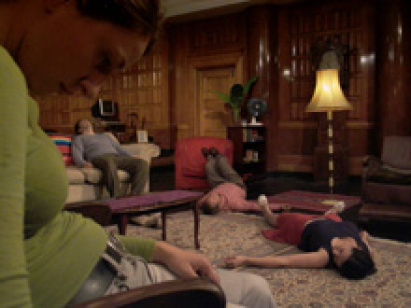
Five large video projections shown concurrently. The unbroken, real-time shots of domestic scenes explore innocuous, seemingly insignificant events. Everyday incidents are played very slowly. The consciousness of each performer escapes the intention of their slow action. As the nuances change in the slowly shifting picture, the subtle inference of relationships and situations is constantly modified. There is an acute awareness of being alive, of horror and of wonder. Elements within the picture - a fire, running water – are reminders that time has not slowed down. Unlike a fixed image that arrests and holds onto a moment, here moments inexorably slip by.
The performers’ sense of awkwardness and isolation alerts the viewer to the imperfect stillness. Sounds from the video images invade the space to create an uneasy sense of instability. The movement produces inadvertent and painful noises of creaking, cracking floorboards and furniture in the performers attempt to be silent.