Prof David Burrows
- Professor, Head of Undergraduate Fine Art Media
Featured Media
Slade School of Fine Art
University College London
Gower Street
London
WC1E 6BT
Biography
David Burrows is an artist and writer interested in notions and concepts of the new in sacred, mass and avant-garde cultures. He studied at Goldsmiths College and graduated in 1994. He was selected for Becks Futures in 2001 and received a Paul Hamlyn Visual Artists Award in 2003. His current practice addresses the production of fiction as a transformative process as well as notions of impermanence and immanence, developing interests explored in earlier work that addressed violence, destruction, crisis and disorientation as structural elements in sacred, mass media and avant-garde cultures.
David Burrows has published essays and reviews in magazines and journals including Art Monthly, Variant, Mute, Angelaki, New Left Review and catalogue essays for DJ Simpson, Jemima Stheli and Mark Wallinger and Manuel Ocampo. He has edited anumber of books of collected essays including 'Whose Afraid of Red, White andBlue' 1998, 'Making a Scene' (with Henry Rogers) 2001 and 'Performance Fictions' 2011 all addressing art, performance, scenes and politics, and all published by Article Press.
As well as establishing a solo art practice he often works in collaboration. Past collaborations include exhibitions with the artists' group BANK, Bob & Roberta Smith and DJ Simpson. Since 2005, he has collaborated with Simon O’Sullivan to address the relation of aesthetics, politics and the sacred through the 'performance-fiction' Plastique Fantastique. Through the production of events, films, comics, writing, installations and artifacts, Plastique Fantastique (a group of human and inhuman avatars) deliver communiqués from the extreme past and future that are baroque, express a subversive urgency and are frequently participatory. 'First Manifesto of Plastique Fantastique’ proposes a practice that moves participants “from work time (utility) into sacred time (play)” by executing practice as ritual and performance.
Before taking up the post of Head of Undergradute Fine Art Media at the Slade School of Fine Art in 2010, he was Reader in Fine Art at Birmingham City University, where he worked in the School of Art from 1997 and where he coordinated Fine Art Research.
David Burrows has exhibited extensively in the UK and abroad including Chisenhale Gallery London, Arts Space Sidney, Mori Art Museum Tokyo, Frederieke TaylorGallery New York, Galerie Praz-Delavallade Paris. He has participated in the 2010 Tatton Biennial and 'Event Horizon' at the Royal Academy of the Arts, London (with Simon O’Sullivan). In 2003 he exhibited in the British Council survey exhibition 'Macro/Micro: British Art 1996 – 2002', Kunsthalle Budapest. David Burrows and the collaboration Plastique Fantastique are represented by IMT Gallery in London.
Research Summary
I work individually and in collaboration to explore notions and concepts of the new in avant garde, utopian, sacred and mass media cultures. A second research concern is the investigation of the ways in which fiction and performance are transformative processes or processes through which worlds and relations are formed and maintained. This research draws upon continental philosophy and theories concerned with subjectivity, ontology and performance and performativity. I am interested in the ways that art and other social and cultural formations can be understood as residual or emergent cultures that resist, escape or open up different orientations to the dominant organisations of everyday life. In relation to this, exploring the legacy of the avant garde and the role of scenes in developing new orientations has been an ongoing concern, both as an object of study and as an aspect of my art practice, collaborations and curatorial projects. These research concerns have developed from earlier work that addressed the ways that impermanence and immanence, violence, destruction, crisis and disorientation are important structural elements in popular and mass culture and avant-garde culture. A corollary of these concerns is an interest in art and writing and the ways in which writing is an aspect of art practice. This interest relates to my recent research concerned with the diagrammatic, and art as a diagrammatic presentation or practice that escapes or is captured by discursive regimes. Since 2005, I have collaborated with Simon O'Sullivan on the 'performance fiction' Plastique Fantastique, which explores the relation of art, politics and the sacred. Through the production of events, films, comics, writing, installations and artifacts, Plastique Fantastique (a group of human and inhuman avatars) deliver communiqués from the extreme past and future that are baroque, express a subversive urgency and are frequently participatory. The 'First Manifesto of Plastique Fantastique’ proposes a practice that moves participants “from work time (utility) into sacred time (play)” by executing practice as ritual and performance.
Recent exhibitions include:'Night is also a Sun', IMT Gallery London 2012; 'The Diagram: Blackboard Series' Banner Repeater London and Torna Istanbul 2011; 'We are grammar' Pratt Gallery New York 2011; 2010 Tatton Park Biennial; ‘Event Horizon’ at the Royal Academy of the Arts, London. Recent published writing: 'Performance Fiction', Article Press and Mute (2011) 'An art scene as big as the Ritz: the logics of scenes' in ‘Deleuze & Contemporary Art’, Edinburgh University Press (2010), 'The Chymical Wedding: Masochism and Performance', Angelaki (2010 with Simon O’Sullivan) and 'Readymades, Lavender Mist and Mirror Travel' in ‘Deleuze, Guattari and the Production of the New’, Continuum (2009).
Teaching Summary
I am Head of Undergraduate Fine Art Media at the Slade School of Fine Art, teaching practical and theoretical aspects of Fine Art. I have taught undergraduates, graduates and research students, supervising two doctoral students to completion.
Exhibitions
Mars Year Zero 2019 - Dilston Gallery, Southwark Park Galleries, London
Mars Year Zero is a speculative story of CIMON (Crew Interactive Mobile companiON manufactured by the international space station) and other artificial and automated intelligence and tech-animals. The exhibition narrates the escape of these avatars from human bondage, and their attempts to bring chaos to order and found a society of friends in a precarious and hostile environment.
Through film, music, images, comics, artificts and performance, the UK-based group Plastique Fantastique present a sci-fi fiction addressing precarious ecologies and the 'notion of staying with the trouble', as well as nascent tech-life in which human and non-human natures meet. This exhibition explores the political and fictional aspects of narratives found in the news, everyday media and the promotional material of corporations concerning environmental and space-exploratory narratives, at a time when space has become the horizon for not just scientists and governments but business and elites.
Zero City 2019 - IMT Gallery, London
Zero City is an exhibition and performance by Plastique Fantastique that addressed narratives of the future found in contemporary politics and business. Through film, digital prints and sculpture the exhibition addressed the theme of zero and production, work contracts and consumption and waste, and also the notion of a year zero following the artificial intelligence singularity. The exhibition looked at projected new subjects and human-machine relations and life, tracing tropes of mastery and enslavement and sacrifice in the narratives found in the news media, and political and commercial ventures.
Landscapes of the Future 2018 - Helsinki Contemporary, Helsinki Finland
Landscapes of the Future Helsinki Contemporary Group show curated by Beaconsfield Art Works including David Burrows, Anna Bunting-Branch, , BAW (aka David Crawforth and Naomi Siderfin) in collaboration with Bruce Gilbert, Onya McCausland, Kieth Piper, Ioana Marinescu and Philip Thompson.
'Diagram of the Horizon of a Black Hole: Blind Date Implosion' 2018 - Installation Of Mix Media And Audio Work - Helsinki Contemporary
'Diagram of the Horizon of a Black Hole: Blind Date Implosion' is a work presented in the grouo show, Landscapes of the Future. The work explored the diagrammatic imaginary of physics and science illustartions for lay-people as well as contributing new perspectives on how ieas about the genre of landscape in art might be transformed through scientific perspectives.
Past Future Catcher Repeater: The Story of the Vril 2017 - Nun's Theatre, Galway, Ireland
'Past Future Catcher Repeater: The Story of the Vril' was an exhibition and performance commisioned for the TULCA Arts Festival in Ireland. The exhibition and performance consisted of a two films, objects/propos and a narrative and audio delivered by performers. 'Past Future Catcher Repeater: The Story of the Vril' addressed various myths of a post-Anthropocene futures.
Welcome Traitor Meme! 2017 - MAC Belfast, DCA Dundee, Bury Museum and Gallery, UK
'Traitor Meme' was an installation consisting of two film projection with audio, nine panels and rope. The installation was also the site for a performance with same title, and as an element of the work. The work addressed the notion and theory of memes in relation to memes that are transformative or invite sacrifice. This involved researching the hanging man tarot card (an image of inversion, betrayal and and equivalent images or figures foumd in social media sites and the internet. The work combined the forms of medieval culture (mumming in relation to the performance, and tarot cards in relation to contemporary imagery) with forms of digital media. This made the work an important contribution to the exhibition 'Shonky', which was a Hayward Gallery touring show that explored the aesthetics of awkwardness and was curated by John Walter. The exhibition toured MAC Belfast, DCA Dundee and Bury Museum and Art Gallery. The exhibition featured a full colour catalogue published by the Southbank/Hayward Gallery.
After London 2016 - Horse Hospital Art Centre, London UK
After London was a Plastique Fantastique residency, exhibition and performance event that addressed the effects of platform capitalism and environmental changes on the relationships and cultures of London. Through sculpture, film and projection and performance, and through collaboration with Orphan Drift and hosting other artists, a future map of London was drawn,
Obliteration Device 2014 - IMT Gallery, London, UK
Curator of exhibition of work by Jakup Auce, Aline Bouvy, David Burrows, John Cussans, Benedict Drew, Ryan Jordan, Roberto Peyre, Simon O’Sullivan, Hannah Sawtell, Tai Shani. The exhibition addressed the notion of art, notions of singulairty and diagrammatics.
Pigdogmonkeyfestos 2014 - Airspace Gallery
Contributed collaborative work to exhibition exploring contemporary artists' use of manifestos.
In outer space there is no painting and sculpture! 2014 - Summerhall
The exhibition consisted of three works, commissioned by Summerhall for Edinburgh Science Festival 2014. The exhibition addressed different conceptions and diagrammatic approaches to singularities, gravity and light. 'Have you ever seen an atom?' is a 5 x 5 meter circular assemblage made from wood, glitter, paper, card, polyethelyne foam and light paper and also consisted of audio and video work. This work addresses themes of time and space and references diagrams of singularities produced by scientists to popularize ideas of relativity and quantum physics. This work was presented as a fiction, as an aftermath of a wormhole virus being unleashed by the Revolutionary Army of Astrophysicists who weaponize black holes to attack everyday consumer culture and values. The audio-video work presented animations of digital and domestic consumer objects and scientific concepts. The films and hand-made objects presented were distorted, slowed or repeated as if caught in the accretion disc of a black hole. The work was developed in part from research undertaken for UCL's 'Wonders of the Cosmos' seminar series for which I presented a paper exploring the concept of a diagrammatic imaginary developed by researching different scientific and aesthetic practices. The exhibition further developed ideas about diagrams discussed in the paper concerning the imaginary and the real, and mathemes and pathemes. As well as this, a double projection titled 'Eyes are a gift of the Sun' (addressing ideas about light and invisibility) and a single channel video titled 'In outer space there is no painting and sculpture!', (a diagram of a singularity and collapse of gravity, using GIFs of animals downloaded from the intranet) were also exhibited.
Animation, Infiltration, Documentation Video Show 2014 - Hal Project Space, Space Mass
Contributed collaborative film to exhibition exploring performance and documentation.
'The Starseed Transmission: a diagrammatic message from outerspace' 2013 - Enclave, 50 Resolution Way, London, UK
The film 'All the fantasies of the people' and the assemblages 'Gabba, gabba, gabba, all hail the great gobbler 1' and ''Gabba, gabba, gabba, all hail the great gobbler 2' were produced for the group exhibition, 'The Starseed Transmission: a diagrammatic message from outerspace', addressing non-language-based diagrammatic communications. The starting point for the show was Carl Sagan's diagram engraved onto NASA’s Pioneer 10, now over 8 billion miles away, intended as a message for intelligent life. The show also presented work by Sovay Berriman, Plastique Fantastique, Rowena Harris, Dean Kenning and Inês Rebelo.
Magic Eye 2013 - Grand Union
Contributed collaborative work exploring feedback loops produced by consumer culture and diagrams of life cycles of parasites, through fictional characters, sculpture and film.
Your Extinction, Our Future 2013 - IMT Gallery
The collaborative exhibition explored subjectivity as feedback loops, the legacy of cybernetics and the mutation of language in social media through film projections, hand-made posters and assemblages. The exhibition was supported by the Arts Council of England.
Changing 2013 - Griffin Gallery
Contributed to exhibition exploring painting as an expanded practice.
Swarms of Black Flies Make the Roses Purple 2012 - IMT GAllery, Unit 2/210 Cambridge Heath Road London E2 9NQ UK
Swarms of Black Flies Make the Roses Purple presented instances of collaboration practices concerned with technologies of production. In particular the exhibition explored how contemporary artists manipulate technologies for artistic purpose. With precedents provided through the work of William S. Burroughs and Brion Gysin (whose work was included in the show) the exhibition presented new works that investigate artistic communion and transmutation. Collaborative work I produced with Simon O'Sullivan for the exhibition explored the use of mathemes (diagrams) as process for writing and imagining subjectivities and avatars and the manipulation of reading/speech functions of computers to produce 'cut-up' texts.
There is not and never has been anything to understand! 2012 - ASC Gallery, 128 Blackfriars Road, London, SE1 8EQ
The exhibition was curated by myself and Simon O'Sullivan as a communiqué from Plastique Fantastique, our performance fiction collaboration. Our curation of the work by 21 artists, artist collectives and theorists (including Reza Negarestani, Suzanne Treister, John Russell, Joanne Tatham & Tom O'Sullivan, Benedict Drew and John Gillis & Aline Bouvy, John Cussans & Roberto Peyre, Dean Kenning, Pil & Galia Kollectiv) involved inviting practitioners to collaborate on a large installation and fanzine publication. The exhibition presented new art by practitioners working with diagrammatic approaches and/or concerned with traversing genres. The exhibitors shared an interest in fiction, appropriation and speculative thought or the inhuman. The exhibition was conceived as a 'crystalline' presentation that challenged conventions of exhibiting discrete and separate works, achieved by placing works in a diagram pasted throughout the space and curating the sound-bleed of the various audio works to create a layered and disorientating effect. The exhibition was a meta-diagram presenting and producing relations between cosmic, biological, social and political and sacred economies. Simon O'Sullivan and myself produced two works for the show, an 'Alter to the pre-industrial modern' in collaboration with Tom Clark, and 'Plastique Fantastique crystal matheme'. The exhibition concluded with two performances by WE and Neil Chapman and Ola Stahl.
THIS THIS MONSTER THIS THINGS 2012 - Focal Point Gallery Southend Central Library Victoria Avenue Southend-on-Sea Essex SS2 6EX
‘THIS THIS MONSTER THIS THINGS’, was curated by Giorgio Sadotti curated the exhibition and created an exquisite corpse from objects produced by fifty-one artist each producing a body part for a monster.
This process resulted in a meta-artwork, a bastard object or a curatorial monster that mockingly presents a ‘complete’ entity.
I produced a colon for the monster with songs - 'Power of Love', 'I feel Love', 'Love will tear us apart' - to form the sound of a troubled digestion system.
Night is also a Sun: G-lbl Hystr-c P-nc J-peg 2012 - IMT Gallery, Unit 2/210 Cambridge Heath Road London E2 9NQ UK
'Night is also a Sun: G-lbl Hystr-c P-nc' J-peg was an exhibition of hand-cut paper cut-outs, mobiles and audio-visual work that addressed viral mutation, propagation, repetition and collapse. A collision between visual styles, the artifice of pictograms and the characteristics of the handmade was staged through mixing the analogue and the digital.
The exhibition explored one proposition: ‘Pain is also joy, curse is also a blessing, night is also a sun…’ That is, the sun – an analogy for enlightenment – is eclipsed by the intensity of its after-image, (absolute vision is blind and blinding). The exhibited work draws upon traditional, folk and mass media artifacts such as Halloween silhouettes, Chinese paper cuts and flow diagrams and presents search-engine trash as good fortune charms, sigils and diagrams and symbols of anxiety and aspiration.
Mulitverse Expanded and Multiverse 2011 - 'Mulitverse Expanded' was at Akershus Kunstsenter, Lillestrom, Norway and 'Multiverse' was at Danielle Arnaud contemporary art 123 Kennington Road, London SE11 6SF UK.
'Mulitverse Expanded' at Akershus Kunstsenter Norway 2011 is the expansion of an ongoing exhibition project instigated by Ole Hagen, with Multiverse at Danielle Arnaud in London and its accompanying performance event Open Multiversity at Swedenborg Hall in 2009, for which myself and Simon O'Sullivan produced texts, artworks and performances for. The project invited six artists and the writer Michael Morcock to experiment with fiction and narrative as a tool for investigating notions of multiple worlds and universes within science, art, culture and philosophy. Simon and I produced diagrams of performances (figures for the processes, fictions and subjective and physical states that the performances produced) in the form of films, assemblages and large-scale wall works. The diagrams drew upon figures produced by modern thinkers such as Henri Bergson and Jacques Lacan, but also folk and sacred imagery that presented finite and infinite relations and transformations and becomings.
The Diagram: Blackboard Series 2011 - Space London and Dail Zero for Istanbul Biennale, Torna Istanbul.
The exhibition invited artists and a philosopher to produce a blackboard drawing, reflecting their interest in diagrams. The project was curated by Banner Repeater and Folio Magazine for Space London and Dail Zero for Istanbul Biennale, Torna Istanbul. I appropriated a world health organization diagram presenting epidemics to produce a flow diagram of hysteria and human and animal mutation. The diagrams produced for the project were photographed in London where they were sent to Istanbul to be redrawn, which causing further mutations of icons and symbols. My diagram was produced with this process in mind. I also produced a text, 'The Diagram: a user's guide', that explored anthropological, philosophical and aesthetic notions concerning diagrams for a publication produced by Banner Repeater. Also taking part were John Mullarkey, Claire Nichols, Dean Kenning, Clunie Reid.
Impossible Diagrams 2011 - One Film Projection, Three Monitor Works, Posters Mmanipulated By Hand, Glitter, Wax Candles, Insense, Coloured Gels For Lights. - Grey Area, Brighton, UK
The exhibition explored the ways in which art, as a diagrammatic practice, facilitates the production of impossible objects and events, in ways similar to how topology and mathematics facilitates the infinite to be thought. Through one projected film, three monitor works and 23 hand-manipulated printed posters works. The work was presented through the collaboration Plastique Fantastique. The diagram was utilised as means for capturing the relations and experiences produced through performance art and ritualised performance.
Plastique Fantastique TV: towards non-human propaganda! 2011 - One Film Projection, Posters Mmanipulated By Hand, Glitter, Plaster Board, Wood. - Xero, Coma & Kline, London, UK
The exhibition consisted of an hour long compilation of films that presented documentation of performances spliced and edited into recorded television programmes and news casts, emphasising and exploring the flatness and formal aspects of the TV screen often overlooked by conventional TV. 30 original posters, manipulated by hand through drawing and spraying, presented texts, images and diagrams concerning modes of performance that employed disorientation and play as mythopoetic art practice.
We are grammer. 2011 - Pratt Institute, New York, US.
The exhibition presented a survey of art practices that employed text and writing, different to first and second generation conceptual artists. The exhibition focused on the use of language in art located at the intersection of philosophy, current thinking on art, and contemporary theories of language. The exhibition presented collaborative art work made with Simon O'Sullivan, as plastique fantastique, that explored the notion of performance fiction.
Rubble Stir 2010 - Wire, Paper, Card, Perpsex, Cd Of Three Songs, Cd Player And Speaker. - The Glue Factory, Glasgow, UK
Work presented for the exhibition included a mobile of images derived from news images of a single day, and sculpture reference russian constructivist propaganda machines broadcasting three songs concerning work, labour and the future. The works combined to reflect upon different notions of the new in mass and avant-garde culture.
Avalon 2010 - DVD Film, Glitter And Pigment, Paper, Card, Leather, Perspex. - Embassy Gallery, Edinburgh, UK
The exhibition surveyed contemporary art practices identified with 'a new medievalism' and an interest in folk, craft and scared cultures as means of critiquing modernity and economic and social structures. The exhibition concerned work that reveisted the past to investigate a 'pre-modern futurity'. Work presented through plastique fantastique collaboration utilised the notion of sigils and détournement to present logos from communication industries as 'spell-binding' symbols of capture that utilise repetition to become part of the fabric of culture.
Dead fingers talking 2010 - Perspex, Leather, Wax, Plasticine, Cd, Cd Player, Speakers, Feathers, Crystals - IMT Gallery, London, UK
Dead Fingers Talk was an exhibition presenting two unreleased tape experiments by William Burroughs from the mid 1960s alongside responses by 23 artists, musicians, writers, composers and curators. Few writers have exerted as great an influence over such a diverse range of art forms as William Burroughs. Burroughs, author of Naked Lunch, The Soft Machine and Junky, continues to be regularly referenced in music, visual art, sound art, film, web-based practice and literature. One typically overlooked, yet critically important, manifestation of his radical ideas about manipulation, technology and society is found in his extensive experiments with tape recorders in the 1960s and ’70s. Dead Fingers Talk: The Tape Experiments of William S. Burroughs was the first exhibition to truly demonstrate the diversity of resonance in the arts of Burroughs’ theories of sound. Work exhibited for the exhibition, as plastique fantatsique, explored Burroughs notion of recordings as reality, mixing recorded sounds of cats with recent news broadcasts and recordings of fake new broadcasts.
Tatton Biennial 2010 2010 - Performance, Printed Comic (edition 8000), Assemblage Made From Steel, Paint, Perspex, Wire, Ribbon, Wood, - Tatton Park Gardens, Chesire, UK.
The work 'A history of the visitation' presented for the Biennial included a public art work/structure, two performances and comic. The research addressed alternative forms for a public art work other than that of sculpture in a public space by investigating a local myth about a site - and through re-enactment and fiction, engaging the audience in performance and the creation of myth. The performances and the comic explored notions of ritual and disorientation as a means to arrest habit and habits of perception. in doing so, the structure referenced Robert Smithson's ideas and interest in enantiomorphic chambers and the performances referenced performance art engaged in acts of endurance from the 1970s.
Library of Babel/in and out of place 2010 - Polyethylene Foam - Zabludowicz Collection, London, UK
Man Plus 2009 - DVD Films, Dvd Players, Speakers, Wood, Paint, Paper, Foam, Soundtrack For Radio Broadcast - DX DIY Art Centre: The Old Police Station, London, UK & Oticalradio broadcast
The research explored the notion of a body without hierarchies in science fiction, in particular in Frederik Phol's novel 'Man Plus', comparing and marking similarities to Antonin Artaud's notion of the body in 'To be done with the Judgement of God' in which the term 'Body Without Organs' is first used.
Salute in the distance 2009 - Paper, Card, Polyethlene Foam - Star Space, Shanghai, China
The theme of the exhibition was translation. For this two person show with Miao Xiaochun, work was presented that examined the notion of evolution and cultural presentations of nature and culture in mass culture and art.
Stranger things are happening 2009 - Glitter, Pigment, Perpsex, Masks Made From Felt, Card, Paint. - Aspex Gallery, Portsmouth, UK
Stranger Things Are Happening brought together artists that use diverse media to create works which convey bizarre scenarios, poking at the human psyche. The artists involve themselves either as character or as narrator, using theatrical backdrops and humour to delve into the more challenging and questionable asp ects of society. They invent fantasy personalities and situations that examine matters such as the hysteria around mass media and popular culture, and the place the characters (or us as individuals) have within them. The work presented through the collaboration plastique fantastique addressed notions of performance fiction and the notion of impermanence and the ways in which the new and time are presented in consumer culture and folk culture.
Multiverse 2009 - DVD Film, Glitter And Pigment, Felt, Perspex. - Danielle Arnaud Gallery, London, UK
Multiverse brought together artists who use fiction to access the virtual potential for multiple co-existing worlds. The term multiverse, first coined by William James, has become associated with quantum theory and new cosmology. Applied to the universe it implies that there could be an infinite number of universes decohered from each other. It also operates in relation to the idea of a multidimensional hyperspace. The scientific future of the term might be uncertain, but it can describe a radical way of considering fiction. For the exhibition, through the collaboration Plastique Fantastique, works presented explored notions and forms of the diagram to present subjective experience of performance and the multiplicity of potential fictions that imagine non human worlds or durations. In particular, the Möbius Strip, impossible objects from mathematics, Lacan's Torus and Bergson's cone were utilised to explore ways of making the multiplicity and infinity of the multiverse accessible to thought through art works and drawings.
Star Maker 2009 - E:vent Gallery, London, UK
Star Maker was devised by Mark Harris and David Burrows, both of whom thought of an exhibition drawing upon ideas about matter, life-forms, time, entropy and utopia in Olaf Stapledon’s book Star Maker at exactly the same time. The pair surveyd and selected artists that shared a common interests in the non-human and the cosmic, entropy and geological time.
Event Horizon 2008 - Perspex,felt, Paper, Wood, Shoe, Glitter, Pigment, Dvd Film Projections, - Royal Academy of Art, London, UK
'Diagrams of the Black Mass for Partial Objects' was an installation, presented for the exhibition Event Horizon. The work was produced in collaboration with Simon O'Sullivan as Plastique Fantastique. We produced a diagram, in the form of a large glass, a vitrine and a felt mat, referencing the alchemical and mathematical notions found in the work of Marcel Duchamp, Henri Bergson's notion of the 'pure present' and sacred practices concerned with immateriality and impermanence. The assemblage was designed as a platform to frame mass media images and consumer objects. The work was designed to foreground and contrast different notions of the new, temporality, duration and materiality. Films of the black mass performance were on display for the duration of the show, the works were 'activated' through the performance of a 'Black Mass for Partial Objects' (a term used to designate elements within arrangements or economies of desire).
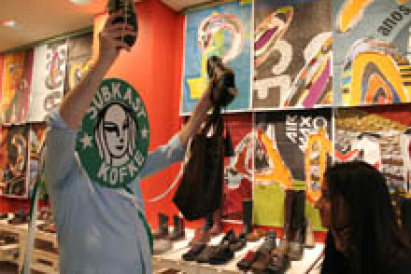
The performance took place in Bond Street - through a procession and the purchasing of fashion items - and in the Galleries of the Royal Academy - where the objects were 'fossilised' through emersion in oil and silicon and glitter. Following this, an inversion occurred, a member of the performance group was inverted and a 'demon' broadcast a communiqué concerning the technologies of consumer culture and the ways in which time is captured or presented by such technologies.
The research took the form of performance and fiction to explore temporality in art, mass media and scared cultures.
One Day Comic 2008 - Comic Book And Billboards - Eastside Projects, Birmingham and City of Birmingham, UK
Berlin-based Henrik Schrat’s one-day-comic concept focuses on the short term, but intense cooperation of two artists or artist-groups. Without any previous preparation, two artists meet in the morning, and start to develop a comic strip together – to be completed in one day. Schrat's collaboration with the collaboration Plastique Fantastique produced a comic called 'product clearing' that examined consumerism and ritual. The comic appeared on bill boards in the city and advertised a website where the adventures of individuals 'cured' of consumerism could be found.
100 years, 100 artists, 100 works 2008 - Rochelle School Gallery, London, UK and TFL
Transport for London (TFL)/Platform for Art commissioned 100 artists were asked to reflect on the Roundel design that signifies the tube system and produce a work. Work was exhibited at Rochelle school and made into editions of prints.
Protocols for Deceleration 2008 - DVDs, Monitors, Performance, Perspex, Felt, Glitter, Prints On Paper, Ribbons, Wax Candles, Broom, Stopwatch, Whips - Outpost Gallery, Norwich
The exhibition, presented through the collaboration of Plastique Fantastique, was designed as a series of 'clearing' stations to disconnect the veiwer, wishing to follows a series of protocols, from their attachment to objects, commodities and identifications. The exhibition addressed how performance art echoes the practices of religions, cults and state institutions concerned with subjectification, control and enlightenment.
New Work UK Screenings 2008 - DVD - Whitechapel Art Gallery, London, UK
The screening event presented the film 'The Chymical Wedding' produced through the collaboration Plastique Fantastique, and addressed the notion of the impossibility of the sexual relation through performance and masochism. The Chymical Wedding was a parade and ritual performed at Tate Britain that looked back to the custom of ‘mumming’. Traditionally, ‘mummers’ would wander the country, drunk and in masks, and gatecrash New Year festivities to perform a play. Drawing also upon Sascha Masoch and John Dee, The Chymical Wedding forms part an ongoing series of communiqués.
All over the new smart 2008 - Paper, Card, Polyethlene Foam - f a projects, London, UK
The exhibition presented magazine covers as messages from strangers, designed to channel our attention in specific ways, through the signifying and asignifying (or affective) aspects of the images and material properties of the glossy covers. The covers were presented as powerful and affective 'technologies' or designs that demand and construct specific subjectivities. Through the collages, Burrows explores, amongst other things, the following three approaches as a means of responding to these messages, with the aim of harnessing or countering the power of these mass media communiqués.
Doodles - a playful technology that harnesses the durations that escape attention paid to everyday matters. Doodles are made in a distracted, absent-minded state without the aim of communication. Burrows’ doodles create ‘all-over’ and ‘from any-direction-whatever’ compositions.
Diagrams - a technology that marks out or indexes movements, forces, thoughts, actions and desires that traverses representation.
Sigils - abstract or graphic images and symbols, often made with extreme care and craft, which are developed from spelling out and then abstracting wishes and incantations. Through this process, the original wish or incantation is forgotten except at an unconscious level. In practices that utilise sigils, the wish is burnt into the mind by an individual concentrating intently on the sigil which is often destroyed at the end of the process. The covers, with their logos and images of consumer culture were presented as powerful sigils, and the work, in turn was presented as seeking to produce new, 'detourned' or counter sigils.
Plague of Diagrams - ICA, London, UK
"How many of these rough political rats are there around us? How many of them break things they don’t understand? How many of these rats simplify? How many of them have built such homogeneous, cruel systems upon the horror of disorder and noise?" Michel Serres, The Parasite
"The plague is met by order; its function is to sort out every possible confusion." Michel Foucault, Discipline & Punish
Plague of Diagrams was an exhibition and a programme of performances, talks and discussions concerning the relationships between diagrammatic practices and thought in different disciplines. In particular, the event explored the function and use of diagrams in art as expanded diagrammatic practice beyond the graphic presentation of information.
The event explored diagrams as actual/virtual machines that while taking material form and indexing existing relations and objects, point to other arrangements. As Gilles Châtelet declared, diagrams are gestures that invite other gestures. This is a vision of diagrams as abstract machines activated through performance or thought; a notion of diagrams as relays that connect or traverse different times and spaces. It is a conception of diagrams as critical and logical exploratory devices that, in presenting what is not apparent or visible—real abstractions, potential modes of being, hidden relations—paradoxically depend on the register of the imaginary and the inventive production of images, figures and gestures.
Since the Enlightenment, when diagrams facilitated scientific and statistical breakthroughs, to cybernetic research of the twentieth century, to the algorithmic devices that govern relations and economies today, diagrams have extended and organised human culture. While diagrams have proliferated we can draw a distinction between diagrams that index and deliver knowledge, and diagrams that pose problems and facilitate thought as an exploratory process. Plague of Diagrams addressed not just the critical and organisational functions of diagrams but the art of diagramming too, while taking account of the reductive, controlling or ideological use of diagrams.
Plague of Diagrams was organised by David Burrows and Dean Kenning in collaboration with Ami Clarke, Andrew Conio, John Cussans and David Osbaldeston. The collaboration has developed out of discussions and events staged by the Diagram Research Use and Generation Group (DRUGG).
Contributors
David Burrows, Rachel Cattle & Jenna Collins, Neil Chapman & Gillian Wylde, Ami Clarke, Richard Cochrane, Andrew Conio, John Cussans, David Burrows, Benedict Drew, English Heretic, Nikolaus Gansterer, Joey Holder, Dean Kenning, Christoph Lueder, Stine Llungdalh, Adelheid Mers, Mike Nelson, Paul O'Kane, David Osbaldeston, Plastique Fantastique, Patricia Reed, John Russell, Erica Scourti, Andy Sharp, Kamini Vellodi, Martin Westwood and Carey Young.
What the Frog's Eyes no longer tell the Frog's Brain - IMT Gallery London, UK
The exhibition addressed cybernetic cultures through the eyes of the machines and animals created or used in the experiments of first, second and third periods of cybernetic research. The exhibition examined narratives of performance and superiority in commercial applications of cybernetics and computing, and included an animation based on the 'Mac v PC' adverts made by Apple.