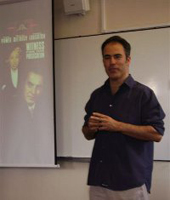
Professor David A. Lagnado
Research Interests
My research focuses on the psychological processes that underlie human learning, reasoning and decision-making.
A major theme is the central role played by causal models in cognition: how people learn models from uncertain data, and use these models to draw inferences and make decisions. I have applied this work to investigative and legal reasoning, showing how people use causal models to interpret evidence and make decisions. I also explore how people generate and evaluate explanations, and the interplay between causal thinking and judgments of responsibility and blame.
Contact
Professor David Lagnado
Course Director, MSc Cognitive and Decision Sciences
Experimental Psychology
University College London, UK
E-mail: d . lagnado @ ucl . ac . uk
Publications
2019
de Zoete, J., Fenton, N. E., Noguchi, T., & Lagnado, D. A. (2019). Countering the ‘probabilistic paradoxes in legal reasoning’ with Bayesian networks. Science & Justice [pdf]
Fenton, N., Neil, M., Yet, B., & Lagnado, D. (2019). Analyzing the Simonshaven Case using Bayesian Networks. Topics in Cognitive Science.
Neil, M., Fenton, N. E., Lagnado, D. A. & Gill, R. (2018), Modelling competing legal arguments using Bayesian Model Comparison and Averaging. AI and Law. [pdf]
Pilditch, T. D., Fenton, N., & Lagnado, D. (2019). The zero-sum fallacy in evidence evaluation. Psychological science.
Stolerman, D., & Lagnado, D. (2019). The Moral Foundations of Human Rights Attitudes. Political Psychology.
2018
Blakey, E., Tecwyn, E. C., McCormack, T., Lagnado, D. A., Hoerl, C., Lorimer, S., & Buehner, M. J. (2018). When causality shapes the experience of time: Evidence for temporal binding in young children. Developmental science.
Schneps, L., Overill, R., & Lagnado, D. (2018). Ranking the Impact of Different Tests on a Hypothesis in a Bayesian Network. Entropy, 20(11), 856.
Bramley, N., Gerstenberg, T., Mayrhofer, R. & Lagnado, D. A. (2018). The role of time in causal learning. Journal of Experimental Psychology: Learning, Memory & Cognition.
Gerstenberg, T., Ullman, T. D., Nagel, J., Kleiman-Weiner, M., Lagnado, D. A., & Tenenbaum, J. B. (2018). Lucky or clever? From expectations to responsibility judgments. Cognition, 177, 122-141.
Koskuba, K., Gerstenberg, T., Gordon, H., Lagnado, D., & Schlottmann, A. (2018). What’s fair? How children assign reward to members of teams with differing causal structures. Cognition, 177, 234-248.
Osman, M., Fenton, N., Pilditch, T., Lagnado, D., & Neil, M. (2018). Whom Do We Trust on Social Policy Interventions? Basic and Applied Social Psychology, 1-20
Walasek, L., Yu, E. C., & Lagnado, D. A. (2018). Endowment effect despite the odds. Thinking & Reasoning, 24(1), 79-96.
Kirfel, L. & Lagnado, D. (2018). Statistical Norm Effects in Causal Cognition. Proceedings of the 40th Annual Conference of the Cognitive Science Society.
Pilditch, T.D., Hahn, U., & Lagnado, D. (2018). Integrating dependent evidence: naïve reasoning in the face of complexity. Proceedings of the 40th Annual Conference of the Cognitive Science Society.
Liefgreen, A., Tesic, M. & Lagnado, D. (2018). Explaining away: significance of priors,diagnostic reasoning, and structural complexity, In Proceedings of the 40th Annual Meeting of the Cognitive Science Society.
Dewitt, S., Lagnado, D. & Fenton, N. (2018) Updating prior beliefs based on ambiguous evidence. In Proceedings of the 40th Annual Meeting of the Cognitive Science Society.
2017
Bramley, N., Dayan, P., Griffiths, T. & Lagnado, D. A. (2017). Formalizing Neurath's ship: Approximate algorithms for online causal learning. Psychological Review, 124, (3), 301-338.
Bechlivanidis, C., Lagnado, D. A., Zemla, J. C., & Sloman, S. (2017). Concreteness and abstraction in everyday explanation. Psychonomic Bulletin & Review, 1-14.Gerstenberg, T., Peterson, M. F., Goodman, N. D., Lagnado, D. A. & Tenenbaum, J. B. (2017). Eye-tracking Causality. Psychological Science, 28, (12), 1731-1744.
Lagnado, D. A., & Gerstenberg, T. (2017). Causation in legal and moral reasoning. The Oxford Handbook of Causal Reasoning, 565-601.
Smit, N. M., Morgan, R. M., & Lagnado, D. A. (2018). A systematic analysis of misleading evidence in unsafe rulings in England and Wales. Science & Justice, 58(2), 128-137.
Sarin, A., Lagnado, D. A., & Burgess, P. W. (2017). The Intention-Outcome Asymmetry Effect. Experimental Psychology. 64 (2), 124-141.
Zemla, J. C., Sloman, S., Bechlivanidis, C., & Lagnado, D. A. (2017). Evaluating everyday explanations. Psychonomic Bulletin & Review, 1-13.
Fenton, N., Lagnado, D., Dahlman, C., & Neil, M. (2017). The opportunity prior: a simple and practical solution to the prior probability problem for legal cases. In Proceedings of 16th edition of the International Conference on Artificial Intelligence and Law (pp. 69-76). ACM.
Bramley, N. R., Mayrhofer, R., Gerstenberg, T., & Lagnado, D. A. (2017). Causal learning from interventions and dynamics in continuous time. In Proceedings of the 39th Annual Meeting of the Cognitive Science Society. Austin, TX: Cognitive Science Society.
Kirfel, L. & Lagnado, D. (2017). Oops, I did it again. The impact of frequency on causal judgements. Proceedings of the 39th Annual Conference of the Cognitive Science Society. Austin, TX: Cognitive Science Society.
2016
Alicke, M. D., Mandel, D. R, Hilton, D., Gerstenberg, T. & Lagnado, D. A. (2016). Causal conceptions in social explanation and moral evaluation: A historical tour. Perspectives in Psychological Science. 10 (6), 790-812.
Bechlivanidis, C. & Lagnado, D. (2016). Time Reordered: Causal perception Guides the Interpretation of Temporal Order Cognition, 146, 58-66. [pdf]
Bramley, N. R., Gerstenberg, T. & Tenenbaum, J. B. (2016). Natural Science: Active learning in dynamic physical microworlds. In Papafragou, A., Grodner, D., Mirman, D., & Trueswell, J.C. (Eds.) Proceedings of the 38th Annual Meeting of the Cognitive Science Society (pp. 2567 - 2572). Austin, TX: Cognitive Science Society. [pdf][supplement]
Connor Desai, S., Reimers, S & Lagnado, D. (2016). Consistency and credibility in legal reasoning: A Bayesian network approach. In Papafragou, A., Grodner, D., Mirman, D., & Trueswell, J.C. (Eds.) Proceedings of the 38th Annual Meeting of the Cognitive Science Society. Austin, TX: Cognitive Science Society.
Fenton, N., Neil, M. Lagnado, D. A., Marsh, W. Yet, B., & Constantinou, A. (2016). How to model mutually exclusive events based on independent causal pathways in Bayesian network models. Knowledge-Based Systems, 113, 39-50.
McCormack, T., Bramley, N. R., Frosch, C., Patrick, F. & Lagnado, D. A. (2016). Children's Use of Interventions to Learn Causal Structure. Journal of Experimental Child Psychology. 141, 1-22. [pdf]
Smit, N., Lagnado, D. A., Morgan, R. & Fenton, N. (2016). Using Bayesian networks to guide the assessment of new evidence in an appeal case. Crime Science 5 (1), 1-12.
2015
Bramley, N. R., Dayan, P. & Lagnado, D. A. (2015). Staying afloat on Neurath's boat - Heuristics for sequential causal learning. In Proceedings of the 37th Annual Conference of the Cognitive Science Society (pp. 262-267). Austin, TX: Cognitive Science Society.
Lagnado, D. A. & Gerstenberg, T. (2015). A difference-making framework for intuitive judgments of responsibility. In D. Shoemaker (Ed.), Oxford Studies in Agency and Responsibility, 2, Oxford University Press
Bramley, N. R., Lagnado, D. A., & Speekenbrink, M. (2015). Conservative forgetful scholars: How people learn causal structure through sequences of interventions. Journal of Experimental Psychology: Learning, Memory & Cognition.[pdf]
Chockler, H., Fenton N.E., Koeppens J., & Lagnado, D. A. (2015). Causal analysis for attributing responsibility in legal cases. 15th International Conference on Artificial Intelligence & Law (ICAIL 2015), San Diego, June 8-12, 2015, pp 33-42
Gerstenberg, T., Goodman, N. D., Lagnado, D. A. & Tenenbaum, J. B. (2015). How, whether, why: Causal judgments as counterfactual contrasts. In Proceedings of the 37th Annual Conference of the Cognitive Science Society.
Kominsky, J. F., Phillips, J., Gerstenberg, T., Lagnado, D. A. & Knobe, J. (2015). Causal superseding, Cognition, 137, 196-209.[pdf]
McCormack, T., Frosch, C., Patrick, F. & Lagnado, D. A. (2015). Temporal and statistical Information in causal structure learning. Journal of Experimental Psychology: Learning, Memory, and Cognition, 41, 395–416.[pdf]
Newell, B.R, Lagnado, D.A., & Shanks, D.R. (2015). Straight choices: the psychology of judgment and decision. Psychology Press. Second edition.
Nikolic, M. & Lagnado, D. A. (2015). There aren't plenty more fish in the sea: A causal network approach. British Journal of Psychology. [pdf]
Wilkinson L, Tai YF, Lin CS, Lagnado DA, Brooks DJ, Piccini P, Jahanshahi M (2015). Probabilistic classification learning with corrective feedback is associated with in vivo striatal dopamine release in the ventral striatum, while learning without feedback is not. Human Brain Mapping.
Sloman, S. & Lagnado, D. A. (2015). Causality in thought. Annual Review of Psychology, 66, 223-247.[pdf]
de Zoete, J, Sjerps, M, Lagnado, D. A. & Fenton, N.E. (2015). Modelling crime linkage with Bayesian Networks. Science & Justice.[pdf]
2014
Bramley, N. R., Gerstenberg T. & Lagnado, D. A. (2014). The order of things: Inferring causal structure from temporal patterns. In P. Bello, M. Guarini, M. McShane, & B. Scassellati (Eds.), Proceedings of the 36th Annual Conference of the Cognitive Science Society. Austin, TX: Cognitive Science Society.
Fenton, N., Lagnado, D. A., Hsu, A., Berger, D. & Neil, M. (2014). Response to “On the use of the likelihood ratio for forensic evaluation: Response to Fenton et al.” Science & Justice, 54 (4), 319-320.
Gerstenberg, T. & Lagnado, D. A. (2014). Attributing responsibility: Actual and counterfactual worlds. In J. Knobe, T. Lombrozo & S. Nichols (Eds.), Oxford Studies of Experimental Philosophy.
Gerstenberg, T., Goodman, N. D., Lagnado, D. A. & Tenenbaum, J. B. (2014). From counterfactual simulation to causal judgment. In P. Bello, M. Guarini, M. McShane, & B. Scassellati (Eds.), Proceedings of the 36th Annual Conference of the Cognitive Science Society. Austin, TX: Cognitive Science Society.
Gerstenberg, T., Ullman, T. D., Kleiman-Weiner, M., Lagnado, D. A. & Tenenbaum, J. B. (2014). Wins above replacement: Responsibility attributions as counterfactual replacements. In P. Bello, M. Guarini, M. McShane, & B. Scassellati (Eds.), Proceedings of the 36th Annual Conference of the Cognitive Science Society. Austin, TX: Cognitive Science Society.
Kominsky, J. F., Phillips, J., Knobe, J., Gerstenberg, T. & Lagnado, D. A. (2014). Causal supersession. In P. Bello, M. Guarini, M. McShane, & B. Scassellati (Eds.), Proceedings of the 36th Annual Conference of the Cognitive Science Society. Austin, TX: Cognitive Science Society.
2013
Bechlivanidis, C. & Lagnado, D. (2013). Does the “why” tell us the “when”? Psychological Science, 24, 1563-1572.[pdf]
Fenton, N., Neil, M., Lagnado, D. A. (2013). A general structure for legal arguments about evidence using Bayesian networks. Cognitive Science, 37, 61–102. [pdf]
Fenton, N., Berger, D., Lagnado, D., Neil, M. & Hsu, A. (2013). When ‘neutral’ evidence still has probative value, Science & Justice.[pdf]
Gerstenberg, T., Bechlivanidis, C. & Lagnado, D. A. (2013). Back on track: Backtracking in counterfactual reasoning. In M. Knauff, M. Pauen, N. Sebanz, & I. Wachsmuth (Eds.), Proceedings of the 35th Annual Conference of the Cognitive Science Society. Austin, TX: Cognitive Science Society. [pdf]
Lagnado, D.A., Fenton, N., Neil, M. (in press). Legal idioms: a framework for evidential reasoning. Argument and Computation. [pdf]
Lagnado, D. A., Gerstenberg, T. & Zultan, R. (2013). Causal responsibility and counterfactuals. Cognitive Science, 37, 1036-1073.[pdf]
2012
Zultan, R., Gerstenberg, T. & Lagnado, D. A. (2012). Finding fault: Causality and counterfactuals in group attributions. Cognition, 125(3), 429-440. [pdf]
Frosch, C. A., McCormack, T., Lagnado, D.A., Burns, P. (2012). Are causal structure and intervention judgments inextricably linked? A developmental study. Cognitive Science, 36(2), 261-285.
Gerstenberg, T., Goodman, N. D., Lagnado, D. A. & Tenenbaum, J. B. (2012). Noisy Newtons: Unifying process and dependency accounts of causal attribution. In N. Miyake, D. Peebles, & R. P. Cooper (Eds.), Proceedings of the 34th Annual Conference of the Cognitive Science Society. Austin, TX: Cognitive Science Society, 378-383. [pdf]
Gerstenberg, T. & Lagnado, D. A. (2012). When contributions make a difference: Explaining order effects in responsibility attributions Psychonomic Bulletin & Review, 19(4), 729-736. [pdf]
2011
Lagnado, D. A. (2011). Thinking about Evidence. in Dawid, P., Twining, W., Vasaliki, M. (ed.) Evidence, Inference and Enquiry. Oxford University Press/British Academy. [pdf]
Lagnado, D. A. (2011). Causal Thinking. in McKay-Illari, P., Russo, F., Williamson, J. (ed.) Causality in the Sciences. Oxford University Press. [pdf]
Gerstenberg, T., Lagnado, D. A, Speekenbrink, M. & Cheung, C. (2011). Rational order effects in responsibility attributions. In L. Carlson, C. Hölscher, & T. Shipley (Eds.), Proceedings of the 33rd Annual Conference of the Cognitive Science Society. Austin, TX: Cognitive Science Society, 1715-1720. [pdf]
Gerstenberg, T., Ejova, A. & Lagnado, D. A. (2011). Blame the skilled. In L. Carlson, C. Hölscher, & T. Shipley (Eds.), Proceedings of the 33rd Annual Conference of the Cognitive Science Society. Austin, TX: Cognitive Science Society,720-725. [pdf]
Schächtele, S., Gerstenberg, T. & Lagnado, D. A. (2011). Beyond outcomes: The influence of intentions and deception. In L. Carlson, C. Hölscher, & T. Shipley (Eds.), Proceedings of the 33rd Annual Conference of the Cognitive Science Society. Austin, TX: Cognitive Science Society, 1860-1865. [pdf]
Frosch, C.A., McCormack, T., Lagnado, D.A., Burns, P. (2011). Are causal structure and intervention judgements inextricably linked? Cognitive Science.
Channon, S., Lagnado, D. A., Fitzpatrick, S., Drury, H. & Taylor, I. (2011). Judgments of cause and blame: Sensitivity to intentionality in Asperger's syndrome. Journal of Autism and Developmental Disorders.
Hagmayer, Y. & Lagnado, D. A. (2011). Causal models in judgment and decision making. In Dhami, M., Schlottman, A., Waldmann, M. (ed.) Judgment and decision making as a skill: Learning, Development and Evolution. Cambridge: Cambridge University Press.
Wilkinson, L., Beigi, M., Lagnado, D. A. & Jahanshahi, M. (2011). Deep brain stimulation of the subthalamic nucleus selectively improves learning of weakly associated cue combinations during probabilistic classification learning in Parkinson's disease. Neuropsychology, 25, 286-294.2010
Channon, S., Lagnado, D. A., Drury, H., Matheson, E., Fitzpatrick, S., Shieff, C., Mendoza, N. & Maudgil, D. (2010). Causal reasoning and intentionality judgments after frontal brain lesions. Social Cognition.
Channon, S. Fitzpatrick, S., Drury, H., Taylor, I. & Lagnado, D. A. (2010). Punishment and sympathy judgments: Is the quality of mercy strained in Asperger’s syndrome? Journal of Autism and Developmental Disorders, 40, 1219-1226.
Gerstenberg, T., Lagnado, D. A. (2010). Spreading the Blame: The Allocation of Responsibility amongst Multiple Agents. Cognition, 115, 166-171. [pdf]
Hagmayer, Y., Meder, B., Osman, M., Mangold, S. & Lagnado, D. A. (2010). Spontaneous Causal Learning While Controlling A Dynamic System. The Open Psychology Journal, 3, 145-162. [pdf]
Lagnado, D. A. & Speekenbrink, M. (2010). The Influence of Delays in Real-Time Causal Learning. The Open Psychology Journal, 3, 184-195. [pdf]
Perales, J. C., Shanks, D. R. & Lagnado, D. A. (2010). Causal Representation and Behavior: The Integration of Mechanism and Covariation. The Open Psychology Journal, 3, 174-183. [pdf]
Wilkinson, L., Jahanshahi, M., Gahir, H., Dharmindra, A. & Lagnado, D. A. (2010). Medication impairs probabilistic classification learning in Parkinson's disease. Neuropsychologia.
2009
Lagnado, D. A. (2009). A causal framework for integrating learning and reasoning. Behavioral and Brain Sciences, 32, 211-212.
Moore, J. W., Lagnado, D. A, Deal, D. C. & Haggard, P. (2009). Feelings of control:contingency determines experience of action. Cognition, 110, 279-283. [pdf]
Speekenbrink, M., Lagnado, D. A., Wilkinson, L., Jahanshahi, M. & Shanks, D. R. (2009). Models of probabilistic category learning in Parkinson’s disease: Strategy use and the effects of L-dopa. Journal of Mathematical Psychology.
2008
Lagnado, D. A. & Channon, S. (2008). Judgments of Cause and Blame: The influence of Intentionality and Foreseeability. Cognition, 108, 754-770. [pdf]
Lagnado, D. A. &Harvey, N. (2008). The impact of discredited evidence. Psychonomic Bulletin and Review, 15 (6), 1166-1173. [pdf]
Wilkinson, L., Lagnado, D. A., Quallo, M. & Jahanshahi, M. (2008). The effect of feedback on non-motor probabilistic classification learning in Parkinson’s disease. Neuropsychologia, 46 (11), 2683-2695.
Yu, E., Lagnado, D. A. & Chater,N. (2008). Retrospective evaluations of gambling wins: Evidence for a 'peak-end' rule. Proceedings of the 30th Annual Conference of the Cognitive Science Society, Love, B., McRae, K., Sloutsky, V. (ed.) , 77-82.
2007
Lagnado, D. A. (2007). Perspectives on Daniel Kahneman. Thinking & Reasoning, 13, 1-4.
Lagnado, D. A. & Shanks, D. R. (2007). Dual concerns with the dualist approach. Behavioral and Brain Sciences, 30 (3), 271-272.
Lagnado, D.A., Waldmann, M. R., Hagmayer, Y., & Sloman, S.A. (2007). Beyond covariation: Cues to causal structure. Gopnik, A., & Schultz, L. (Eds.), Causal learning: Psychology, philosophy, and computation. OUP. [pdf]
Hagmayer, Y., Sloman, S.A., Lagnado, D.A. & Waldmann, M. R., (2007). Causal reasoning through intervention. Gopnik, A., & Schultz, L. (Eds.), Causal learning: Psychology, philosophy, and computation. OUP. [pdf]
Newell, B.R, Lagnado, D. A., & Shanks, D. R. (2007). Straight choices: The psychology of judgment and decision. Psychology Press.
Newell, B.R., Lagnado, D.A., & Shanks, D.R. (2007). Challenging the role of implicit processes in probabilistic category learning. Psychonomic Bulletin and Review, 14, 505-511.
2006
Lagnado, D. A., Newell, B., Kahan, S., & Shanks, D. R. (2006). Insight and strategy in multiple cue learning. Journal of Experimental Psychology: General, 135, 162-183. [pdf]
Lagnado, D. A., & Sloman, S. A. (2006). Time as a guide to cause. Journal of Experimental Psychology: Learning, Memory & Cognition, 32, 451-460. [pdf]
2005
Sloman, S.A. & Lagnado, D.A. (2005). Do we ‘do’? Cognitive Science, 29, 5–39. [pdf]
Sloman, S.A. & Lagnado, D.A. (2005). The Problem of Induction. In K. Holyoak & R. Morrison (Eds.), Cambridge Handbook of Thinking and Reasoning, Cambridge University Press.
2004
Lagnado, D.A. & Sloman, S.A. (2004). The advantage of timely intervention. Journal of Experimental Psychology: Learning, Memory & Cognition, 30, 856-876. [pdf]
Lagnado, D.A. & Sloman, S.A. (2004). Inside and outside probability judgment. In D. Koehler & N. Harvey (Eds.), Blackwell Handbook of Judgment and Decision Making. Blackwell.
Sloman, S.A. & Lagnado, D.A. (2004). Causal Invariance in Reasoning and Learning. In B. Ross (Ed.), The Psychology of Learning and Motivation, 44, 287-325. San Diego: Elsevier Science.
2003
Lagnado, D.A. & Shanks, D.R. (2003). The influence of hierarchy on probability judgment. Cognition, 89, 157-178.
2002
Lagnado, D.A. & Shanks, D.R. (2002). Probability judgments in hierarchical learning: a conflict between predictiveness and coherence. Cognition, 83, 81-112.
Lagnado, D.A. & Sloman, S.A. (2002). Learning causal structure. In W. Gray & C. D. Schunn (Eds.), Proceedings of the twenty-fourth annual conference of the cognitive science society, Erlbaum. [pdf]
Sloman, S.A. & Lagnado D.A. (2002). Counterfactual undoing in deterministic causal reasoning. In W. Gray & C. D. Schunn (Eds.), Proceedings of the twenty-fourth annual conference of the cognitive science society, Erlbaum.
2000
Shanks, D.R & Lagnado, D.A. (2000). Sub-optimal reasons for rejecting optimality? Behavioral and Brain Sciences, 23, 761-762.