 Close
Close


The Lemon laboratory has a longstanding interest in LFPs and their functional role. LFPs are interesting for a number of reasons:
- they are involved in long-range transmission of synchronous activity, allowing communication between functionally discrete cortical areas which are anatomically interconnected;
- motor cortex LFP oscillations are synchronised with the motor output and coherent with EMG in contralateral hand muscles. This has provided a new means of investigating cortico-muscular interactions in humans;
- LFPs are information-rich signals that could be used for control of a brain machine interface (BMI). A BMI represents a means of restoring motor control to paralysed and disabled patients.
We have recently made the novel demonstration that LFPs recorded from motor and premotor cortex show clear grasp-related selectivity. Monkeys were trained to observe, reach out, grasp and hold one of six objects presented in a pseudorandom order. It was a common finding that during stable grasp, LFPs in M1 (90/92 sites tested) and PMv (81/97) showed object/grasp selectivity. Selectivity was maximal in the beta range but also present at higher frequencies (30-50 Hz). Interestingly, when the LFP power associated with grasp of a specific object was large in the beta frequency range it was usually of low power in the higher range, and vice-versa.
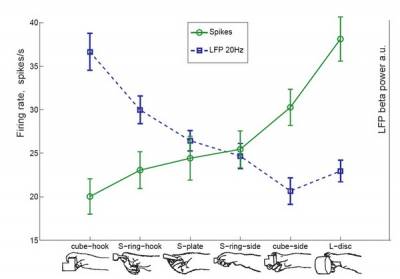
Our current objectives are to investigate the distribution of grasp-specific LFPs across motor and premotor cortices, the relationship of these LFPs and activity of different classes of neurons (including identified PTNs), and the reliability of LFPs as control signal for BMI.
References
Spinks RL, Kraskov A, Brochier T, Umilta MA, Lemon RN (2008) Selectivity for Grasp in Local Field Potential and Single Neuron Activity Recorded Simultaneously from M1 and F5 in the Awake Macaque Monkey. Journal of Neuroscience 28:10961-10971.
Brochier T, Spinks RL, Umilta MA, Lemon RN (2004) Patterns of muscle activity underlying object-specific grasp by the Macaque monkey. J Neurophysiol 92:1770-1782.
Umilta MA, Brochier T, Spinks RL, Lemon RN (2007) Simultaneous recording of macaque premotor and primary motor cortex neuronal populations reveals different functional contributions to visuomotor grasp. J Neurophysiol 98:488-501.