Prof. B. Day

Whole-body Sensorimotor Lab

Lab Head: Professor Brian Day


DayLab News:

Congratulations to Meghan Morley, DayLab team member, for successful completion of her MSc in Clinical Neuroscience.

New brain and behaviour findings in karate experts featured in the Daily Mail, the Telegraph and Sky News!  See publication (open access) in Cerebral Cortex.

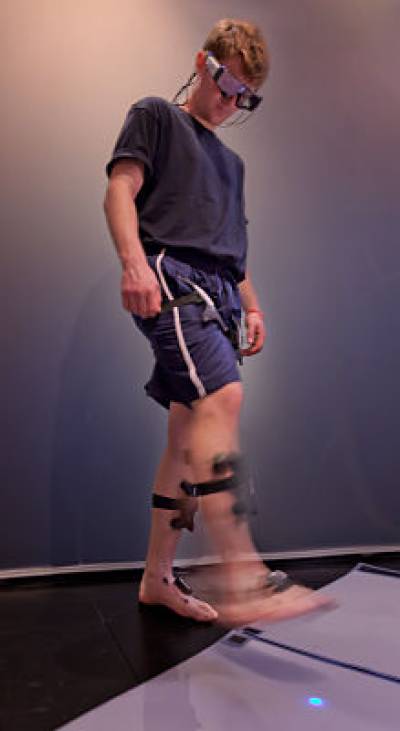
Former team member, Timothy Muller, was awarded the Burnstock Prize for the top intercalating medical student in Neuroscience at UCL.  The prize was given for outstanding exams, coursework and his project here in the lab (picture below).

Former team member, Dr. Lisa Bunn, was presented with the Gordon Holmes Clinical Neuroscience Award by the Royal Society of Medicine on 1st March.  The award was given in recognition of her work with Spinocerebellar Ataxia patients here in the lab.  Story in Frontline Magazine.

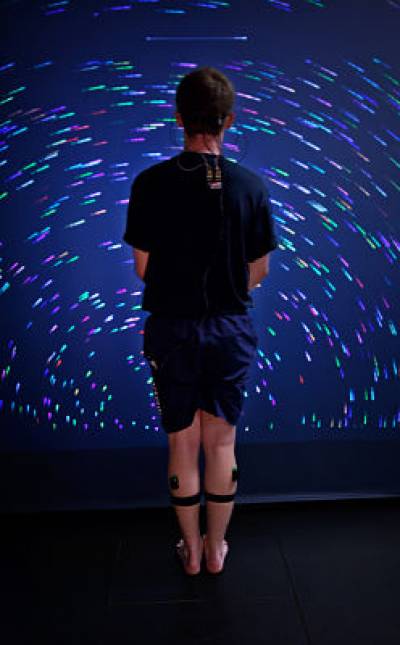
Moving Dots

About us

The laboratory focuses on neural processes that control human movement and balance, and their disorders resulting from damage to the central nervous system.
Our main lines of investigation are aimed at understanding the mechanisms that control and integrate whole-body actions, in particular standing, walking, and reaching. We are interested in how the neural processes combine sensory information from vestibular organs, eyes, muscles and skin to compute motor instructions. The brain regions in which we are currently interested include the cerebellum, basal ganglia, and parietal cortex.
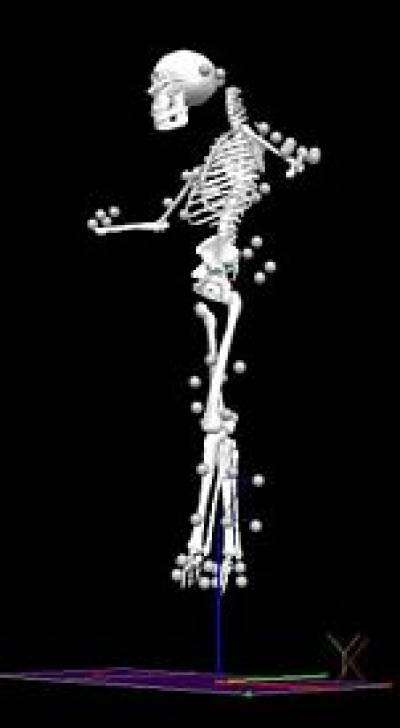
Skeleton

The labs are housed on the 5th floor of 33 Queen Square.

The main research tools consist of non-invasive sensory stimulation techniques coupled with 3D movement measurement technology.

The recording equipment includes eight CODA sensor units each of which can determine the 3D coordinates of up to 56 infrared emitting body markers.

This kinematic information is combined with force data from up to five Kistler force plates and two JR3 6-axis force handles, electromyographic activity transmitted wirelessly from up to 32 muscles using a Delsys Trigno system, as well as gaze data from a head mounted system from Applied Science Laboratories.

Current research topics - selected publications:

Walking and Stepping

Standing

Trunk Control

Upper Limb

Vestibular Basics

Group members:

Professor Brian L Day (Principal Investigator; brian.day{at}ucl.ac.uk) publications

Dr Tim Cacciatore (Research Associate; t.cacciatore{at}ucl.ac.uk)

Dr Irene Di Giulio (Research Associate; i.digiulio{at}ucl.ac.uk)

Dr Rania Kalliolia (Clinical Research Associate; e.kalliolia{at}ucl.ac.uk)

Dr Omar Mian (Research Associate; o.mian{at}ucl.ac.uk) academia.edu page

Ms Amy Peters (Research Associate; amy.peters{at}ucl.ac.uk)

Dr Rebecca St George (Honorary Research Associate; rebecca.george{at}ucl.ac.uk)

Mr Daniel Voyce (Senior Research Engineer; d.voyce{at}ion.ucl.ac.uk)

Current Grants

Medical Research Council:  Optimising STN-DBS for late-emerging axial symptoms in Parkinson's disease. (2012-2015)

Brain Research Trust:  Can deep brain stimulation improve the cognitive deficits associated with Parkinson's disease? (2012-2015)

Wellcome Trust:  A multi-user facility for analysis of large-volume movements for investigation of motor control processes in health and disease. (2008-2013)

Medical Research Council:  Functional effects of active muscle stiffness on movement in the elderly. (2009-2012)

Engineering and Physical Sciences Research Council:  Measurement and modelling of electric fields induced in the human body by temporally changing magnetic fields: Understanding bio-effects of magnetic fields associated with magnetic resonance imaging. (2010-2012)


The UCL Institute of Neurology promotes teaching and research of the highest quality in neurology and the neurosciences. The Institute of Neurology and the National Hospital for Neurology and Neurosurgery are members of  UCL Partners, Europe's largest academic health science partnership.