 Close
Close


UCL-led Twinkle exoplanet mission completes design milestone
16 June 2016
Twinkle, a mission led by UCL scientists that will unravel the story of planets in our galaxy, has completed a key design milestone. The results of the "payload study" demonstrate that Twinkle's instruments will be able to achieve the mission's science objectives.
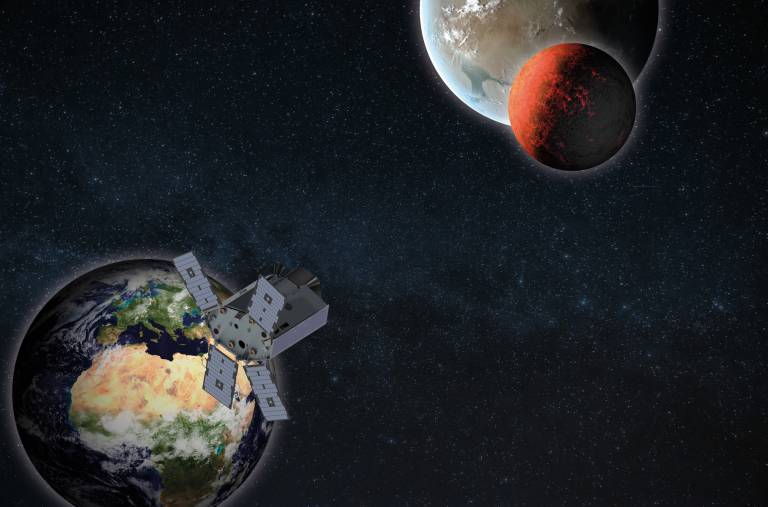
Twinkle's will analyse light transmitted through, and emitted or reflected by, the atmospheres of exoplanets in order to give radical insights into worlds orbiting distant stars.
"This is a big step for Twinkle," said Dr Giorgio Savini (UCL Physics and Astronomy), and Twinkle's Payload Lead, who is responsible for the study. "We can now demonstrate that Twinkle will have the agility, stability and sensitivity required to pick out this light, analyse the spectra and allow us to extract information on the gases present."
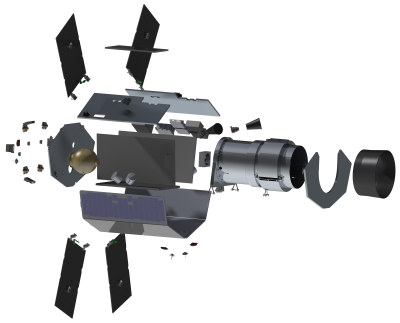
The Twinkle spacecraft will be constructed by the world-leading small satellite company, Surrey Satellite Technology Ltd (SSTL), and will carry a payload weighing less than 100kg that includes the scientific instrumentation, electronics, a cooling system and a fine guidance system.
The whole payload package is about the size of a water boiler and will be built by a consortium of UK companies and institutions. The UCL Mullard Space Science Laboratory is responsible for the overall mechanical design.
Links
Open Days
The Faculty participates in a number of open days throughout the academic year, including the UCL Undergraduate Open Days and the UCL Graduate Open Day.

Friends of Out@UCL
Professor Ivan Parkin - Dean, UCL Faculty of Mathematical and Physical Sciences
"I fully support the aims of the Friends of Out@UCL campaign. I have personal experience of the need for such a campaign and the difficulties that the LGBTQ+ community face." Read more...
Snapshots from Space History
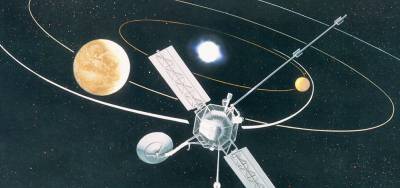
Online exhibition of historic space photos from the faculty's planetary science archives.