 Close
Close


Nanotechnology to leverage infections and antibiotic sensing
21 August 2015
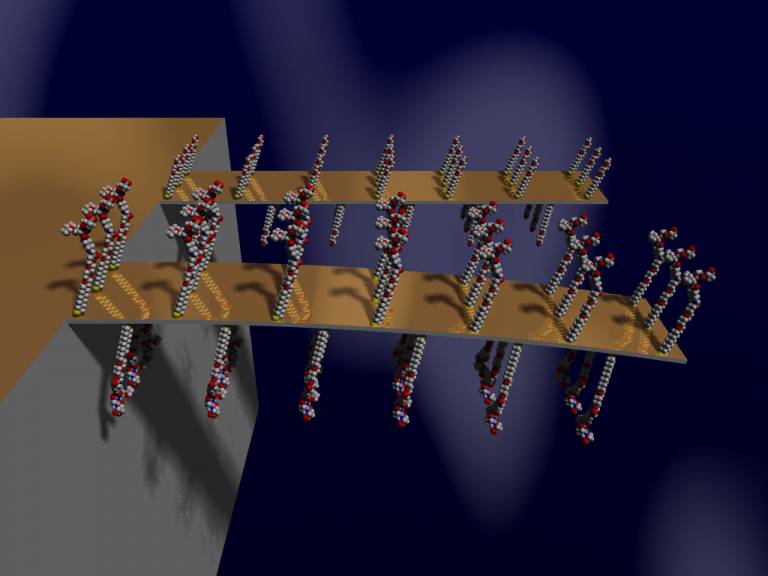
Miniaturized tests can revolutionize the speed of diagnosing diseases, according to new research from UCL.
The study, published in Nature Nanotechnology and led by Joseph Ndieyira (London Centre for Nanotechnology at UCL) refines a promising experimental technology for diagnostic devices. The team, which includes several LCN researchers, developed ultrasensitive sensors that can assess antibiotic efficacy, haemophilia and HIV infections within minutes. The sensors take the form of tiny cantilevers, less than the width of a human hair, coated with molecules similar to those found in bacterial cell walls, mini-antibodies raised against HIV proteins and anti-clotting antibodies.
These cantilevers can be tuned to be sensitive to different molecules: in this study, they were sensitised to the antibiotic Vancomycin, the proteins present in the HIV virus, or blood anti-clotting factors (for haemophilia). When one of these substances is present, the properties of an appropriately coated cantilever's surface are affected. This gently bends the cantilever, quickly and accurately revealing the molecule's presence.
This new method will allow the development of rapid point-of-care tests that can make a definitive multiple diagnoses of infections, identify the resistance profile of causative organisms in parallel on the same device and make the tests suitable and cost effective for use in a primary care situation, such as a clinic.
Infections caused by HIV and bacteria affect many millions of people worldwide and remain major causes of mortality in adults and children. Antimicrobial resistance is now a global threat. It is clear that a major driver of antimicrobial resistance is excessive or inappropriate use of antibiotics.
Meeting these challenges requires quicker and easier diagnostic tests, so that appropriate treatments can be chosen. The team believes that their technology can cut the time delay between tests, results and repeat appointments, which hinders public health efforts to tackle new threats.
Notes
The research is published this week in a paper entitled "Decoupling competing surface binding kinetics and reconfiguration of receptor footprint for ultrasensitive stress assays", in the journal Nature Nanotechnology.
The team includes Joseph Ndieyira, Rachel McKendry, Ben Webb, Manuel Voegtli and Samadhan Patil (all London Centre for Nanotechnology) as well as colleagues at Imperial College London and the Royal Free Hospital.
High resolution images
A cantilever bends as the molecules on its surface react with a pathogen. Credit: Ndieyira et al.
Related links
Media contact
Oli Usher
UCL Faculty of Mathematical and Physical Sciences
020 7679 7964
o.usher@ucl.ac.uk
Science contacts
Joseph Ndieyira
London Centre for Nanotechnology and UCL Division of Medicine
j.ndieyira@ucl.ac.uk
Open Days

The Faculty participates in a number of open days throughout the academic year, including the UCL Undergraduate Open Days and the UCL Graduate Open Day.

Friends of Out@UCL
Professor Ivan Parkin -
Dean, UCL Faculty of Mathematical and Physical Sciences
"I fully support the aims of the Friends of Out@UCL campaign. I have
personal experience of the need for such a campaign and the
difficulties that the LGBTQ+ community face." Read more...
Snapshots from Space History

Online exhibition of historic space photos from the faculty's planetary science archives.