 Close
Close


Reacting at the speed of light
21 August 2013
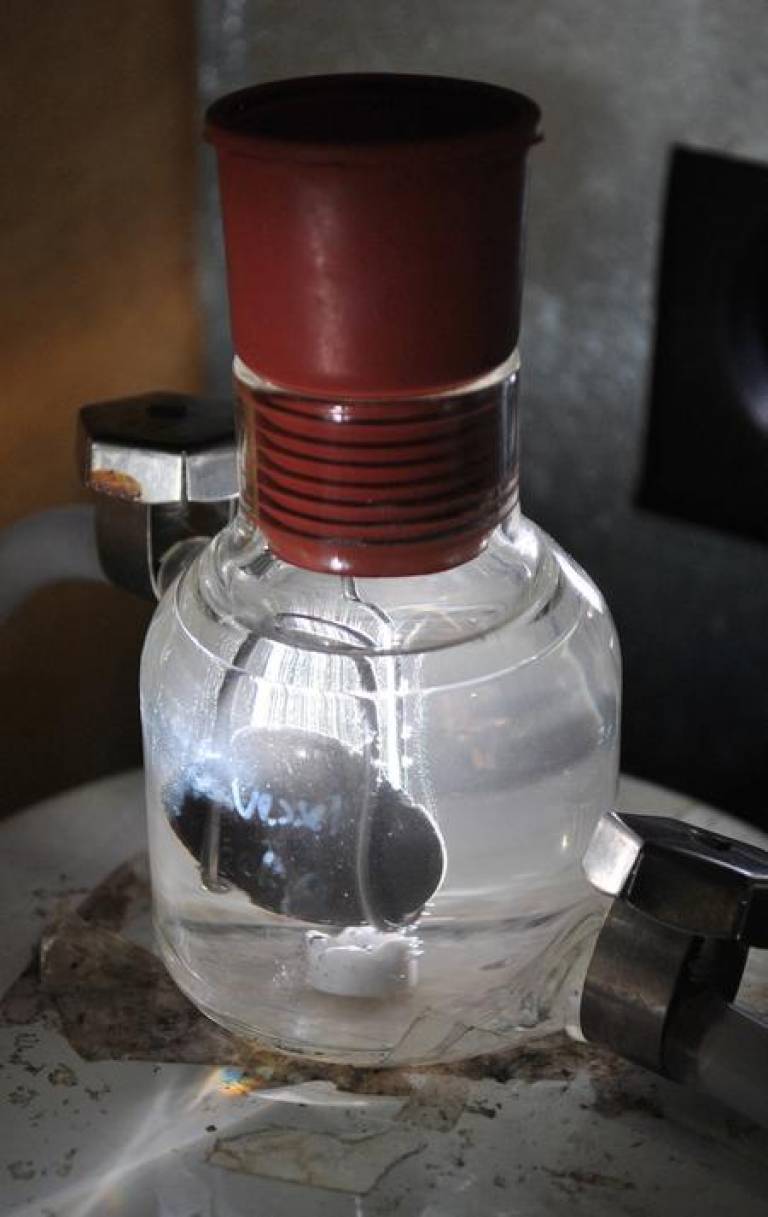
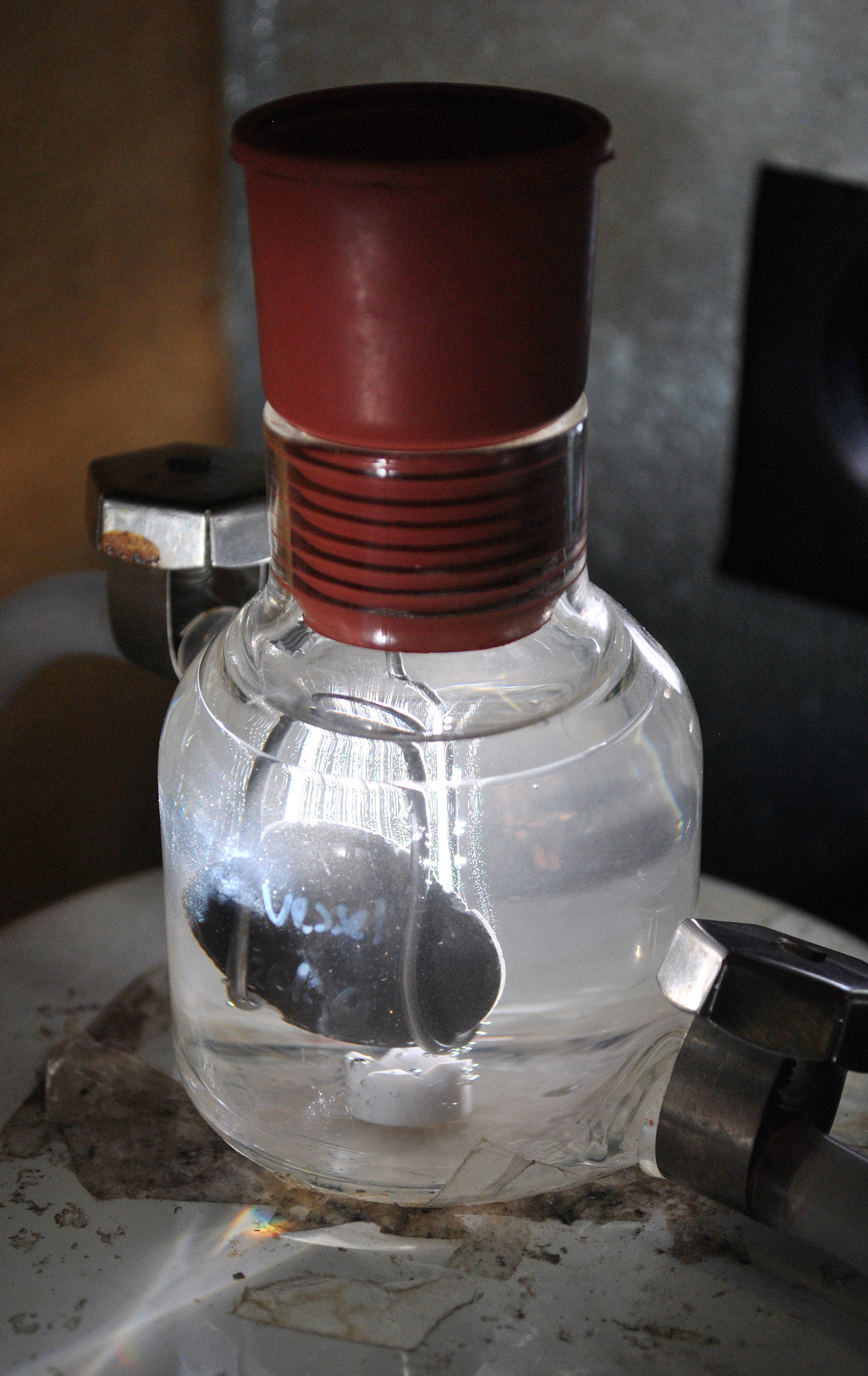
It might look like an Alka-Seltzer bubbling away, but far from releasing CO2, this experiment could hold within it a cure to our addiction to fossil fuels. Tiny bubbles of hydrogen stream from a disc of titania (TiO2), which is breaking down the water surrounding it under the influence of bright light. Once the technology is perfected, factories producing hydrogen fuel from sunlight and water could become a reality.
Photocatalysis - the process by which chemical reactions are triggered, enabled or powered by light - is a big area of research within UCL, with studies concentrating on its ability to produce clean fuels from water and self-cleaning surfaces that break down grease and grime by themselves.
In the reaction here, photons from the light source (which is just out of frame to the right of the picture) hit the surface of the titania disc, exciting electrons within the atomic structure These then react with the water molecules, splitting it into its constituents of hydrogen and oxygen. In this experiment, chemicals dissolved in the water prevent the formation of oxygen, which would otherwise recombine with the hydrogen.
There are a couple of major challenges which need to be addressed before this process can be scaled up to industrial levels.
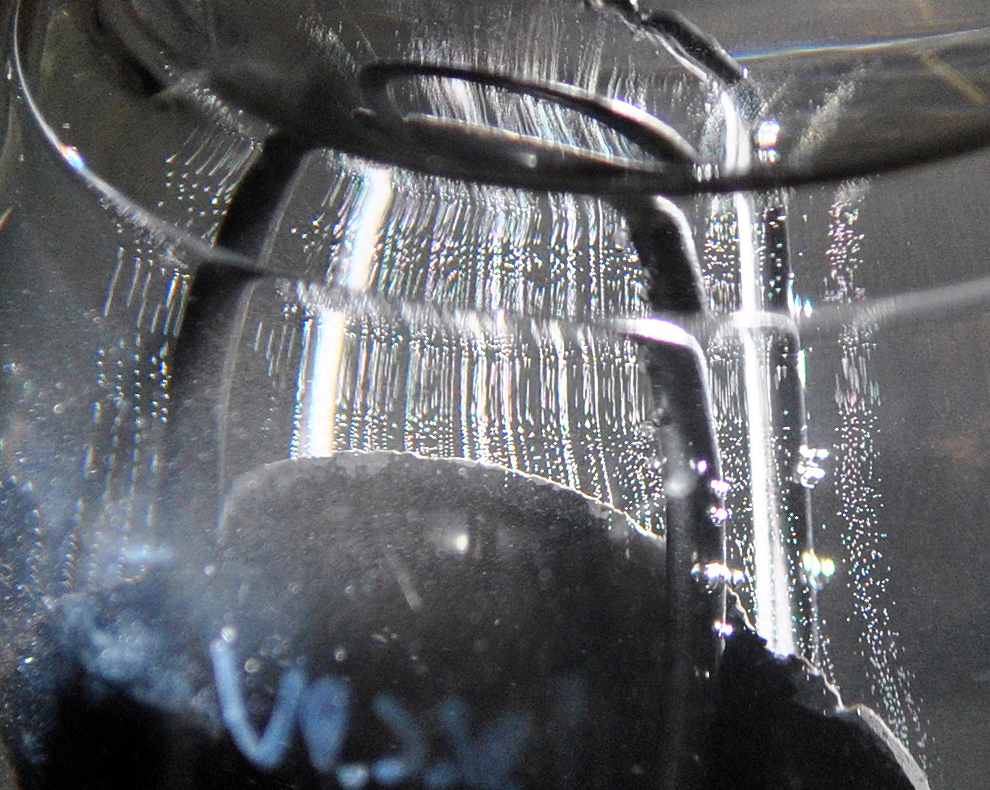
First, the photocatalysts need to be able to work with visible light. In the experiment pictured here, the light we actually see with our eyes is not contributing to the chemical reaction in any way; only the small proportion of ultraviolet is actually doing any work, meaning that the vast majority of the energy is wasted.
Second, the process needs to work with pure water, without any need for chemical additives which make the process more complex and expensive.
And finally, it needs to be made vastly more efficient: to produce useful quantities of fuel on scales that can be burned in engines or reacted in fuel cells, you need more than a fine stream of bubbles.
Scientists have recently taken a step towards better understanding of photocatalysts. A team of chemists at UCL solved a long-standing puzzle regarding titania, making the substance better understood than ever before.
Photo credit: O. Usher (UCL MAPS)
Links
High resolution images
Titania photocatalyst producing hydrogen
Titania photocatalyst producing hydrogen (high contrast)
These images can be reproduced freely providing the source is credited
Open Days

The Faculty participates in a number of open days throughout the academic year, including the UCL Undergraduate Open Days and the UCL Graduate Open Day.

Friends of Out@UCL
Professor Ivan Parkin - Dean, UCL Faculty of Mathematical and Physical Sciences
"I fully support the aims of the Friends of Out@UCL campaign. I have personal experience of the need for such a campaign and the difficulties that the LGBTQ+ community face." Read more...
Snapshots from Space History
Online exhibition of historic space photos from the faculty's planetary science archives.