 Close
Close


Professor Virginia Mantouvalou receives British Academy Mid-Career Fellowship
7 May 2020
Professor Mantouvalou will have 12 months of research leave supported by the British Academy to work on her book on the topic ‘Structural Injustice and Workers’ Rights’.
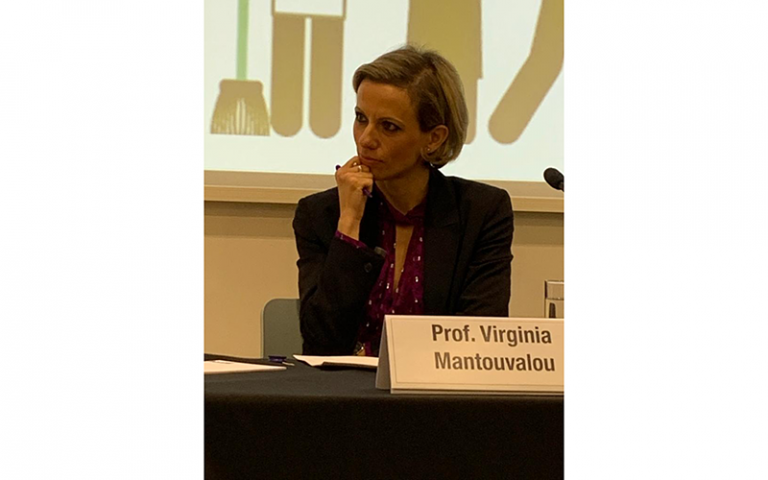
Professor Virginia Mantouvalou (Professor of Human Rights and Labour Law at UCL Laws) has been awarded a prestigious British Academy Mid-Career Fellowship. Thanks to this fellowship, Professor Mantouvalou will have 12 months of research leave supported by the British Academy to work on her book on the topic ‘Structural Injustice and Workers’ Rights’.
An increasing number of jobs are precarious, making workers vulnerable to various forms of ill-treatment and exploitation. The UK Government's main approach has been to criminalise the actions of unscrupulous employers who seek to exploit precarious workers. This approach, however, has been ineffective, partly because it ignores the broader socio-economic structures that place workers in conditions of vulnerability.
In her project Professor Mantouvalou develops an alternative solution, seeking to identify structures that force and trap workers in conditions of exploitation. She focuses specifically on what she calls ‘state-mediated structural injustice', where legislative schemes that promote otherwise legitimate aims create inadvertent vulnerabilities that force and trap workers in conditions of exploitation. She uses examples such as restrictive visa regimes, welfare conditionality programmes, such as Universal Credit, and zero-hour contracts to illustrate the unjust structures. She finally assesses whether these legal structures are compatible with human rights law (both civil and social rights) and makes proposals for legal reform.
Earlier this academic year, Professor Mantouvalou gave her inaugural lecture on this topic at UCL. This will be published in Current Legal Problems.
Find out more
See Professor Mantouvalou’s Inaugural Lecture
See also Mantouvalou, V. (2020) 'Welfare-to-Work, Structural Injustice and Human Rights', Modern Law Review