 Close
Close


The Bentham Hackathon—a weekend well spent by Dr Louise Seaward
3 October 2017
The Bentham Project, in UCL’s Faculty of Laws, is tired (but happy!) this week, as we spent the weekend taking part in our first Hackathon. It was an inspiring few days and we came away hugely impressed by the useful and creative digital research tools that our hackers produced over the course of a weekend.
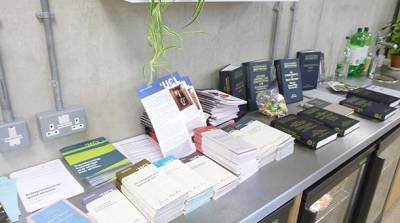
The Bentham Hackathon was held in partnership with the technology company IBM, along with the support of UCL Centre for Digital Humanities and UCL Innovation and Enterprise. It was designed as a collaborative and open event where participants could work together to explore how digital tools can help us to research Bentham’s philosophy.
The Hackathon took place over one evening and two full days between 20 and 22 October 2017 and brought together coders, developers, computer scientists, digital humanists, humanities researchers and some of the volunteer transcribers from Transcribe Bentham. Take a look at the hackBentham hashtag on Twitter to see what happened at the event!
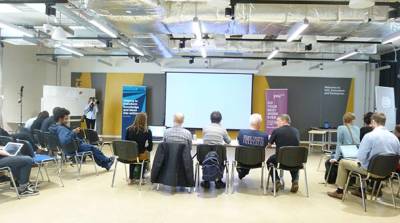
By the Saturday morning, the participants had formed 6 teams who were ready to #hackBentham. They were working on the following challenges set out by the Bentham Project:
– How can we use keyword searching to explore Bentham’s writings?
– Can we use technology to decipher Bentham’s difficult handwriting?
– Can we build a user-friendly interface for navigating and transcribing documents?
– Can we build a more user-friendly version of the Transcribe Bentham crowdsourcing platform?
The attendees had a large amount of data to work with: thousands of images of Bentham’s manuscripts and transcripts of their content, metadata for the entirety of the Bentham papers held both at UCL and the British Library and various printed editions of Bentham’s writings and correspondence.
IBM provided access to their Bluemix platform where the hackers could experiment with the Object Store, Watson Knowledge Studio and Node-RED applications. IBM also used this platform to pre-process some of the Bentham data so that the participants could get to work quickly.
The teams worked diligently all weekend, with the support of members of the Bentham Project and developers from IBM. Coding and discussion went on until 8:30pm on the Saturday evening, fuelled by pizza, coffee and Coca Cola!
On Sunday afternoon it was time for the teams to submit and present their final outputs. IBM generously provided prize money of £1000 for the event and it was up to a panel of judges from the Bentham Project, IBM and UCL Innovation and Enterprise to award the spoils!
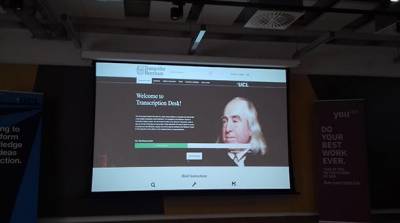
First up was the ‘Bencharms’ team, who used IBM Cloudant to produce a more attractive version of the Transcribe Bentham Transcription Desk, with enhanced functionalities like allowing users to see more easily whether a page has already been transcribed. They also had the idea of a mobile app where users could contribute to Transcribe Bentham by transcribing single words.
Team ‘XScribe’ put together a searching interface for the Bentham papers, where users would be able to look for keywords but also see whether certain manuscripts have already been transcribed. They also worked on image extraction and segmentation to make it easier for transcribers to match the line of their text transcription to the corresponding line in the image. Again, these ideas have the potential to speed up the transcription process significantly.
Two teams ‘Bentham Budds’ and ‘Benthamligraphy’ chose to work on a language model that could predict the words that Bentham would be most likely to use. They used Tensorflow and IBM’s Node-RED software for machine learning to train a model using a sample of transcripts of Bentham material. Such a model could increase productivity of Transcribe Bentham volunteers and Bentham Project researchers as Bentham’s handwriting is often so difficult to read.
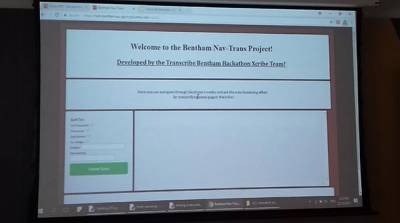
‘QSP’ was a team which included two volunteer transcribers from Transcribe Bentham and they decided to work on a sandpit area to help orientate new users of the platform. Their ‘Box 999’ area included helpful videos and links for new transcribers and also allowed users to practice transcribing pages and get immediate feedback on any errors. This was a fitting suggestion as we find it difficult to attract new volunteers to Transcribe Bentham, possibly because people can be daunted by the prospect of transcribing a complete page on their own.
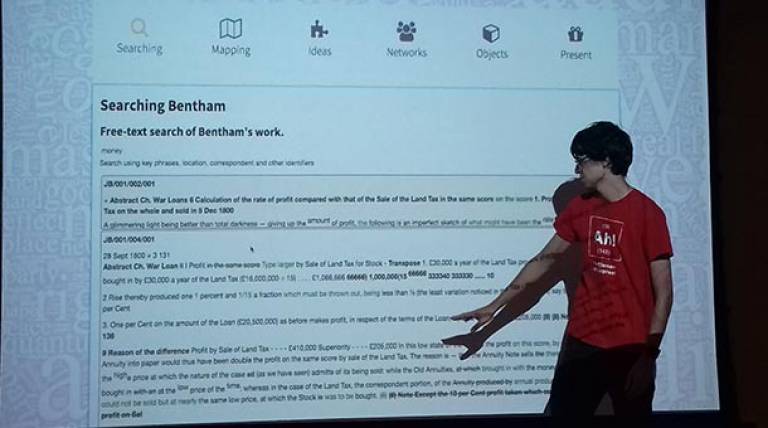
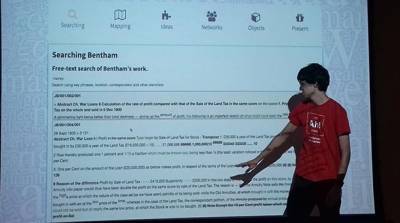
But the winning team was ‘Bentham’s Head’! Their fantastic site called Locate Bentham not only has the potential to facilitate existing research questions but could also generate new areas of enquiry. The team created an interface where users can perform keyword searches on Bentham transcripts, view a Google map of the places mentioned in Bentham’s correspondence, trace the development of Bentham’s ideas over time, examine Bentham’s social network based on his list of correspondents and even analyse Bentham’s personality using IBM Watson Personality Insights. This was an amazing breadth of resources, embedded in functional and attractive interface. Well done team!
The Bentham Project had little idea what could happen at a Hackathon but we were struck by the concentration and creativity of all the teams. A big thank you to everyone who took part and to our partners at IBM, UCL Centre for Digital Humanities and UCL Innovation and Enterprise.
We want to continue to develop some of the ideas and connections made at the Hackathon; to improve both Transcribe Bentham and the digital research tools at Bentham Project’s disposal. IBM have kindly allowed participants continued access to the Bluemix platform and we are planning to get involved in the upcoming Learn Hack at UCL on 24-26 November.