News

Study questions effectiveness of genetic testing strategy for inherited high cholesterol, Steve Humphries publishes in The Lancet

Publication date:

Prof Steve Humphries

A substantial proportion of individuals with a clinical diagnosis of Familial Hypercholesterolaemia (FH) inherit a combination of small-effect changes in several genes (polygenic) rather than a large-effect mutation in a single gene (monogenic), according to a new paper in The Lancet.

Blood screening that is preventing heart attacks–but not in England, Prof Humphries is mentioned in a Guardian article

Publication date:

Suzanne Sheppard is painfully aware of the devastation heart disease can wreak. Her father, Christopher Rogers, died of a massive heart attack in 1988 when he was 41 and she was 15. His father had also died unusually young – at 54 – and, again, of what doctors call a myocardial infarction.

Nick Luscombe publishes in Cell

Publication date:

Direct competition between hnRNP C and U2AF65 protects the transcriptome from the uncontrolled exonization of Alu elements.

Vacancy: Research Associate in Statistical Genetics

Publication date:

Salary: £32,055 - £38,744 per annum
Closing Date: 5pm on 14 Dec 2012
Further information: main UCL vacancy page

UGI's Prof Francois Balloux co-authors paper on genetics and climate reconstructions to track the global spread of modern humans out of Africa

Publication date:

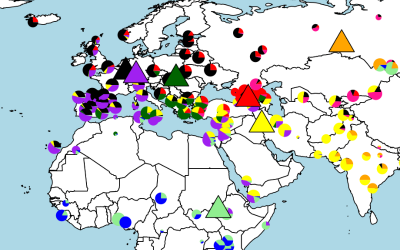
Research indicates the out-of-Africa spread of humans was dictated by the appearance of favourable climatic windows. By integrating genetics with high resolution historical climate reconstructions, scientists have been able to predict the timing and routes taken by modern humans during their expansion out of Africa. Their research reveals that the spread of humans out of Africa was dictated by climate, with their entry into Europe possibly delayed by competition with Neanderthals.  

UGI's Prof Andres Ruiz-Linares reports in Nature Native Americans descend from three key migrations

Publication date:

Scientists have found that Native American populations — from Canada to the southern tip of Chile — arose from at least three migrations, with the majority descended entirely from a single group of First American migrants that crossed over through Beringia, a land bridge between Asia and America that existed during the ice ages, more than 15,000 years ago.

4 Scholarships available for MSc in Genetics of Human Disease  

Publication date:


The UGI MSc in Genetics of Human Disease has been awarded a training grant from MRC. UGI is offering the Masters Excellence Scholarships  (£4,200 towards fees and £15,740 stipend) for up to to 4 academically outstanding UK/EU students per year.  

UGI Spring 2012 Newsletter

Publication date:

The latest issue of UGI Newsletter is ready to view.

Direct observation of the interconversion of normal and pathogenic forms of α-synuclein, Prof Nick Wood publishes in Cell

Publication date:

15 May 2012

Cremades N, Cohen SIA, Emma Deas, Abramov AY, Chen AY, Orte A, Sandal M, Clarke RW, Dunne P, Aprile FA, Bertoncini CW, Wood NW, Knowles TPJ, Dobson CM, Klenerman D.  Direct observation of the interconversion of normal and pathogenic forms of α-synuclein. Cell 2012 (in press)

Research paper: X-linked megalocornea caused by mutations in CHRDL1 identifies an essential role for ventroptin in anterior segment development

Publication date:


Webb, TR and Matarin, M and Gardner, JC and Kelberman, D and Hassan, H and Ang, W and Michaelides, M and Ruddle, JB and Pennell, CE and Yazar, S and Khor, CC and Aung, T and Yogarajah, M and Robson, AG and Holder, GE and Cheetham, ME and Traboulsi, EI and Moore, AT and Sowden, JC and Sisodiya, SM and Mackey, DA and Tuft, SJ and Hardcastle, AJ (2012) X-linked megalocornea caused by mutations in CHRDL1 identifies an essential role for ventroptin in anterior segment development. Am J Hum Genet , 90 (2) 247 - 259.

Full paper can be obtained from here.


Article:  How a mother's genes can increase birth weight

Publication date:


Researchers at the UCL Institute of Child Health have found a single genetic variant inherited from the mother significantly increases a baby’s birth weight.
Baby weight

On average, the RS1 variant of PHLDA2 increases birth weight by 93g (~3%) if inherited from the mother and 155g (~5%) if inherited from the maternal grandmother via the mother. This is a highly significant effect for a single gene, and the first known example of a genetic variant affecting birth weight through maternal inheritance of an imprinted gene.

Fetal growth is an important area of research which takes into account the future health of babies. As such, the gene (PHLDA2) is already known to have a profound effect on birth weight by acting as a growth suppressor. In this instance, the gene is only “switched on” from the copy inherited from its mother. The copy from the father is silent. Genes regulated in this way are termed ‘imprinted’.

Three separate cohorts of babies were checked in this study, including the Avon Longitudinal Study of Parents and Children (ALSPAC). Taking into consideration the average birth weight of a baby is 3000 grams, 155 grams is a very significant weight increase. This is a similar magnitude to the reduction in birth weight caused by maternal smoking, a well-established cause of concern to obstetricians.

This study also describes the more common RS2 variant, which is only found in humans. The authors have hypothesised that it has evolved to produce a smaller baby as a protective effect to enhance the mother’s survival during childbirth. The father’s lack of involvement in evolutionarily terms may stem from his own survival not being at stake and he can continue to reproduce with other females.

For one gene to have this magnitude of effect on a baby's birth weight is very significant

Dr Gudrun Moore, Great Ormond Street Hospital Children's Charity Professor of Clinical and Molecular Genetics at the UCL Institute of Child Health, comments:

“Most of us will think of both the mother’s and father’s genes as having an equal influence on birth weight. Scientists for some time have recognised the particular influence of the mother’s genes, but this is the first time we have seen to what extent.

“For one gene to have this magnitude of effect on a baby’s birth weight is very significant. We suspect it will be the first of many examples once further details of interactions of the genome with the epigenome are unravelled. ”

Research into the PHLDA2 gene is part of a programme of work that will continue beyond this study. Further insight into the function of PHLDA2 along with other imprinted genes will help to establish the genetic basis of fetal growth as well as the common and serious complications of pregnancy, such as when a fetus is unable to achieve its genetically determined potential size (Intrauterine Growth Restriction).


The full article, published in the American Journal of Human Genetics, can be accessed at here.


A matter of priorities: Bacteria evolved way to safeguard crucial genetic material, Prof Nick Luscombe publishes in Nature

Publication date:

23 April 2012

Different genes mutate at different rates, in the bacterium E. coli.
Credit: EMBL / I. Martincorena.

UCL student Anna Rose has been awarded the Tony Jackson Memorial Prize for 2011

Publication date:

ANNA ROSE CROP


UCL student Anna Rose (UCL Medical School), who also briefly studied at the Genetics Instute for MSc in Genetics of Human Disease, has been awarded the Tony Jackson Memorial Prize for 2011 for her work with HIV positive children in Zambia.

Article: Four Genetic Loci Influencing Electrocardiographic Indices of Left Ventricular Hypertrophy

Publication date:


Below is an abstract of a paper recently published by Sonia Shah from UGI. The full article can be found here.

Search UCL News