Planetary Nebulae
Planetary nebulae (PNe) occupy a pivotal position in several branches of modern astrophysics. They are the chief source in the Universe of carbon, the basic constituent of life, and of s-process elements, which in the solar system, dominate the abundances of elements heavier than the iron-group. In terms of stellar evolution, PNe provide a link between the last ascent of the red giant branch (the asymptotic giant branch, or AGB) and the white dwarf end-point to the life of low- and intermediate-mass stars. PNe enrich the surrounding interstellar medium and directly influence the next generation of star formation, thus having important implications for galactic evolution.
|
|
|
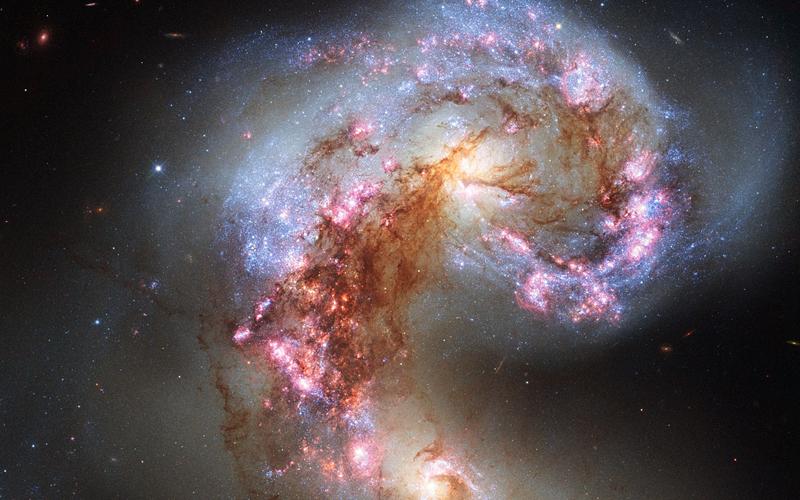
Figure 1. The various forms and shapes of Planetary Nebulae. |
PNe have played a crucial role in the development of the nebular
diagnostic techniques that are applied to all galactic and
extragalactic nebulae, This is because they have well-resolved
structures, usually posses's a high degree of symmetry, and are ionized
by a single, centrally located star. For this reason they provide
probably the best astrophysical laboratories for the diagnosis of
physical processes operating within ionized nebulae. They provide
excellent test beds for atomic data and for stellar and nebular models
as well as testing important stellar evolution predictions.
Abundance determinations - discrepancy & opportunity
Emission line nebulae are ionized and heated by the strong UV radiation
fields from stars (or the central engines in the case of AGNs) and glow
by emitting strong emission lines. The spectra of ionized nebulae are
dominated by strong H and He recombination lines, emitted following
capture of free electrons by ionized H and He atoms, and by collisional
lines excited by inelastic electron impacts with heavy elements ions.
Until recently, heavy element abundances of ionized nebulae have been
based on bright optical and UV collisionally excited lines (CELs, e.g.
[O III] 5007 Å, C III] 1908 Å).
|
|
|
Figure 2. A typical planetary nebula spectrum. |
The advent of high quantum efficiency large-area CCD detectors on
medium and large telescopes opened up a new era of very deep
spectroscopy of nebulae, with simultaneous access to reliable fluxes
for extremely weak and relatively strong emission lines. For the first
time, the recombination spectra of the elements heavier than helium
could be analyzed, precisely at the time when extensive and reliable
atomic data on photoionization and recombination became available.
Accurate ionic abundances from optical recombination lines (ORLs) are
now possible. Our recent abundance analyses of PNe using this new
technique strongly indicate that the traditional method based on CELs
may have significantly underestimated metal abundances for many
nebulae. Being excited by the same mechanism as H recombination lines,
ionic abundances derived from ORLs are almost independent of the
thermal and density structure of the objects under study and are
therefore intrinsically more reliable than CEL abundances, which have
an exponential (Boltzmann factor) dependence on the adopted electron
temperature. For CELs with low critical densities, the results are also
sensitive to the adopted electron density. Using high quality
measurements, we found that the ORL CNO abundances deduced for NGC 7009
were all about a factor of 5 higher than the corresponding CEL values.
These large discrepancies between ORL and CEL abundances are not an
isolated phenomenon -- analyses of a large sample of Galactic PNe for
which we have obtained deep optical spectra show that the ORL to CEL
abundance ratios vary from source to source and span a wide range from
1-80.
The large discrepancies between the CEL and ORL abundances observed in
many PNe point to the possibility that there are fundamental flaws in
our current understanding of the nebular thermal and ionization
structure. Without a better understanding of when, why and how the
discrepancy occurs, nebular abundances cannot be taken as intrinsically
secure. Since the discrepancy varies from object to object, the cause
is likely to be found in the nebular physical conditions, rather than
in the basic atomic physics. Given the strong temperature dependence of
CEL abundances, the lower CEL abundances have often been attributed to
the presence of large temperature fluctuations in nebulae. The large
temperature fluctuations required to reconcile ORL and CEL abundances
are not predicted by photoionization models. Proposed mechanisms
include shocks, density inhomogeneities and abundance gradients. Direct
observational evidence in favour of such interpretations still remains
to be found however.
|
|
|
Figure 3. Multi-wavelength imaging of NGC 6153. |
Our multi-waveband abundance analysis of NGC 6153 provided fresh
insight into this fundamental problem. Deep high resolution
spectroscopy of this unusual nebula unveiled a forest of strong ORLs
from CNO and Ne ions. Utilizing data from the UV to the far-IR, we
found that its ORL CNO and Ne abundances relative to H are all
consistently higher, by a factor of ten, than the corresponding values
deduced from optical, UV or infrared CELs, regardless of the excitation
energies or critical densities of the latter. While the He abundance is
constant across the nebula, the C and O ORL abundances decrease by a
factor of two over a radius of 15 arcsec from the centre, pointing to
abundance gradients.
|
|
|
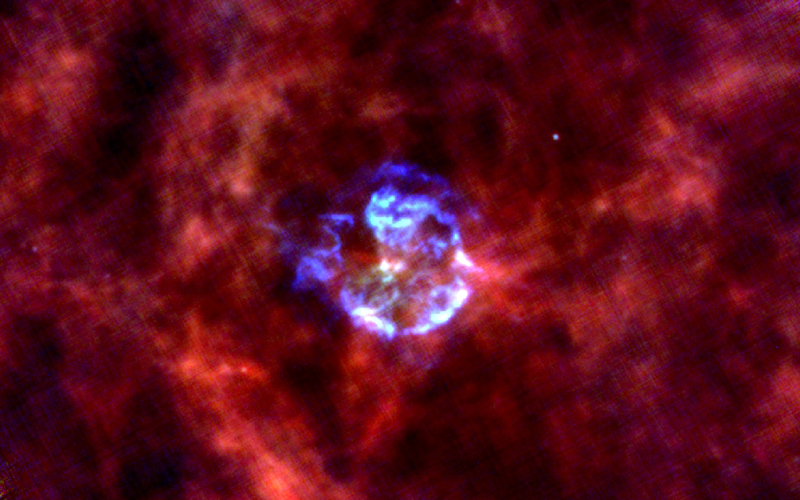
Figure 4. Abell 30 |
The ORL O/H abundance of NGC 6153, six times solar, is three times that
of NGC7009, and is amongst the highest of the 80 PNe surveyed by us,
only surpassed by M1-42 and Hf 2-2. The high metallicity of nebulae
such as NGC 6153, together with their very large ORL to CEL abundance
discrepancy factors, offers a unique opportunity to test possible
explanations for this fundamental abundance determination problem
observed in many PNe. In the case of NGC 6153, temperature fluctuations
alone were rejected because the IR fine structure lines, which have no
significant temperature sensitivity, yield abundances very similar to
those given by the UV/optical CELs. Similarly, density inhomogeneities
alone failed to explain all the observed patterns, in particular the
low electron density deduced from the high-n Balmer line decrement.
Instead, we found that empirical nebular models containing two
components with very different densities and temperatures were able to
account for many of the observed patterns, but only if one of the
components is significantly H-deficient and very cool, suggesting that
NGC 6153 may have experienced a recent ejection of H-deficient knots,
similar to those observed in the `born-again' PN A30.
Thanks to Xiaowei Liu for this article.
Page last modified on 24 November 2006