Atmospheric Physics
This page lists all the PhD projects offered by Atmospheric Physics
group.
Solving the Cometary Coma Problem
Unlike most objects in the Solar System, comets are essentially unchanged since their formation 4.5 billion years ago. Consequently, research into comets has concentrated on their chemistry, which is believed to be representative of the region of the Solar System in which they were formed, and may even have seeded life on Earth. Most of our knowledge is derived from infrared spectra of the coma, a region that comprises dust and gases leaving the nucleus. This focus of attention on chemistry has meant that work on understanding the physical processes at work in cometary coma has been sidelined. Recently, by comparing high-resolution spectra with our BT2 spectral database for the water molecule, we were able to demonstrate that current cometary models are missing some crucial physics. If you would like to join our small team, you will be involved in observing comets, analysing their spectra and in developing new models of cometary coma, incorporating new physics. Moreover, as the Physics and Astronomy Department at UCL is a world leader in molecular spectroscopy, both of a theoretical and applied astrophysical nature, you will be able to draw extensively on this existing expertise. If you regard yourself as being an original thinker, you will enjoy working us.
Contact: Prof. Steve Miller (s.miller AT ucl.ac.uk); Dr Bob Barber (rjb AT star.ucl.ac.uk)
Modelling the Terrestrial Atmosphere
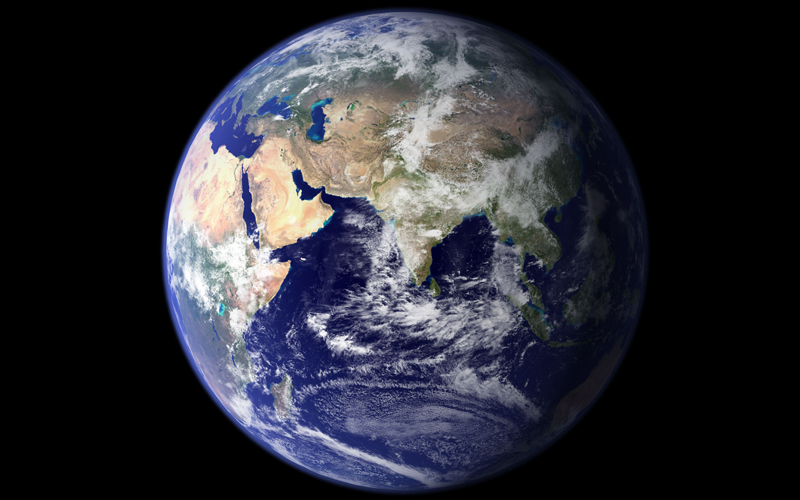
The Atmospheric Physics Laboratory has developed a comprehensive model of the Earth's upper and middle atmospheres (15 km to 600km altitude). This is being used for a number of studies, including comparisons with satellite data, and ground-based instruments. One particularly important strand of our work is the look at how effects in the lower atmosphere - the troposphere where we have the weather and climate that affects us - may be linked to what happens on the Sun or in near-Earth space. This covers the fields of 'Space Weather', where, for example, we see how the effects of solar flares can penetrate to the ground, and the way solar variability might affect the climate.
In recent years evidence has accumulated that there is a link between solar variability (in the sense of changes in the solar cycle/sunspots and radiative output) and climate change. This is controversial because the effects that are seen to change cyclically on the Sun represent a tiny fraction of the Sun's output, and most of the energy that reaches the Earth from the varying phenomena is expected to be "soaked up" by the minute fraction of the Earth's atmosphere that borders interplanetary space. However, correlations show there appears to be linkage of some kind. A number of theories have been developed to explain this, including some control of clouds by cosmic rays, varying mechanisms for particle entry through the Earth's magnetic shield, and the release of trapped wave energy from the lower atmosphere by small modifications to the critical mesopause layer of the atmosphere.
Apart from our own model studying these effects we have a collaboration with the Met Office where we are looking at issues to do with coupling their tropospheric model to our upper atmosphere model. One recent project we have started is to look at how the 'Global Electric Circuit' might affect the coupling to the magnetosphere and beyond. This Circuit is driven by thunderstorms charging up the ionosphere above 100km height to 250-300KV with respect to the ground. There is a "Fair Weather" current back down from the ionosphere over the rest of the Earth. We are trying to understand how this might affect the dynamics, chemistry and thermodynamics of the atmosphere.
Contact: Prof. Alan Aylward (a.aylward AT ucl.ac.uk); Dr Anasuya Aruliah (a.aruliah AT ucl.ac.uk)
Planetary Aurorae and Magnetosphere-Ionosphere Coupling
The beautiful auroral displays of magnetised planets (such as the Earth, Jupiter and Saturn) are the result of powerful global systems of electrical current which flow between their ionospheres and magnetospheres. At the giant planets, rapid rotation plays an important role in the formation of auroral ovals. The Atmospheric Physics Laboratory group at UCL have a wealth of experience in both observations and modelling of the auroral physics and the global atmospheric flows which arise via the electrodynamic coupling of the planet and its space environment. We have analysed enormous datasets of ground-based spectroscopic observations of giant planetary aurorae, taken in infrared light, which reveal the emissions from the ion H3+. Such data have enabled us to confirm the primary role of this ion in the heating and dynamics of the hydrogen-rich auroral regions of the gas giants. Planned future work includes ongoing mapping of the H3+ emissions in order to build a more comprehensive picture of the physical conditions in the ionospheres of the gas giants.
On the modelling side, we have built global models of the thermospheres and ionospheres of Jupiter, Saturn and Uranus. These have been used in pioneering studies of the effects of auroral precipitation on upper atmospheric flows and planetwide heating processes. Such studies are important for identifying the types of energy inputs required to explain the unusually high temperatures in the upper atmospheres. Planned future work includes more studies of how time variability of the aurora and the magnetospheric conditions affect the atmospheric flows and heating: a key question here is the timescale associated with the atmosphere's response to changes in magnetospheric conditions. We have recently collaborated with the team who manage the magnetometer aboard the Cassini spacecraft on studies of Saturn's magnetospheric structure, and we envisage that this experience with spacecraft data will provide valuable future inputs and constraints for our own planetary models.
Magnetospheric Projects: Since 2009, our 'Atmospheric Physics' group has extended our modelling expertise out into the magnetospheric region and constructed models of the disc-like, rapidly rotating magnetospheres of Jupiter and Saturn. We have published several studies comparing the Saturn model with observations from the Cassini spacecraft of the planet's magnetic field and plasma environment. Further comparative studies of this nature are needed. On the more theoretical side, we also wish to build a more 'complete' magnetospheric model for Saturn by including the effect of the solar wind interaction, which for example 'distorts' the planet's plasma sheet from an equatorial disc into a 'bowl-like' shape. Thus for someone interested in plasma / magnetospheric physics, there is a variety of options for postgraduate work.
Contacts: Dr Nick Achilleos (nick AT apl.ucl.ac.uk); Prof. Steve Miller (s.miller AT ucl.ac.uk)
Structure and Energetics of the high-latitude MIT system
We have a network of Fabry-Perot Interferometers (FPIs) in
northern Scandinavia, within the Arctic Circle, used to study the
Earth's
upper atmosphere: the magnetosphere-ionosphere-thermosphere (MIT)
system.
This study is achieved by
measuring airglow and auroral emissions, more commonly known as the
Northern Lights. The upper atmosphere near the magnetic poles
is highly dynamic due to direct coupling with the turbulent solar
wind, via the Earth's magnetosphere. The project will involve
instrumental fieldwork with the FPIs, and collaboration with other
instruments such as the EISCAT radar and magnetometers, which provide
complementary observations of the ionosphere, as well as comparison
with the APL atmospheric model. The investigation will be into the
small-scale structure and the energetics of the interaction between
the neutral and charged particles of the upper atmosphere.
Contact: Dr Anasuya Aruliah (a.aruliah AT ucl.ac.uk)
Probing the Atmosphere of Jupiter and Saturn in the Far Infrared
The wavelengths beyond 50 microns contain the spectroscopic signatures
of many molecules at temperatures and under environmental conditions
that cannot be easily accessed in other wavelength regions. These far
infrared wavelengths can only be observed using observatories placed
beyond the Earth's atmosphere as they are blocked from reaching the
ground even at the highest terrestrial observatories. One of the space
based observatories that UCL has been involved in building was the
European Space Agency's Infrared Space Observatory (ISO) which operated
from 1995 until 1998. Although almost all of the data from this
facility has now been published, significant and unique data sets taken
on the planetary atmospheres of Jupiter and Saturn have not see the
light of day. With the exciting new observations from the latest
infrared satellite (Herschel) now being released it is now time to
revisit the ISO observations and, together with the atmospheric
modelling expertise present in the Astronomy group, to build a new
detailed model of the planetary atmospheres of the gas giants to look in
detail at the chemistry and structure of their atmospheres and what
these unique data can reveal in conjunction with the latest
observations.
Contact: Prof Bruce Swinyard (bruce.swinyard@stfc.ac.uk) and Prof Steve Miller (s.miller@ucl.ac.uk)
Page last modified on 20 dec 12 16:53 by Serena Viti