A A A

Astrophysics Group News

Dr Stephen Feeney

RAS Michael Penston Thesis Prize for 2012: Runner-up prize awarded to Dr Stephen Feeney

Dr Stephen Feeney has been awarded the runner-up prize for the Michael Penston Thesis Prize 2012. This Royal Astronomical Society (RAS) prize is awarded to the best doctoral thesis in Astronomy and Astrophysics; Stephen's thesis was entitled ‘Novel Algorithms for Early Universe Cosmology'. More...

Dr Nick Achilleos

ESA selects instruments to be flown on its icy moons mission

 The JUpiter ICy moons Explorer mission (JUICE) will study Jupiter and its large, ice/ocean-bearing moons. JUICE is planned to launch in 2022 and arrive in 2030. Dr Nick Achilleos (Astrophysics) is part of the J-MAG Consortium, an international team of investigators who have successfully proposed one of the 11 scientific experiments to be flown on board this mission. More...

An annotated version of Herschel's view of Betelgeuse. Image credit: ESA/Herschel/PACS/MESS.

Betelgeuse braces for a collision

However you pronounce its name*, the star Betelgeuse is hard to miss on a clear winter's night. Representing the top left shoulder of Orion the Hunter it blazes a bright red colour. At over 600 light years away Betelgeuse is not particularly close, but it shines 100,000 times as brightly as our Sun.  More...

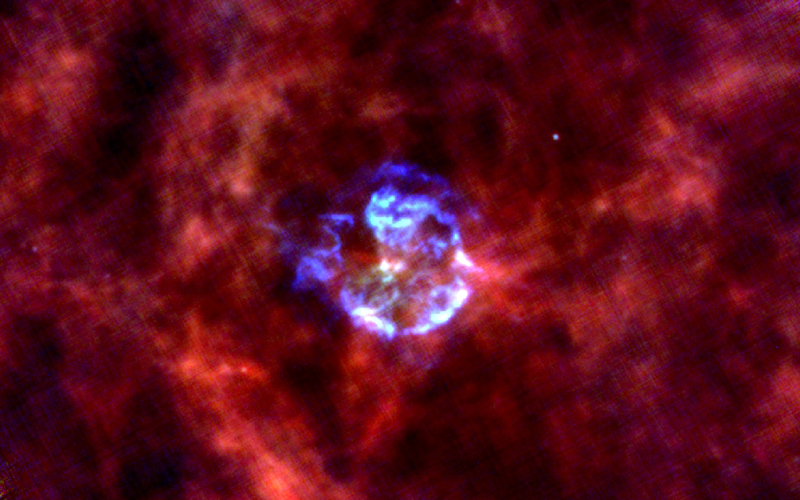
The Crab Nebula as seen in visible (left), showing the glow from hot gas, and far-infrared (right) showing hot (blue/green) and cool (yellow/orange) dust shining in the remnant. Image credit: ESA/Herschel/SPIRE/PACS/MESS (Far-IR); NASA/ESA/STScI (Visible)

Dust Factory in the Crab Nebula revealed by the Herschel Space Observatory

Herschel has produced an intricate view of the remains of a star that died in a stellar explosion a millennium ago. It has provided further proof that the interstellar dust which lies throughout our Galaxy is created when massive stars reach the end of their lives. More...

Seminars

Please see list below for seminars taking place this term. Coffee will be served in the new Astrophysics kitchen from 3.30pm and the seminars will take place in the Pearson Lecture Theatre.  Please arrive on time to avoid disruption.  

Date  Title Speaker
Monday 22 April 2013 Quasar and star formation feedback throughout the cosmic epochs Roberto Maiolini (Cambridge)
Wednesday 24th April  2013  Prof. Serena Viti Inaugural  Serena Viti (UCL)
Monday 29th April 2013 WALRUS-3D: A sparsity-based approach to weak lensing density reconstructions in 3D

Adrienne Leonard (CEA Saclay)

Monday 13th May 2013

Laura Wolz:

Investigating the bias from foreground removal in intensity mapping surveys

Ailsa Prise:

An investigation of a coronal mass ejection and its associated widespread solar energetic particle event

Angela Occhiogrosso:

Development of astrochemical models based on laboratory data

Internal seminar: Laura Wolz (UCL) Ailsa Prise (MSSL) and Angela Occhiogrosso (UCL)
Monday 20th May 2013 Modified gravity theories with the Vainshtein mechanism: cosmological behaviour and constraints Baojiu Li (Durham)
Monday 3rd June 2013 Planet Formation and Migration Richard Nelson (QMUL)
Monday 10th June 2013
Cosmological constant, its problems and a possible solution T. Padmanabhan (IUCAA)

Monday 22 April 2013: Roberto Maiolini (Cambridge)

'Quasar and star formation feedback throughout the cosmic epochs'

Over the entire life of the Universe only 4% of the baryons have been converted into stars, while gravitational collapse and gas cooling would predict that locally about 80% of the baryons should be in stars. Hence, rather than understanding how stars have formed throughout the cosmic times, it is more important to understand why stars have not formed. To keep the star formation efficiency low, most models of galaxy evolution invoke some form of negative feedback. In low mass galaxies most of the feedback is thought to be associated with outflows generated by SNe and/or radiation pressure. In massive galaxies an additional source of energetic feedback is required to quench star formation and to prevent these galaxies from overgrowing. Most models suggest that this additional feedback is ascribed to the nuclear accreting black holes reaching quasar-like luminosities, which should generate massive outflows cleaning the host galaxies of its gas content, hence quenching star formation.

While observational evidence for starburst-driven outflows has been known for several years, clear and direct observational evidence for quasar-driven massive and energetic outflows has been obtained only very recently through multi-wavelength observations. I will review these observational evidences of negative quasar feedback, both in the local universe and at high redshift.

I will show how these observational results can constrain theoretical models of galaxy evolution. More generally, I will show that such massive molecular outflows, especially those at high redshift, can account for the observational properties of massive local galaxies.

I will also discuss the case, proposed by some recent models, of positive feedback in the quasar-driven outflows, i.e. star formation triggered within the molecular outflow. If confirmed observationally this could be a new, alternative mode of galaxy formation. I will discuss the observational prospects of testing and investigating this scenario.

Wednesday 24 April 2013: Serena Viti (UCL)

In this lecture I will give an overview of the field that has been central to my research for the last fifteen years: molecular astrophysics. Molecules are present in most astrophysical environments within galaxies and, besides having a key role in the formation and shaping of such galaxies, they are also ideal tracers of their physical characteristics. I will use examples from different regions of space, from interstellar and star forming gas in the Milky Way, to extragalactic star forming regions to demonstrate how important molecules are for our understanding of star and galaxy formation.

Monday 29th April 2013: Adrienne Leonard (CEA Saclay)

WALRUS-3D: A sparsity-based approach to weak lensing density reconstructions in 3D

Weak gravitational lensing has become a powerful tool for studying the dark universe, allowing us to place constraints on key cosmological parameters, and offering the possibility to place independent constraints on the dark energy equation of state parameter, w. Typically, weak lensing studies consider two-point statistics of the shear signal, either in projection or tomographically, binning the data into several redshift bins. With the upcoming Euclid mission, and the ongoing Dark Energy Survey, there is considerable interest in generating reconstructions of the dark matter distribution using weak lensing measurements, either alone or in combination with galaxy density information. While several methods exist to do this in two-dimensional projection, the field of 3D density mapping is still very much in its infancy. In recent years, several linear approaches to this problem have been developed which, while promising, do show a number of problematic artefacts and systematic errors.

In this seminar, I will present WALRUS-3D: a new, non-linear and sparsity-based approach to 3D weak lensing density mapping. Sparsity-based methods use a simple assumption: that the signal we are aiming to recover can be represented (approximately) sparsely in an appropriate dictionary. This prior provides a very powerful constraint on the inverse problem of recovering the matter density from weak lensing measurements, and allows us to dramatically improve the quality of 3D density reconstructions as compared to earlier, linear methods.


Monday 13th May 2013: Laura Wolz (UCL) Ailsa Prise (MSSL)and Angela Occhiogrosso (UCL)

Laura Wolz

Investigating the bias from foreground removal in intensity mapping surveys

Abstract:

In the last decade, a technique called intensity mapping has been proposed. The basic idea is that the entire HI flux of a wide patch in the sky is mapped onto a coarse grid for each redshift bin. These maps are then used to measure cosmology through their power spectrum. An important issue when dealing with intensity mapping data is the presence of strong galactic foregrounds which can be up to five orders of magnitude higher than the HI signal. I will present our results of the foreground removal with a simulated intensity mapping survey. To separate HI signal and galactic foreground, we use a fast independent component analysis. I will show that the foregrounds can be effectively removed on small scales of the matter distribution, however, the large scales are affected. In the cosmological analysis, these contaminations can induce a bias on the parameters.

Ailsa Prise (MSSL)

An investigation of a coronal mass ejection and its associated widespread solar energetic particle event

Abstract: 

Multi-spacecraft observations were used to study the in-situ effects of a coronal mass ejection (CME) which erupted from the Sun on 3 November 2011. The evolution of the CME and its associated wave on the Sun were studied, finding that the initial lateral expansion of the CME closely tracked the propagation of the wave. 

Solar energetic particles (SEPs) were observed arriving at several locations, implying that the particles are as widespread as 200 degrees in longitude. An analysis of the SEP arrival times at different spacecraft locations suggests that there is delay in release time for some of the particles. We conclude that this delay is a result of the time taken for the CME to expand to reach the footpoints of the magnetic field lines connecting the spacecraft to the Sun.

Angela Occhiogrosso (UCL)

Development of astrochemical models based on laboratory data

Abstract:

To date, over 175 different molecular species have been detected in the ISM. Many of them are formed in the gas phase, but there are a growing number of species that form more efficiently on grain surfaces during the collapse of star-forming cores. UCL CHEM is a chemical model that takes into account the gas-grain interactions occurring during this collapse, with the aim of reproducing the observed abundances of molecules in star-forming regions.

Since there are few observational clues about the synthesis of complex organic molecules on grains, experiments can be performed in order to collect laboratory data of interstellar relevance. My present work couples UCL CHEM with the most recent experimental results on the formation of various complex organic molecules, including methyl formate, ethylene oxide and acetaldehyde, all which have been the subject of recent astronomical interest.

In addition, I will also mention experimental work on a gas-phase project involving reactions between atomic oxygen and small hydro- carbons, which may have relevance to the circumstellar envelopes of carbon stars, etc. 

Monday 20th May 2013: Baojiu Li (Durham)

'Modified gravity theories with the Vainshtein mechanism: cosmological behaviour and constraints'

I will talk about the generic features of a class of modified gravity theories, which recover GR in high density regions by the Vainshtein mechanism. These include the well-known Dvali-Gabdadze-Porrati (DGP) braneworld model and the Galileon gravity models. I will describe their cosmological signatures revealed by linear perturbation calculation and N-body simulations, the physics behind those features and the constraints from the current cosmological data.

Monday 3rd June 2013: Richard Nelson (QMUL)

TBC

Monday 10th June 2013: T. Padmanabhan (IUCAA)

'Cosmological constant, its problems and a possible solution'

Abstract to follow.

Page last modified on 09 may 13 10:32 by Alexandra N D Fanghanel