Investigating complex oxide films and multilayers for use in electronic device technology
28 February 2013
L. Qiao, K. H. L. Zhang, M. E. Bowden, T. Varga, V. Shutthanandan, R. Colby, Y. Du, B. Kabius, P. V. Sushko, M. D. Biegalski, S. A. Chambers, |
The impacts of cation stoichiometry and substrate surface quality on nucleation, structure, defect formation, and intermixing in complex oxide heteroepitaxy - LaCrO3 on SrTiO3(001) |
Advanced Functional Materials (published online) |
Since the discovery of high-temperature superconductivity in cuprates at the end of the last century, complex oxide films and multilayers have been of significant interest in condensed-matter physics and materials science, as well as electronic device technology, because of their wide range of physical properties.

Although complex oxides are now viewed as one of the
next frontiers in electronic materials, reproducible and
reliable oxide electronic devices cannot be fabricated
and the mechanisms for their operation cannot be
understood unless control over epitaxial film growth
and heterojunction formation is achieved.
The question of stoichiometry in complex oxide films and its relationship to functional properties is largely unexplored. In the pulsed laser deposition (PLD) growth, it is often tacitly assumed that composition is preserved in going from the ablation target to the film. However, this assumption may not be valid, particularly when the substrate is exposed to only one part of the plume. Evidence for changes in the cation atom ratios during laser ablation has recently been generated for perovskites, such as SrTiO3 (STO), BaTiO3, PbTiO3, LaAlO3, SrRuO3, LaMnO3, and SrMnO3.
In comparison, composition control is more straightforward in molecular beam epitaxy (MBE) growth, at least in principle. Due to each metal source being independently controlled, the film composition can be tunes throughby tuning metal evaporation rates and accounting for the dependences of sticking coefficients at the growth temperature.

This paper describes how several analytical techniques,
along with ab initio simulations have been used
to investigate the effect of cation
stoichiometry and substrate surface quality on
the crystallinity, surface morphology, interfacial
mixing, and defect generation in MBE-grown
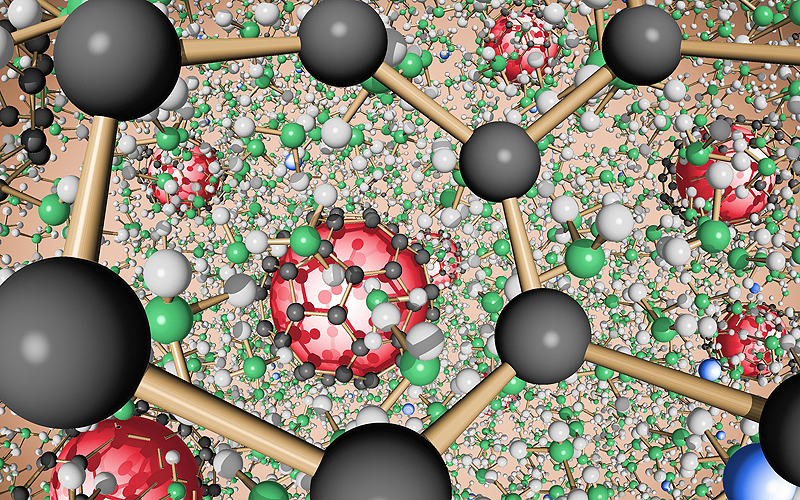
LaCrO3 / SrTiO3(001) films (see Figure, above).
The relatively small in-plane lattice mismatch
(~0.5% for pseudocubic LCO) facilitates coherent growth of
LCO on STO(001) and allows the effect of film
composition on structure to be systematically investigated.

It has been found that this material is able to accommodate
La-to-Cr ratios which differ from unity by as much as
~15% in the Cr-rich direction without extensive loss
of structural quality (see Figure, left). The material buckles structurally
more readily in the La-rich direction.
In cases directions, the data and calculations are
consistent with cation anti-site defect formation as a
way the LCO lattice can accommodate La-to-Cr atom ratio
mismatches.

Cation mixing occurs at the interface for all film compositions,
and is not affected by stoichiometry in any obvious way.
Comparison of data for LCO/ STO(001) with that
for LCO/Si(001), both prepared at ambient temperature,
reveals that interfacial mixing is driven
at least in part by defects in the STO.
These results provide guidelines and a framework for understanding the best ways to prepare complex oxide heterojunctions for either fundamental materials research or novel device fabrication.
In particular, this study demonstrates that the compositions of both BO2 and AO sublattices of LCO can deviate significantly from the ideal stoichiometry without inducing major lattice structure changes. Given that electronic, magnetic and optical properties can be substantially manipulated by much smaller changes in composition,, it is concluded that structural analysis alone provides inadequate characterisation of these materials and can, in turn, lead to misleading interpretation of the observed physical phenomena.
For more information see:
- Multiband optical absorption controlled by lattice strain in thin-film LaCrO3, Physical Review Letters 110, 077401 (2013).
- Band alignment, built-in potential and the absence of conductivity at the LaCrO3/SrTiO3(001) heterojunction, Physical Review Letters 107, 206802 (2011).
- Instability, intermixing and electronic structure at the epitaxial LaAlO3/SrTiO3(001) heterojunction, Surface Science Reports 65, 317-352 (2010).
- Cation mixing, band offsets and electric fields at the LaAlO3/SrTiO3(001) heterojunctions with variable La:Al atom ratio, Surface Science 605, 1381-1387 (2011).
- Thermodynamic instability at the stoichiometric LaAlO3/SrTiO3(001) interface, Journal of Physics: Condensed Matter 22, 312201 (2010).