Certificate in Astronomy
|
|
The Department
UCL is one of the leading establishments for higher education in the country. The Physics and Astronomy Department has consistently achieved very high ratings for both teaching and research across the board, and the College contains one of the largest and widest-ranging research efforts in astronomy and space science in the country.
UCL has led the way in astronomical education. The BSc degree course in astronomy was established more than fifty years ago, the earliest by far and for many years the only such course in England and Wales. The four-year MSci Astrophysics course now gives an unsurpassed level of astronomical education up to the frontiers of scientific research.
The experience and skills of this distinguished Department are brought to the Certificate in Astronomy, to meet the perceived need for part-time evening study in astronomy that goes beyond normal evening classes but stops short of the level of a full first-degree course.
Facilities at UCL
Students will be registered as part-time students at UCL and
will be entitled to full use of College facilities including the
Students' Union and the College Library. All registered
students
will be given a UCL computer account and must keep their
password up to date.
Students will also be able to use departmental facilities including the undergraduate common room (useful for evening refreshments!) and the departmental undergraduate library.
*The UCL Department of Physics and Astronomy
launched its popular and
successful Undergraduate Diploma in Astronomy in 2001. However, it no
longer satisfies new UK and European rules for HE awards. From 2006 it
has been replaced by the Certificate in Astronomy, which fully
satisfies
these rules and has complete transferability as equivalent to the first
year of a degree course.
The course extends over two academic years, starting in late September each year.
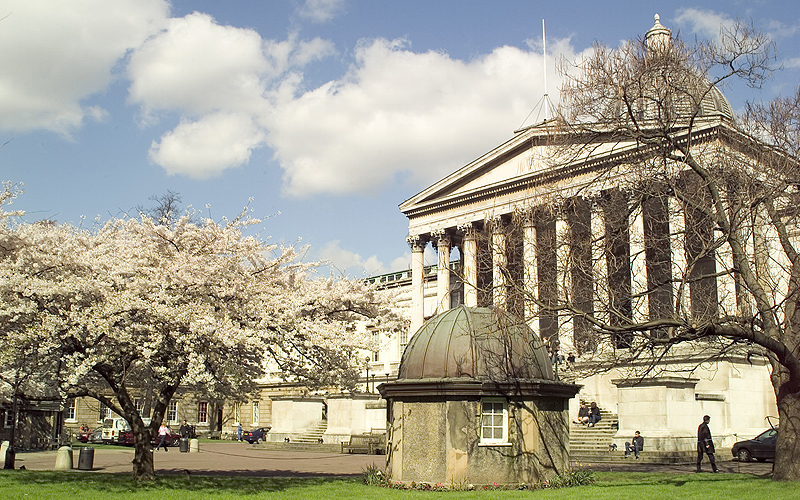
First-year lectures will be given by the Department of Physics and Astronomy, at University College London in Gower Street (The exact location will depend on central booking of lecture spaces which cannot be confirmed until the start of September.) This is a convenient central London location, easily accessible by public transport. Classes will be held on Tuesday evening each week during the academic Term. The hours will be from 6.00 pm to 9.00 pm. The structure of the evening will be as follows:
| 6.00-6.50 | lecture |
| 6.50-7.15 | refreshment break |
| 7.15-8.00 | lecture |
| 8.00-8.10 | short break |
| 8.10-9.00 | lecture |
The programme of lectures will be interspersed with discussion sessions and problem classes. After an introductory induction evening in the first week, classes will run for eleven weeks in each of the two teaching terms each year.
Lecture Course Syllabus
Two modules will be taught in each term, as follows:
| First Year, Term 1 | Foundations of astronomy. |
| Techniques in astronomy. | |
| First Year, Term 2 | The Solar System. |
| The Sun and stars. | |
|
Second Year, Term 1 |
Extra-solar planets and the search for life. |
| Interstellar astronomy. | |
|
Second Year, Term 2 |
High-energy astrophysics. |
| Extragalactic astronomy and cosmology. |
The three lectures each evening will normally be one on one module, and two on the other module running that term, arranged to give equal numbers of lectures in the two modules over the term.
Click here for the detailed syllabus.
Practical Sessions
Students will attend practical classes at the Mill Hill Observatory in groups. Each student will have eight evenings at the Observatory in each year of the Certificate, attending at three-weekly intervals for four weeks in each of the teaching terms. Classes run from 6.30 to 9.30 pm, on WEDNESDAY evenings in the first and second year of the Certificate.
The weather can be uncertain. On clear nights full use will be made of the Observatory's suite of telescopes under appropriate supervision. Students will be instructed in the use of telescopes and the types of observation that can be made. For cloudy nights there is a good range of other practical activity, including the use of catalogues, star charts and images, and computer-based packages.
Astronomy Dissertations
At the start of the Session, students in the first and second
years
choose a topic from a list provided, and research and write an
extended
essay on their specific area of Astronomy or Astrophysics of
length
about 4,000 words. The research is expected to use the
UCL
Library (both physical and electronic resources) as well as other
sources such as the Internet. For both
years, the final deadline for submission will be during the week
following the Easter
break.
Provisional Syllabus for Lecture Courses
YEAR ONE |
First Term |
|
Foundations of Astronomy An overview of modern
astronomy, providing an introduction to the night sky, stars,
galaxies and cosmology. Techniques in Astronomy Optical and mechanical properties of telescopes; recent developments in large mirrors, adaptive and active optics. Diffraction effects in telescopes and instruments; Rayleigh Criterion, Airy function. High- and low-resolution spectroscopy; spectroscopic diagnostics in astrophysics. Radio Astronomy. Instruments and detector systems in space, including infrared, ultraviolet and X-ray missions). |
Second Term |
|
The solar system Basic geography, interior structures, surface features and atmospheres of the terrestrial planets. Plate tectonics, volcanism, seismology and radiometric dating on the Earth. Impact cratering, polar regions, and origin of the Moon. Interiors, atmospheres and rings of the giant planets. Basic geography and surface features of the satellites of the giant planets. Properties of Pluto and other dwarf planets. Asteroids, meteorites, comets and Kuiper Belt. Origin of the solar system. The Sun and Stars The Sun; its nuclear energy source, structure, environment and activity cycle; principal observable layers; photosphere, chromosphere, corona. Measurements of the properties of stars, including magnitudes. Luminosity, effective temperature and stellar classification, H-R diagram. Outline of stellar evolution with reference to the H-R diagram. The white dwarf, neutron star and black hole end-states of stars. |
YEAR TWO |
First Term |
|
Interstellar Astronomy Overview of the interstellar medium; ionized, atomic and molecular gas; examples from red giant envelopes, planetary nebulae, supernova remnants, and absorption in cold gas clouds. Photoionization and recombination; heating and cooling processes. Interstellar dust; extinction and reddening. Cosmic rays. Star formation; hydrostatic equilibrium, free-fall and induced collapse; observational signatures; gas flows from star-forming regions. Extra-solar planets and the search for life Methods for searching for planets; Doppler shifts, transits, imaging and infrared observations. Recent results and implications for theories of the formation of planetary systems. Future missions. Schematic history of the development of life on Earth. Criteria for life; habitable zones, life-times of stars; panspermia. Possibilities of life elsewhere in the solar system, including the cases of Mars, Europa and Titan (current and future spacecraft missions). Signatures for life and the role of atmospheric compositions. The Darwin mission. SETI and the prospects for intelligent life; the Drake equation, the Fermi paradox; searches for signals and artefacts from other civilisations. |
Second Term |
|
High-energy Astrophysics High-energy galactic and extragalactic sources; supernovae, gamma-ray sources, interacting binary stars, accretion disks. Production and absorption of high-energy photons in the Universe. Neutrino astronomy; supernova 1987a, solar neutrino problem, neutrino detectors. Gravitational wave astronomy; general relativity, binary pulsars, LIGO and LISA detectors. Extragalactic astronomy and cosmology Structure of the Milky Way; Hubble galaxy types, content and properties. Hubble's Law and distance indicators (Cepheids). Distribution of galaxies in clusters and superclusters. Active galaxies and quasars. Gravitational lensing. Dark matter. Observational basis of cosmology; Olbers' paradox. History of the Universe. Friedmann models - assumptions and solutions; fundamental cosmological parameters. Origin and significance of the CMBR, plus COBE results. Cosmic nucleosynthesis. Successes and failures of the standard Big Bang model. The inflationary Universe. Formation of structure in the Universe. |
Provisional Syllabus for Practical Courses
YEARS ONE AND TWO |
| The syllabus includes the use of telescopes, the use of astronomical software, the operation of a CCD camera, observations of the Moon, planets, stars, nebulae, and galaxies by direct viewing and by imaging and spectroscopy, laboratory exercises covering topics such as planetary surfaces, pulsars, stellar spectra, interstellar matter, galaxy classification, comets, and the moons of Jupiter. Weather permitting, students will have opportunities to obtain images with and observe through the Radcliffe 24-inch/18-inch double refractor telescope, and to obtain spectra with the Allen 24-inch reflector. |
Entry Requirements
The Certificate course is intended for students with a variety of backgrounds and experience and the entry requirements are flexible. No particular previous knowledge or experience of astronomy is expected, just a strong interest in the subject. In the Certificate course the use of mathematics is kept to a minimum and it is sufficient for students to have an acquaintance with mathematics to about GCSE standard or an equivalent. This does not have to be particularly recent. The Certificate course will require a commitment to study at a fairly advanced level. There are no specific A-level requirements but students will be expected to have had experience of study to A-level standard or an equivalent in any subjects. Prospective students who are unsure whether their qualifications are adequate for the Certificate course are invited to consult the Admissions Tutor.
Please note that since the Certificate in Astronomy is a part-time course we can only accept applications from people who are already resident in the United Kingdom for reasons other than full-time education.
How to apply?
Applications may be sent in at any time up to mid-September, but you are strongly recommended to apply well before the end of August. The enrolment process is quite complex and lengthy, and during the months of September and October the College administration departments are extremely busy, so your registration is likely to be delayed considerably if you apply late. The consequences of this would be that you would not have your ID card to gain access to the library or Students' Union and you would need to come in during normal working hours to have your ID card made as this cannot be done by post or by proxy.
- Notes for prospective students. Please read it thoroughly before completing the application.
- Download the application form (pdf version).
Please return the completed application to the admissions
tutor for evening students:
Dr Mike Dworetsky
Department of Physics and Astronomy
University College London
Gower Street
London WC1E 6BT
Please print this form out, single sided if possible, give the
reference form to the person providing it, and complete the
Disability/Ethnicity survey form. The reference is required
and if possible, applicants should provide as referee the name of
a person who can vouch for their academic suitability for the
Astronomy Certificate or previous satisfactory performance on some
other course. The reference should be in a sealed envelope signed across the
seal by the referee and be submitted with the rest of the
application. Alternatively, you can ask the referee to send
the form to the admissions tutor, Dr Mike Dworetsky, Astronomy Certificate Tutor, at
the above address. Please
remember to use Large Envelope postage if you use a large envelope
(currently [Jan 2013] 90p First Class and 69p Second Class for
100g or less).
All candidates who may be made an offer of
admission will be invited to attend for interview.
General enquiries
To request a paper copy of the application form and for any other enquiries, please contact Christine Johnston at the following address:
Department of Physics and Astronomy
University College London
Gower Street,
London WC1E 6BT
tel: 020 7679 3943
e-mail: astrocert@ucl.ac.uk
UK Students Fees
Students will be required to pay a tuition fee, which for the
year 2013/2014 is £1,150 per annum. The fee may be paid either in full at the start of each academic
year or – provided your application can be processed before
September – you may opt to pay in equal instalments in October
and January of each year. There is a provision to pay your
fees
on line via UCL's PORTICO Registry software.
If you have lived abroad recently please read the
section further below on Overseas Student Fees.
Equivalent or Lower
Qualifications In 2008, the Secretary of State withdrew Higher
Education Council funding from students taking courses offering an
equivalent or lower qualification to one already held.
However, a
number of exceptions were made for science courses and it is our
understanding that the Certificate of Higher Education in
Astronomy is
one of these, hence there is no plan to charge any higher fees for
the
Certificate other than those stated above, except for modest
increases
each year related to inflation of home student fees.
Overseas Student Fees
The College does not receive any government funding in respect
of students who fall into the "overseas" category and
so charges a much higher fee in such cases. The overseas student
tuition fee for the year 2013/2014 is £9,750 per
annum. This page will be updated when the information
becomes available.
There are two criteria (and only two) which are considered in deciding whether someone can be granted "Home or EC student" status.
For citizens of the EC the student must have been ordinarily resident in the European Economic Area wholly or mainly for non-educational purposes for the full three years preceding 1 September in the year the course is due to start.
For non-EC nationals the same criterion as above applies PLUS the student must have been granted the right of permanent residence in the UK by the Home Office before 1 September in the year the course starts.
For legal reasons the College must apply these rules rigorously. However, if you are resident in Britain and would like to follow our course but would not be able to pay the overseas fee we can enrol you as a Continuing Education student. You would then not be eligible for the award of the UCL Certificate but would receive a Certificate from the Department of Physics and Astronomy certifying the modules which you have passed. Please contact the Admissions Tutor for further details.
UCL Term Dates, 2013–2014
Classes at UCL will be on the following dates:
| Induction evening |
Tuesday, 24 September, 2013* from 5.30pm |
| Term 1 | Tuesday, 01 October to Tuesday, 10 December, 2013 |
| Term 2 | Tuesday, 14 January to Tuesday 25 March, 2014 |
*Induction is very
important. Please advise the Tutor if you cannot attend for
any reason, and we will deal with your registration details as soon
as possible.
Provisional dates for First-Year practical classes at the Observatory, 2013–2014
Practicals in First Year are at the Observatory on Wednesday
evenings and students will be allocated to one of the following
groups. Student preferences will be taken into account in setting
up the groups but it will not normally be possible to transfer
later on between groups.
*The final Group B and C sessions will be on the evenings of
Thursday 20 March and Thursday 27 March (provisionally--subject to
change).
| Group A | Group B |
Group
C |
|
| 2013 |
October 02 |
October 09 |
October 16 |
|
October 23 |
October 30 |
November 06 |
|
|
November 13 |
November 20 |
November 27 |
|
|
December 04 |
December 11 |
January 15 |
|
| 2014 |
January 22 |
January 29 |
February 05 |
|
February 12 |
February 19 |
February 26 |
|
|
March 05 |
March 12 |
March 19 |
|
|
March 26 |
March 20* |
March 27* |
Practical classes will be at the Department's own observatory, the University of London Observatory in Mill Hill, North-West London. The Observatory is conveniently reached by Thameslink trains from central London. There is no car parking at the Observatory for students, but it is possible to park in the nearby Daws Lane Car Park.
The Observatory has recently been refurbished and the accommodation and equipment for student use have been extended. It is equipped with the following telescopes: the Radcliffe 24/18-inch refractor; the Allen 24-inch reflector; the Fry 8-inch refractor; two 14-inch Celestron reflectors. The telescopes have a full range of instruments including spectrographs and CCD detectors.
Getting to ULO
The Observatory is located off the northbound carriageway of the A1 in Mill Hill, North London. (There is no vehicular access from the southbound carriageway; pedestrians on the southbound side of the road must use the under-road subway just north of the Observatory.) It is easily reached by public transport.
Click through for a Google Map, or UK Street Map. The Observatory is on the north-bound (western, or left-hand) side of Watford Way dual carriageway, and not in Mill Hill park. (If in doubt, note that the Observatory domes are easily identifiable by zooming in on Google Maps' 'satellite view'.)
From UCL
The fastest way to get to ULO from UCL is to catch the tube from Euston Square to Farringdon, then change platform to catch a First Capital Connect mainline train towards Luton or St Albans, disembarking at Mill Hill Broadway. (Mainline trains run every 15–20 minutes during the day.)
It's then about 800m (somewhat over half a mile; a 10–15-minute walk) to the Observatory