|
|
|
|
4 YEAR PHD IN NEUROSCIENCE
funded by the Wellcome Trust & MRC
Why study Neuroscience at University College London?
Outstanding research opportunities
University College London (UCL) offers unrivalled
opportunities for PhD research in all aspects of neuroscience.
Specimen PhD projects are given below: the subjects studied range from
the molecular biology of neuronal proteins, through cellular
neuroscience, to the behaviour of sensory and motor systems and brain
imaging. Neuroscience research is carried out in all of the College's
biomedical departments, by researchers who are among the leaders of
their fields, using the most modern techniques to address important
problems of basic and clinical neuroscience. Research labs are well
funded, so that PhD students have the best chance of getting off to a
productive start in their research. UCL produces the highest quality
neuroscience research of any university in the country. For the field
neuroscience it generates 30% of England’s contribution to the world’s
most highly cited publications (documented HERE),
more than twice as much as either Cambridge or Oxford, and in the
sub-field of neuroimaging UCL and its hospitals produce 65% of
England’s contribution to the world’s highly cited papers which is more
than 4-fold larger than either of the runners up (Oxford and Kings
College London). Accordingly it is an outstanding place to train the
next generation of neuroscience researchers.
Cultural and social opportunities provided by London
UCL is located in Bloomsbury, close to the entertainment
areas of the West End and South Bank which offer an enormous range of
music, art, theatre and film, and a vast number of restaurants and
bars. London is extremely socially diverse: most PhD students rapidly
establish a thriving social life.
Why choose to study Neuroscience in the 4 year Programme?
Because the 4 year Programme provides a better training,
equipping students with the experimental and theoretical techniques
needed to do outstanding research in their future career (see tab below on Student Outcomes).
Deficiencies of 3 year PhDs
Conventional 3 year PhDs involve a student working with a
supervisor who they often have little knowledge of before they start,
on a project which they have little prior understanding of. The
resulting training can be rather narrow (limited to learning the
techniques offered by that one lab), and students sometimes select
supervisors or projects which are not best suited to them.
Structure of the 4 year programme
Value of the first year
The four year programme provides a broader and deeper
research training in neuroscience, and allows students to make a more
informed choice of supervisor and project. This is achieved by having
an initial training year in which the students attend some specialized
courses, and do three brief (3 month) research projects in different
labs. Out of the three broad subject areas of Molecular Neuroscience,
Cellular Neuroscience and Systems Neuroscience & Imaging, students
will choose laboratories from at least two areas, in order to
maintain a broad expertise across neuroscience in the first year. By
working in different labs, the students will have the opportunity to
acquire a broader range of experimental and theoretical techniques,
and to try out supervisors with whom they may wish to do research for
the PhD. For the structure of the 1st year please refer to the tabbed panel 'Year 1 Structure' section below.
The 3 PhD years
After their first year, students will work in one lab doing research for the PhD (this might be one of the labs they worked in during the first year, or a different lab). During the PhD students will be encouraged to attend advanced training courses in the USA and Europe. For supervisors available for PhDs please refer to the tabbed panel 'Supervisors' section below.
Pastoral care
Throughout the 4 years, the student's progress will be monitored and assessed by a committee responsible for the training provided. Students will be integrated into the community of neuroscience researchers at UCL by participation in journal clubs and social events. Career advice will be given in the last year to prepare the student for their post doctoral career.
The 4 year PhD Committee
The committee currently comprises David Attwell,
Sarah-Jayne Blakemore, Patricia Salinas and Alasdair Gibb, and
students can approach any of the committee members for advice and
guidance when needed.
Student experiences and outcomes
Want to read about students' experiences on the 4 year programme? - they are described in Trends in Neurosciences (July 2000) Vol 23, pages 280-283. An assessment of how well the students do scientifically on the programme is given in the tabbed panel 'Student Outcomes' section below.
|
MOLECULAR NEUROSCIENCE Andrew Copp John Parnavelas
Juan Pedro
Martinez-Barbera Jason Rihel Christiana Ruhrberg Stephanie Schorge |
CELLULAR NEUROSCIENCE Patrick Anderson
Mala Shah |
SYSTEMS/COGNITIVE NEUROSCIENCE Sven Bestmann
Francesca Cacucci Marco Davare Jörn Diedrichsen Karl Friston Kenneth Harris Steve Kennerley
Eleanor Maguire
Marko Nardini Maneesh Sahani Vince Walsh Plasticity and recovery in health and disease Jason Warren |
How to apply and what studentships are available?
The next intake of students will be in September 2013. Students will spend the first year learning a wide range of neuroscience techniques by doing 3 month projects in different laboratories, before choosing a full research project and supervisor for the subsequent 3 years. Projects available cover the whole range of neuroscience, from molecular biology through cellular mechanisms to systems neuroscience and imaging.
Up to six PhD studentships,
with a stipend starting at £22,278, will be available. These also pay
fees at the EU rate, research costs to the laboratory and provide
funds for travel to conferences or courses. Applicants should have, or
expect to get, at least an upper 2nd class degree in any area of
Biological or Physical Sciences (the course allows conversion to
neuroscience from a physical sciences background). Non-UK applicants
may apply, and receive the normal stipend etc., except that fees will
only be paid at the EU rate (see Detailed instructions for more details)
To apply we need to receive a CV, a statement of why you want to do the PhD and at least two academic references, all e-mailed to NeuroPhD@ucl.ac.uk. Before you apply you must read these Detailed instructions on how to apply.
Any questions not answered on that page should be sent to David Attwell at d.attwell@ucl.ac.uk
The deadline for receiving applications and references is January 7th, 2013. Interviews are expected to be at the end of January 2013.
Please note that you must activate your referees to send their references; we don't do that for you.
Structure of the First Year of the 4 Year PhD
The first year has 3 main components, compulsory courses, optional courses and (occupying most of the time) three 3 month laboratory placements spent doing research and learning techniques.
Compulsory Courses
These consist of:
|
An Induction course introducing you to the College A course on Current Techniques in Neuroscience A Topics in Neuroscience course, structured like a journal club in which you present research papers A Statistics course A course on Library and Database Usage An Electronics course A course on the Ethics of Animal Experimentation Two Neuroscience courses chosen from the Optional list below Attending Journal Clubs associated with the lab placements (see below) A Science Communication course (may also be taken in the 2nd year) |
Optional Courses
These consist of:
|
Computing Courses on E-mail, Word Processing, Internet, Spreadsheets,
Powerpoint, Visual Basic, and more advanced programming A Mechanical Workshop course A Further Statistics course A Radiation Safety course Orientation for Foreigners English for Foreigners |
The following Neuroscience Courses:
|
Advanced Cytology Neural Basis of Learning + Motivation Advanced Neuroanatomy Neurobiology of Neurodegenerative Disease Cellular + Developmental Neurobiology Control of Movement Neural Computation Peripheral Nervous System Animal Cell Biology Develpmantal Biology: Cell + Molecular Aspects Molecular + Cellular Pharmacology Neuropharmacology Synaptic Pharmacology Neurobiology of Behaviour Neurophysiology Cell Physiology Speech Hearing Memory Visual Perception Neurobiology of Vision Pain Clinical Neuroscience |
6 weeks 6 weeks 6 weeks 5 weeks 22 weeks 6 weeks 6 weeks 6 weeks 6 weeks 11 weeks 6 weeks 6 weeks 6 weeks 6 weeks 6 weeks 6 weeks 6 weeks 6 weeks 6 weeks 5 weeks 5 weeks 5 weeks 2 weeks |
Journal clubs in the rotation labs
The Laboratory Placements
Three of these are done, chosen from labs working in the broad areas of Molecular Neuroscience, Cellular Neuroscience, and Systems and Imaging Neuroscience. Students must choose 3 placements covering at least 2 of these broad areas (in order to avoid over-specialization in the first year). For example, students might do a placement in one lab which they think they might want to do their PhD research in, one in a similar lab for comparison, and one in a lab studying something quite different to gain experience in another area. Students doing these placements often publish papers on their work, or present it at scientific meetings.
For information on supervisors and projects refer to the supervisors tab
Assessment
Student progress during the first year is assessed by:
(i) exams on the Topics in Neuroscience course, the Ethics of Animal Experimentation course and on the Statistics course
(ii) a write-up and 10 minute oral presentation on each lab placement
(iii) their placement supervisor’s assessment of their work
(iv) their contribution to journal clubs they attend
(v) the writing of a research plan outlining their proposed PhD project for the subsequent 3 years.
FOUR YEAR PhD PROGRAMME IN NEUROSCIENCE AT UCL
How well do the students in the programme do scientifically?
Scientific publications
As of April 2007, the students going through the programme since 1996 have published a total of 251 journal papers since entering the programme, with 28 (11%) high profile papers in Nature family journals, Science, Cell or Neuron.
Five years after starting the programme, the 15 students in the first three years’ entry had published 80% more papers/student than the average of all 123 three year PhD students recruited to the same departments at the same time. One might hypothesise, however, that this superiority of the 4 year students could reflect the 3 year PhD students being less selected or working with weaker supervisors. To assess whether the 4 year programme confers particular benefits, we therefore carried out tougher comparisons, that were not confounded by the inclusion of weaker supervisors who we do not allow onto the programme, or by the selection bias inherent in our admission process. We did this as follows.
First we removed supervisor bias, by comparing the output of students in our programme with the output of matched 3 year PhD students who did a PhD in the same lab at approximately the same time (all except 5 of the 66 1996-2004 students could be matched). The results are plotted in Figure 1 as absolute number of papers, and in Figure 2 as the relative productivity of 4 and 3 year students (1 is added to the number of papers before taking the ratio to avoid divisions by zero). From 7 years after starting, the productivity of 4 year students increases significantly (Fig. 2) above that of 3 year PhD students with the same supervisors. Students in the first 3 entry cohorts have now received 2621 citations of their papers, compared with 1421 citations of the papers of matched 3 year students in the same labs (84% more).
Figure 1
Figure 2

Secondly, to eliminate effects of the higher selection to which our students were subjected, we compared the output of our 4 year students, with the output of students who we made an offer to but who chose to take up a place on a 3 or 4 year PhD elsewhere. This ensures that the comparator students were viewed by our committee as being at least as good as the accepted students. The results (Figure 3) show a significantly higher output, from 7 years after starting the course, by our 4 year students than by students who rejected our offer.
Figure 3

We conclude that going through the first year of the 4 year PhD adds significant long-lasting value to the students’ scientific training.
Career Path after the PhD
Most of the students follow a career in research. As of 2007, of the 37 students who have obtained their PhD, 29 (78%) went on to post-doc positions, 6 went to science-related jobs (drug companies, scientific administration, patent agency or management consultancy) and 2 left science, so overall 95% (35/37) took up positions using their science. The earlier cohorts are now starting to obtain permanent academic positions or Career Fellowships: one is a lecturer at the Royal Vet College, 3 are Royal Society Dorothy Hodgkin Fellows at UCL, one has a 5 year Faculty position at EBRI (Rome), one is an MRC CDF in Leicester, one is a Wellcome RCDF at UCL, two have permanent positions in Edinburgh.
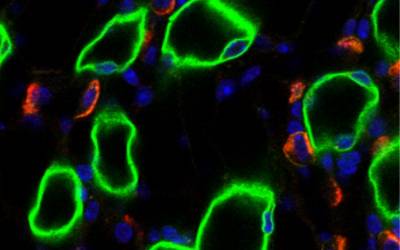
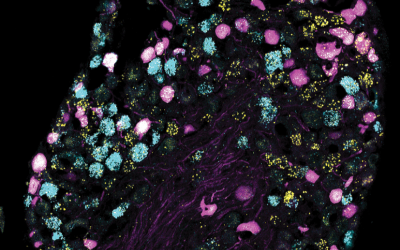
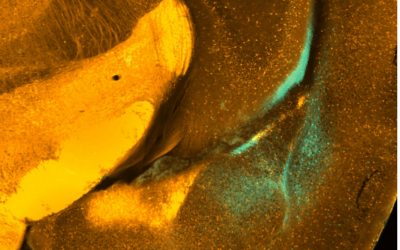
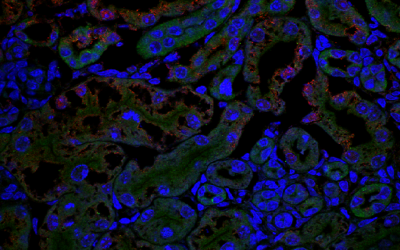
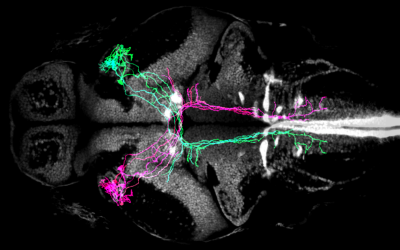
The images at the top of this page
The pictures at the top of this page
show different levels of function of the nervous system.
The left hand picture shows cellular interactions between neurons: the
axon of an inhibitory interneuron (green) makes synapses onto a
cerebellar Purkinje cell (red) in the brain's motor system. Image by
Beverley Clark and Michael Häusser.
The middle picture shows information superhighways in the brain: the
gold colour shows antibody to myelin, which speeds the conduction of
information along neuronal axons in the brain's white matter. Image by
Ragnhildur Káradóttir and David Attwell.
The right hand picture shows function at the whole brain level: the red
and yellow colour shows areas where neurons are detected to be active
using fMRI (functional magnetic resonance imaging) during a particular
task, superimposed on a structural image of the brain. Image courtesy
of Sarah-Jayne Blakemore and the Wellcome Trust Centre for
Neuroimaging, UCL.