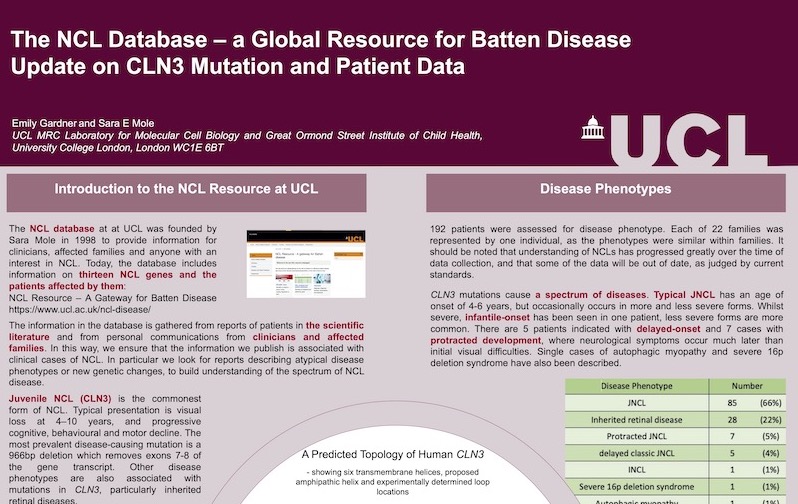
NCL Mutation Database
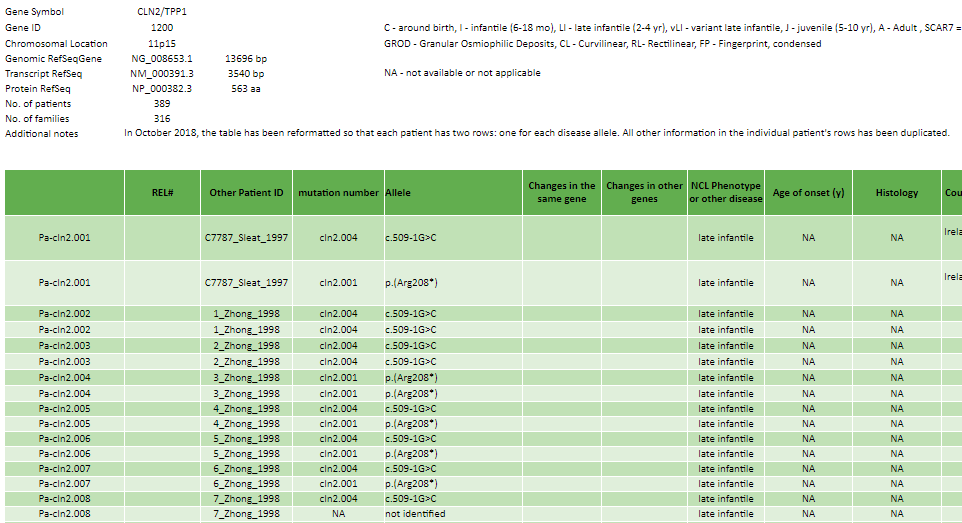
This database contains published mutations and polymorphisms in the NCL genes together with unpublished data included with permission.
It follows the mutation nomenclature recommendations of the Human Genome Variation Society.
The database is protected by copyright and database rights. It is freely accessible and can be reproduced if proper reference is made to the database and its contributors.
Many of the lesions present in this database are included in others, including the European Bioinformatics Institute
Sequence Variation Database,
the Cardiff-based Human Gene Mutation Database, the UK Diagnostic Mutation Database (DMuDB)
and the Human Genome Variation Database. These are good sources of sequence variants but may not contain unpublished mutations.
To submit new mutations please contact Sara Mole.
NCL Genes Tables
Human NCL genes
- CLN10/CTSD - Mutations cause NCL with onset in early childhood, or at later ages.
- CLN1/PPT - Mutations generally cause NCL with onset in infancy, or any age up to adulthood.
- CLN2/TPP1 - Mutations generally cause NCL with onset in late infancy, or at later ages.
- CLN3 - Mutations cause NCL with juvenile onset, and occasionally disease of slower progression.
- CLN4/DNAJC5 - Two mutations cause autosomal dominant adult onset NCL, also known as Parry disease.
- CLN5 - Mutations generally cause NCL with onset in late infancy, or at later ages up to adulthood.
- CLN6 - Mutations generally cause NCL with onset in late infancy, or at later ages up to adulthood including Kufs type A.
- CLN7/MFSD8 - Mutations generally cause NCL with onset in late infancy, or at later ages.
- CLN8 - Mutations generally cause NCL with onset in late infancy, or a very different disease, Northern epilepsy.
- CLN9 - This gene symbol is used for NCL with onset in the juvenile age range that is not CLN3 disease.
- CLCN6 - Single mutations have been described in two late onset NCL patients.
- SGSH - Two heterozygous mutations have been described in a single patient who was diagnosed with adult onset NCL. Mutations in this gene usually cause the more severe and unrelated disorder MPSIIIA .
Animal NCL genes
- cln6/nclf - The gene homologous to CLN6 is mutated in a naturally ocurring mouse model, nclf.
- mnd/cln8 - The gene homologous to CLN8 is mutated in a naturally ocurring mouse model, mnd.
- CLN8/CNCL - The gene homologous to CLN8 is mutated in a naturally ocurring dog model, English Setter.
- CLN2 - The gene homologous to CLN2 is mutated in a naturally ocurring dog model, Longhaired Dachshund.
- CLN5 - The gene homologous to CLN5 is mutated in a naturally ocurring dog model, Border collie.
- CLN5 - The gene homologous to CLN5 is mutated in a naturally ocurring cow model, Devon cattle.
- CLN5 - The gene homologous to CLN5 is mutated in a naturally ocurring sheep model, Borderdale.
- CLN6 - The gene homologous to CLN6 is mutated in two naturally ocurring sheep models, Merino and South Hampshire.
- CTSD/CLN10 - The gene homologous to CTSD is mutated in a naturally ocurring dog model, American Bulldog.
- CTSD/CLN10/CONCL - The gene homologous to CTSD is mutated in a naturally ocurring sheep model, Swedish Landrace.
- ARSG - The gene homologous to ARSG is mutated in a naturally ocurring dog model, American Staffordshire Terrier.
- ATP13A2 - The gene homologous to ATP13A2 is mutated in a naturally ocurring dog model, Tibetan Terrier.