LAPT ( London Agreed Protocol for Teaching )
is a system developed by me (Tony Gardner-Medwin) in the 1990s at UCL, as a learning tool for physiology students in London universities
and medical schools. It has expanded substantially since then, into new fields and with the principles of Certainty-Based Marking
incorporated into software and assessment strategies in other institutions and to a limited extent in Moodle. I am retired now, and have
shifted hosting of London use (mainly UCL & Imperial) to a single website tmedwin.net/cbm,
with the links from students or VLEs (Blackboard-Learn, Moodle) handled by
CBM Selftests,
where open access exercises are also available.
Certainty-Based Marking (CBM)
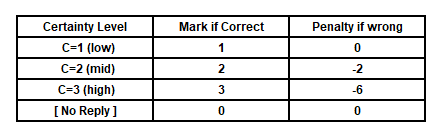
CBM aims to improve both the reliability of computer-based assessment and the effectiveness of student selftests as learning tools.
Both issues are addressed in my teaching publications.
Briefly, CBM promotes deeper thinking in order to get high marks. Students benefit by seeking related aspects of their knowledge that may bear on
a particular question, and using these to make a sound judgement about how certain or uncertain they should be that their preferred answer is correct.
Conventional systems award equal credit to correct answers arising from sound knowledge or from lucky guesses. This is simplistic,
inefficient and unjust as a means of assessing knowledge, and worst of all, in the context of study it encourages acceptance of
superficial ways of thought as being adequate. Further explanation is given at
CBM Selftests.
Selftests for Efficient Home Study in the 'New Normal' CBM Selftests were designed to encourage and improve student home-working.
They help shift some basic elements of tutorial-style teaching (e.g. questions requiring careful thought)
away from the need for face-to-face interaction, which has now become quite problematic and expensive in staff time.
Several features of CBM Selftests make them different from conventional VLE or distance-learning strategies, and this may help
with the problems arising with Covid-19:
Selftests are intended for private or collaborative study. Students can submit their results anonymously if they wish
(or not at all), though submission with their id enables them to review their work later. Students should learn to manage their
learning, choosing topics where they may make mistakes. Selftest mistakes should never be held against them since
they are the most effective (albeit embarrassing, if someone is watching!) way to learn.
The system has a minimal need for internet transfers. An exercise is downloaded by a browser in one go and
then can run indefinitely (providing instant feedback and explanations) without an internet connection**. Final voluntary
submission uses the host internet site for summary analysis, and the data is recorded (with or without an id).
CBM Selftests are unsuitable for high-stakes assessment, since fast performance requires that answers are stored
on the student computer (though in a pretty obscure way). High stakes assessment with CBM should use Moodle or OMR sheets.
Selftests are useful as practice tools for things like maths exercises or word tests, using randomised questions [
Try This!, or
This! ].
Students may be encouraged to repeat tests ad lib for their own good and to submit evidence of a good score as an
informal course requirement.
Submitted data is available to staff to identify problematic topics and unclear questions.
An anonymous comment system (recording context) allows students to query and discuss issues around questions or topics, and staff to respond.
An exercise is simple to write as a text file, or to adapt from other formats. Most selftests are straightforward in structure, but
the system also allows combinations of many question types, flexible answer checking and optional presentational issues. See the
CBM Demo File and
Authoring Manual.
Students have in the past been keen and very useful in developing exercises relevant to their current course structure and their study.
During the vacation, many may currently be interested in such work, and I am sure it should be possible to arrange to pay them.
I am currently working on the software to make it independently manageable on separate institution sites, or on
a standalone PC or mobile, using client Javascript and server PHP. This is largely complete, but I would welcome comments &
suggestions or offers of help from anyone interested or with useful knowledge. The Covid crisis has been a useful spur (and
indeed opportunity!) to get this work done, which I had been contemplating for some years.
** Images used in questions or explanations are currently downloaded as and when encountered. But if student internet
connections are unreliable, separate download en bloc is possible for uninterrupted home work.