 Close
Close


The discovery of mirror neurons in the premotor cortex of macaque monkeys generated some major new concepts in cognitive and motor neuroscience. A large number of non-invasive investigations have indicated that a similar 'mirror neuron system' exists in humans. Mirror neurons have been implicated in several different roles, including understanding the actions and intentions of others, prediction and imitation. In addition, it has been suggested that disturbance of this system could contribute to autism. Moreover, activity of mirror neurons during action observation could be used to train brain machine interfaces operated by paralysed individuals. However, our knowledge of the distribution of mirror neurons in the motor and premotor cortex and of their input and output connectivity is still rudimentary.
We recently showed that identified pyramidal tract neurons (PTNs) in area F5 of the premotor cortex could show mirror-like properties, which means that mirror activity influences sensorimotor function in the spinal cord. Interestingly, about half of these PTNs, although active when the monkey grasped, showed complete suppression of their discharge when monkeys observed an experimenter grasping an object. We are currently following up these observations to see if these suppression mirror neurons could act to suppress the monkey’s own movements while it watches the actions of others.
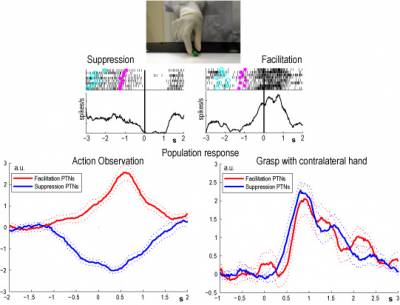
Reference
Kraskov A, Dancause N, Quallo MM, Shepherd S, Lemon RN (2009) Corticospinal neurons in macaque ventral premotor cortex with mirror properties: a potential mechanism for action suppression? Neuron 64:922-930. PMC free text