 Close
Close


Cognitive-Motor Neuroscience Group
Lab Head: Professor Marjan Jahanshahi
We can speed up or slow down our movements through motivation (eg walking faster when in a hurry) or attention (eg walking slower on ice and paying attention to every step). Slowness and mobility problems are features of Parkinson’s Disease. However, under demanding circumstances, such as during a fire alarm, patients with Parkinson’s disease can move faster, the so-called paradoxical kinesis. Also movement speed in PD is increased by external cues such as lines on the floor. We are interested in investigating the modulatory influence of motivation, attention and external cueing on movement speed in healthy controls and in Parkinson’s disease, how these factors interact, and the neural mechanisms by which they alter movement speed.
Examples of relevant publications
Kojovic M, Higgins A, Jahanshahi M. In Parkinson's disease STN stimulation enhances responsiveness of movement initiation speed to high reward value. Neuropsychologia. 2016 Aug;89:273-80. doi: 10.1016/j
Kojovic M, Mir P, Trender- Gerhard I, Schneider SA, Pareés I, Edwards MJ , Bhatia KP Jahanshahi M Motivational modulation of bradykinesia in Parkinson’s disease off and on dopaminergic medication. J Neurology, 2014 Apr 1[Epub Ahead of print]
McDonald LM, Griffin HJ, Angeli A, Torkamani M, Georgiev D, Jahanshahi M. Motivational modulation of self-initiated and externally triggered movement speed induced by threat of shock: experimental evidence for paradoxical kinesis in Parkinson’s disease. PLOS One, 2015 Aug 18;10(8):e0135149. doi: 10.1371/journal.pone.0135149. eCollection 2015
Griffin HJ Greenlaw R, Limousin P, Bhatia K, Quinn NP Jahanshahi M The effect of real and virtual visual cues on walking in Parkinson’s Disease. Journal of Neurology, 2011 Jun;258(6):991-1000.
Mir P, Trender-Gerhard I, Edwards MJ, Schneider SA, Bhatia KP, Jahanshahi M, Motivation and movement: The effect of monetary incentive on performance speed. Exp Brain Res. 2011 Apr;209(4):551-9.
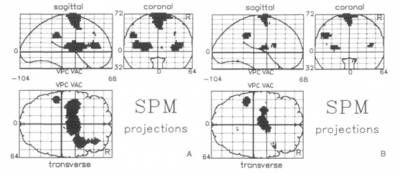
Jahanshahi et al (1995) Brain, 118, 913-933
 |