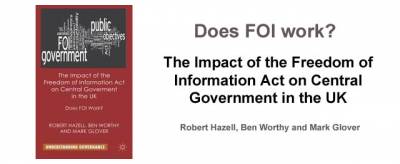
Impact of FOI on Whitehall
2007-2009

The Freedom of Information Act 2000 is intended to make government more transparent, participatory, effective and responsive to its citizens. Has it worked? Who uses the Act, and what do they want to know? Has it improved their trust in government? Has it made government more effective and responsive? Have there been adverse side effects on the working of Whitehall?
This study will help to clarify the purposes of FOI, and to evaluate the impact of the legislation through empirical testing of its effects. We will accomplish this by carrying out surveys of FOI requesters and of senior managers and officials in central government departments with stakeholders of those departments, and analyse departments’ publication schemes and FOI request disclosure logs. To get a feel for the effects of FOI on the wider public who do not make FOI requests, we will analyse newspaper coverage of the FOI Act and disclosures.
The findings from this study will help to clarify the benefits and disbenefits of FOI, especially as they relate to government transparency and accountability, public understanding, public participation in the political process and the quality of government decision-making.
- This project was funded by the ESRC and the Ministry of Justice
- This project was led by Prof Robert Hazell, with support from Dr Ben Worthy and Mark Glover
The Constitution Unit is funded by the ESRC and the Ministry of Justice to evaluate the impact of Freedom of Information (FOI) in the UK. The primary aims of this project are:
- to clarify the theoretical reasoning behind the introduction of FOI
- to evaluate the performance of FOI against its policy objectives
- to assess the impact of FOI on the working of the Whitehall model.Â
Preliminary research has identified six policy objectives which will be tested in the course of the research. We will investigate to what extent the following objectives of the UK FOI Act are being achieved:
- Greater transparency
- Increased accountability
- Better public understanding of government decision making
- More effective public participation in the political process
- Increased public trust and confidence in government
- Better quality of government decision making
At the same time, we will examine how the introduction of FOI has affected the Whitehall model, in particular five key characteristics of the model:
- Civil service neutrality
- Cabinet system
- Ministerial accountability to Parliament
- The culture of secrecy
- Effective government.
The five main research methods we will use are:
- survey of FOI requesters
- interviews with officials and senior FOI managers
- focus groups with departmental stakeholders
- analysis of departments’ publication schemes and disclosure logs
- analysis of media reporting of FOI.
The main outputs from the project will be a book by the principal researchers, and articles in academic and policy journals.
Research Results and Findings
- Buy the book from publishers Palgrave Macmillan
- Read our short end-of-award report submitted to the ESRC at the conclusion of our research: End of Award Report Summary, September 2009
- Read the longer version expanding on our methods and conclusions: End of Award Report, September 2009
- 'Opening up? The impact and future of FOI in the UK', presentation to the Institute of Historical Research, 4 October 2011
- 'More Open but Not More Trusted? The Effect of the Freedom of Information Act 2000 on the United Kingdom Central Government', Governance, Volume 23, Issue 4, October 2010
- 'Assessing the Performance of Freedom of Information', Government Information Quarterly, Volume 27, Issue 4, October 2010
- 'The Impact of FOI: the evidence'. Presentation to the Constitution Unit Government Information Policy Seminar Series, 19 November 2008
- 'Has FOI worked in Whitehall?' Constitution Unit presentation to FOI Live 2008 Conference, 3 June 2008
- 'Is this the high water mark of freedom of information?' Constitution Unit press release, 27 February 2008
- 'Measures of Success for FOI', Robert Hazell's paper for the International Conference of Information Commissioners, 29 November 2007
- 'Evaluating the FOIA 2000: Challenges and Progress', seminar of 31 October 2007. 'Issues and Questions' paper; seminar presentation.
- 'Journalists' use of the UK Freedom of Information Act', Open Government Journal, Vol. 3, No. 1 (2007). Press release.
- 'What is Freedom of Information For? An exploration of the objectives behind the FOI Act 2000'. Paper presented to PSA Conference 2007.
"According to a report last year from Robert Hazell, a former civil servant who is now a politics professor at University College London, and Dr Ben Worthy, the FoI act has not undermined the ability of civil servants to give frank advice, as Blair claims, nor affected government record-keeping.
But they concluded that while the act has achieved its core objectives of greater transparency and accountability, it has done nothing to achieve three of its four secondary objectives (improved decision-making and better public understanding and participation in government) and has hindered progress towards its fourth (increased trust).
They said most news reports based on information obtained through FoI had the effect of reducing trust. "This is because of the media's predominantly negative reporting, exacerbated by government resistance to media requests, and pre-existing low levels of trust." Ian Cobain, 'Mixed results since Blair's 'dangerous' Freedom of Information Act launched', Guardian, 20 September 2011
- "Here are three statements frequently made about freedom of information: Freedom of information is for the ordinary citizen; There would be no need for FOI requests if government published more information proactively;Freedom of information has a chilling effect on the quality of advice and the public record... But are they true? Not according to a new analysis of how FOI has worked in practice since it came into force in the UK in 2005. The researchers involved in the study, academics based at the Constitution Unit at University College, London, maintain that they are simply powerful myths." Martin Rosenbaum, 'FOI truths, or myths?', Open Secrets: A blog about freedom of information, 13 September 2010
- "Is freedom of information working? Depending on who you listen to, it's either tremendously successful or expensive and badly abused. Neither of these caricatures is correct. Thankfully, a proper academic study is trying to cut through the spin and find the answer." Chris Ames, 'Oi, FOI', Guardian: Comment is Free, 16 May 2007
- "Researchers from the Constitution Unit, a think tank at University College London, found that some journalists from both tabloid and broadsheet newspapers had experienced "significant disappointment" with the process of getting answers to and appealing requests." Patrick Smith and Martin Stabe, 'FoI frustrates journalists, report finds', Online Press Gazette, 24 April 2007
- "More than one in five newspaper stories which arise from journalists using FOI are about costs and expenses. This was the most popular kind of newspaper FOI-based story in 2005, according to a study published today by the Constitution Unit at University College, London." Martin Rosenbaum, 'Give me numbers', Open Secrets. A blog about freedom of information, 24 April 2007
- "Hazell's Iron Rule of FoI", in Michael White, 'The Price of Candour', Guardian, 4 April 2007
- "This will be an international first, since no FOI regime has been the study of systematic evaluation" (PSA News, October 2006).
- "The research is timely and should offer important new insight into the impact of the act" (Steve Wood, Campaign for Freedom of Information blog, 22 August 2006)