A A A

Eleftheria Polykarpou's Webpage

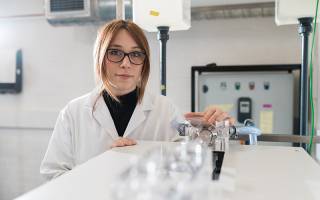
Photo of Eleftheria Polykarpou Postgraduate Researcher

Phone: +44 (0)20 7679 0491
Email: e.polykarpou@ucl.ac.uk
Address:
Department of Chemical Engineering
University College London
Torrington Place
London WC1E 7JE
United Kingdom

Dr. Eleftheria Polykarpou received her first degree in Chemical Engineering from the University of Patras in 2007. She completed her Diploma thesis at the Technical University of Munich as an Erasmus-Socrates student and spent her summer placement at NESTLE S.A. In 2007 she joined the Department of Biochemical Engineering of UCL with a scholarship from IMRC to undertake a PhD in collaboration with the Department of Chemical Engineering. Following her PhD, she worked as a research assistant on optimisation-based techniques for minimising the energy consumption of a promising liquid-liquid desalination process.

Currently she is a teaching fellow at the Chemical Engineering Department, involved in Transport Proccesses I (CENG1001), Process Heat Transfer (CENG2006), Engineering Experimentation (CENG1003) and Process Plant Design (CENG3006) subjects, as well as various MEng and MSc research projects.

Research project

Title: Optimisation of Chromatography for the purification of proteins

Supervisors: Dr Lazaros Papageorgiou and Dr Paul A. Dalby (Biochemical Engineering)

Most of today's biotherapeutics, diagnostic and other pharmaceutical products are proteins and polypeptides. These biotechnological products are mainly produced by microorganisms and mammalian cell lines. After the fermentation stage, the product must be recovered and purified with several steps that comprise the downstream processing stage. After the recovery stage, the remaining product is practically a mixture of proteins containing the "target protein" and through purification it can be isolated. The most widely used purification techniques are chromatographic steps.

The separation and purification of the desired product has always been a bottleneck because of the high capital cost of the equipment and matrices, the operating cost and the required final product quality. In some cases, the purity level of the product can even reach 99.9% for vaccines and antibiotics and the cost of purification may account for up to 60% of the overall process. Enhanced and more efficient chromatographic operations hold a key to reducing the production cost. The objective of this work is to investigate the application of mixed integer optimisation techniques for synthesising downstream purification processes to determine the minimum number of  chromatographic steps in the optimum sequence for given purity and recovery levels.

Selected publications

Eleftheria M. Polykarpou, Paul A. Dalby, Lazaros G. Papageorgiou, (2011)Optimal synthesis of chromatographic trains for downstream protein processing. Biotechnology Progress, 27 (6)1653-1660, DOI: 10.1002/btpr.670

Eleftheria M. Polykarpou, Paul A. Dalby, Lazaros G. Papageorgiou, (2011) An MILP formulation for the synthesis of protein purification processes. Chemical Engineering Research and Design, In press, DOI:10.1016/j.cherd.2011.11.021

E. M. Polykarpou, P. Dalby and L. G. Papageorgiou (2009) An MINLP Formulation for the Synthesis of Chromatographic Protein Purification Processes with Product Loss In: Jeowski, J. and Thullie, J. (eds.) Proceedings of the 19th European Symposium on Computer Aided Process Engineering (ESCAPE-19), Krakow, Poland, 14-17 June 2009, Computer Aided Chemical Engineering, vol. 26. Amsterdam, Elsevier Science. pp. 1057-1062. doi:10.1016/S1570-7946(09)70176-2

Page last modified on 16 dec 11 15:42