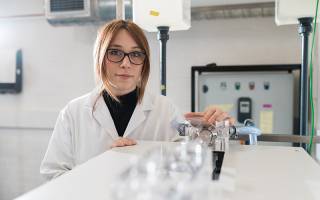
Edward Close's Webpage
|
Postgraduate Researcher Email: e.close@ucl.ac.uk |
Address: Department of Biochemical Engineering University College London Torrington Place London WC1E 7JE United Kingdom |
Edward Close received his first degree as a Master of Chemical Engineering
at University College London in 2009. He was short-listed for the SET Chemical Engineering Student of the Year Award 2009 for his MEng research project.
Edward is now completing an Engineering
Doctorate working with both the Department of Chemical Engineering and the
Department of Biochemical Engineering at UCL, in collaboration with Pfizer. He is currently spending time with Pfizer, USA, until the end of 2011.
Research project
Title: Process modelling approaches to biological complexity in the production of therapeutic proteins
Supervisors: Dr Eva Sorensen and Dr Daniel Bracewell (Biochemical Engineering, UCL)
The surge in the number of therapeutic proteins in clinical evaluation has driven process development groups to create common downstream processing purification platforms that are flexible enough to accommodate most, if not all, of their future pipeline molecules. These consist of of a well-defined sequence of unit operations, typically utilizing a cascade of chromatography columns, with most operating parameters being pre-defined and only a small subset of parameters requiring development effort. However, even with a flexible platform, due to compressed project timelines, long experimental times, and the need to survey an extremely large parameter space, the selection and development of an appropriate chromatography unit operation for a particular purification objective is still a complex and challenging process.

Furthermore, the US Food and Drug Administration (FDA), through its Process Analytical Technology (PAT) and Quality by Design (QbD) initiatives, now encourages development teams to develop processes based upon a high degree of product knowledge and process understanding, where quality is built into the product and process based on scientific understanding, rather than the current ‘test and see’, or mainly empirical, approach. Against this background, there is a need for new strategies and tools to aid and provide an alternative to traditional process development techniques. Integrated modelling and experimentation (IME) purification process development methods show significant promise for this purpose.
This project aims to conduct a more comprehensive study of an IME approach to chromatography column development than has previously been seen. This is to be achieved by taking advantage of the collaboration with Pfizer to apply the approach to industrial chromatography columns, from an industrial perspective, rather than an idealised column from an academic perspective. The collaboration between Pfizer, the Department of Biochemical Engineering, UCL, and the Department of Chemical Engineering, UCL, makes it uniquely possible for this work to do this.
Selected Publications
E Close and E Sørensen, ‘Modelling of Direct Contact Membrane Distillation
for Desalination’, Proceedings of ESCAPE'20, Volume 28, 2010, Pages
649-654.
Page last modified on 15 sep 11 09:42