|
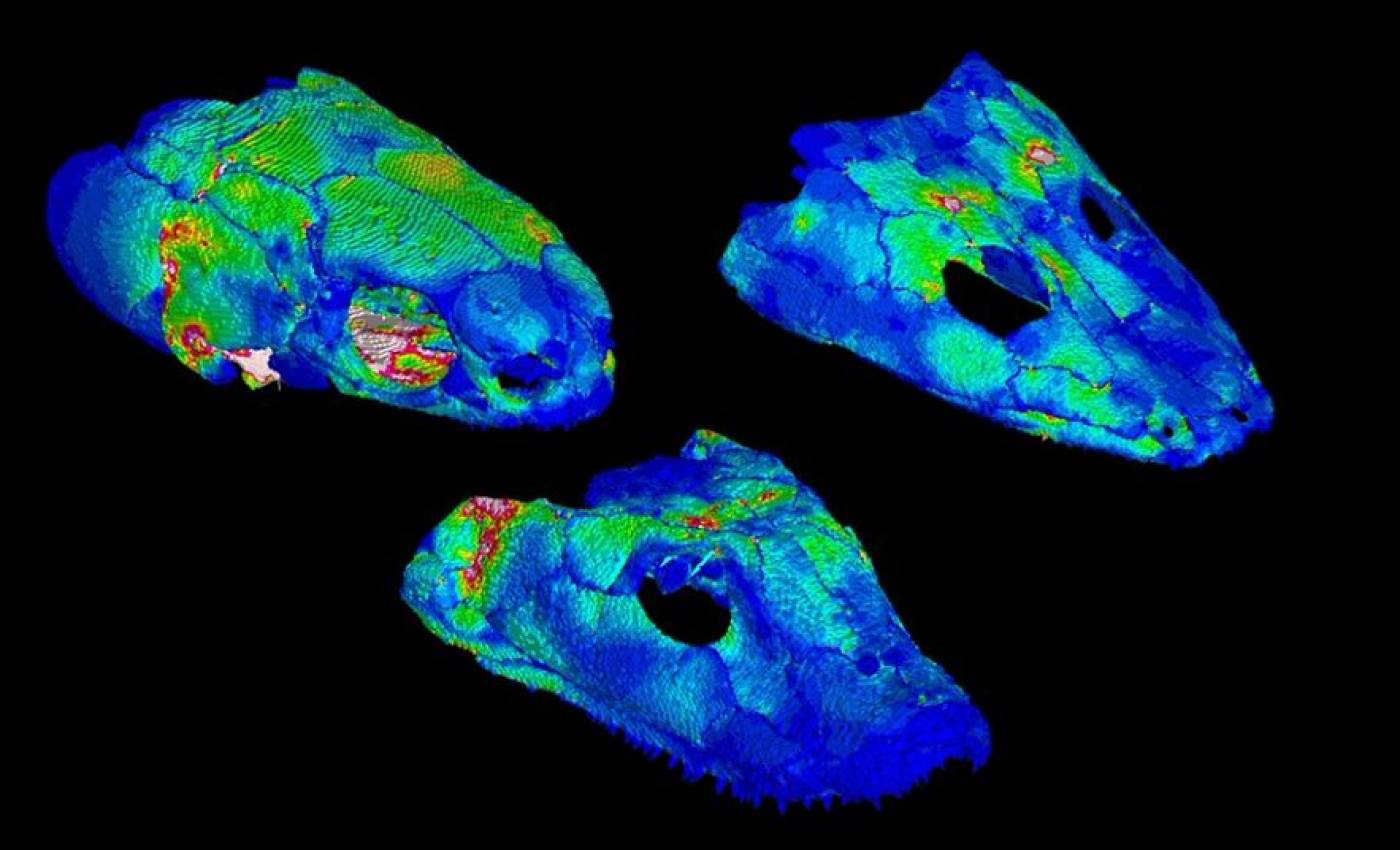
December 2011 Marc Jones and Susan Evans contribute to a paper led by Neil Curtis (University of Hull) investigating strain in the skull of the New Zealand tuatara (Sphenodon) using a sophisticated three dimensional computer model. This work is published in PLoS ONE and is part of a multi-disciplinary collaboration between the Evans Lab and colleagues at the University of Hull and Hull-York Medical School funded by the BBSRC.
|
December 2011 Marc Jones presents a poster on cranial joints at the Joint Winter Meeting of Anatomical Societies held in Cardiff (UK) as part of the lab's collaborative BBSRC project with University of Hull
and Hull-York Medical School.
|
|
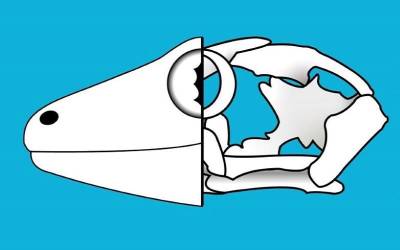
December 2011 Paul Barrett contributes to a paper describing a new species of Ceratopsian from Canada (Spinops sternbergoru) in a paper published in Acta Palaeontologica Polonica first authored by Andrew Farke.
Life restoration (copyright Dmitry Bogdanov) and skull reconstruction (copyright Lukas Panzarin):
|
December 2011 Marianne Pearson presents a poster on salamander morphological characters at the Young Systematic's Forum held in London, UK.
|
|
November 2011 Marc Jones contributes to a paper in Journal of Systematic Palaeontology on the phylogenetic position of Dinheirosaurus lourinhanensis a diplodocid sauropod dinosaur from the Late Jurassic of Portugal. This publication was led by Phil Mannion (UCL, Earth Sciences) and carried out in collaboration with Octavio Mateus (Universidade Nova da Lisboa and Museu da Lourinhã, Portugal), Rosie Barnes and Paul Upchurch ( both UCL, Earth Sciences).
|
November 2011 Marc Jones publishes a paper with Sebastian Apesteguía in Cretaceous Research about a tuatara-like fossil from the Late Cretaceous of South America.
|
November 2011 Susan Evans, Marc Jones, Marianne Pearson and Paul Barrett
all attend the 72nd
annual meeting of the Society of Vertebrate Paleontology (SVP) held in Las Vegas, USA. Susan Evans presented a talk on the earliest
known live-bearing lizard, Marc Jones presented a talk on the origin of
lepidosaurs, Paul Barrett presented a talk on archosaur pneumaticity,
and Marianne Pearson presented a poster on the fossil record of the
earliest terrestrial herbivores.
|
|
October 2011 With Yuan Wang (IVPP, Beijing, China), Susan Evans publishes a paper in Cretaceous Research on new material of the fossil lizard Yabeinosaurus.
|
October 2011
Roger Benson (University of Cambridge and University College London) visits the lab to enter
data into the Palaeobiology
Database.
|
|
September 2011 Susan Evans, Marc Jones, Paul Barrett, Ryoko
Matsumoto, and Marianne Pearson all attend the 59th metting of the
Symposium of Vertebrate Palaeontology and Comparative Anatomy (SVPCA) in Lyme Regis. Susan presented a talk on the fossil lizard Yabeinosaurus, Marc presented a talk on food processing in reptiles linked to the BBSRC skull mechanics project,
Paul presented a talk on a new sauropod dinosaur skull, and Ryoko
presented a talk on a new fossil choristoderan reptile from France. Marc
also attended the field trip to Kimmeridge Bay (below).
|
|
August 2011 Marc Jones attends the 15th International Symposium on Dental Morphology in Newcastle where he presented a talk on research carried out in conjunction with Roger Benson (University of Cambridge and recently UCL).
|
July 2011
Marc Jones assisted with a ThinkWrite training course in Aschau (Germany) as part of the Amgen Scholars Program hosted by Ludwig-Maximilians-Universität München, LMU (University of Munich) in partnership with the University of Cambridge and the Karolinska Institut (Stockholm). Marc also visited collections at Ludwig-Maximilians-Universität München, LMU (University of
Munich) hosted by Oliver Rauhut and Richard Butler.
|
July 2011
Paul Barret provides a quote for the Guardian Newspaper regarding a new
research that questions the position of Archaeopteryx as the first bird.
|
|
July 2011
Susan Evans coauthors a paper in Naturwissenschaften with Yuan Wang (IVPP, Beijing China) on a gravid lizard from the Cretaceous of China. The specimen from the Jiufotang Formation
preserves the remains of at least 15 embryonic skeletons within the
body cavity of a mother lizard. This discovery dated to 120 million
years ago represents the earliest known example of viviparity
in a lizard. This reproductive strategy is more commonly associated
with placental mammals but is found in about 20% of the 6000 living
species of lizard and appears to have evolved in this clade repeatedly
for life in cold or stressful environments.
This pregnant lizard features on BBC nature as well as several other internet news outlets such as LiveScience, MSNBC, MSN, mother nature network, tawnet, UPI, Zeenews, physorg and blogs such as serpent research and hornofAfrica.
Schematic restoration by Marc Jones:
|
July 2011
Marc Jones visited the specimen collections at Muséum National d'Histoire Naturelle and attended
the 5th international meeting on Cranio-Cervical Systems (CCS5)
presenting a poster of Sphenodon suture work carried out as part
of the BBSRC skull mechanics project.
|
|
June 2011
Roger Benson (University of Cambridge) visits the lab to examine
lepidosaur material.
|
|
June 2011
Marc Jones, and Susan Evans publish a paper in Palaeontologia Electronica with colleagues from University of Hull and Hull York Medical School on the cranial sutures in Sphenodon (New Zealand tuatara). This work shows that most of the joints between individual skull bones involve simple abutments or large overlaps. The latter provide a large surface area for fibrous tissues that maintain the rigidity of the skull. These overlaps tend to be more extensive in the adult animals that, compared to juveniles, bite more forcefully and eat harder prey.
A related blog post: tuatara skull joints by Heinrich Mallinson.
|
|
June 2011 Paul Barrett publishes a first author paper in Biology
Letters about the first spinosaur fossil record of Australia with
colleagues from University of Cambridge, Museum Victoria Melbourne and
Monash University, Clayton, Australia. The specimen described represents the first member of the Spinosauridae recorded from
Australia. When considered together with other recent Cretaceous dinosaur finds,
this helps to demonstrate that many dinosaur groups were much more
cosmopolitanat this time than thought previously. Image Museum Victoria/NHM copyright:
|
|
June 2011
We are pleased to announce that Ryoko Matsumoto passed her PhD viva and submitted her final thesis after minor corrections.
|
May 2011 Marianne Pearson presented a poster at Progressive Palaeontology hosted by University of Leicester.
|
|
May 2011
Sijia Zhao joins the lab for four weeks to carry out a short summer project involving CT scan data of lizard skulls.
|
May 2011 Marc Jones is elected to be a Fellow of the Linnean Society of London.
|
|
May 2011
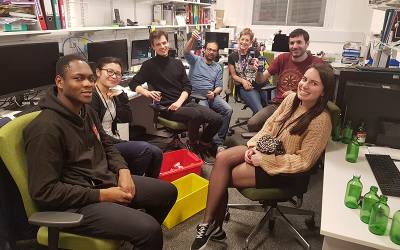
Marc Jones again provides a talk for Nature Live at the Natural History Museum hosted by Charlotte Coales. Photo taken by Elizabeth Robson.
|
May 2011 Paul Barrett was awarded the Bicentenary Medal by the Linnean Society of London.
|
April 2011 Upon invitation Susan Evans presents a talk on reptile skull evolution mechanics for the Paläontologisches Institut und Museum der Universität Zürich, Switzerland.
|
|
March 2011 Susan Evans publishes a paper with Yuan Wang (IVPP, Beijing) in Journal of Systematic Palaeontology about a new fossil lizard from the Yixian Formation of China. The specimens preserve amazing detail of soft tissue structures including details of scalation, cartilage elements, and claw sheaths. Cladistic analysis using morphological characters places the new taxon in a sister group relationship to 'Scleroglossa'.
|
March 2011 Ulrich Witzel (Ruhr-Universität Bochum) visits the lab.
|
|
February 2011 Marc Jones provides a talk for Nature Live at the Natural History Museum on the
tuatara of New Zealand hosted by Charlotte Coales. Photo taken by David Godfrey.
|
|
January 2011 Marta Gomez Betanzos joins the lab to carry out volunteer work for 9 weeks.
|
January 2011 Paul Barrett provides a quote for the BBC News regarding a new dinosaur find from China.
|
January 2011 Flora Gröning (University of Hull) visits the lab.
|