|
CDB Seminars Thursday 23 May at 1pm __________________________ Thursday 30 May at 1pm
|
Dr Guillaume Charras
|
Contact details: Office: Room 3C2 Tel: +44 (0)20 7679 2923 Ext: 32923 Fax: +44 (0)20 7679 0595 Email: g.charras@ucl.ac.uk |
Biography
- 2007-present Royal Society University Research Fellow
- 2003-2006 Wellcome Trust Overseas Post-Doctoral Fellow, Harvard Medical School, USA, Laboratory of Prof Tim Mitchison
- 1999-2002 Ph. D. Biochemistry, University College London, Laboratory of Prof Mike Horton
- 1996-1998 M. Sc. Georgia Institute of Technology, USA, Laboratory of Prof Robert Guldberg
- 1994-1997 Diplome d’Ingénieur Ecole Centrale de Paris, France
- 1992-1994 Classes Préparatoires Scientifiques, Lycée St Louis, France
Research Interests
- Neutrophil motility and chemotaxis in microfluidic capillaries
- Biophysics of cell blebbing
- Mechanics of simple cellular aggregates (cysts, sheets, tubules)
- Biophysics of cell sheet invagination
- Biological determinants of strain transmission within epithelia
My general interest lies in the biophysics of living cells
both at the single cell and tissue level.
At the single cell level, my research aims to understand the
biological and physical mechanisms that power cell motility within
three-dimensional environments such as connective tissue. Other research looks
at the biophysics and biology of cell protrusions known as blebs.
At the
tissue level, my research is investigating what single cell properties influence
tissue properties using simple cellular aggregates such as cysts. Another aspect
of this research is the design of in vitro systems to study simple, yet
important, morphogenetic events such as cell sheet invagination.
To
investigate these questions, the laboratory combines modern molecular and cell
biological techniques with biophysical measurement and micromanipulation
techniques derived from nanotechnology, microfluidic technology, and
computational modelling.
My laboratory is funded by the Royal Society, the
Biotechnology and Biological Sciences Research Council, and the Human Frontier
Science Program.
There are often openings for PhD and post-doctoral positions in the lab, if you are interested please get in touch with me directly.
Recent Papers
- Charras G.T., Hu C.-K., Coughlin M., and Mitchison T.J., “Re-assembly of a contractile actin cortex in cell blebs”, Journal of Cell Biology, 175(3), 477-490 (2006). [download PDF file]
The cortex is a 0.1 to 1 µm thick layer of actin and
associated proteins that underlies the cell membrane and determines the shape of
animal cells. Whereas the biology of some actin structures (lamellipodia,
filopodia) is well understood, the events leading to the formation and
subsequent regulation of a submembranous actin cortex are not due to the lack of
a good model system. In this paper, we use blebs as model systems to study actin
cortex assembly. We identify the proteins involved in cortex assembly as well as
their dynamics and ultrastructural arrangement.
- Charras G.T., Yarrow J.C., Horton M.A., Mahadevan L., and Mitchison T.J., “Non-Equilibration of Pressure in Blebbing Cells”, Nature, 435, 365-9 (2005). [download PDF file]
Current models for protrusive motility in animal cells
focus on cytoskeleton-based mechanisms, where localized protrusion is driven by
local regulation of actin biochemistry. In plants and fungi, protrusion is
driven primarily by hydrostatic pressure. For hydrostatic pressure to drive
localized protrusion in animal cells, it would have to be locally regulated, but
current models treating cytoplasm as an incompressible viscoelastic continuum or
viscous liquid require that hydrostatic pressure equilibrates essentially
instantaneously over the whole cell. Here, we use cell blebs as reporters of
local pressure in the cytoplasm. When we locally perfuse blebbing cells with
cortex-relaxing drugs to dissipate pressure on one side, blebbing continues on
the untreated side, implying non-equilibration of pressure on scales of ~10um
and ~10sec. We can account for localization of pressure by considering the
cytoplasm as a contractile, elastic network infiltrated by cytosol. Motion of
the fluid relative to the network generates spatially heterogenous transients in
the pressure field, and can be described in the framework of poroelasticity.
- Charras G.T. and Horton M.A., “Determination of Cellular Strains by Combined Atomic Force Microscopy and Finite Element Modelling”, Biophysical Journal, 82(6), 2970-81 (2002). [download PDF file]
Many organs adapt to their mechanical environment as a
result of physiological change or disease. Cells are both the detectors and
effectors of this process. Though many studies have been performed in vitro to
investigate the mechanisms of detection and adaptation to mechanical strains,
the cellular strains remain unknown and results from different stimulation
techniques cannot be compared. By combining experimental determination of cell
profiles and elasticities by atomic force microscopy with finite element
modeling and computational fluid dynamics, we report the cellular strain
distributions exerted by common whole-cell straining techniques and from
micromanipulation techniques, hence enabling their comparison.
Researc
|
Figure 1: Neutrophil
Chemotaxis Neutrophils are the primary cells of the immune system responsible for detecting and preventing bacterial infections, as well as driving inflammation. Neutrophils circulate freely in the bloodstream, and when passing through an inflamed region attach the blood vessel wall, traverse the endothelium (transendothelial migration), and migrate through the connective tissue to the site of infection (chemotaxis). Here a neutrophil (in red) is shown migrating through a 10x3µm microfluidic channel towards a source of chemoattractant (in blue). Scale bar = 5µm. In collaboration with Dr Irimia, Massachusetts General Hospital |
Figure 2: Circus movements in xenopus
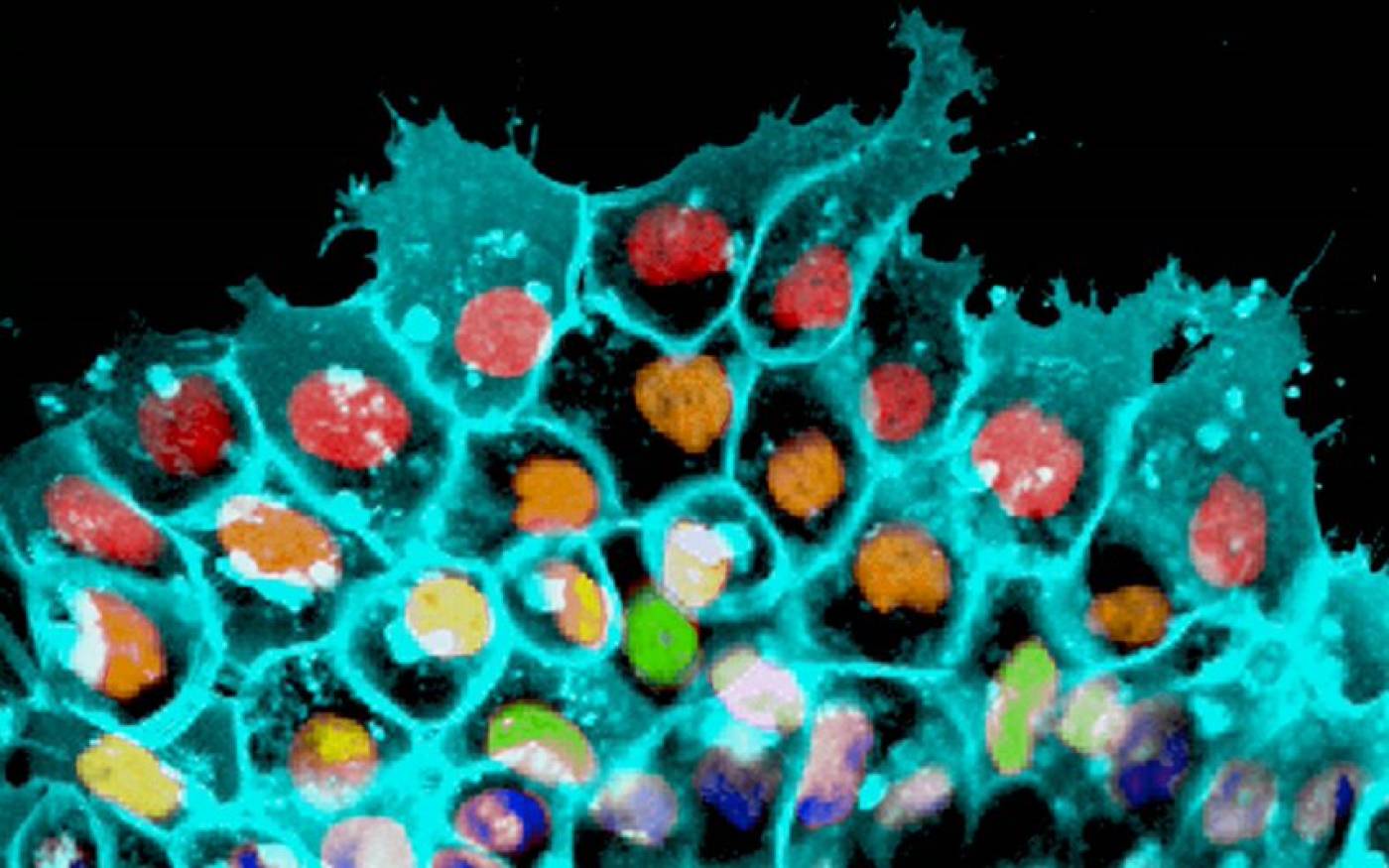
blastomeres Dissociated cells of the animal pole of xenopus embryos display characteristic dynamics of the cell membrane, known as circus movements. In these cells, a local delamination of the cell membrane from the cytoskeleton (a bleb) can propagate around the cell as a traveling wave which circles the cell periphery multiple times. This wave progresses through cycles of delamination. In this image, the blastomere has been injected with RNA encoding the PH domain of phospholipase C _ tagged with GFP, which highlights the cell membrane. Three separate time points showing the progression of the traveling wave have been superimposed in the following colours: red t=0s, green t=5s, blue t=10s. Scale bar=10µm. |
|
|
|
Figure 3: MDCK cell cyst Given appropriate culture conditions, some cells can form structures akin to a football with each patch of the football being a cell. These structures are known as cysts and are a good model of multicellular structure as they are amenable to genetic manipulation, mechanical testing, and comprise sufficiently few cells (~100) that they can be modelled computationally. In this figure, a phase contrast image of a MDCK cell cyst is shown. The thickness of the rim of this cyst is approximately 10 µm and comprises only one cell. In the top left corner, the shadow of a micropipette used to deform the cyst can be distinguished. |
Figure 4: Actin cytoskeleton of a blebbing
cell Blebs are spherical cellular protrusions that occur in many physiological situations. Two distinct phases make up the life of a bleb each of which have their own biology and physics: expansion, which lasts ~30s, and retraction, which lasts ~2min. During expansion, the cell membrane delaminates from the actin cortex and fills with cytosol. Growth stalls as an actin cortex reforms under the bleb membrane, and retraction starts, driven by myosin-II. In this figure, the cell membrane has been removed with detergent and the actin cytoskeleton stabilized with phalloidin. The cell has been imaged using scanning electron microscopy revealing the cage-like structure of actin filaments within retracting blebs. |
|
|
Page last modified on 24 may 10 15:30 by Glenda Young